June 5, 2026
Structural Fragility: Why Fuel Price Shocks Expose India's Outsourced Coal Mining Model
Across extractive industries worldwide, the gap between who bears operational risk and who controls input costs creates persistent tension within supply chains. In coal mining, this tension becomes acutely visible whenever diesel prices spike sharply, because fuel is not merely one cost among many. It is the engine that powers every tonne of production. Understanding how India's coal mining contractor ecosystem is structured around this single critical input helps explain why Bharat Coking Coal diesel price relief for contractors represents more than a routine procurement adjustment. It reflects a fundamental recognition that fixed-price contracts and volatile fuel markets are an inherently unstable combination.
India's coal sector depends overwhelmingly on outsourced service providers for both extraction and logistics. Unlike vertically integrated mining operations where fuel costs are absorbed within a single corporate structure, the contract-based model externalises this burden entirely onto smaller, capital-constrained businesses operating with narrower margins and fewer hedging tools. When fuel prices move within predictable ranges, this model functions reasonably well. When they spike abnormally, the entire supply chain becomes vulnerable to contractor financial distress, reduced service capacity, and ultimately, disruptions in coal output.
The coal supply challenges arising from such disruptions can ripple across power generation and industrial production. The May 2026 fuel price adjustment of approximately ₹7.5 per litre on petrol and diesel, effective from May 15, crossed a threshold that transformed fuel price volatility from a manageable commercial risk into a structural threat requiring institutional intervention. The result was BCCL's formally approved Bharat Coking Coal diesel price relief for contractors, a decision that carries implications far beyond the operational level.
When big ASX news breaks, our subscribers know first
The Architecture of Diesel Price Risk in Contract Mining
How Fuel Becomes a Margin Cliff for Mining Contractors
Diesel performs two distinct but equally critical roles in coal mining operations: it powers the Heavy Earth Moving Machinery (HEMM) that extracts coal from open-cast and underground workings, and it propels the transportation fleets that move extracted coal from pit-head to dispatch infrastructure. Both functions are non-negotiable. Neither can be substituted with alternative energy sources at scale within any operationally relevant timeframe, which means contractors cannot reduce their fuel exposure through technology pivots when prices rise sharply.
For HEMM-dependent contractors, diesel typically represents a substantial share of total variable operating costs. While precise figures vary by equipment type, fleet age, operational intensity, and haul distances, fuel expenditure in heavy mining operations is widely understood across the industry to constitute a significant proportion of running costs. When this input becomes significantly more expensive over a short window, and when contracts do not contain automatic price variation clauses, the financial impact is direct and immediate. Margins that appeared viable at the time of bidding can deteriorate rapidly, leaving contractors with a binary choice: absorb the losses or reduce operational intensity.
For coal transportation contractors, fuel exposure can be proportionally even higher, as cost structures for hauling operations are dominated by variable fuel consumption rather than capital depreciation or labour costs. Long-haul routes with heavy loads amplify the impact of every rupee per litre increase, making transportation contractors particularly sensitive to the kind of sharp, rapid price adjustment seen in mid-May 2026. Furthermore, crude oil price trends globally continue to introduce additional layers of uncertainty for contractors trying to forecast their cost base.
"The fundamental problem with fixed-price contracts in fuel-intensive industries is that they transfer price risk without transferring price control. Contractors can manage their own efficiency, but they cannot manage a global crude oil market."
Why Standard Efficiency Gains Cannot Substitute for Price Relief
A common misconception in outsourced mining procurement is that contractors can absorb fuel cost increases through operational improvements. While efficiency gains such as reduced idle time, optimised haul routes, and better fleet maintenance do reduce fuel consumption at the margins, they cannot offset a sudden ₹7.5 per litre increase across an entire diesel-consuming fleet. The mathematics simply do not support it.
An efficiency improvement that reduces diesel consumption by five percent against a price increase that raises cost per litre by a comparable percentage over a very short period offers minimal financial relief to a contractor operating dozens of pieces of heavy equipment across multiple shifts. This reality underpins why BCCL determined that external intervention was necessary rather than expecting contractors to self-manage through the cost increase.
What BCCL's Diesel Price Relief Mechanism Actually Does
The Formal Decision and Its Institutional Weight
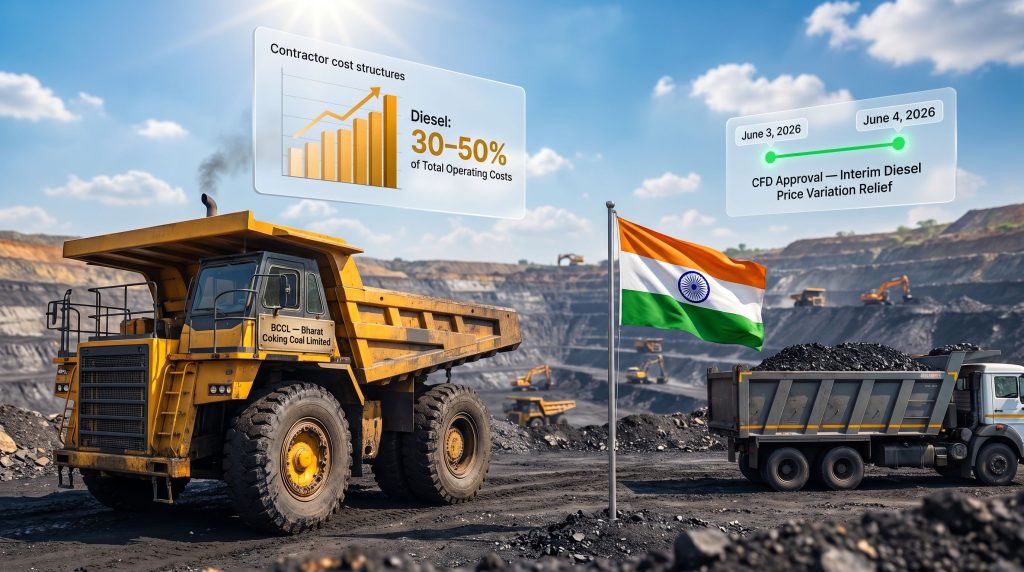
Bharat Coking Coal Limited formally approved its interim diesel price variation compensation mechanism following clearance by the company's Committee of Functional Directors (CFD) during consecutive meetings on June 3 and June 4, 2026, according to a regulatory filing reported by ET EnergyWorld. The involvement of the CFD rather than lower-level management signals that this decision was treated as a matter of material significance requiring senior executive oversight, consistent with the potential financial and operational implications of the policy.
Critically, the CFD did not develop this framework independently. The mechanism implements a policy architecture previously approved at the Coal India Ltd (CIL) level, meaning BCCL's role was implementation rather than origination. This distinction matters because it:
- Establishes the measure's institutional legitimacy within a parent-company framework
- Suggests potential applicability across other CIL subsidiaries facing identical fuel cost pressures
- Reduces the risk of the decision being challenged as an ad hoc or inconsistently applied policy
- Creates a replicable template that can be activated without requiring subsidiary-level policy creation
The interim classification is precise in its meaning within Indian public sector procurement. It signals a temporary response to an abnormal triggering condition rather than a permanent revision to standard contract pricing terms or risk allocation frameworks.
Eligibility: Who Qualifies and Why These Categories Were Selected
The compensation mechanism applies exclusively to ongoing contracts in two specific service categories, a boundary that reflects deliberate targeting of the highest-risk and most operationally critical areas of BCCL's outsourced operations:
- HEMM hiring contracts covering heavy earthmoving equipment used in coal extraction
- Coal transportation service contracts covering the movement of extracted coal from pit-head to dispatch points
The restriction to ongoing contracts is a significant design feature. Contractors bidding for new tenders do so with full knowledge of current fuel prices and can incorporate these into their pricing strategies. Contractors operating under pre-existing agreements had no such opportunity, having committed to pricing structures before the abnormal price movement occurred. The eligibility boundary therefore reflects a principled allocation of responsibility rather than an arbitrary limitation.
Contracts must also satisfy approved terms and conditions established under the CIL framework, introducing standardised qualification criteria that prevent inconsistent application across different mining operations or contractor relationships.
Compensation Calculation: The Bulk Diesel Benchmark and Why It Matters
| Parameter | Detail |
|---|---|
| Compensation Basis | Bulk diesel prices, not retail pump prices |
| Trigger Condition | Abnormal increase in bulk diesel rates |
| Eligible Contract Types | HEMM hiring and coal transportation services |
| Contract Status Required | Ongoing contracts only |
| Approval Authority | BCCL Committee of Functional Directors (CFD) |
| Policy Framework | Coal India Ltd (CIL) approved |
| Financial Quantification | Not determinable; dependent on actual contractor claims |
The decision to anchor compensation to bulk diesel prices rather than retail pump prices is technically significant and reflects genuine understanding of how industrial fuel procurement works. Bulk diesel is purchased through volume supply arrangements directly from refineries or authorised industrial distributors, with pricing that differs from retail in several important respects: bulk rates exclude certain retail taxes and distribution margins, and are negotiated against volume commitments rather than purchased on a per-fill basis.
Using retail prices as the compensation benchmark would either overstate or misrepresent the actual cost impact on contractors, depending on how bulk premiums and discounts interact with retail price movements in any given period. The bulk diesel benchmark consequently ensures that compensation reflects operational reality rather than a pricing tier that contractors do not actually use.
CIL's Policy Architecture: A Scalable Response to a Systemic Problem
Why the Top-Down Framework Changes the Significance of This Decision
Coal India Ltd functions as the holding company for a network of coal-producing subsidiaries operating across India's coal-bearing states. As the world's largest coal mining company by output, CIL's procurement policies and contractor frameworks have implications that extend well beyond any single subsidiary operation. When CIL develops and approves a diesel price variation framework, it creates a policy instrument that can be deployed across the entire subsidiary network without requiring each entity to develop its own response.
This architectural approach has practical consequences for understanding the BCCL decision. Rather than representing an isolated response by one subsidiary to a local contractor problem, the mechanism reflects a coordinated institutional recognition that the May 2026 fuel price increase created systemic risk across CIL's outsourced operations nationally. BCCL's implementation may therefore be the first of multiple subsidiary-level activations of the same parent framework.
Other CIL entities operating significant volumes of outsourced HEMM hiring and coal transportation contracts could implement comparable interim measures under the same policy umbrella, creating a degree of consistency across the sector that individual ad hoc decisions would not achieve. In addition, India coal trading reforms underway at the national level may further reshape how fuel price risk is allocated across the sector in future contract structures.
What Standardisation Means for Contractors Operating Across Multiple CIL Sites
For contractors who work across multiple CIL subsidiary operations simultaneously, the standardised framework carries practical operational significance. It reduces the uncertainty that would otherwise arise from navigating different relief mechanisms, eligibility criteria, and calculation methodologies at different sites. A consistent framework means that contractors can model their compensation expectations with greater predictability across their portfolio of CIL contracts, supporting better financial planning during a period of elevated cost pressure.
Contractor Economics: Translating Policy Into Financial Reality
Short, Medium, and Long-Term Impact Across the Contract Lifecycle
The financial implications of the Bharat Coking Coal diesel price relief for contractors operate across multiple timeframes, with different dynamics at each stage:
| Timeframe | Contractor Impact | BCCL Financial Exposure |
|---|---|---|
| Short-term (0-6 months) | Margin relief; reduced risk of operational default on existing contracts | Cannot be quantified; entirely claim-dependent |
| Medium-term (6-18 months) | Improved contract continuity; reduced service disruption probability | Potential increase in total contract payout values |
| Long-term (18+ months) | Framework may be absorbed into standard contract terms if fuel volatility persists | Structural increase in outsourced mining cost base |
The most immediate effect is stabilisation. Contractors facing margin erosion following the May fuel price increase gain a mechanism through which cost increases attributable to the abnormal price movement can be partially recovered, reducing the financial pressure that might otherwise lead to operational cutbacks, equipment underutilisation, or contractual disputes.
The Contingent Liability Question
BCCL has explicitly acknowledged, as reported by PSU Connect, that the financial impact of this measure cannot be quantified at this stage and will depend on the actual claims submitted by eligible contractors. This creates a contingent liability on BCCL's balance sheet whose magnitude will only become clear as claims are received and processed.
"The unquantifiable nature of this liability reflects a deliberate policy design: relief is calibrated to actual demonstrated cost increases rather than estimated or theoretical exposure. This claim-based structure protects BCCL from paying compensation that exceeds genuine contractor cost increases while ensuring that qualifying contractors receive meaningful support."
From a financial disclosure standpoint, this contingent liability will require careful monitoring in BCCL's reporting, particularly if bulk diesel prices remain elevated and claim volumes prove substantial. The commodity price impacts on mining company performance more broadly suggest that BCCL is not alone in navigating these pressures across the sector.
Fuel Inflation as a Macroeconomic Signal: Beyond the Mining Gate
CRISIL's Warning and Its Implications for India's Industrial Cost Structure
Credit rating agency CRISIL's analysis, cited in ET EnergyWorld's reporting on the BCCL decision, connects elevated fuel prices to a transmission chain that extends well beyond the mining sector: higher transportation costs feed into manufacturing input costs, which in turn can contribute to consumer price inflation if global crude oil benchmarks remain elevated over a sustained period.
For India's coal sector specifically, this chain reaction carries particular significance because coal does not exist in isolation within the energy economy. Higher contractor costs translate into higher effective coal procurement costs for thermal power utilities, which then face increased pressure on fuel cost components within their generation economics. In a power sector where fuel costs represent a major proportion of variable generation costs, this pressure can eventually affect electricity pricing and industrial competitiveness.
The BCCL decision therefore occupies a position within a much larger economic architecture than a simple contractor support measure might suggest. It is one intervention point within a broader cost-push dynamic that, if left unaddressed, could propagate through multiple layers of India's industrial economy. Furthermore, the consequences for resource and energy exports in competing markets highlight just how globally interconnected these fuel-driven cost pressures have become.
The Structural Exposure Created by Outsourced Coal Production Models
India's coal sector structure creates a specific vulnerability that distinguishes it from power sector fuel cost management. In electricity generation, fuel cost increases can often be partially recovered through regulatory tariff mechanisms that allow utilities to pass through input cost changes. In coal mining, contractor cost increases are absorbed within the procurement chain without an equivalent automatic pass-through mechanism.
When unaddressed, sustained fuel inflation in the mining contractor segment can reduce the pool of financially viable contractors willing to bid for new tenders, gradually compressing the supplier base and reducing competitive pressure in procurement processes. A contracted supplier base is ultimately more expensive for public sector coal companies than a competitive one, meaning that the short-term cost of not providing fuel relief may be lower than the long-term cost of supplier attrition and reduced competitive tension in future tender processes.
The next major ASX story will hit our subscribers first
Is This Relief Temporary or the Beginning of a Structural Shift?
What the Interim Classification Conceals About Long-Term Trends
The word interim carries specific meaning in Indian public sector procurement, but it should not obscure the possibility that this measure represents the early manifestation of a more durable change in how fuel price risk is allocated between coal companies and their contractors. Three scenarios could determine whether the current interim measure becomes a permanent feature of CIL subsidiary contracts:
- Sustained crude oil elevation: If global crude benchmarks remain high beyond the near term, the temporary triggering condition for this measure becomes a persistent market reality, creating pressure to formalise automatic price variation clauses as standard contract terms
- Formal CIL contract revision: CIL could update its standard contract templates to include built-in fuel price variation mechanisms triggered by defined threshold movements in bulk diesel prices, converting the current exceptional measure into a routine contractual feature
- Regulatory or policy direction: Broader policy considerations related to contractor ecosystem health and coal production continuity could drive formal contractual updates across the CIL network
Each pathway would represent a different degree of structural change, ranging from incremental contract revision to a fundamental reconsideration of how fuel price risk is allocated in long-term mining service agreements.
Key Takeaways for Understanding BCCL's Contractor Relief Decision
The Bharat Coking Coal diesel price relief for contractors is a multi-layered policy action that operates simultaneously at the operational, institutional, financial, and macroeconomic levels. The following points capture its most significant dimensions:
- Risk rebalancing is underway: The decision signals a meaningful shift toward shared fuel price risk between BCCL and its contractor base, moving away from the fixed-price model that left contractors fully exposed to input cost volatility
- The CIL framework provides scale: Because the mechanism originates from a CIL-level policy approval, it has the potential to be deployed across multiple subsidiaries without requiring independent policy development at each operational entity
- Contractor ecosystem health is strategically valued: The fact that BCCL intervened rather than allowing contractor margins to erode reflects an institutional understanding that disruptions to the contractor base directly threaten coal production continuity
- Financial exposure remains open-ended: The contingent liability created by this measure will require ongoing monitoring and disclosure as claims are submitted and processed by eligible contractors
- Macroeconomic linkages elevate the significance: CRISIL's warning about fuel-driven cost inflation contextualises this operational decision within a broader economic challenge that connects mining procurement to consumer price dynamics across India's industrial economy
Disclaimer: This article is based on publicly available information from ET EnergyWorld's reporting dated June 5, 2026, and is intended for informational purposes only. Financial figures, policy details, and market projections are subject to change. Nothing in this article constitutes financial or investment advice. Readers should conduct independent research and consult qualified advisers before making decisions based on information contained herein.
Want to Track the Next Major Mineral Discovery Before the Market Moves?
Discovery Alert's proprietary Discovery IQ model scans ASX announcements in real time, instantly identifying high-potential mineral discoveries across more than 30 commodities — turning complex data into clear, actionable opportunities for investors at every experience level. Explore how historic discoveries have generated significant returns on the Discovery Alert discoveries page, and begin your 14-day free trial today to position yourself ahead of the broader market.