June 5, 2026
The Infrastructure Arms Race Reshaping Mining Services in Western Australia
Every major resource cycle eventually forces a reckoning with the physical infrastructure that supports it. In Western Australia, that reckoning is playing out not at the mine face, but in the industrial corridors of Perth and the Pilbara, where equipment manufacturers are making multi-million dollar bets on purpose-built service capacity. The question driving these decisions is fundamentally economic: how much does an hour of unplanned downtime actually cost a Pilbara iron ore operation, and what is the right level of investment to prevent it?
For context, unplanned equipment downtime at large-scale mining operations can cost operators anywhere from tens of thousands to over one hundred thousand dollars per hour when lost production, labour, and logistics costs are combined. That financial reality is reshaping how global mining equipment and technology services companies think about regional infrastructure, and it helps explain why Weir opens Perth facility investments of this scale are increasingly common across WA's industrial landscape.
When big ASX news breaks, our subscribers know first
Why WA's Mining Intensity Is Driving Service Infrastructure Investment
Western Australia is not simply a large mining jurisdiction. It is one of the most production-intensive mining regions on Earth, responsible for a substantial share of global seaborne iron ore supply, and increasingly central to hard rock lithium production feeding the energy transition supply chain. The WA resources sector impact on the broader economy continues to grow, with the Pilbara region alone accounting for roughly 40% of global iron ore exports — a concentration of output that places extraordinary demands on the equipment keeping those operations running continuously.
This production intensity creates a structural challenge for equipment service providers. Mine sites in the Pilbara, Goldfields, and Mid West regions operate around the clock across 365 days, meaning the window for planned maintenance is narrow and the cost of unplanned stoppages is severe. Service providers that cannot deliver rapid turnaround on critical components face commercial exposure as mine operators embed increasingly stringent service level agreements into supply contracts.
Industry Reality: As mining operations scale up and process more ore per day, the mechanical complexity of their equipment increases proportionally. A modern comminution circuit processing tens of thousands of tonnes daily contains multiple high-value assets, each of which represents a potential single point of failure if not serviced within defined intervals.
The geographic reality of WA mining compounds this challenge further. Many major operations are located 1,200 to 1,600 kilometres from Perth, meaning that every hour a component spends in transit is an hour it is not contributing to production. This is precisely the operational logic underpinning regional service infrastructure investments.
What the Hazelmere Facility Represents in Physical Terms
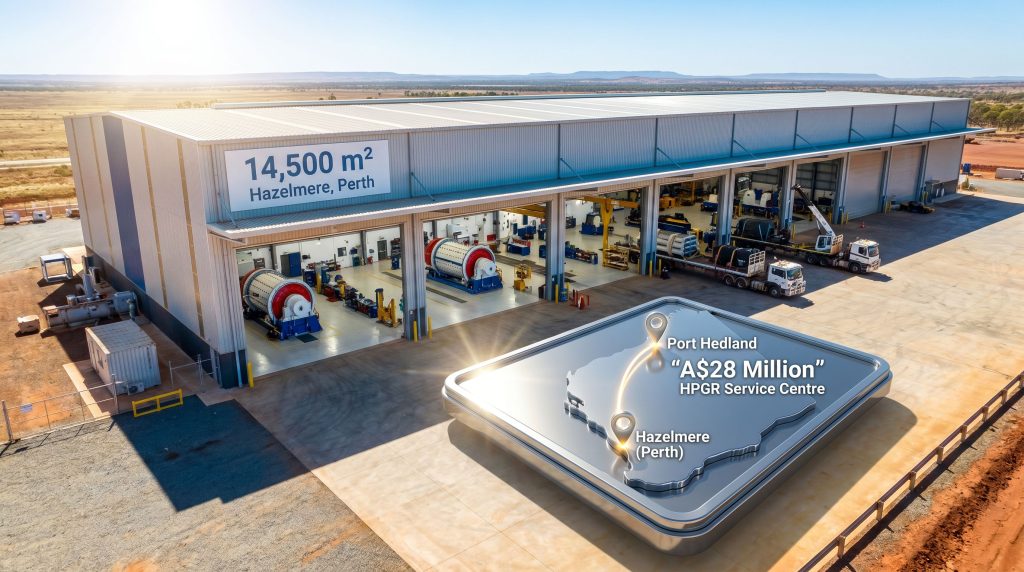
When Weir opens Perth facility infrastructure at this scale, the specifications matter. The purpose-built Hazelmere site spans 14,500 square metres, a footprint that reflects the company's intent to consolidate its entire Western Australian operational base into a single, cohesively designed environment. This is not a warehousing upgrade or an office relocation. It is a ground-up facility engineered to support the full range of service, testing, and logistics functions required to maintain Weir's product portfolio across WA mine sites.
The facility officially opened in June 2026, with WA Mines and Petroleum Minister David Michael MLA attending alongside Weir Minerals leadership, marking the transition from Weir's previous Perth base to this next-generation consolidated hub.
| Facility Attribute | Specification |
|---|---|
| Location | Hazelmere, Perth Eastern Industrial Corridor |
| Total Footprint | 14,500 square metres |
| Primary Role | Consolidated WA service and operations hub |
| Previous Facility | Directly replaces prior Perth base |
| Official Opening | June 2026 |
| Opening Ceremony | WA Mines and Petroleum Minister and Weir leadership |
Purpose-built design carries meaningful advantages over retrofitted or repurposed industrial spaces. A facility designed from concept stage around specific equipment servicing workflows can incorporate features that older buildings structurally cannot: overhead crane systems rated for heavy component handling, workshop bays dimensioned for large-format grinding and slurry equipment, cleanroom-adjacent areas for precision component work, and integrated testing rigs calibrated to manufacturer specifications. When a facility is retrofitted rather than purpose-designed, compromises accumulate across all of these areas.
Hazelmere's Logistics Position: More Than Convenient Geography
Hazelmere occupies Perth's eastern industrial corridor, which at first glance may seem like a routine suburban industrial precinct. In logistical terms, however, the location is a deliberate choice with material consequences for service turnaround times across WA's mining regions.
The suburb sits at the nexus of freight routes feeding into the Great Eastern Highway and the broader network of arterial roads connecting Perth to the Pilbara, Goldfields, and Mid West. This positioning enables direct, efficient heavy freight movement without the complications of navigating through metropolitan Perth from a centrally or coastally located facility. For oversized components typical of HPGR rolls and slurry pump assemblies, this routing efficiency is not trivial.
Key logistical advantages of the Hazelmere location:
- Direct arterial access to freight corridors serving the Pilbara (north-east), Goldfields (east), and Mid West (north)
- Avoidance of inner-metropolitan freight routing restrictions that apply to heavy and oversized loads
- Proximity to Perth Airport's freight precinct, enabling air freight options for time-critical smaller components
- Position within an established heavy industrial zone with compatible infrastructure including power supply, hardstand areas, and separation from residential noise constraints
The Port Hedland Dimension: A Two-Node WA Service Network
The Hazelmere opening cannot be assessed in isolation. It forms one half of a deliberate two-node service strategy anchored by the A$28 million Enduron HPGR service centre in Port Hedland. Furthermore, the Port Hedland service centre positions specialist HPGR reconditioning and maintenance capability directly within the Pilbara, reducing the round-trip distance for the region's most equipment-intensive mining operations to a fraction of what a Perth-only service model would require.
| Facility | Location | Capital Investment | Primary Function |
|---|---|---|---|
| Hazelmere Hub | Perth Eastern Corridor | Purpose-built consolidation | Broad WA service and operations base |
| Port Hedland Centre | Pilbara, WA | A$28 million | Enduron HPGR flagship service centre |
Together, these two facilities represent a network architecture rather than a single-point service model. The Perth hub handles the broader operational, logistics, and service functions that benefit from proximity to Perth's industrial ecosystem. The Port Hedland centre handles the high-frequency, high-complexity HPGR service work that benefits from proximity to the Pilbara's concentration of processing operations.
Strategic Observation: A two-node network of this kind reduces the average service transit time for Pilbara-based operators compared to a Perth-only model, while simultaneously providing the metropolitan logistics infrastructure that remote Pilbara servicing alone cannot replicate. The combined model is architecturally more resilient than either node in isolation.
Understanding Enduron HPGR Technology and Its Growing Role in WA Processing
Central to the Port Hedland facility's mandate is the Enduron High Pressure Grinding Roll (HPGR), a comminution technology that has gained substantial adoption across WA's iron ore and hard rock lithium sectors over the past decade. Understanding why a dedicated service centre for this technology warrants a A$28 million investment requires understanding what the technology actually does and why it is difficult to service without specialist infrastructure.
An HPGR works by feeding ore between two counter-rotating rolls operating under very high applied pressure, typically in the range of 50 to 300 megapascals depending on application. This compressive fracture mechanism breaks ore particles differently from conventional impact or attrition grinding. Rather than relying on steel grinding media in a rotating drum, HPGR uses controlled compression to induce fracture along natural grain boundaries within ore particles.
Performance characteristics that explain HPGR adoption in WA mining:
- Energy consumption reductions of 20 to 40% compared to conventional ball mill circuits in comparable hard rock applications
- Generation of micro-cracks within ore particles that improve downstream leach and flotation kinetics, increasing metal recovery rates
- Reduced water consumption relative to wet tumbling mill circuits, critically important in WA where water availability and licensing constraints are genuine operational factors
- Lower grinding media consumption, reducing ongoing consumables expenditure and the logistics burden of supplying steel balls to remote sites
- Compatibility with dry or semi-dry processing configurations, which are increasingly relevant as WA operations develop dry processing circuits to manage tailings storage challenges
The servicing complexity of HPGR units arises primarily from the wear surfaces on the rolls themselves. The roll surfaces, typically protected by tungsten carbide stud arrays or similar wear-resistant materials, experience significant degradation under continuous operation and require periodic reconditioning or replacement. This work demands precision machining capability, specialist metallurgical knowledge, and testing infrastructure to validate roll geometry and surface hardness after reconditioning. These are not capabilities that can be improvised in a standard workshop environment.
The next major ASX story will hit our subscribers first
The Broader METS Sector Context: Why In-Region Investment Is Accelerating
Weir's dual-facility strategy reflects dynamics operating across the entire WA Mining Equipment, Technology and Services sector. In addition, the WA resources contribution to the state's economy underpins an estimated A$30 billion or more in annual METS sector revenue, with maintenance, repair, and overhaul services representing a substantial and growing proportion of that total. Several converging forces are pushing METS companies toward purpose-built, regionally anchored infrastructure.
Structural drivers accelerating METS infrastructure investment in WA:
- Uptime contractualisation — Major mining operators are increasingly embedding quantified uptime guarantees and response time requirements into supply agreements, making geographically distant service centres commercially unviable for contract retention
- Supply chain risk redistribution — Post-pandemic supply chain disruptions exposed the vulnerability of long, thin supply chains, incentivising METS companies to build regional inventory depth and servicing redundancy
- Equipment sophistication — As mining equipment becomes more technologically complex, the servicing capability required to maintain it exceeds what can be deployed from a fly-in service crew model alone
- Workforce localisation pressures — WA's labour market dynamics favour companies with established local facilities that can offer stable employment rather than itinerant project-based work
- Local content frameworks — WA government policy frameworks have long favoured suppliers demonstrating genuine in-state operational presence rather than commercial arrangements routed through eastern states or offshore
The ministerial attendance at the Hazelmere opening reflects the alignment between Weir's investment decision and the state's longstanding policy orientation toward in-state value-add investment in the resources sector. It does not imply any specific government funding, project designation, or preferential regulatory treatment, but it does signal that the investment sits comfortably within the state's resources development objectives.
Consolidation Strategy: Why a Single Purpose-Built Hub Outperforms Dispersed Facilities
One aspect of the Hazelmere development that deserves specific attention is the consolidation model itself. Weir did not simply add a new facility to its existing WA footprint. It replaced its previous Perth base with a single, purpose-designed hub, concentrating functions that may previously have been distributed across multiple locations.
This consolidation approach delivers operational advantages that are not always immediately obvious. However, understanding these benefits helps contextualise the scale of capital commitment required:
- Unified technical knowledge base — When specialist technicians work alongside each other in a single facility, institutional knowledge accumulates and transfers more efficiently than across dispersed sites
- Inventory rationalisation — A single consolidated store reduces duplicate stock holdings and improves visibility of parts availability, reducing both capital tied up in inventory and the risk of stockouts on critical items
- Cross-product service capability — Weir's product range spans slurry pumps, HPGR, hydrocyclones, screens, and other processing equipment. A consolidated facility can support cross-trained technicians capable of working across this range in ways that smaller, product-specific sites cannot
- Customer interface simplification — Mine operators dealing with multiple Weir product lines benefit from a single operational contact point rather than navigating multiple facility locations
Consequently, the Hazelmere hub also positions Weir well within broader industry trends, including mining digital transformation initiatives that are reshaping how service operations are managed and monitored across the sector.
Frequently Asked Questions: Weir's Hazelmere Perth Facility
Where is Weir's new Perth facility located?
The facility is situated in Hazelmere, on Perth's eastern industrial corridor in Western Australia. The location provides direct access to freight routes connecting Perth to WA's primary mining regions, including the Pilbara, Goldfields, and Mid West.
How large is the Hazelmere facility?
The purpose-built site covers 14,500 square metres, representing a significant scale upgrade from the previous Perth base it replaces.
Who opened the Hazelmere facility?
The facility was officially opened by WA Mines and Petroleum Minister David Michael MLA alongside Weir Minerals leadership in June 2026.
Does Weir have other WA infrastructure?
Yes. The company also operates a A$28 million service centre in Port Hedland that functions as the flagship Enduron HPGR service centre for the Pilbara region. Furthermore, operations such as the Onslow iron haulage and the Onslow transhipper expansion demonstrate how Pilbara infrastructure investment more broadly continues to evolve. Together, the two Weir facilities form a two-node service network across WA.
Why is HPGR technology relevant to WA mining?
Enduron HPGR technology is widely deployed in WA's iron ore and hard rock lithium processing circuits due to its energy efficiency, reduced water consumption, and ability to improve downstream recovery performance. The technology's growing adoption in the region underpins the strategic rationale for a dedicated Pilbara-based service centre.
Key Takeaways: What the Hazelmere Opening Signals
- The 14,500 sqm Hazelmere facility consolidates Weir's entire WA operational base into a purpose-designed hub, directly replacing the previous Perth facility — marking the moment Weir opens Perth facility operations at a new level of scale
- Combined with the A$28 million Port Hedland HPGR service centre, Weir has established a geographically intelligent two-node WA service network
- The investment reflects an industry-wide acceleration of METS infrastructure spending driven by uptime contractualisation, supply chain resilience, and equipment complexity
- Enduron HPGR technology's energy efficiency advantages of 20 to 40% over conventional grinding circuits, combined with its water savings and improved recovery performance, are making it increasingly central to WA processing strategy
- The WA METS sector's estimated A$30 billion-plus annual revenue base creates a compelling commercial backdrop for purpose-built service infrastructure investments of this kind
Readers seeking broader context on Western Australia's mining services sector and equipment technology trends can explore ongoing coverage at miningmagazine.com, which provides technical reporting across global mining operations, equipment, and services.
Ready to Capitalise on the Next Major ASX Mining Discovery?
Western Australia's infrastructure arms race signals the scale of capital flowing into the resources sector — and where major investment goes, significant mineral discoveries often follow. Discovery Alert's proprietary Discovery IQ model scans ASX announcements in real time, delivering instant alerts on significant mineral discoveries and turning complex data into actionable opportunities, much like the historic returns achieved by De Grey Mining and WA1 Resources highlighted on Discovery Alert's dedicated discoveries page. Begin your 14-day free trial today and position yourself ahead of the broader market.