June 5, 2026
The Scale Problem That Separates Graphite Projects From Graphite Businesses
In battery-grade graphite production, the gap between laboratory success and commercial viability is not measured in chemistry. It is measured in kilograms. Dozens of projects around the world can demonstrate impressive purity results at the bench scale, where small feed quantities, tightly controlled conditions, and highly attentive operators make almost anything look promising. The genuinely difficult question is whether those results hold when the process runs on industrial equipment, processing multi-kilogram lots, under conditions that approximate what a real production facility would demand.
This is the precise challenge that the Sarytogan Graphite bulk purification program in USA is now designed to answer. With bulk concentrate from Kazakhstan's Karaganda region now shipped to American Energy Technologies Company (AETC) in Wheeling, Illinois, the program represents a meaningful step-change in what the Sarytogan project can prove about itself and, more importantly, what it can offer to the battery supply chains that need it most.
When big ASX news breaks, our subscribers know first
Why the Sarytogan Graphite Bulk Purification Program in USA Matters Now
The timing of this initiative is not incidental. Global battery manufacturers, particularly those operating in Europe, are under increasing pressure to diversify away from Chinese-dominated graphite supply chains. Natural graphite currently accounts for the majority of anode material in lithium-ion batteries, and China controls an estimated 70-80% of global natural graphite processing capacity. For Western battery manufacturers, that concentration of processing capability in a single geopolitical jurisdiction represents a structural vulnerability that has become increasingly difficult to ignore.
Furthermore, the global graphite shortage has accelerated the urgency with which supply chain planners are seeking alternative sources. Against that backdrop, any project capable of delivering battery-grade natural graphite from outside China carries inherent strategic value. However, strategic value and commercial readiness are not the same thing. What converts one into the other is precisely the kind of plant-scale validation that the Sarytogan Graphite bulk purification program in USA is now pursuing.
What Makes Sarytogan's Deposit Fundamentally Different
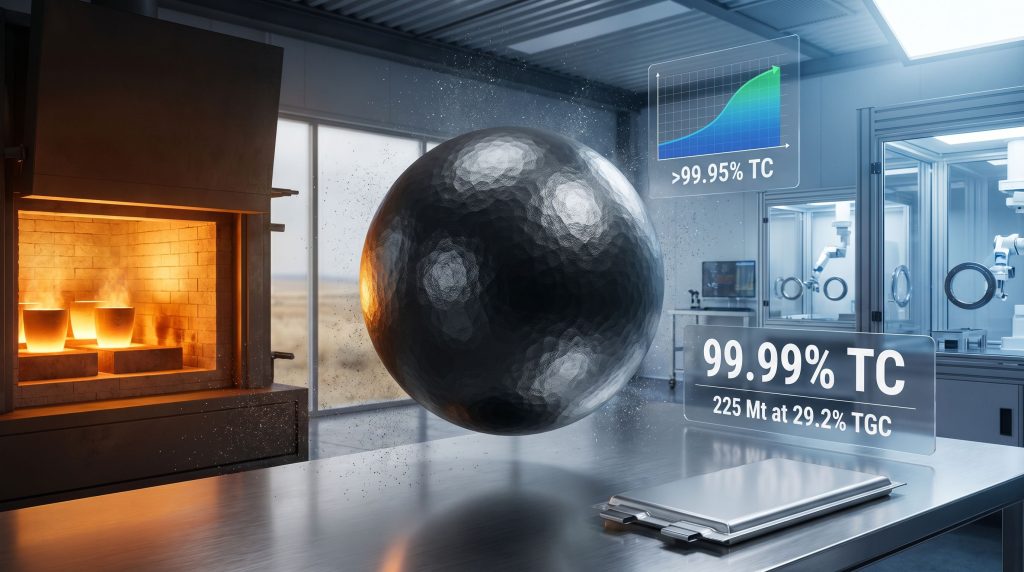
Before examining the purification program itself, it is worth understanding what makes the underlying feedstock unusual. The Sarytogan Graphite project, located in the Karaganda region of Central Kazakhstan, hosts a mineral resource of 225 million tonnes at 29.2% total graphitic carbon (TGC). That grade figure is exceptional by global standards. Most commercially operating graphite mines work with average grades between 5% and 15% TGC. At 29.2%, Sarytogan sits in a category occupied by only a small number of deposits worldwide.
| Metric | Sarytogan Detail |
|---|---|
| Resource Size | 225 million tonnes (Mt) |
| Average Grade | 29.2% Total Graphitic Carbon (TGC) |
| Location | Karaganda Region, Central Kazakhstan |
| Initial Exploration | 1980s, via trenching and diamond drilling |
| Modern Exploration Resumed | 2018, through 100%-owned subsidiary Ushtogan LLP |
| Ownership Structure | 100% owned by Sarytogan Graphite Limited (ASX: SGA) |
High feedstock grade matters enormously for downstream purification economics. When concentrate entering the purification circuit already carries a high natural carbon content, the energy and reagent requirements to push material to battery-grade purity thresholds are substantially lower than they would be for lower-grade feedstocks. This is a cost structure advantage that becomes increasingly significant at scale, and it is one of the reasons the Sarytogan project has attracted attention from potential European offtake customers.
Inside the AETC Facility: What the Plant-Scale Process Actually Involves
AETC is not a newcomer to Sarytogan's material. The Illinois-based graphite processing specialist worked with the company through 2024 and 2025, demonstrating the performance of Sarytogan graphite across several industrial and high-technology applications. That prior relationship means the 2026 program begins with an established technical baseline rather than starting from scratch.
The plant-scale testwork sequence covers six distinct processing stages, each of which serves a specific function in transforming raw concentrate into battery-ready anode material:
-
Characterisation – Comprehensive analysis of the bulk concentrate's physical and chemical properties, establishing the baseline from which all subsequent processing decisions are made.
-
Granulation – Fine graphite particles are bound together into uniform granules, improving the consistency of feed material entering the thermal treatment stages.
-
Calcining – The granulated material is subjected to elevated temperatures to drive off volatile impurities and prepare the carbon structure for high-purity treatment.
-
Thermal Purification – The core high-purity step, where material is processed at very high temperatures (typically exceeding 2,500°C in industrial graphitisation furnaces) to remove residual non-carbon elements and achieve ultra-high carbon purity.
-
Spheronisation – Purified graphite particles are mechanically shaped into spherical form, which is the geometry required for efficient packing and electrochemical performance in battery anodes.
-
Battery Test Trials – The finished spherical material undergoes electrochemical performance evaluation, including charge-discharge cycling and capacity measurement, in pouch cell format.
A particularly significant aspect of the 2026 program is the use of 3-6 kg concentrate lots as feed material. This is a deliberate engineering choice. At benchtop scale, researchers typically work with gram-level quantities where uniformity can be tightly managed. Multi-kilogram lots introduce the natural variability present in bulk shipments, testing whether process parameters that worked at small scale remain effective when processing conditions become harder to control with precision. Successfully processing 3-6 kg lots through the full sequence provides a far more credible data set for downstream DFS modelling than benchtop results alone.
The Purity Challenge: Why 99.95% TC Is the Commercial Threshold
Battery manufacturers specify a minimum total carbon (TC) purity of 99.95% for anode-grade graphite. This threshold is not arbitrary. At purity levels below this figure, residual impurities including iron, silicon, and sulphur compounds can interfere with the electrochemical reactions at the anode, reducing cell capacity, increasing irreversible first-cycle losses, and in some cases compromising long-term cycle life. The specification exists because battery performance at the cell and pack level is highly sensitive to anode material quality.
| Purification Route | Purity Achieved | Meets Battery-Grade Specification (>99.95% TC)? |
|---|---|---|
| Conventional Hydrometallurgical Route | ~99.87% TC | No |
| Alkaline Purification (Benchtop, Prior Testing) | 99.99% TC | Yes |
| Thermal Purification (2026 Bulk Program Target) | 99.99% TC (target) | Yes, if validated at bulk scale |
The 12 basis point gap between 99.87% and 99.99% TC may sound minor in percentage terms, but in materials science it represents the difference between commercial rejection and commercial acceptance. Prior benchtop work using alkaline treatment followed by thermal purification has already demonstrated 99.99% TC is achievable with Sarytogan material. The 2026 AETC program exists to determine whether that result is reproducible at processing conditions that more closely approximate an industrial operation.
In addition, bulk graphite concentrate manufacture has already commenced, providing a foundation of real-world production data that further strengthens the credibility of results generated at the AETC facility.
What battery manufacturers ultimately purchase is not a purity number on a specification sheet. They purchase consistency. Demonstrating that a material can hit 99.99% TC across multiple bulk processing runs is qualitatively different from demonstrating it once at laboratory scale.
The Two Products Targeting Different Market Segments
The purification program is designed to produce two distinct output streams, each targeting different end markets:
Uncoated Spherical Purified Graphite (USPG) is the primary battery anode target product. Spherical graphite is the form in which natural graphite is incorporated into lithium-ion battery anodes. The uncoated designation indicates the material has been purified and spheronised but has not yet undergone carbon coating, a final processing step that some customers prefer to apply themselves using their own proprietary coating formulations. Offering USPG gives potential customers flexibility in how they integrate the material into their own manufacturing processes.
Ultra High Purity Fines (UHPF) are a secondary product stream arising from the spheronisation process. When graphite particles are mechanically shaped into spheres, the process generates fine particles that do not meet the size specifications for battery anodes. These fines, at very high purity, have value in applications including lubricants, thermal management materials, expandable graphite products, and certain advanced composite applications. UHPF effectively converts what would otherwise be a processing by-product into a commercial output.
In addition to these two material products, AETC will supervise the manufacture and performance testing of 5Ah pouch cell lithium-ion batteries at a leading European battery innovation centre. Pouch cell testing at this capacity is directly relevant to the performance requirements of electric vehicle and energy storage applications, and the results will form part of the evidence package presented to potential offtake customers.
The Definitive Feasibility Study Connection
Sarytogan has structured its feasibility work in two separate but connected studies, with the split driven by the company's funding envelope and the logical sequencing of project development. A definitive feasibility study of this nature typically requires robust, plant-scale performance data before downstream assumptions can be credibly modelled.
The upstream DFS, covering mine development, ore processing, and concentrate production through to graphite concentrate output, is scheduled for completion during Q3 2026. This study will establish project capital costs, operating cost assumptions, mine schedule, and the overall economic framework for the concentrate-producing component of the project.
The downstream DFS, which will address the purification plant, spheronisation facility, and finished battery-grade product specifications, will be directly informed by the outcomes of the current AETC trials. This sequencing is logical. Building a downstream DFS around assumed purification performance metrics creates a study with significant uncertainty. Building it around demonstrated plant-scale performance data creates a study with substantially higher credibility in the eyes of both financiers and offtake partners.
This means the 2026 purification program serves a dual function. It generates customer samples that can advance commercial conversations, and it simultaneously produces the technical data that will underpin the downstream half of the project's feasibility framework.
EU Critical Raw Materials Act Designation: What It Actually Means
The Sarytogan project holds strategic project designation under the European Union's Critical Raw Materials Act (CRMA). This classification is reserved for deposits formally assessed as strategically important to Europe's clean energy transition and industrial supply chain security. Consequently, it covers materials including graphite, lithium, cobalt, manganese, and nickel among others.
It is important to understand what this designation does and does not represent from a project-specific standpoint. The CRMA framework establishes regulatory pathways, timelines for permitting processes, and eligibility criteria for certain financing mechanisms. Whether Sarytogan accesses any specific funding instrument or receives preferential permitting treatment as a result of this status depends on subsequent commercial and regulatory processes that are distinct from the designation itself.
What the designation unambiguously provides is external validation that European institutions regard this type of deposit, and this level of material quality, as relevant to the continent's critical minerals demand for supply chain security. For potential European battery manufacturers evaluating whether to engage with Sarytogan as a supplier, that validation carries weight in internal procurement discussions.
The next major ASX story will hit our subscribers first
Kazakhstan's Underappreciated Role in the Global Graphite Equation
Kazakhstan occupies an unusual position in the critical minerals conversation. The country is well known as a major uranium producer, accounting for roughly 40-45% of global uranium output, but its graphite potential has received comparatively little attention from Western investors and supply chain planners. In this context, understanding the broader battery metals investment landscape helps explain why Sarytogan's positioning is increasingly relevant to international capital.
The Karaganda region's geological character, shaped by Precambrian metamorphic sequences, is the source of the high-grade graphite mineralisation at Sarytogan. Flake graphite deposits of this type, where carbon has been concentrated through high-grade metamorphic processes over geological timescales, tend to produce larger, higher-crystallinity flakes than hydrothermal or igneous-associated deposits. Flake size and crystallinity both correlate with easier processing to high purity and better electrochemical performance in finished battery cells.
From a logistics standpoint, Kazakhstan's position provides relatively straightforward access to both European and East Asian markets via established rail corridors, including the Trans-Caspian International Transport Route that has seen increased freight traffic as supply chain planners seek alternatives to traditional routing through Russia.
What Comes Next: From Purification Outputs to Commercial Conversations
The downstream commercial pathway from the AETC program follows a logical progression. Purified and spheronised material, validated through pouch cell testing, will be packaged as customer samples for distribution to battery manufacturers and anode material producers who have previously expressed interest after testing smaller Sarytogan samples.
This is a critically important commercial dynamic. The existence of a pre-qualified customer audience that has already evaluated the material at small scale and is actively waiting for larger samples represents a meaningful acceleration of the typical commercial development timeline. Rather than introducing the material to new prospects from scratch, the customer sampling phase begins with counterparties who already have internal data on Sarytogan graphite performance.
The pathway from customer sampling to offtake negotiation involves additional stages including extended qualification testing, integration into cell manufacturing trials, and commercial term negotiation. These processes typically take between 12 and 36 months depending on the customer and the application.
However, the fact that Sarytogan is entering this phase with an established technical track record and the downstream DFS development running in parallel positions the company to advance multiple workstreams simultaneously rather than sequentially. For investors monitoring the broader graphite industry challenges facing producers globally, this concurrent approach to technical validation and commercial engagement represents a notably disciplined development strategy.
Disclaimer: This article is intended for informational purposes only and does not constitute financial or investment advice. The Sarytogan Graphite project involves forward-looking development activities and technical targets that are subject to risk, uncertainty, and change. Readers should conduct their own due diligence and consult a licensed financial adviser before making any investment decisions. Past purification results at benchtop scale are not a guarantee of equivalent outcomes at plant scale.
For ongoing coverage of Sarytogan Graphite and the broader critical minerals sector, readers can explore related reporting at themarketonline.com.au.
Want To Identify The Next Major Mineral Discovery Before The Market Does?
Discovery Alert's proprietary Discovery IQ model scans ASX announcements in real time, instantly converting complex mineral data across 30+ commodities into actionable investment insights — from high-grade graphite developers like Sarytogan to the next potential market-moving find. Explore how historic mineral discoveries have generated extraordinary returns, then start your 14-day free trial at Discovery Alert and position yourself ahead of the broader market.