June 5, 2026
The Infrastructure Gap That Will Define Vaca Muerta's Next Decade
Unconventional oil development has a well-documented paradox at its core: the geology can be world-class, the technology proven, and the capital committed, yet everything still hinges on whether a pipeline gets built on time. This tension, familiar to anyone who followed the Permian Basin's midstream scramble of the mid-2010s, is now playing out in the Argentine province of Neuquén at a scale that few outside the Latin American upstream sector have fully appreciated.
Chevron's $13.8-billion Chevron Argentina oil development proposal, formally filed on June 2, 2026, under the country's Large Investment Incentive Regime, crystallises this dynamic with precision. The numbers are large, the geological case is compelling, and the development history at the block is already underway. However, the production target — a 4x-plus increase from current output levels — will not materialise unless a 437-kilometre crude pipeline is commissioned on schedule. Understanding why requires working through the proposal from the ground up.
When big ASX news breaks, our subscribers know first
Argentina's RIGI Program and the Scale of Chevron's Commitment
Argentina's Régimen de Incentivo para Grandes Inversiones, known by its acronym RIGI, was designed to solve a specific problem: how to attract long-duration, capital-intensive foreign investment into an economy with a well-documented history of policy reversals, currency controls, and fiscal instability. The framework offers qualifying projects a package of fiscal stability guarantees, tax concessions, and regulatory protections intended to ring-fence approved investments from future changes in the domestic policy environment.
The program has attracted substantial interest. Prior to Chevron's June 2026 filing, RIGI had accumulated approximately $93 billion in commitments across 36 approved projects, a figure that underscores both the scale of investor appetite for Vaca Muerta exposure and the Argentine government's success in marketing the framework internationally. Furthermore, the broader geopolitical risk landscape surrounding energy investment has made RIGI's stability guarantees even more attractive to long-horizon capital allocators.
Chevron's $13.8-billion application is the second-largest individual submission the program has received. Only YPF's $25-billion LLL Oil development proposal ranks ahead of it. Put differently, Chevron's single filing represents close to one-seventh of the program's entire accumulated commitment base prior to its submission.
It is critical to understand that RIGI approval and a final investment decision are entirely separate events. A successful application grants regulatory certainty and fiscal protections. It does not commit capital, and it does not guarantee that production targets will be met.
This distinction carries significant implications for anyone assessing the proposal's probability-weighted outcomes. The filing is a formal expression of strategic intent, not a binding capital deployment schedule.
El Trapial-Este: What the Block Is and How It Got Here
Geological Position Within Vaca Muerta
El Trapial-Este sits in northern Neuquén province within the Vaca Muerta unconventional formation, the organic-rich shale and tight carbonate sequence that has reshaped Argentina's upstream sector over the past decade. Chevron operates the block at a 100% working interest, an unusual configuration in a formation where most major projects involve consortium structures.
The Vaca Muerta is frequently described in the same breath as the Permian Basin, and while that comparison requires careful qualification, the geological fundamentals justify the attention. Consequently, the formation's organic richness, depth consistency, and lateral continuity across large acreage positions make it one of the few unconventional plays outside North America with genuine Tier 1 characteristics. These attributes are comparable to major Argentine resource systems that have similarly attracted international capital in recent years.
What differentiates Vaca Muerta geologically from most North American shale plays is its carbonate content, which creates a more brittle rock matrix that responds well to hydraulic fracturing but demands precise completion engineering to optimise fracture geometry and avoid unwanted height growth.
A Development History Built on Deliberate Progression
Chevron's approach to El Trapial-Este has followed a staged methodology that reflects lessons learned from early-phase unconventional development in the Permian:
- 2021: A seven-well pilot programme assessed formation viability, fracture response, and per-well productivity at scale.
- Late 2022: Following encouraging pilot results, Chevron transitioned to a full-scale development phase, deploying horizontal laterals exceeding 3,000 metres in length.
- 2023: A $500-million capital commitment was formalised for the active development phase, signalling conviction in the asset's commercial potential.
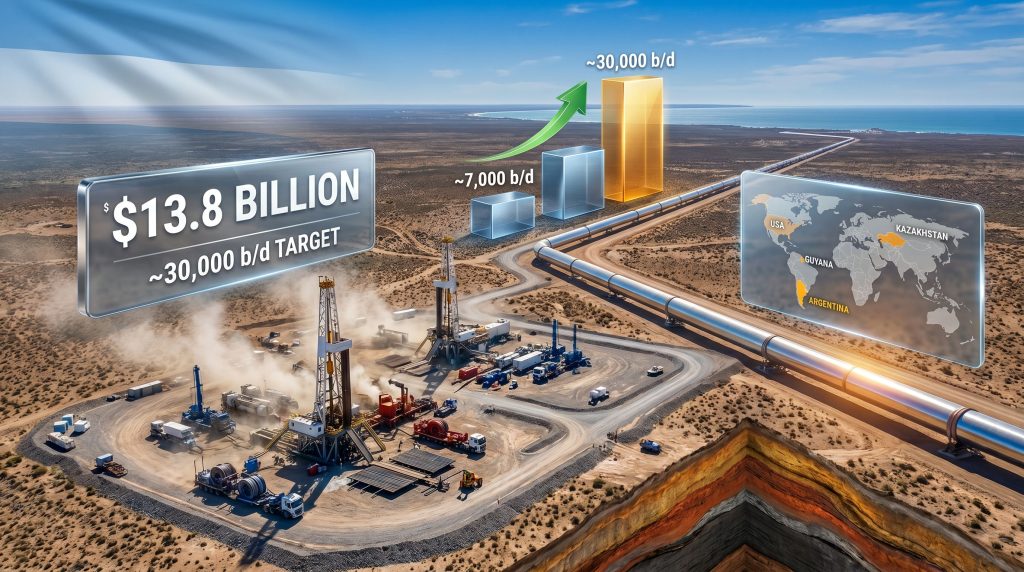
- June 2, 2026: The RIGI application was filed, targeting a production increase to approximately 30,000 barrels per day from a current baseline of roughly 7,000 b/d.
The extended-reach laterals being deployed at El Trapial-Este are noteworthy. At 3,000 metres-plus, these are among the longer laterals being drilled in South American unconventional development. Longer laterals improve per-well economics by spreading fixed drilling and completion costs across a greater productive interval, a principle that transformed Permian Basin economics as the industry shifted from 5,000-foot to 10,000-foot and now 15,000-foot laterals in West Texas.
The transfer of Permian completion and stimulation techniques to Neuquén is not incidental to the business case; it is central to it.
| Development Milestone | Year | Detail |
|---|---|---|
| Pilot programme | 2021 | Seven-well formation test |
| Full development launch | Late 2022 | Extended-reach horizontal drilling begins |
| Phase capital commitment | 2023 | $500 million allocated |
| RIGI application filed | June 2, 2026 | $13.8 billion proposal submitted |
| Production target | RIGI-dependent | ~30,000 b/d from ~7,000 b/d current |
Vaca Muerta vs. the Permian Basin: An Honest Technical Comparison
Where the Formation Delivers and Where It Falls Short
The economic comparison between Vaca Muerta and the Permian Basin is a subject of active debate within the upstream industry, and the answer depends heavily on which metrics are prioritised.
On a normalised productivity basis, the case for Vaca Muerta is strong. According to Rystad Energy, when well output is adjusted for lateral length and fracture intensity, the best blocks within Vaca Muerta match or exceed Permian Basin performance. Wellhead breakeven costs in premium Neuquén acreage run at approximately $40 per barrel, a figure that positions the formation competitively against most global unconventional plays at current oil prices. However, the commodity price sensitivity inherent to large unconventional developments means that project economics can shift materially with sustained oil price movements.
The cost structure, however, tells a more complicated story:
- Drilling and completion costs in Neuquén remain an estimated 30 to 40% higher than comparable operations in Midland, Texas, according to Rystad Energy.
- The cost gap reflects structural factors including shallower services market depth, more complex cross-border equipment supply chains, and logistics constraints inherent to operating in a less mature unconventional basin.
- Unlike the Permian, where decades of cumulative infrastructure investment have created a dense ecosystem of drilling contractors, completion crews, sand suppliers, and water management systems, Vaca Muerta is still building that ecosystem.
The Permian Basin's cost efficiency was not the product of geology alone. It was the result of thirty years of cumulative infrastructure investment, supplier competition, and operational learning. Vaca Muerta is on that trajectory, but it is still in earlier innings.
This cost gap matters for project economics at lower oil prices but is less decisive at the $60-to-$80 Brent range. It is also a moving target. As Vaca Muerta's production volumes grow and the services sector matures, the structural cost disadvantage is expected to narrow, though the timeline for that convergence remains uncertain.
What Makes Unconventional Neuquén Technically Distinct
Several characteristics differentiate Vaca Muerta development from North American unconventional analogs in ways that are not always captured in high-level comparisons:
- The formation's mixed shale-carbonate lithology creates stimulation challenges that require adapted completion designs, a key reason why technology transfer from the Permian is not a simple copy-paste exercise.
- Water management at scale remains less developed than in the Permian, where produced water recycling infrastructure is now standard. As Vaca Muerta production volumes increase, water handling will become an increasingly significant operational variable.
- The altitude and weather conditions in parts of Neuquén create seasonal operational constraints with no direct Permian equivalent, adding complexity to drilling schedules and well completion timing.
- Regulatory differences in well spacing, environmental permitting, and production reporting between Argentina and Texas mean that operational playbooks require adaptation even when the core drilling and completion technology is directly transferred.
The VMOS Pipeline: Why Infrastructure Is the Critical Variable
A 437-Kilometre Corridor That Changes Everything
Chevron's production target at El Trapial-Este is not framed as an aspiration. The company has explicitly stated that achieving approximately 30,000 b/d is contingent on takeaway infrastructure being available. That infrastructure has a name: the Vaca Muerta Oil Sur pipeline, universally referenced as VMOS.
The VMOS system is a 437-kilometre crude oil transport corridor designed to connect Neuquén basin production to an Atlantic coast export terminal, providing the basin with direct export-oriented takeaway capacity that does not currently exist at the required scale. The project carries a $2.9-billion investment commitment and was approved under the RIGI framework. In addition, global supply chain constraints affecting large infrastructure procurement could influence the pipeline's construction timeline and cost profile.
The pipeline's capacity build-out is staged:
| Phase | Timeline | Capacity |
|---|---|---|
| Initial commissioning | Expected end of 2026 | 180,000 b/d |
| Phase 2 expansion | 2027 | 550,000 b/d |
| Long-term potential | Post-2027 | Up to 700,000 b/d |
The Consortium Behind VMOS
VMOS is not a Chevron-only undertaking. Chevron and Shell have finalised their partnership in the pipeline as part of a consortium led by YPF, with participation from the major operators active in the Neuquén basin:
- YPF (lead operator)
- Chevron Argentina SRL
- Pan American Energy
- Vista Energy
- Shell
- Pampa Energía
- Pluspetrol
- Tecpetrol
- Gas y Petróleo del Neuquén (Class B shareholder, representing the provincial government's interest)
The consortium structure creates both alignment and complexity. All major producers have a shared interest in VMOS being commissioned on schedule, since all face the same takeaway constraint. However, capacity allocation across consortium members once the pipeline is operational will require commercial agreements that have not yet been publicly detailed.
The commissioning timeline for VMOS is the single most important near-term variable for Chevron's El Trapial-Este production ramp. A delay of twelve months in pipeline commissioning translates directly into a delay of similar duration in production growth, regardless of how many wells have been drilled.
Chevron's Global Portfolio Logic and Where Argentina Fits
Reading the Strategic Signal in the RIGI Filing
To understand why Chevron is pursuing a $13.8-billion commitment in Argentina, it helps to place the filing in the context of the company's broader capital allocation strategy. Chevron's leaning into Argentina's shale growth opportunities reflects a deliberate portfolio decision, not simply an opportunistic response to RIGI's incentive structure.
During Chevron's first-quarter 2026 earnings call in May, chief executive Mike Wirth communicated that the company's 2030 production targets are anchored in assets that are currently producing, rather than in projects yet to reach final investment decision. He also indicated that even at Brent prices exceeding $100 per barrel, Chevron would not accelerate Permian Basin production, preferring instead to manage that asset for free cash flow optimisation rather than volume growth.
This strategic posture has important implications. It signals that Chevron's international growth options, including Argentina, are the mechanism through which incremental volume growth is expected to occur. Argentina was named alongside Tengiz in Kazakhstan, the Stabroek Block in Guyana, the Permian Basin, and Venezuela as a source of equity crude feeding Chevron's global refining system.
| Asset | Country | Strategic Function |
|---|---|---|
| El Trapial-Este (RIGI filing) | Argentina | Unconventional oil growth option |
| Tengizchevroil (TCO) | Kazakhstan | Core equity crude supply |
| Stabroek Block | Guyana | High-growth deepwater development |
| Permian Basin | USA | Free cash flow optimisation |
| Venezuela assets | Venezuela | Equity crude for refining system |
The RIGI filing, submitted just weeks after the earnings call, represents the operational follow-through on a strategic priority that Wirth had already communicated to investors. The timing is unlikely to be coincidental.
The next major ASX story will hit our subscribers first
Risk Framework: Five Conditions That Must Align
What Has to Go Right for $13.8 Billion to Be Deployed
The gap between a RIGI application and a producing 30,000 b/d asset is substantial. Five discrete conditions must be satisfied, and failure in any one of them alters the project's trajectory materially:
- RIGI approval must be granted by the Argentine government. The application remains subject to formal review and is not automatically approved.
- VMOS pipeline commissioning must occur on the expected late-2026 schedule, and capacity must be allocated to El Trapial-Este volumes in sufficient quantity to support the targeted production rate.
- Oil price sustainability above the ~$40/bbl wellhead breakeven is necessary for the project's economics to support full capital deployment. A sustained move toward $40 or below would compress returns significantly.
- Drilling cost reduction in Neuquén relative to North American benchmarks must continue, narrowing the current 30-40% gap to improve capital efficiency at the project level.
- Chevron board ratification of a formal final investment decision must occur as a separate and subsequent corporate governance step. The RIGI filing does not substitute for this process.
Structural Risks That Persist Regardless of Project Merit
Beyond the project-specific conditions, Argentina's macro environment introduces risks that are structural rather than transient. Understanding resource investment risk in emerging market contexts helps illustrate why even well-structured projects must account for sovereign variables that fall outside any single operator's control:
- Sovereign risk arising from Argentina's history of currency controls, debt restructuring, and policy reversals creates a discount that long-duration capital commitments must price in.
- Inflation and cost escalation in a high-inflation domestic economy can erode drilling and operating cost projections, particularly for service contracts denominated in Argentine pesos.
- Export revenue allocation between federal and provincial governments has historically been a source of political tension in Argentina's hydrocarbon sector, and future changes to royalty or export tax structures cannot be fully ruled out over a multi-decade project life.
- Infrastructure execution risk on VMOS itself: large-scale pipeline construction in Argentina carries its own project delivery risks, and a commissioning delay would create a direct and immediate constraint on production growth.
Disclaimer: This article contains forward-looking statements, production forecasts, and financial projections sourced from corporate filings and third-party analysts. These do not constitute investment advice. Energy project outcomes are subject to material uncertainties including commodity prices, regulatory decisions, and infrastructure execution. Readers should conduct independent due diligence before making investment decisions.
Frequently Asked Questions: Chevron Argentina Oil Development Proposal
What is Chevron's $13.8-billion Argentina proposal?
Chevron filed a formal application on June 2, 2026, to participate in Argentina's RIGI programme for a large-scale unconventional oil development at its El Trapial-Este block in Neuquén province. The Chevron Argentina oil development proposal targets a production increase from approximately 7,000 b/d to 30,000 b/d, subject to infrastructure availability and regulatory approval.
Has Chevron made a final investment decision?
No. The RIGI application is a regulatory filing, not a capital commitment. A separate board-level final investment decision would be required before the full $13.8 billion could be deployed.
What is the VMOS pipeline and why does it matter?
The Vaca Muerta Oil Sur pipeline is a 437-kilometre crude transport corridor connecting Neuquén basin production to an Atlantic export terminal. Chevron has explicitly linked its 30,000 b/d production target to VMOS capacity being available. Without the pipeline, production growth at El Trapial-Este faces a hard physical ceiling.
How does Vaca Muerta compare economically to the Permian Basin?
In terms of normalised well productivity, Vaca Muerta's best acreage is broadly comparable to the Permian when adjusted for lateral length and stimulation intensity. Wellhead breakevens of approximately $40/bbl are competitive globally. However, drilling costs in Neuquén remain 30-40% higher than in Midland, Texas, according to Rystad Energy, representing a structural cost disadvantage that the industry is working to close.
How large is Chevron's proposal relative to other RIGI submissions?
Chevron's $13.8-billion filing is the second-largest project submitted under RIGI, behind only YPF's $25-billion LLL Oil development. It represents approximately one-seventh of the programme's total accumulated commitments prior to this filing.
Want To Track The Next Major Resource Discovery Before The Market Moves?
Discovery Alert's proprietary Discovery IQ model scans ASX announcements in real time, instantly identifying significant mineral discoveries and turning complex data into actionable investment insights — the same kind of edge that has historically driven extraordinary returns for early movers. Start your 14-day free trial today and explore historic discovery outcomes on Discovery Alert's dedicated discoveries page.