June 4, 2026
The Hidden Carbon Budget Buried Inside Every Forged Component
Every time an aerospace turbine disc, an automotive crankshaft, or a defence-grade structural fitting leaves a forging press, it carries with it an invisible carbon ledger. That ledger begins at the steelmaking furnace, extends through billet preparation, runs across the forging floor, and continues into finishing and despatch. For most of manufacturing history, that ledger went unread. Today, driven by converging regulatory, commercial, and financial pressures, the sustainable practices in modern metal forging that were once optional are rapidly becoming the baseline expectation for market participation.
Understanding what that transformation actually involves, technically, economically, and strategically, requires moving beyond surface-level sustainability language and into the mechanics of how forging operations consume energy, generate waste, and interact with global supply chains.
When big ASX news breaks, our subscribers know first
Why the Forging Industry's Carbon Position Is More Complex Than It Appears
Embedded Emissions and the Upstream Challenge
The IPCC's Sixth Assessment Report estimated that direct industrial greenhouse gas emissions accounted for approximately 24 percent of global anthropogenic emissions in 2019, with a further 5 percent attributable indirectly through purchased electricity and heat. Within that industrial total, iron and steel production alone contributes roughly 7 to 9 percent of global energy-sector CO₂ emissions when both direct and indirect sources are counted, according to the IEA's Iron and Steel Technology Roadmap.
Forging sits downstream of these primary processes, meaning its carbon footprint is partly embedded in the metal it receives, not just in the energy consumed on the forging floor itself. A forging operation that decarbonises its heating systems while continuing to source blast furnace steel has only addressed a fraction of its full emissions profile. This distinction matters enormously for Scope 3 accounting and for customers in aerospace, automotive, and defence who are now conducting full supply-chain carbon assessments.
The energy intensity of different steelmaking routes illustrates the scale of the challenge. Furthermore, emerging pathways such as green iron production are beginning to redefine what low-carbon feedstock can look like for downstream manufacturers:
| Production Route | Energy Consumption (per tonne of steel) | CO₂ Emissions (per tonne) |
|---|---|---|
| Blast Furnace / Basic Oxygen Furnace (BF-BOF) | 20-30 GJ | 1.8-2.3 tonnes |
| Electric Arc Furnace (EAF, scrap-based) | 2.5-3.5 GJ | 0.3-0.4 tonnes (low-carbon grid) |
| EAF powered by renewable electricity | 2.5-3.5 GJ | Near-zero direct emissions |
Source: IEA Iron and Steel Technology Roadmap
Regulatory Frameworks Reshaping Commercial Reality
Three regulatory developments are reshaping the economics of sustainable practices in modern metal forging more than any other:
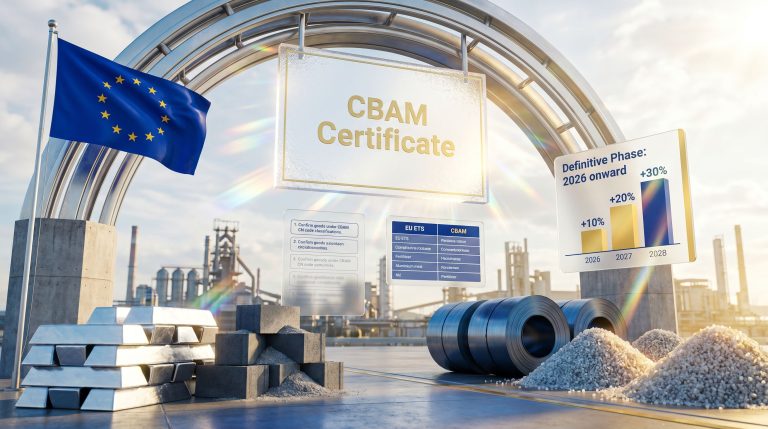
- EU Carbon Border Adjustment Mechanism (CBAM): From 2026 onward, forged products entering the European Union from jurisdictions without equivalent carbon pricing will carry an embedded carbon cost. This creates a direct financial incentive for non-EU producers to reduce emissions intensity, not just a reputational one.
- EU Emissions Trading System (ETS): Carbon prices on the EU ETS ranged between approximately €60 and €100 per tonne of CO₂ as of 2024-2025, creating a significant ongoing cost burden for carbon-intensive forging facilities operating within the EU.
- ISO 14001 and ESG disclosure requirements: Major OEM customers in aerospace, automotive, and defence are increasingly embedding environmental management system certification and Scope 1, 2, and 3 emissions disclosure as mandatory supplier qualification criteria.
Energy typically represents 15 to 40 percent of total forging production costs, meaning that investments in energy efficiency simultaneously address carbon targets and operational cost competitiveness, without requiring any trade-off between the two objectives.
Core Technologies Driving Sustainable Practices in Modern Metal Forging
Induction Heating: Redefining the Energy Benchmark
The shift from combustion-based furnaces to induction heating systems represents one of the most consequential technical transitions in forging sustainability. Induction heating works by passing alternating current through a coil surrounding the metal billet, generating an electromagnetic field that induces eddy currents directly within the workpiece. Heat is generated inside the metal itself, not radiated from an external flame.
The efficiency difference is substantial. In addition, advanced forging techniques continue to evolve alongside these heating innovations, further compounding the gains available to manufacturers:
- Conventional gas-fired combustion furnaces operate at thermal efficiencies of 30 to 50 percent, with significant losses through exhaust gases, radiant heat, and thermal mass heating.
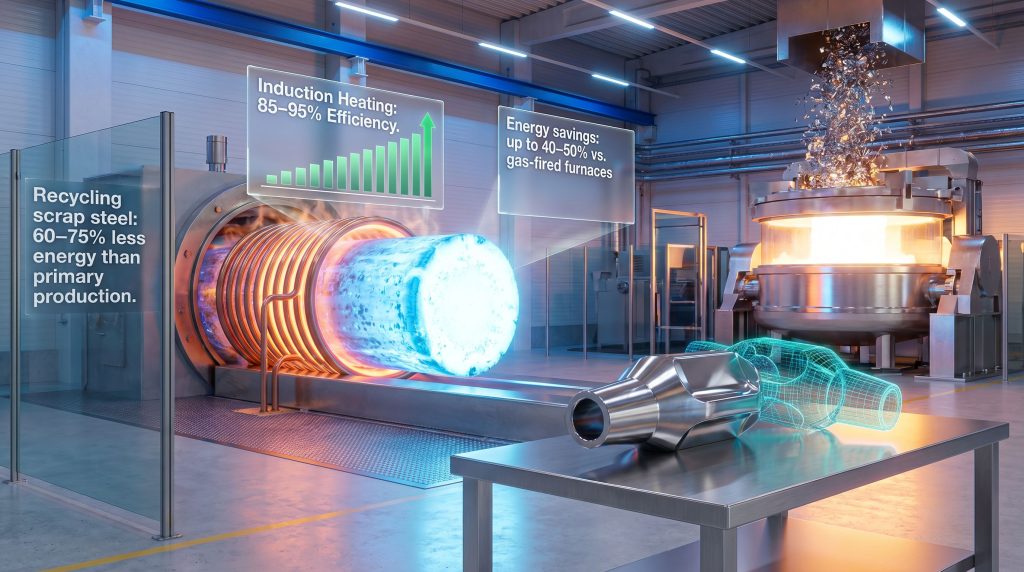
- Induction heating systems achieve thermal efficiencies of 85 to 95 percent, delivering heat precisely where it is needed with minimal losses.
- Energy savings of 40 to 50 percent versus gas-fired equivalents have been documented in comparable forging applications.
- When paired with renewable electricity supply, induction heating generates near-zero direct process emissions.
Beyond efficiency, induction heating delivers faster heat cycles, more precise temperature uniformity across the billet cross-section, and significantly reduced scale formation, all of which improve metallurgical consistency and reduce post-forge defect rates.
Electric Arc Furnaces and the Green Hydrogen Transition
For operations involved in upstream metal preparation, EAF technology operating on scrap steel feedstock offers a dramatically lower-carbon alternative to primary production. EAF routes consume approximately 400 to 500 kWh per tonne of steel produced, compared to roughly 4,000 to 5,000 MJ per tonne via traditional blast furnace processing, a reduction of more than 80 percent in energy intensity.
Green hydrogen represents the longer-horizon decarbonisation pathway for processes where full electrification is not yet feasible. Produced through electrolysis powered by renewable electricity, hydrogen iron reduction produces only water vapour, with zero CO₂ output. Several European steel producers have entered pilot deployment phases. Cost competitiveness with natural gas is projected under current electrolyser cost reduction trajectories to be achievable in the 2030 to 2035 timeframe.
| Heating Technology | Thermal Efficiency | Emissions Profile | Commercial Status |
|---|---|---|---|
| Gas-Fired Combustion Furnace | 30-50% | High CO₂ | Incumbent |
| Induction Heating | 85-95% | Near-zero (renewable grid) | Commercially mature |
| Electric Arc Furnace (EAF) | 75-85% | Low (grid-dependent) | Commercially mature |
| Green Hydrogen Furnace | Moderate-High | Near-zero | Early commercial / pilot |
Material Efficiency as a Sustainability Lever
The Energy Economics of Recycled Feedstock
One of the least discussed but highest-impact sustainable practices in modern metal forging is the substitution of recycled feedstock for virgin raw materials. The energy differentials are striking:
- Recycling scrap steel requires approximately 60 to 75 percent less energy than producing primary steel from iron ore through conventional blast furnace routes.
- Secondary aluminium production, using recycled scrap, consumes approximately 5 percent of the energy required for primary smelting from bauxite ore, representing a 95 percent energy reduction.
Beyond the energy dimension, recycled feedstock sourcing reduces exposure to volatile commodity pricing in iron ore, coking coal, and primary aluminium markets, improving supply chain resilience at the same time as it reduces emissions intensity.
Near-Net Shape Forging: Precision as a Waste Strategy
Near-net shape forging is a methodology that warrants more attention than it typically receives in sustainability discussions. By producing forgings that closely approximate their final geometric dimensions, manufacturers significantly reduce the volume of material removed during subsequent machining operations.
Conventional forging processes can generate 20 to 30 percent of input material as offcut waste and machining swarf. Optimised near-net shape techniques, supported by advanced finite element analysis (FEA) die design and metal flow simulation, can reduce this figure to under 10 percent in well-designed operations, pushing material yields above 90 percent.
The capital investment required for FEA-optimised tooling is typically recovered through reduced raw material procurement costs, lower machining energy consumption, and decreased waste disposal expenditure, making this one of the highest-return sustainability investments available to mid-scale forging operations.
Closed-Loop Scrap Recovery: Circular Economy in Practice
Closed-loop scrap recovery systems capture all scrap generated within the forging cycle, including flash, offcuts, and rejected components, and reintroduce this material directly into the production process rather than routing it externally. This approach delivers multiple simultaneous benefits:
- Eliminates cross-contamination of alloy grades through controlled segregation
- Maximises the economic value of recovered material
- Reduces raw material procurement volumes
- Supports Scope 3 emissions reduction through lower upstream processing requirements
For a mid-scale forging operation processing 50,000 tonnes per annum, a well-implemented closed-loop system could recover and reuse an estimated 5,000 to 8,000 tonnes of scrap annually, representing significant material cost avoidance.
Operational Note: The pairing of near-net shape forming with closed-loop scrap recovery consistently delivers some of the highest combined returns of any sustainability investment in forging, reducing material cost, energy consumption, and waste disposal expenditure simultaneously, without requiring disruptive process redesign.
Digital Technologies Accelerating Forging Sustainability
Digital Twin Simulation
Digital twin platforms create virtual replicas of the entire forging process, from billet heating through die contact and final geometry formation. Engineers can identify energy inefficiencies, test die geometry variations, and optimise press parameters before committing to physical tooling or production runs.
In complex component manufacturing, digital twin deployment has demonstrated capacity to reduce prototype and tooling scrap by 20 to 35 percent, while also shortening development cycles and improving first-pass quality rates.
Predictive Maintenance and AI-Driven Process Control
Sensor networks monitoring press load, die temperature, hydraulic system performance, and component dimensional accuracy in real time allow AI-driven anomaly detection systems to identify deviation patterns before they result in equipment failure or defective output.
Industry benchmarks suggest that predictive maintenance implementation can reduce unplanned maintenance expenditure by 10 to 25 percent while also eliminating the embodied energy losses associated with scrapped components and unplanned production downtime.
Waste-Heat Recovery Systems
Exhaust thermal energy from forging furnaces and presses represents a recoverable resource that most conventional facilities discharge to atmosphere. Well-designed waste-heat recuperation systems can recover 15 to 30 percent of total furnace energy input for reuse in billet preheating, facility heating, or steam generation, reducing total site energy consumption without additional fuel input.
Supply Chain Transparency and ESG Accountability
Blockchain-Enabled Material Traceability
Distributed ledger technology is increasingly being applied in forging supply chains to create auditable records of material origin, processing history, recycled content percentages, and associated carbon footprints at each production stage.
This capability directly supports compliance with emerging regulatory requirements including the EU Battery Regulation, EU Deforestation Regulation, and supply chain due diligence legislation that mandates documented material provenance across multiple jurisdictions.
Scope 1, 2, and 3 Reporting Frameworks
Forging companies operating in global supply chains are increasingly required to report emissions under the GHG Protocol's three-scope framework:
- Scope 1: Direct emissions from owned combustion processes, including furnaces and fleet vehicles.
- Scope 2: Indirect emissions from purchased electricity and heat.
- Scope 3: All other indirect emissions across the value chain, including upstream raw material processing and downstream product use.
Third-party verification through ISO 14001 certification, Science Based Targets initiative (SBTi) alignment, and annual disclosure to CDP (formerly Carbon Disclosure Project) is increasingly standard practice among forging suppliers to major OEM customers.
The next major ASX story will hit our subscribers first
Comparing Sustainability Measures: Return on Investment Framework
| Sustainability Measure | Energy Impact | Waste Reduction | Capital Intensity | Payback Potential |
|---|---|---|---|---|
| Induction Heating | High | Low | Medium | Medium-term |
| Recycled Feedstock Sourcing | High | Medium | Low | Near-term |
| Near-Net Shape Forging | Medium | High | Medium | Medium-term |
| Closed-Loop Scrap Recovery | Medium | High | Low-Medium | Near-term |
| Digital Twin Simulation | Medium | High | Medium | Medium-term |
| Predictive Maintenance | Medium | Medium | Low-Medium | Near-term |
| Green Hydrogen Furnace | High | Low | High | Long-term |
| Waste-Heat Recovery | Medium-High | Low | Medium | Medium-term |
Strategic Takeaway: No single measure resolves the full sustainability challenge in forging operations. The highest-performing facilities combine cleaner heating technology, recycled feedstock prioritisation, digital process optimisation, and closed-loop material recovery into a layered, sequenced investment programme that generates compounding returns over time.
The Economic Case for Sustainable Forging Investment
Sustainability in forging is not a cost centre. Considered as an integrated programme rather than a series of isolated compliance expenditures, it generates measurable financial returns across multiple dimensions:
- Energy cost reduction: Induction heating and waste-heat recovery programmes can reduce total energy expenditure by 20 to 45 percent depending on the baseline process configuration.
- Material cost savings: Near-net shape forming and closed-loop scrap recovery reduce raw material procurement volumes and waste disposal costs simultaneously.
- Maintenance cost reduction: Predictive systems deliver industry-benchmarked savings of 10 to 25 percent in unplanned maintenance expenditure.
- Market access: CBAM compliance from 2026 creates a direct commercial incentive for emissions reduction for any forging operation serving EU customers.
- Financing access: ESG ratings improvement enables access to sustainability-linked bonds and green finance facilities at preferential rates.
- Talent acquisition: Survey data indicates that more than 70 percent of engineering professionals under 35 factor employer sustainability credentials into employment decisions.
The broader mining decarbonisation benefits documented across heavy industry further reinforce the financial logic, demonstrating that sustainability investment and commercial performance are not competing priorities but mutually reinforcing ones.
Frequently Asked Questions: Sustainable Practices in Modern Metal Forging
What is the most energy-efficient heating method used in sustainable metal forging?
Induction heating is the leading technology by thermal efficiency, achieving 85 to 95 percent efficiency compared to 30 to 50 percent for gas-fired combustion furnaces. When supplied by renewable electricity, it produces near-zero direct process emissions.
How does near-net shape forging reduce material waste?
By producing components that closely match their final dimensions, near-net shape forging reduces the volume of material removed during machining. FEA-optimised die design can push material yields above 90 percent in some applications, compared to 70 to 80 percent in conventional forging routes.
What is a closed-loop scrap recovery system in metal forging?
A closed-loop system captures all scrap generated during forging, including flash, offcuts, and rejected parts, and reintroduces it directly into the production cycle. This maximises material utilisation, reduces procurement costs, and supports circular economy principles without routing material externally.
How does green hydrogen contribute to sustainable forging?
Green hydrogen produced from renewable-powered electrolysis combusts to produce only water vapour, eliminating CO₂ from the heating stage entirely. Broader commercial viability in the metals sector is projected for the early 2030s as electrolyser costs continue to decline.
Is sustainable forging economically viable for small and mid-scale manufacturers?
Yes, particularly through a phased approach. Lower-capital measures including closed-loop scrap recovery, recycled feedstock sourcing, lean manufacturing principles, and predictive maintenance deliver meaningful cost and emissions reductions without the capital requirements of full furnace replacement or hydrogen infrastructure. These foundations also strengthen the financial case for subsequent higher-capital investments.
Where Sustainable Metal Forging Is Headed
The 2025 to 2040 period will be defined by the convergence of three structural forces in forging: electrification of heating processes, digitalisation of process control, and systematic integration of circular material flows. These are not parallel trends but interdependent ones, where each reinforces the others.
Sector-specific decarbonisation timelines are tightening. Aerospace forging supply chains face customer-driven Scope 1 and 2 net-zero targets as early as 2035. Automotive forging suppliers are aligning with OEM commitments ranging from 2035 to 2040. The EU Green Deal industrial policy mandates progressive heavy manufacturing decarbonisation through both 2030 interim milestones and 2050 net-zero commitments.
Mining electrification and decarbonisation trajectories offer a useful parallel here, demonstrating how capital-intensive industries are managing the transition through phased investment and policy alignment. On the technology frontier, additive-forging hybrid manufacturing represents an emerging category of particular interest, combining the geometric freedom of additive methods with the superior mechanical properties of forged microstructures.
AI-optimised alloy development for lightweighting and solid-state forging processes are additional areas of active development that may alter the sustainability calculus in ways not yet captured in current decarbonisation roadmaps.
The forging operations best positioned for this transition are not necessarily those with the largest capital budgets. They are those that have built the clearest understanding of where their emissions and waste actually originate, and have assembled a sequenced, evidence-based investment programme to address them systematically. Developments in green iron production in Australia and other regions further illustrate how upstream transformation is creating new opportunities for downstream manufacturers to access lower-carbon feedstocks as part of this broader strategic realignment.
Disclaimer: This article contains forward-looking statements, projections, and technology cost trajectories based on currently available data from sources including the IEA, IPCC, and industry research. These projections are subject to change as market conditions, technology costs, and regulatory frameworks evolve. This content is intended for informational purposes only and does not constitute financial, investment, or legal advice.
Readers seeking additional perspectives on sustainable manufacturing practices in the metals and mining sector may find related industry coverage at Metals & Mining Review, which publishes ongoing analysis of innovation, technology, and environmental responsibility across global metals processing industries. Furthermore, metal fabrication sustainability guidance from industry bodies provides complementary practical frameworks for manufacturers at every scale of operation.
Want to Know Which ASX Companies Are Leading the Green Metals Revolution?
The shift toward low-carbon feedstocks, green iron, and decarbonised supply chains is reshaping the entire metals and mining investment landscape — and Discovery Alert's proprietary Discovery IQ model delivers real-time alerts the moment significant ASX mineral discoveries are announced, ensuring investors are positioned ahead of the broader market. Explore Discovery Alert's discoveries page to understand how historic mineral discoveries have generated substantial returns, and begin your 14-day free trial today to secure your market-leading edge.