June 4, 2026
When Industrial Policy Wears an Agricultural Mask
The global ammonia market sits at an unusual crossroads. On one side, nitrogen-based fertilisers remain the backbone of modern food production, underpinning crop yields that feed billions of people. On the other, a new generation of low-carbon ammonia is rapidly emerging as a coveted commodity in international clean energy supply chains, valued not for growing corn or soybeans but for transporting hydrogen across oceans to power stations and steel mills in Asia and Europe.
Understanding this distinction is essential to evaluating the Louisiana Blue Point ammonia plant fertilizer relief claims that senior U.S. officials put forward in May 2026. When federal cabinet members publicly positioned the Blue Point Complex near Donaldsonville as a lifeline for American farmers struggling with surging input costs, the commercial reality embedded in corporate filings told a significantly different story.
When big ASX news breaks, our subscribers know first
What Is the Blue Point Complex and Who Controls It?
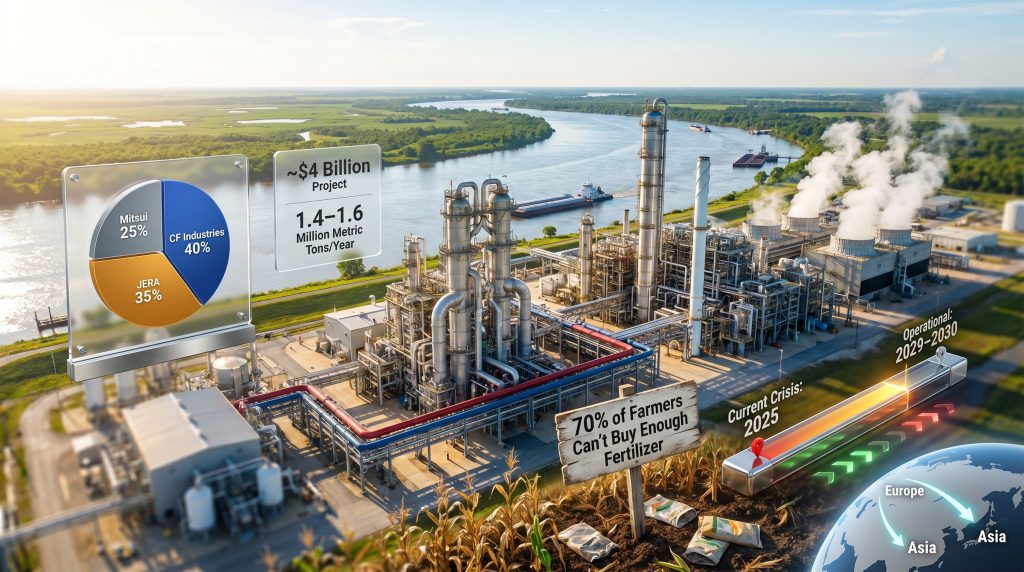
The Blue Point Complex is a proposed $4 billion low-carbon ammonia production facility situated in Ascension Parish, Louisiana, approximately 60 miles northwest of New Orleans. The project is structured as a three-party joint venture with ownership divided as follows:
| Partner | Ownership Stake | Primary Business |
|---|---|---|
| CF Industries | 40% | U.S. nitrogen fertilizer production |
| JERA | 35% | Japan's largest power generator |
| Mitsui | 25% | Japanese industrial conglomerate |
According to JERA's corporate disclosures, the facility is designed to become the largest single ammonia production facility in the world, with annual output projected between 1.4 and 1.6 million metric tons. The facility would operate within the broader RiverPlex MegaPark, a planned 17,000-acre industrial corridor that would also accommodate a steel plant, a gas-fired power facility, a second ammonia factory, and carbon dioxide pipeline infrastructure.
Critically, commercial operations are not anticipated until 2029 to 2030, a timeline that renders the plant structurally irrelevant to any near-term agricultural input crisis.
Blue Point by the Numbers
| Metric | Detail |
|---|---|
| Total Project Cost | ~$4 billion |
| Annual Production Capacity | 1.4 to 1.6 million metric tons |
| CO₂ Capture Target | ~2.3 million tonnes per year |
| Claimed Emissions Reduction | Over 95% of production CO₂ |
| Expected First Production | 2029 to 2030 |
| Wetlands Impact (Construction) | ~50 acres |
| Criteria Air Pollutants | Up to 926 tons per year |
| Hazardous Air Pollutants | ~342,000 pounds per year |
| Greenhouse Gas Emissions | Up to 467,000 tons per year |
The Official Narrative vs. What Corporate Filings Reveal
At a press conference held on May 19, 2026, Agriculture Secretary Brooke Rollins, Energy Secretary Chris Wright, and EPA Administrator Lee Zeldin collectively framed the accelerated permitting of the Blue Point Complex as a direct response to soaring fertiliser costs facing U.S. farmers. The messaging centred on nitrogen-based fertiliser production as a domestic agricultural necessity, with the permitting pace itself held up as evidence of decisive policy action.
Agriculture Secretary Rollins publicly celebrated the speed at which the U.S. Army Corps of Engineers wetlands permit was being processed, describing the accelerated timeline as a signature of the administration's approach to cutting regulatory delays. This accelerated permitting policy has become a recurring feature of the current administration's industrial strategy, applied across multiple sectors simultaneously.
What senior officials did not disclose is that a legally binding offtake structure embedded in the joint venture agreement contractually distributes ammonia output in proportion to each partner's ownership stake, meaning 60% of all production is already committed to JERA and Mitsui before a single ton is manufactured.
A CF Industries filing submitted to the U.S. Securities and Exchange Commission on May 7, 2026, states directly that all three partners are required to purchase ammonia from the Blue Point joint venture in accordance with their respective ownership percentages once production commences. The same filing confirms that JERA and Mitsui have committed their combined share of low-carbon ammonia volumes to power generation, steel production, and other industrial applications.
Mitsui's own press release states unambiguously that its share of the ammonia will be directed toward buyers in Europe, Asia, and other international markets, with no domestic agricultural designation referenced.
The Fertilizer Destination Problem: A Structured Comparison
| Claim Made Publicly | What Corporate Documents Show |
|---|---|
| Blue Point will supply domestic fertilizer markets | 60% of output contractually committed to JERA and Mitsui for industrial and export use |
| The project addresses the current price crisis | Operations won't begin until 2029 to 2030 |
| Permitting serves agricultural communities | The permit covers a multi-use industrial megapark |
| Blue Point is a net environmental benefit | Permit documents confirm substantial air pollutant and greenhouse gas releases |
| The plant will lower input costs for farmers | CF Industries' 40% share has no confirmed fertilizer-market designation |
What Actually Drove Fertilizer Prices Higher?
The fertiliser affordability crisis cited by federal officials did not originate from a domestic supply shortfall that new production capacity could resolve. Nitrogen fertiliser prices surged by as much as 40% following the disruption of the Strait of Hormuz beginning in late February 2026, when U.S. and Israeli military operations against Iran effectively closed one of the world's most critical maritime chokepoints.
The Strait of Hormuz is not merely a crude oil corridor. It is a central transit route for:
- Natural gas, the primary feedstock for ammonia synthesis and the dominant energy source powering the manufacturing process itself
- Finished fertilizer products, including urea and other nitrogen compounds exported from Gulf-region producers
- Liquefied natural gas (LNG) destined for European and Asian industrial markets, further compounding LNG supply pressures already affecting global energy markets
When the strait was effectively closed, both raw material costs and finished fertiliser prices spiked simultaneously. A Farm Bureau survey conducted during the height of the disruption found that 70% of U.S. farmers reported being unable to purchase the full volume of fertiliser their operations required. The practical consequence was a planting-season input crisis unfolding in real time.
Yet the administration's public communications made no reference to the geopolitical origin of the price disruption. Instead, a long-horizon industrial infrastructure project was presented as an actionable response to an acute, present-tense supply problem.
Notably, CF Industries reported a 20% revenue increase in its first-quarter earnings, a direct consequence of the same supply constraints the administration publicly cited as a crisis requiring intervention. The company financially benefiting most visibly from the fertiliser price spike is the same company whose project received high-profile permitting promotion as a relief measure.
How Low-Carbon Ammonia Actually Works, and Why It Commands Premium Pricing
The Chemistry and Commercial Logic of Blue Ammonia
Conventional ammonia production relies on the Haber-Bosch process, combining nitrogen extracted from the atmosphere with hydrogen derived from natural gas reforming. This process generates substantial CO₂ emissions at scale. Blue ammonia, by contrast, applies carbon capture and storage technology to intercept CO₂ before atmospheric release, with captured gas injected into geological storage formations.
Blue Point's developers target a 95%+ reduction in production emissions, capturing approximately 2.3 million tonnes of CO₂ annually. The commercial premium attached to low-carbon ammonia does not primarily come from agricultural buyers. It comes from:
- Clean energy supply chains — Ammonia functions as a practical hydrogen carrier. Hydrogen is converted into ammonia for long-distance maritime transport, then reconverted to hydrogen at the destination before combustion. Hydrogen combustion produces no greenhouse gas emissions.
- Japanese government certification — Both JERA and Mitsui have received formal designation from Japan's Ministry of Economy, Trade and Industry as certified suppliers of low-carbon hydrogen, signalling that their ammonia offtake serves national clean energy policy objectives, not agricultural input markets.
- Corporate carbon accounting — International buyers pay premium prices for low-carbon ammonia because it can be counted against national and corporate emissions reduction commitments.
Furthermore, the growing appetite for low-carbon industrial inputs is reshaping green transition supply chains across multiple sectors, with ammonia increasingly viewed as a foundational component rather than a niche commodity.
The Verification Gap in Blue Ammonia Claims
An important dimension of the Blue Point conversation that receives limited public attention is the absence of commercial-scale proof-of-concept for blue ammonia at this production magnitude. No facility of comparable size has yet demonstrated the promised emissions reduction performance across a full operational cycle.
Questions about the long-term geological integrity of CO₂ storage, methane leakage during natural gas extraction and processing, and comprehensive lifecycle emissions accounting remain open in the scientific literature. This matters because the environmental justification for the project, and the regulatory accommodations associated with it, rest heavily on emissions claims that have not been independently validated at the proposed scale.
The Modeste Community and Environmental Justice Dimensions
A Majority-Black Community in the Path of Industrial Expansion
The Blue Point Complex does not exist in geographic isolation. It is embedded within the proposed RiverPlex MegaPark footprint, a development plan that would require the displacement of Modeste, a majority-Black community of approximately 600 residents in Ascension Parish. Many Modeste families hold generational ties to the land extending back to the era of plantation slavery along the Mississippi River corridor between New Orleans and Baton Rouge.
The industrial buildout proposed for the surrounding area would introduce:
- Two large-scale ammonia production facilities
- A steel manufacturing plant
- A gas-fired power generation facility
- Carbon dioxide pipeline and injection infrastructure
Anne Rolfes, Director of the Louisiana Bucket Brigade, has publicly characterised the administration's conduct as undermining the foundational purpose of environmental review. Her position, as reported by Oil & Gas Watch, is that pre-committing to permit approval before an independent review concludes converts a protective legal mechanism into a procedural formality, stripping communities of the substantive protection environmental law is designed to provide.
What Permit Documents Confirm About Pollution Exposure
The facility's own permit documentation quantifies an emissions profile that contradicts any straightforward characterisation of the project as an environmental benefit:
- Criteria air pollutants forming smog and soot: up to 926 tons per year
- Hazardous air pollutants: approximately 342,000 pounds per year
- Greenhouse gas emissions: up to 467,000 tons per year, equivalent to the annual emissions of more than 94,000 passenger vehicles
- Wetlands and waterway impacts from construction: approximately 50 acres
These figures come from the company's own permit application submitted to the U.S. Army Corps of Engineers. In addition, concerns raised by local communities in Louisiana about cumulative air quality impacts have drawn increasing scrutiny from environmental justice advocates.
The next major ASX story will hit our subscribers first
The Structural Policy Gap: What Farmers Actually Need
The distinction between structural and symptomatic policy responses is critical when evaluating whether the Louisiana Blue Point ammonia plant fertilizer relief claims have any operational merit for agriculture.
Symptomatic response: Announce a long-horizon industrial infrastructure project as a near-term supply solution, generating favourable coverage while providing no material relief within the current or near-future growing seasons.
Structural response: Address the geopolitical and trade conditions generating the price volatility, including Strait of Hormuz access, natural gas feedstock costs, and domestic nitrogen production capacity with verified domestic market commitments.
A facility contractually structured to direct 60% of its output to overseas industrial buyers, with no confirmed fertiliser-market allocation even for the remaining 40%, and with a production start date of 2029 at the earliest, cannot function as an agricultural relief mechanism by any conventional economic logic.
The 70% of American farmers who told the Farm Bureau they could not afford their required fertiliser volumes needed solutions operating on a timescale measured in weeks and months, not years and decades. However, the broader trajectory of industrial ammonia demand — driven by green steel demand and zero-carbon steelmaking initiatives in Europe and Asia — suggests that low-carbon ammonia's commercial future lies firmly in industrial rather than agricultural markets.
Frequently Asked Questions
Will the Blue Point plant lower fertilizer prices for U.S. farmers?
Based on the contractual offtake structure documented in CF Industries' SEC filing, 60% of production is already committed to JERA and Mitsui for power generation, steel production, and export to international markets. The remaining 40% held by CF Industries has no confirmed domestic fertiliser-market designation. The plant is also not projected to begin operations until 2029 to 2030.
What caused the fertilizer price spike the administration cited?
Nitrogen fertiliser prices rose by up to 40% following disruption to the Strait of Hormuz beginning in late February 2026, a critical maritime transit route for both natural gas feedstocks and finished fertiliser products. The geopolitical origin of the price spike was not referenced in the administration's public communications about the Blue Point project.
Who are JERA and Mitsui, and what will they do with their ammonia?
JERA is Japan's largest power generator and a global energy company. Mitsui is a major Japanese industrial conglomerate. Both have received formal certification from Japan's trade ministry as suppliers of low-carbon hydrogen. Both have publicly committed their Blue Point ammonia volumes to power generation, steel manufacturing, and international export markets.
What are the environmental risks associated with Blue Point?
Permit documentation confirms the facility could emit up to 926 tons per year of smog-forming criteria air pollutants, approximately 342,000 pounds per year of hazardous air pollutants, and up to 467,000 tons per year of greenhouse gases. Construction would disturb roughly 50 acres of wetlands and waterways.
What is the Modeste community's situation?
Modeste is a majority-Black community of approximately 600 residents located within the proposed RiverPlex MegaPark footprint. The industrial development plan as currently structured would require the community's displacement.
Is blue ammonia actually low-carbon?
Developers claim over 95% emissions reduction through carbon capture and storage technology, targeting roughly 2.3 million tonnes of CO₂ captured annually. However, no commercial-scale facility of comparable size has independently validated these claims across a full operational cycle, and permit documents confirm the facility would still generate significant quantities of regulated air pollutants and greenhouse gases.
This article is based on publicly available corporate disclosures, SEC filings, permit applications, and press releases. It does not constitute financial, legal, or investment advice. Readers are encouraged to consult primary source documents when evaluating claims about specific industrial projects. Additional investigative reporting and facility permit data is available through Oil & Gas Watch at oilandgaswatch.org.
Want to Track the Real Investment Opportunities Emerging From the Clean Energy Transition?
Discovery Alert's proprietary Discovery IQ model delivers real-time alerts on significant ASX mineral discoveries tied to the commodities reshaping global industrial supply chains — from low-carbon ammonia feedstocks to the critical minerals underpinning green steel and hydrogen infrastructure. Explore how historic discoveries have generated substantial returns on Discovery Alert's dedicated discoveries page, and begin your 14-day free trial today to position yourself ahead of the market.