June 4, 2026
The Hidden Economics of Going Electric Underground
Few decisions carry more long-term financial consequence for a mining operation than how it moves ore. Haulage is not simply a logistics function. It is the central metabolic process of a mine, and the technology chosen to perform it shapes everything from capital allocation and labour structure to ventilation design and carbon liability. For most of the twentieth century, diesel was the unchallenged answer. Today, that assumption is being dismantled by a convergence of cost pressures, decarbonisation mandates, and a new generation of electric haulage technologies in mining that are mature enough to be commercially evaluated rather than simply admired from a distance.
The transition, however, is not clean or simple. It is not a story of one superior technology replacing another. It is a multi-pathway structural shift in which the optimal solution varies dramatically depending on how deep a mine goes, how much it produces, and how long it expects to operate. Understanding those variables is the starting point for any rigorous evaluation.
When big ASX news breaks, our subscribers know first
Why Diesel Is No Longer the Default Answer
The economics of diesel haulage have been deteriorating for years, and the pressure is now coming from multiple directions simultaneously. Fuel accounts for a disproportionate share of total mine energy expenditure, with underground diesel fleets responsible for a significant portion of direct Scope 1 emissions. As carbon compliance frameworks tighten across major mining jurisdictions, that emissions exposure is increasingly translating into financial liability.
Beyond the direct fuel cost, there is a capital cost that is frequently underappreciated in early-stage mine planning: ventilation. Diesel exhaust underground requires extensive ventilation infrastructure to manage particulate loads, toxic gases, and heat. The fans, ducting, shafts, and ongoing energy required to run adequate ventilation in a large diesel-dependent underground operation represent a substantial and recurring cost burden. When electrification eliminates exhaust at source, that ventilation requirement shrinks materially.
Broader mining electrification trends show that major mining companies including BHP, Rio Tinto, Newmont, and Teck have all committed to net-zero operational targets by 2050. Those commitments are not aspirational window-dressing at the corporate level. They are being operationalised through active piloting of large-scale battery-electric haul trucks and parallel expansion of trolley-assist infrastructure. The structural demand signal for electrified haulage alternatives is now firmly embedded in the capital planning cycles of the world's largest operators.
The Current State of Electric Haulage Deployment
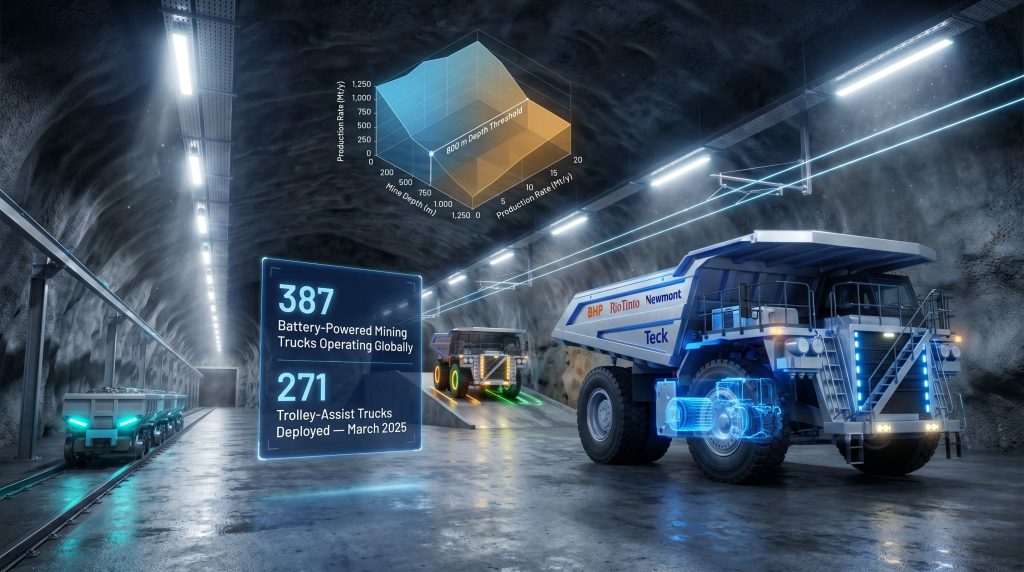
The global deployment picture as of early 2025 provides useful context for understanding where adoption actually stands. According to GlobalData's Development of Electric Vehicles in Surface and Underground Mining study, 387 battery-powered mining trucks were operating across global mining operations as of March 2025. A further 271 trolley-assist trucks were active across surface mining sites worldwide.
Those numbers reveal two important realities. First, trolley-assist represents the most mature large-scale electric haulage deployment currently in operation. Second, while battery-electric truck numbers are growing, large-scale BEV applications for primary haul duties remain predominantly in prototype or early-commercial phases. Adoption is accelerating, but the technology has not yet reached the operational maturity that would make it a routine default specification for new major underground developments.
The transition to electric haulage in mining is not a single-technology event. It is a multi-pathway structural shift that will play out differently across mine types, depths, and production profiles over the next two to three decades.
Breaking Down the Primary Electric Haulage Technologies
Battery-Electric Vehicles: Flexibility With Operational Constraints
BEV haul trucks eliminate direct exhaust emissions underground, reduce heat loads on ventilation systems, and operate at significantly lower noise levels than diesel equivalents. On decline hauls, regenerative braking recovers meaningful energy that partially offsets consumption on the loaded uphill cycle. Furthermore, advances in electric mining transport continue to push the boundaries of what battery-electric vehicles can achieve in demanding underground conditions.
The operational constraint that consistently appears in comparative studies is duty-cycle duration. Under continuous uphill haulage conditions, battery depletion can occur in approximately one hour. Under mixed duty cycles combining loaded uphill travel with unloaded downhill return and regenerative braking recovery, operational windows typically range from 2.5 to 4 hours per charge, according to data from Epiroc. Charging strategies being evaluated include onboard CCS charging, future megawatt-scale charging infrastructure, and battery swapping protocols designed to minimise fleet downtime.
The strongest commercial case for BEVs currently sits in:
- Shorter mine life operations where infrastructure-intensive alternatives cannot be fully amortised
- Shallower depths where cycle times remain manageable without excessive fleet multiplication
- Operations with frequently evolving ore zones that require haulage route flexibility
- Sites where lower upfront capital cost is a binding constraint on the investment decision
Trolley-Assist Systems: Proven Infrastructure for Surface Operations
Overhead catenary systems supply continuous electric power to trucks along primary ramp corridors, eliminating diesel combustion on the highest-energy segments of the haul cycle. With 271 units active globally, trolley-assist is the most commercially mature large-scale electric haulage solution available today.
The economic fit is most compelling in high-tonnage, long-life surface operations with stable and predictable haul routes. The infrastructure intensity that makes trolley-assist reliable is also what limits its flexibility. Route changes require substantial civil and electrical construction programs, making the system poorly suited to operations with dynamic mine plans.
Light Rail Hybrid Systems: The Infrastructure-Intensive Long-Game Solution
Electrified rail-based continuous haulage systems draw power directly from mine supply infrastructure rather than from onboard batteries, eliminating the discrete charging cycle entirely. Automated loading and unloading sequences reduce underground traffic interactions, and regenerative braking on descent cycles provides energy recovery.
The economic logic of these systems is explicitly long-term. High upfront infrastructure investment in track, drive stations, and automated controls becomes economically rational when amortised across 10 to 20 or more years of operation at a productive deep mine. Scaling production requires track extension and additional railcar deployment rather than proportional fleet multiplication, which creates a fundamentally different and more predictable long-term cost structure than a vehicle fleet.
Maintenance focus shifts from managing a large distributed mobile fleet to maintaining fixed rail and drive station assets. This is a different labour model, a different skill set requirement, and a structurally different cost progression over the mine life.
Autonomous Electric Haulage: Where Electrification Meets Automation
The integration of electric drivetrains with autonomous haulage systems represents a compounding opportunity. In addition to the emissions benefits, mining automation trends show that autonomous systems can optimise charging cycle scheduling, route sequencing, and fleet utilisation in ways that human-operated fleets cannot replicate at scale. Safety outcomes improve through reduced human exposure to hazardous underground environments. The combination is currently in advanced pilot and early-commercial deployment phases at select tier-one operations, with performance data beginning to accumulate.
For operators considering autonomous haul truck alternatives, the convergence of electric drivetrains and autonomous control systems is emerging as one of the most strategically significant developments in modern mine planning.
Wireless In-Motion Charging: A Speculative but Strategically Significant Concept
Wireless induction charging embedded within haul road surfaces remains at the research and concept stage, not yet commercially deployed at scale in mining. However, its strategic implications deserve serious attention. If continuous recharging during operation becomes feasible, it would fundamentally alter the battery sizing requirements for electric haulers, enabling the use of significantly smaller and lighter vehicles.
Those smaller vehicles could operate on narrower and steeper ramp geometries, which would reduce the volume of waste rock that must be stripped to maintain haul access. In open-pit operations, that represents a potential step-change in ore-to-waste economics that extends well beyond the haulage cost line alone.
The Three Variables That Determine System Selection
A comparative study conducted by Mining Plus, an Australia-based technical services consultancy, evaluated five haulage methods across a structured parameter matrix covering mine depths from 500 m to 1,250 m and production rates from 1 Mt/y to 20 Mt/y. The five systems evaluated were diesel trucks, BEVs, conveyors, shaft hoisting, and light rail hybrid systems. The findings were also covered in detail by International Mining, which reported on the trade-off analysis and its implications for mine planning decisions.
The core finding was direct: no single technology dominates across all operating scenarios. System selection is a function of the intersection between three site-specific parameters.
| Decision Variable | Why It Matters |
|---|---|
| Mine Depth | Deeper mines extend cycle times for BEVs and intensify charging frequency requirements; fixed-infrastructure systems maintain consistent throughput regardless of depth |
| Production Rate (Mt/y) | Higher throughput requirements amplify the cycle-dependency bottleneck of BEV fleets; continuous systems scale more efficiently |
| Life of Mine | Longer mine lives justify higher upfront infrastructure investment through extended amortisation periods |
Operators who default to BEVs purely on capital cost grounds or operational familiarity may be leaving significant long-term economic value on the table in deeper, longer-life operations.
Infrastructure Requirements: What Each System Actually Demands
BEV Fleet Infrastructure
Deploying a BEV fleet underground requires more than simply replacing diesel trucks with electric equivalents. Charging stations must be integrated into mine electrical distribution networks. Underground layouts must accommodate charging bay access, passing bays, and fleet circulation requirements. Drift dimensions and gradient specifications influence both vehicle selection and cycle time modelling.
As mine depth increases, charging frequency requirements intensify. Fleet size must scale upward to maintain production targets while vehicles are removed from active haulage for charging. This creates a partially self-defeating dynamic in deep high-volume operations: the deeper the mine goes, the more trucks you need, and the more infrastructure, dispatch capacity, and maintenance resources must expand proportionally.
Fixed-Infrastructure Systems
Light rail and trolley-assist systems carry high entry costs concentrated in track, electrical supply, drive stations, and automated control infrastructure. However, once installed, these systems draw power continuously from mine supply rather than from onboard energy storage. Production scaling is achieved through track extension and additional rolling stock rather than fleet multiplication. This creates a step-change cost structure rather than a linear one, which becomes increasingly advantageous at high production rates and long mine lives.
Ventilation: A Shared Benefit With Important Nuances
| Haulage System | Ventilation Benefit | Residual Requirement |
|---|---|---|
| BEV Trucks | Eliminates diesel exhaust, reduces particulate and heat load | Motor and battery heat still requires airflow management |
| Trolley-Assist | Eliminates diesel combustion on primary ramps | Residual diesel use on secondary routes may persist |
| Light Rail Hybrid | Fully eliminates diesel exhaust on rail corridors | Heat and particulates from ore handling still require management |
The next major ASX story will hit our subscribers first
Operational Bottlenecks: Where Each System Creates Friction
BEV fleet productivity is governed by a four-phase cycle: loading, travel, unloading, and charging. Each phase introduces potential delay, and delays compound across large fleets. Underground congestion and queuing risk increases proportionally with fleet size. Dispatch systems, operator teams, and maintenance resources must grow in parallel, creating a largely linear cost structure.
Continuous haulage systems eliminate cycle-based congestion by design. Automated sequences reduce human-traffic interactions underground. The friction points shift to infrastructure: route modifications and depth extensions require capital-intensive construction programs, making these systems less adaptable to rapid changes in mine plan or ore zone location.
| Cost Category | BEV Fleet | Light Rail Hybrid |
|---|---|---|
| Labour | Scales linearly with fleet size | Concentrated on fixed infrastructure teams |
| Maintenance Focus | Distributed across mobile assets (batteries, drivetrains, tyres) | Centralised on rails, drive stations, automated controls |
| Scalability Cost | Linear with each additional vehicle | Step-change with infrastructure additions serving multiple production increments |
How Mine Depth Changes the Economic Calculus
Shallow to Mid-Depth Operations (500 m to 800 m)
At these depths, BEV haul trucks compete strongly. Haul distances keep cycle times manageable, charging frequency requirements remain within operational tolerance, and the lower upfront capital cost of BEV fleets provides a genuine advantage. Operational flexibility supports mines with shorter planned lives or evolving ore body geometry. Consequently, renewable power for mines at these shallower depths can further reduce the total carbon footprint when paired with battery-electric haulage fleets.
Deep Operations (800 m to 1,250 m and Beyond)
Extended haul distances increase BEV cycle times and charging demands. Fleet size requirements grow to maintain production targets, compounding both capital costs and ongoing operating expenses. Fixed-infrastructure systems maintain consistent throughput independent of depth increases, and long amortisation periods become economically viable for mines with confirmed deep reserves.
As a general principle supported by the Mining Plus trade-off data, the total cost of ownership advantage of continuous haulage systems relative to BEV fleets tends to strengthen materially as mine depth exceeds approximately 800 m, particularly at production rates above 5 Mt/y.
The Technology Roadmap: What Comes Next
Battery energy density improvements will progressively extend BEV operating windows and reduce charging downtime. Megawatt-scale charging infrastructure, when it reaches mining-grade commercial availability, will further compress the duty-cycle constraint. Battery swapping systems offer a near-term bridge solution for operations that cannot tolerate extended charging intervals.
Autonomous integration will amplify the economic case for electric haulage technologies in mining across all system types. The ability to optimise charge scheduling, route sequencing, and fleet utilisation through software rather than human coordination will improve utilisation rates and reduce the labour cost premium associated with large underground fleets.
Tim Wiitanen, Vice-President of Product Engineering at Railveyor, has noted publicly that battery technology will continue advancing in ways that create progressively lower-carbon opportunities for shorter-life mining operations, while longer-life operations mining at depth are demonstrating compelling results with light rail hybrid approaches. That dual-track trajectory reflects the broader industry reality: multiple electrification pathways will coexist for the foreseeable future, with site-specific economics determining which approach delivers the strongest long-term return.
Frequently Asked Questions
What is the most widely deployed electric haulage technology in mining today?
Trolley-assist systems represent the most mature large-scale deployment, with 271 units active globally as of March 2025. Battery-electric trucks are growing in number, with 387 units operating worldwide, though large-scale primary haul applications remain largely in early-commercial or prototype phases.
Are battery-electric haul trucks suitable for deep underground mines?
BEVs are operationally viable underground and deliver meaningful ventilation benefits. However, at depths beyond approximately 800 m combined with high production rate requirements, the cycle-time and charging-frequency constraints of BEV fleets can make continuous fixed-infrastructure systems more economically competitive over the long term.
How long does a battery-electric haul truck last on a single charge in active mining?
Under continuous uphill haulage, battery depletion can occur in approximately one hour. Under mixed duty cycles with regenerative braking recovery on return runs, operational duration typically ranges from 2.5 to 4 hours per charge.
Which major miners are piloting electric haul trucks?
BHP, Rio Tinto, Newmont, and Teck are among the major operators actively running large-scale battery-electric haul truck pilots, with several simultaneously expanding trolley-assist system capacity.
Key Takeaways for Mine Planners and Operators
The evaluation of electric haulage technologies in mining cannot be reduced to a simple preference ranking. The optimal solution is a product of the specific intersection between depth, production rate, and mine life at each individual operation.
- BEVs offer the strongest case in shorter-life operations, shallower depths, and mines requiring adaptability to changing ore zones
- Fixed-infrastructure systems deliver superior long-term economics in deep, high-volume, long-life operations where capital costs can be amortised across decades
- Ventilation savings represent a material economic benefit of electrification that is frequently underweighted in initial comparative analyses
- Battery technology advancement will expand the competitive range of BEVs over time, but the pace of improvement relative to operational requirements at depth remains the critical uncertainty
- Autonomous integration will amplify the economic case for electric haulage across all system types by improving utilisation rates and restructuring labour costs
- Pit geometry redesign enabled by smaller autonomous electric haulers may deliver open-pit economic benefits that extend substantially beyond the haulage cost line alone
- No single pathway wins universally, and operators who commit prematurely to a single technology without rigorous site-specific trade-off analysis risk systematic misallocation of capital over multi-decade mine lives
Readers seeking additional industry perspectives on electric haulage technology developments can explore related editorial coverage at Global Mining Review, which publishes ongoing analysis of mining technology and operational innovation.
Want to Stay Ahead of the Next Major Mining Discovery?
Discovery Alert's proprietary Discovery IQ model delivers real-time alerts on significant ASX mineral discoveries — cutting through the complexity of 30-plus commodities to surface actionable opportunities the moment they're announced. Explore how historic mineral discoveries have generated substantial returns and begin your 14-day free trial today to position yourself ahead of the broader market.