June 13, 2026
How a Single Machine Unlocks Billions in Export Value: The Engineering Logic Behind Bulk Terminal Tipplers
Bulk commodity export infrastructure rarely attracts mainstream attention, yet the mechanical systems that sit at the junction of rail and ship represent some of the most throughput-critical engineering in global trade. At iron ore export terminals, no single piece of equipment exerts more influence over export volume than the rail car tippler. Understanding how this technology works, why it degrades over time, and what happens when it reaches end-of-life is essential context for appreciating the scale of what Transnet installs new tippler at Saldanha Iron Ore Terminal represents for South Africa's export economy.
When big ASX news breaks, our subscribers know first
What Is a Tippler and Why Does It Matter for Iron Ore Export Infrastructure?
The Mechanical Role of a Rail Car Tippler in Bulk Commodity Export Terminals
A rail car tippler is a rotary unloading device engineered to invert loaded ore wagons and discharge their contents into a receiving hopper positioned below the rail level. Unlike manual or grab-based unloading methods, a tippler rotates the entire wagon, typically by 160 to 180 degrees, allowing gravity to empty the contents rapidly and completely. The wagon is then returned to its upright position and continues along the rail circuit without any manual intervention or wagon uncoupling in most modern designs.
This rotary mechanism makes tipplers the preferred unloading technology for high-volume iron ore terminals worldwide. At a facility handling tens of millions of tonnes annually, the ability to process a fully loaded wagon in under three minutes is not a convenience — it is a throughput imperative. Every bottleneck at the tippler cascades backward along the entire rail corridor and forward into ship-loading schedules.
How Tippler Technology Determines Throughput Capacity at Port-Side Facilities
The throughput capacity of an iron ore terminal is ultimately constrained by the weakest link in its materials handling chain. In most configurations, the tippler sits at the beginning of that chain, feeding ore onto conveyors that carry material to stockyards and ultimately to ship loaders. If the tippler underperforms due to mechanical wear, aging hydraulics, or outdated control systems, every downstream element in the terminal operates below its designed capacity.
Modern tippler systems are designed to process between 4,000 and 8,000 tonnes per hour depending on wagon payload, wagon cycle frequency, and mechanical configuration. At an annualised level, a well-maintained tippler operating across multiple shifts can process volumes exceeding 20 million tonnes per year from a single unit, making it one of the highest-throughput pieces of equipment in the entire bulk export chain. For a broader iron ore market overview, the scale of this infrastructure becomes even more apparent.
Key Performance Metrics: Wagon Cycle Times, Unloading Rates, and Annual Tonnage Output
Industry benchmarks for rotary tippler performance include the following metrics that operators use to assess equipment health and throughput efficiency:
- Wagon cycle time: The elapsed time from wagon entry to exit, typically ranging from 2.5 to 4 minutes in high-capacity configurations
- Unloading rate: Measured in tonnes per hour, directly influenced by wagon payload weight and cycle frequency
- Availability factor: The percentage of scheduled operating hours during which the tippler is mechanically capable of operating, typically targeted at above 85% for modern units
- Annual throughput contribution: A function of availability, cycle time, and operating shift patterns
When aging tipplers fail to maintain these benchmarks, the capacity shortfall is not merely theoretical. At a terminal handling 96% of a nation's iron ore exports, a degraded tippler represents a direct constraint on the entire export economy of that commodity.
Saldanha Iron Ore Terminal: A Strategic Export Corridor Five Decades in the Making
From First Shipment to National Asset: The Terminal's 50-Year Operational Evolution
The Saldanha Iron Ore Terminal dispatched its inaugural shipment of iron ore in 1976, marking the beginning of what would become one of Africa's most significant bulk commodity export corridors. The terminal was developed in conjunction with the Sishen-Saldanha heavy-haul rail line, one of the longest dedicated iron ore rail corridors in the world, stretching approximately 861 kilometres from the Sishen mine in the Northern Cape to the deep-water port at Saldanha Bay on South Africa's West Coast.
Over five decades, the terminal evolved from a single-purpose export facility into a complex, multi-system operation. Its strategic positioning at Saldanha Bay, which offers naturally deep water capable of accommodating large bulk carriers known as Capesize vessels, gave the facility an inherent logistical advantage that cemented its role as South Africa's dominant iron ore export gateway.
Installed Capacity, Export Volumes, and South Africa's Iron Ore Dependency on Saldanha
Key Metric Callout:
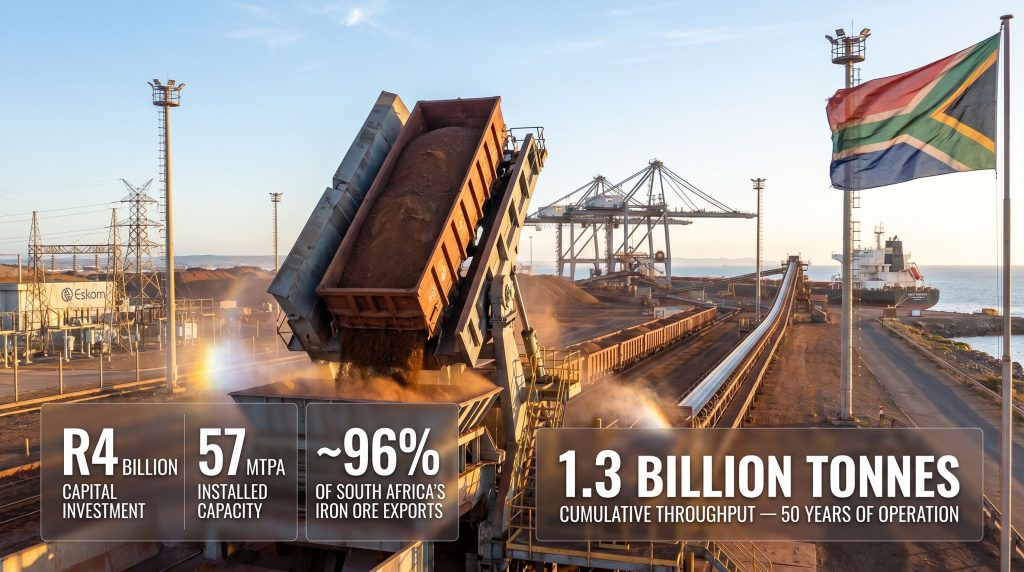
The Saldanha Iron Ore Terminal processes approximately 96% of South Africa's total iron ore exports, with cumulative throughput estimated at 1.3 billion tonnes across its five decades of operation. Installed terminal capacity stands at 57 million tonnes per annum, with a longer-term operational target of approximately 60 million tonnes per annum.
The concentration of South Africa's iron ore export capacity within a single terminal is a structural characteristic of the country's mining logistics architecture. The Sishen-Saldanha corridor was purpose-built as an integrated system, and the terminal at Saldanha Bay was engineered as the designated exit point for iron ore produced at Sishen. This integration creates both operational efficiency and systemic concentration risk.
When any major component within the terminal — particularly the tippler — experiences degradation or failure, there is no alternative export pathway capable of absorbing the volume shortfall. Consequently, iron ore demand prospects for South Africa remain closely tied to the operational continuity of this single facility.
South Africa is consistently among the world's top five iron ore exporters, and the Saldanha terminal is the physical mechanism through which the majority of that export volume reaches global steel markets. For steelmakers in Asia, Europe, and the Middle East who source South African iron ore, the operational reliability of this terminal directly influences their raw material supply chains.
Why Aging Tippler Infrastructure Posed a Systemic Risk to Export Continuity
Industrial rotating equipment operating continuously under high-load conditions has a finite mechanical lifespan. Heavy-haul rail tipplers at high-throughput terminals typically undergo major overhauls on 15 to 20-year cycles, with full replacement often required beyond that horizon if throughput demands have escalated beyond original design parameters.
As the Saldanha terminal's throughput ambitions approached and targeted 60 million tonnes per annum, aging tippler infrastructure became an increasingly significant constraint on the terminal's ability to perform at that level consistently. The decision to invest in a full replacement rather than continued maintenance of existing equipment reflects a strategic judgement that end-of-life infrastructure, regardless of maintenance input, cannot reliably support the throughput trajectory required for the terminal's next operational phase.
Inside the R4-Billion Capital Expansion: What Was Actually Built?
Breaking Down the Infrastructure Scope Beyond the Tippler Installation
While the tippler itself is the headline component of TPT's R4-billion investment at Saldanha, the full project scope reveals a systems-level infrastructure upgrade rather than a simple equipment swap. The tippler cannot function in isolation. Its integration into the terminal required a comprehensive suite of supporting infrastructure spanning power supply, materials handling, digital control, environmental management, and civil engineering.
| Infrastructure Component | Operational Function |
|---|---|
| New Tippler Unit | Rail wagon rotary unloading; primary throughput mechanism |
| 1.7 km Conveyor System | Ore transfer from tippler discharge to stockyard and ship loader |
| New Eskom Substation | Dedicated electrical supply to support expanded power demand |
| Heavy-Haul Rail Infrastructure | Supports increased wagon frequency and higher axle load capacity |
| Road Bridges | Site access, equipment movement, and logistics connectivity |
| Conveyor Tunnels | Protected transfer pathways minimising ore exposure and spillage |
| Gantry Cranes | Heavy lift capability for maintenance and component handling |
| Dust Management Systems | Particulate suppression for environmental compliance |
| High-Mast Lighting | Operational safety enabling continuous 24-hour shift capability |
| Fibre-Optic and Control Systems | Digital integration, remote monitoring, and real-time performance data |
The R4-billion capital deployment reflects the genuine complexity of commissioning heavy industrial port infrastructure, where no single component can be isolated from the systems surrounding it.
Why Systems Integration Defines a Successful Tippler Commissioning
A new tippler connected to aging conveyor infrastructure, inadequate power supply, or outdated control architecture cannot deliver its designed throughput performance. The value of TPT's decision to upgrade supporting systems in parallel with the tippler installation lies precisely in this integration logic. The 1.7-kilometre conveyor system, the new Eskom substation, and the fibre-optic control network collectively ensure that the tippler's mechanical output can be matched and sustained by every downstream element it feeds.
The Role of Control System Architecture in Modern Bulk Terminal Operations
Modern bulk terminal control systems perform functions that go well beyond simple machinery activation. Fibre-optic integrated control architecture enables real-time monitoring of equipment performance parameters, predictive maintenance triggering based on vibration and load data, automated throughput optimisation across the conveyor network, and remote operational management. At a facility targeting 60 million tonnes per annum, control system quality is not an ancillary concern — it is a core determinant of whether the terminal's physical capacity is consistently realised in practice.
How Does the New Tippler Fit Into Transnet's Broader Reinvent for Growth Strategy?
Asset Replacement vs. Greenfield Expansion: Understanding Transnet's Capital Allocation Logic
Transnet's Reinvent for Growth strategy frames capital deployment around two interconnected objectives: restoring capacity headroom that has been eroded by equipment aging, and establishing the operational foundations necessary for future volume growth. These are distinct but complementary goals that explain why the Saldanha tippler investment carries significance beyond its immediate throughput impact.
A greenfield terminal expansion would require years of environmental permitting, land acquisition, civil construction, and equipment procurement. By contrast, investing in a purpose-built replacement tippler and integrated systems upgrade at an existing facility delivers throughput gains on a compressed timeline while leveraging the existing rail corridor, port infrastructure, and operational expertise already embedded at Saldanha. Furthermore, understanding the global iron ore market impact of such investments helps contextualise why Transnet prioritises this approach.
Aging Infrastructure Replacement as a Throughput Risk Management Tool
Strategic Insight:
Capital programmes of this scale at state-owned port operators typically reflect a dual mandate: restoring lost capacity headroom caused by equipment degradation, and creating the operational foundation for future volume growth. At Saldanha, the tippler installation addresses both simultaneously.
Beyond the growth dimension, there is a risk management dimension to this investment that deserves explicit recognition. Aging bulk handling equipment does not fail on a predictable schedule. Unplanned tippler failures at a terminal handling 96% of national iron ore exports would generate immediate and severe economic consequences, including delayed vessel departures, contractual penalties, disrupted mining production schedules, and potential long-term damage to South Africa's reputation as a reliable iron ore supplier.
What the R4-Billion Saldanha Investment Signals About Port Terminal Priorities
The decision to commit R4 billion to a single terminal upgrade signals that Transnet regards Saldanha not merely as an existing asset requiring maintenance, but as a strategic export corridor warranting substantial forward investment. This framing matters for understanding how the facility is positioned within the broader iron ore export chain and what throughput ambitions are attached to its operational future. In addition, the iron ore tariff impacts of shifting global trade conditions make reliable export infrastructure all the more critical.
What Are the Environmental Engineering Dimensions of the Saldanha Expansion?
Iron Ore Dust as an Operational and Regulatory Challenge at Coastal Export Terminals
Iron ore dust generation is an inherent consequence of bulk handling at export terminals. During wagon tipping, conveyor transfer, stockpiling, and ship loading operations, fine particulate matter becomes airborne and can travel considerable distances from its source. At coastal facilities like Saldanha Bay, prevailing onshore and offshore wind patterns can carry iron ore dust into surrounding residential and ecological zones, creating regulatory obligations and community relations challenges that terminal operators must manage continuously.
The reddish-brown iron oxide particulate characteristic of iron ore dust is not merely an aesthetic problem. Fine particulate deposition can affect vegetation, water quality, and in sufficient concentrations, human respiratory health. South African environmental regulations governing dust emissions at industrial facilities require operators to monitor particulate levels and maintain them within prescribed thresholds.
How Dust Suppression Systems Are Engineered Into Modern Bulk Handling Infrastructure
Modern dust management systems deployed at bulk terminal tipplers and conveyor transfer points typically employ a combination of the following approaches:
- Enclosed transfer chutes that contain ore during conveyor-to-conveyor transitions and minimise drop heights that generate airborne dust
- Water mist suppression systems positioned at tippler discharge points, applying fine water droplets that cause dust particles to agglomerate and settle
- Wind barrier infrastructure consisting of perimeter screens or vegetative buffers that reduce the velocity of prevailing winds across stockyard surfaces
- Negative pressure enclosures around high-intensity dust generation points, drawing dusty air through filtration systems before release
- Real-time particulate monitoring using atmospheric sensors networked into the terminal control system, enabling immediate operational response when dust levels approach regulatory thresholds
Environmental Mitigation as a Compliance and Community Relations Imperative
The explicit inclusion of dust management systems within the R4-billion project scope signals that environmental mitigation was treated as an integral design requirement rather than an afterthought. For a terminal operating in proximity to coastal communities and ecologically sensitive zones, the ability to demonstrate active environmental management is increasingly important both for regulatory compliance and for maintaining the social licence to operate at the throughput volumes the terminal targets.
The next major ASX story will hit our subscribers first
Commissioning Timeline and Operational Handover: What Happens Between Installation and Full Production?
The Testing and Commissioning Process for Heavy Industrial Port Equipment
Commissioning heavy industrial equipment at a bulk export terminal is a multi-phase process that bridges the gap between mechanical completion and full operational handover. It cannot be rushed without creating significant reliability and safety risks. The commissioning sequence for a new tippler at a terminal of Saldanha's scale typically progresses through several distinct phases, from dry mechanical testing through to fully loaded operational trials under realistic throughput conditions.
Key Milestones: From June 2026 Testing to Projected September 2026 Handover
Timeline Snapshot:
- June 3, 2026 — Testing and commissioning activities initiated
- August 2026 (estimated) — Commissioning phase conclusion
- September 2026 (projected) — Formal handover to terminal operations team
The commissioning period serves several critical functions that cannot be replicated during the construction phase. Engineers verify that all mechanical, electrical, hydraulic, and control system components perform to specification under actual operating loads. Integration testing confirms that the new tippler's discharge rate is matched by the downstream conveyor capacity. Safety systems including emergency stops, load limiters, and anti-collision controls are tested under simulated fault conditions before operational personnel assume responsibility for the equipment.
Why a Two-Month Commissioning Window Is Standard for Complex Tippler Integrations
A two-month commissioning window for a new tippler installation of this complexity reflects established engineering practice in heavy industrial port infrastructure. The timeframe accommodates sequential testing phases, allows for mechanical adjustment and parameter tuning following initial test runs, provides time to train operational and maintenance personnel on new control systems, and builds in contingency for any integration issues that emerge only under actual operating conditions. Compressing this timeline increases the probability of reliability failures during early operations, which in a terminal of this strategic importance carries costs far exceeding any time savings.
What Does 45% Local Content Achievement Mean for South African Industrial Capacity?
Unpacking Local Content Metrics in Major State Infrastructure Projects
The achievement of approximately 45% local content across the various work packages of the Saldanha tippler project represents a meaningful contribution to South Africa's domestic industrial supply chain. Local content metrics in infrastructure projects of this nature typically measure the proportion of total project expenditure directed toward goods, services, and labour sourced within the country, as distinguished from imported equipment, foreign engineering expertise, and offshore procurement.
For a project of this technical complexity, achieving 45% local content requires deliberate procurement strategy. Rotary tipplers of the scale required for a 57-million-tonne-per-annum terminal involve specialised heavy engineering that may not be fully available within the domestic supply base. The local content achievement therefore likely reflects a combination of civil construction, fabricated steel components, electrical installation, project management services, and skilled and semi-skilled labour that could be sourced domestically.
How the Saldanha Expansion Supported Approximately 1,500 Peak Construction Jobs
The creation of approximately 1,500 jobs during peak construction activity represents a direct employment contribution that extended across multiple trade and professional categories. Large-scale infrastructure projects of this nature typically require civil engineers, structural steel fabricators, electrical technicians, instrumentation specialists, environmental compliance officers, project managers, safety officers, and general construction labour, many of whom are sourced from regional labour markets.
The peak employment figure also underscores a lesser-appreciated characteristic of major port infrastructure investment: the concentration of employment intensity during construction phases, followed by a transition to a smaller but ongoing operational workforce once the facility enters service.
Local Procurement as a Policy Instrument in South Africa's Mining Infrastructure Pipeline
South Africa's Broad-Based Black Economic Empowerment framework and associated preferential procurement regulations create structural incentives for state-owned enterprises to prioritise local sourcing in capital projects. For a project like the Saldanha tippler installation, demonstrating meaningful local content achievement serves both policy compliance purposes and contributes to the broader industrial development narrative that justifies large public infrastructure expenditure.
How Does Saldanha's Expansion Affect South Africa's Iron Ore Export Value Chain?
The Upstream Connection: How Port Throughput Capacity Influences Mining Output Decisions
The relationship between port throughput capacity and upstream mining production is more direct than it might initially appear. Mining operations at Sishen and associated iron ore deposits along the Northern Cape corridor plan their production schedules, ore blending strategies, and capital investment cycles in part around their confidence in the export chain's ability to handle planned volumes.
When terminal throughput is constrained by aging infrastructure, mines either accept lower production rates or accumulate stockpiles that carry their own cost and quality management challenges. A terminal upgrade that demonstrably increases reliable throughput capacity provides upstream producers with greater confidence to invest in their own production expansion. However, China steel and iron ore market dynamics also play a significant role in shaping those upstream investment decisions.
Rail-Port Coordination: The Sishen-Saldanha Iron Ore Corridor as an Integrated Export System
The Sishen-Saldanha corridor functions as a single integrated system despite spanning nearly 900 kilometres. Train frequency, wagon payload, locomotive availability, and terminal unloading capacity must all be coordinated to prevent bottlenecks at any point along the chain. The new tippler's heavy-haul rail infrastructure component is particularly noteworthy in this context. By upgrading the rail infrastructure at the terminal end of the corridor to support increased wagon frequency and higher axle loads, the project contributes to the overall throughput capacity of the entire system, not merely the terminal itself. For further context on port expansion for iron ore demand, historical analyses of Saldanha's development illustrate just how long-range this planning horizon has been.
Downstream Implications for Steel-Producing Nations Dependent on South African Iron Ore
South African iron ore, primarily sourced from the high-grade Sishen deposit, is valued by international steelmakers for its iron content and relatively low impurity profile. Nations with blast furnace steelmaking capacity in Asia and Europe that include South African iron ore in their raw material mix benefit when the Saldanha terminal operates reliably and at high throughput. For these buyers, the commissioning of a new tippler and associated infrastructure at Saldanha represents a positive development for supply chain reliability, reducing the risk of volume shortfalls during periods of high demand.
Frequently Asked Questions: Transnet's Saldanha Iron Ore Terminal Tippler Upgrade
What is a tippler and how does it work at an iron ore terminal?
A tippler is a rotary unloading machine that inverts loaded rail wagons, typically rotating them between 160 and 180 degrees, to discharge their iron ore contents into a receiving hopper. The ore then flows onto a conveyor system that carries it to stockyards or directly to ship loading equipment. The tippler allows rapid wagon turnaround without manual unloading or wagon uncoupling in modern designs.
What is the total capital investment in the Saldanha Iron Ore Terminal expansion?
Transnet Port Terminals committed R4 billion to this infrastructure expansion, encompassing the new tippler, 1.7-kilometre conveyor system, Eskom substation, heavy-haul rail infrastructure, and a comprehensive suite of supporting civil, electrical, and environmental systems.
When will the new tippler at Saldanha be fully operational?
Testing and commissioning commenced on June 3, 2026. The commissioning phase is expected to conclude by approximately August 2026, with formal handover to terminal operations projected for September 2026.
How much of South Africa's iron ore exports pass through the Saldanha terminal?
The Saldanha Iron Ore Terminal handles approximately 96% of South Africa's total iron ore exports, making it the overwhelmingly dominant exit point for the country's iron ore production.
What environmental measures are included in the Saldanha expansion project?
The project incorporates dedicated dust management systems and environmental mitigation measures specifically designed to control iron ore particulate emissions during unloading, conveyor transfer, and stockyard operations. These systems form part of the terminal's ongoing environmental management programme.
How does this project align with Transnet's national infrastructure strategy?
The Saldanha expansion forms part of Transnet's Reinvent for Growth strategy, which prioritises the replacement of aging equipment and infrastructure across port terminal facilities to restore capacity headroom and enable future export volume growth.
Key Takeaways: Saldanha Iron Ore Terminal Tippler Installation at a Glance
| Metric | Detail |
|---|---|
| Total Capital Investment | R4 billion |
| Local Content Contribution | ~45% across work packages |
| Peak Construction Employment | ~1,500 jobs |
| Commissioning Start Date | June 3, 2026 |
| Projected Operational Handover | September 2026 |
| Terminal Share of SA Iron Ore Exports | ~96% |
| Cumulative Historical Throughput | ~1.3 billion tonnes |
| Installed Terminal Capacity | 57 million tonnes per annum |
| Long-Term Throughput Target | ~60 million tonnes per annum |
| Terminal Operating History | Since 1976 (50 years) |
This article contains forward-looking statements regarding commissioning timelines, throughput targets, and operational handover dates. These projections are based on information published by Transnet Port Terminals and reported by Mining Weekly as of June 2026. Actual outcomes may vary. Nothing in this article constitutes financial or investment advice. Readers should conduct independent research before making investment decisions related to companies or commodities discussed herein.
Further Exploration:
Readers seeking additional context on South Africa's iron ore export infrastructure and port terminal operations may find value in exploring publicly available reporting from Mining Weekly at miningweekly.com, which covers ongoing developments across South Africa's bulk commodity export corridors.
Want to Invest in the Next Major Mineral Discovery Before the Broader Market Catches On?
Discovery Alert's proprietary Discovery IQ model delivers real-time alerts on significant ASX mineral discoveries, transforming complex mineral data into clear, actionable insights for investors at every level — explore the historic returns major discoveries have generated to understand the opportunity, then begin your 14-day free trial at Discovery Alert to position yourself ahead of the market.