June 13, 2026
The Infrastructure Race Behind Zero-Carbon Shipping Fuels
The global shipping industry moves roughly 80% of world trade by volume, yet it remains one of the most difficult sectors to decarbonise. Unlike road transport, where battery technology has made rapid inroads, long-haul maritime freight demands energy carriers with extremely high energy density, safe storability over extended voyages, and the ability to be bunkered at ports across multiple continents. This constraint has forced the industry toward a narrow shortlist of next-generation fuel candidates, and green ammonia has emerged as one of the most technically credible options on that list.
Understanding why requires looking at the chemistry first. Ammonia (NH₃) contains no carbon atoms whatsoever, meaning its combustion produces no carbon dioxide. When manufactured using renewable electricity to produce green hydrogen through electrolysis, then combining that hydrogen with nitrogen extracted from the atmosphere via the Haber-Bosch process, the result is a fuel with near-zero lifecycle emissions. It can be stored as a liquid at relatively modest pressures compared to hydrogen, and a vast global ammonia logistics network already exists, having been built over decades to serve the fertiliser industry.
It is within this context that the AM Green VOC Port green ammonia hub in Tuticorin takes on significance that extends well beyond a single port development announcement. Furthermore, the project speaks directly to the broader need for critical minerals for the energy transition and the infrastructure required to support them.
When big ASX news breaks, our subscribers know first
A Partnership Built on Complementary Strengths
AM Green and V.O. Chidambaranar Port Authority (VOCPA) formalised a memorandum of understanding to develop VOC Port in Tuticorin as an integrated green ammonia production, storage, and bunkering hub. The agreement is not simply a letter of intent between two parties exploring a concept; it combines AM Green's large-scale green ammonia production capabilities with a port that already has hands-on experience handling liquid ammonia and carries a government designation as a National Green Hydrogen Hub.
This combination of industrial capability and existing infrastructure is what separates this partnership from many green hydrogen announcements that remain conceptual. VOC Port has decades of operational history with liquid ammonia, meaning the safety systems, handling protocols, and storage knowledge required for green ammonia operations are not being invented from scratch. That baseline lowers both the technical risk and the capital cost associated with early-stage bunkering operations.
The AM Green VOC Port green ammonia hub in Tuticorin will pursue development across several interconnected layers:
- Bunkering infrastructure capable of supplying green ammonia directly to visiting vessels
- Production capacity of 1 million tonnes per annum (MTPA) at a facility planned near the port
- Renewable energy assets to supply the electrolysis-based production process
- Pilot operations to validate safety protocols and operational procedures before full commercial rollout
Breaking Down the Capital Architecture
The investment structure behind this project is layered in a way that reveals how large-scale green energy infrastructure actually gets financed in practice. Rather than a single capital commitment, the project is assembled across distinct components with different risk profiles and timelines.
| Project Component | Estimated Investment | Target Timeline |
|---|---|---|
| Green ammonia bunkering hub (Phase 1) | ₹2,000 crore | By 2029-30 |
| Green ammonia production facility (1 MTPA) | ₹15,000 crore | To be confirmed |
| Renewable energy generation complex | ~₹35,000 crore | To be confirmed |
| Bunkering capacity expansion (500 KTPA) | Subject to market demand | By 2035 |
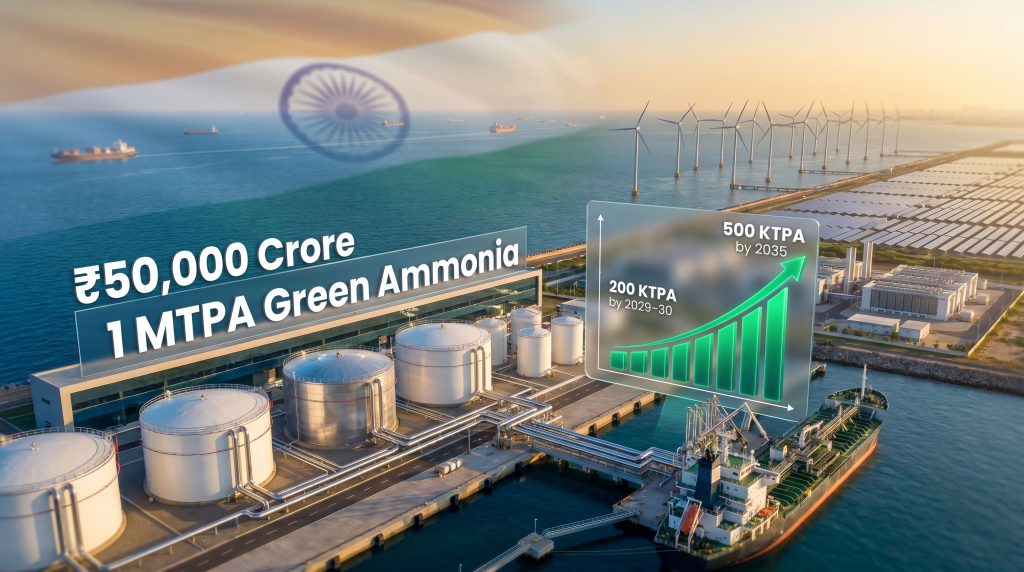
The ₹2,000 crore bunkering hub represents the commercial entry point, targeting up to 200 KTPA of bunkering capacity by 2029-30. This is the infrastructure that directly interfaces with shipping customers and generates early revenue. The ₹15,000 crore production facility is the upstream anchor that supplies the bunkering operation with domestically produced green ammonia, reducing exposure to import price volatility. The renewable energy layer, at approximately ₹35,000 crore, is the upstream upstream, supplying the clean electricity without which the entire production chain cannot function.
The total potential investment footprint across all three layers could exceed ₹50,000 crore, making this one of the largest individual clean energy infrastructure commitments associated with any single Indian port development.
Importantly, AM Green has indicated that a significant portion of the land required for the production facility has already been secured. In large-scale industrial projects, land acquisition is frequently the most time-consuming and politically complex stage. Progress on this front suggests the project has advanced beyond preliminary planning into active site development.
Why Tuticorin Holds a Structural Advantage
Not every port can anchor a green ammonia bunkering business. The requirements are exacting: proximity to major shipping lanes, existing liquid chemical handling capability, access to abundant renewable energy solutions in the surrounding region, and a regulatory environment that supports rapid infrastructure permitting.
Tuticorin satisfies each of these criteria in a way that few Indian ports can match simultaneously.
Geographically, VOC Port sits on India's south-eastern coastline at a point where East-West shipping corridors connecting the Indian Ocean, Southeast Asia, the Persian Gulf, and Europe converge. Vessels transiting between Asia and Europe pass through waters where VOC Port is a practical deviation stop, meaning bunkering demand from international shipping is not theoretical; it follows from the port's physical location.
Operationally, VOC Port has long functioned as a cornerstone of India's conventional ammonia supply chain. This history translates into trained workforce, tested safety procedures, and infrastructure that can be adapted rather than built entirely from zero. That distinction matters enormously in project timelines. Greenfield ammonia terminals at ports without this history face regulatory scrutiny and public concern that can add years to development schedules.
The comparison against other potential Indian green ammonia hubs illustrates the point:
| Factor | VOC Port (Tuticorin) | Other Indian Port Hubs |
|---|---|---|
| Government designation | National Green Hydrogen Hub | Varies by port |
| Existing ammonia handling | Yes | Limited in most cases |
| International shipping access | High (south-eastern coast) | Moderate to high |
| Anchor industrial partner | AM Green (1 MTPA facility) | Varies |
| Bunkering timeline | 2029-30 (Phase 1) | Early-stage planning |
The Bunkering Equation: Demand, Supply, and the Chicken-and-Egg Problem
One of the least-discussed but most consequential challenges facing the green maritime fuel sector is a structural coordination problem. Shipping companies will not order ammonia-capable vessels in large numbers without confidence that bunkering infrastructure exists at major ports. Port operators will not invest in bunkering infrastructure without confidence that sufficient ammonia-capable vessels will call at their facilities. Neither side wants to move first.
The way this problem gets resolved historically is through anchor commitments from large players who are willing to absorb early-stage risk in exchange for first-mover positioning. The AM Green-VOCPA partnership functions precisely as this kind of anchor commitment. By targeting 200 KTPA of bunkering capacity by 2029-30, the partnership signals to vessel operators that Tuticorin will have fuel available, which in turn influences their fleet investment decisions.
The International Maritime Organization's revised strategy targets net-zero greenhouse gas emissions from international shipping by or around 2050, with indicative checkpoints along the way. This regulatory trajectory makes the 2029-30 target for Tuticorin bunkering operations strategically timed relative to the period when fleet operators will face increasing commercial pressure to demonstrate decarbonisation progress.
The phased expansion plan adds further commercial logic. The move from 200 KTPA to 500 KTPA by 2035, contingent on market adoption rates, avoids overbuilding infrastructure ahead of demand while preserving the option to scale rapidly if the market develops faster than expected. This approach mirrors how LNG bunkering infrastructure was rolled out globally in the 2010s, albeit on a compressed timeline given the regulatory urgency.
AM Green's National Strategy and What Tuticorin Represents Within It
The Tuticorin project does not exist in isolation. AM Green has articulated a pan-India ambition to develop more than 4 MTPA of green ammonia production capacity across multiple Indian locations by 2030. The Tuticorin facility, at 1 MTPA, accounts for one quarter of that total target and carries a distinct functional role within the broader portfolio.
The comparison with AM Green's Kakinada project illustrates how different sites serve different market functions:
| Metric | Tuticorin Project | Kakinada Project |
|---|---|---|
| Planned production capacity | 1.0 MTPA | To be confirmed |
| Primary function | Production and bunkering | Production and export |
| Port partner | VOCPA | Kakinada Port |
| Key differentiator | Marine fuel bunkering focus | Export-oriented |
| Investment scale | ₹15,000 crore + ₹2,000 crore | To be confirmed |
This multi-site architecture is significant from a commercial resilience standpoint. Projects with both domestic bunkering demand and export revenue streams are less exposed to any single market's pricing dynamics or regulatory changes. If European import demand for green ammonia softens due to policy shifts, a bunkering-focused facility like Tuticorin continues to generate revenue from passing vessel traffic. Consequently, export-oriented production provides an alternative revenue path if domestic shipping decarbonisation progresses more slowly than anticipated.
The next major ASX story will hit our subscribers first
Tamil Nadu's Renewable Energy Profile and the Production Feasibility Question
The ₹35,000 crore renewable energy layer in the Tuticorin project investment structure deserves closer examination. Green ammonia production at 1 MTPA scale requires enormous quantities of clean electricity. The electrolysis process to produce green hydrogen, which is then synthesised into ammonia, is energy-intensive by design. The viability of producing green ammonia at competitive costs therefore depends critically on access to low-cost renewable electricity at scale.
Tamil Nadu is one of India's leading states for both solar and wind energy development. The state's coastline and inland regions offer strong capacity factors for both technologies, and Tamil Nadu has consistently ranked among the top states in India for installed renewable energy capacity. This resource base directly underpins the decarbonisation economics of siting a large-scale green hydrogen and ammonia complex in the Tuticorin region.
Several additional factors strengthen the production feasibility case:
- Tamil Nadu's existing grid infrastructure supports large renewable energy connections
- The state has established policy frameworks encouraging clean energy industrial development
- Proximity to the port eliminates the need for long-distance green ammonia pipeline transport
- Co-located solar and wind generation can smooth capacity factor variability, improving electrolyser utilisation rates
Higher electrolyser utilisation rates translate directly into lower per-unit production costs, which is one of the central levers determining whether green ammonia can compete on price with conventional grey ammonia in bunkering markets.
The Competitive Landscape India Must Navigate
India's ambition to become a major green ammonia exporter places it in direct competition with several well-resourced national programmes. Australia is advancing multiple large-scale green hydrogen and ammonia projects targeting Asian export markets. Saudi Arabia and Oman are leveraging their access to vast solar resources and existing chemical export infrastructure to develop green ammonia at competitive costs. Chile and Namibia are also positioning themselves as potential Southern Hemisphere suppliers.
India's competitive advantages are genuine but require execution:
- Cost of renewable electricity in high-irradiance Indian states is among the lowest in the world
- Existing chemical manufacturing expertise provides a skilled workforce and supply chain base
- Strategic coastal geography offers natural bunkering positioning on major East-West trade routes
- Domestic demand from Indian coastal shipping and industry provides a revenue floor independent of export market conditions
India's National Green Hydrogen Mission has set a target of producing 5 million tonnes of green hydrogen annually by 2030. Green ammonia, which is essentially green hydrogen in a more easily transported chemical form, serves as the primary vehicle through which this production target gets monetised in export markets. Furthermore, the raw materials for the green transition underpin every aspect of this production chain, from electrolyser components to storage vessels. Each MTPA of green ammonia production exports roughly 0.18 MTPA of embedded green hydrogen, meaning large-scale ammonia facilities are among the most efficient mechanisms for translating domestic renewable energy capacity into traded clean energy commodities.
Safety, Toxicity, and the Operational Realities of Ammonia Bunkering
One aspect of green ammonia's maritime fuel potential that receives insufficient attention in most commercial analyses is the safety and toxicity profile of ammonia as a handled substance. Unlike LNG, which poses primary risks through flammability and cold burn, ammonia is acutely toxic at low concentrations and requires specialised personnel protective equipment, leak detection systems, and emergency response protocols.
Port operators, shipping companies, and maritime regulators are all aware of this, and the industry is actively developing the operational frameworks needed to manage ammonia bunkering safely at commercial scale. VOC Port's existing experience handling conventional liquid ammonia provides a meaningful head start on this process. Port workers and logistics personnel already familiar with ammonia hazard management represent a training and safety advantage that newer ammonia bunkering entrants will need years to replicate.
The development of pilot bunkering operations as part of the AM Green-VOCPA partnership serves a dual purpose. It validates commercial logistics, but equally important, it generates operational safety data and trains personnel under controlled conditions before full commercial volumes create higher-risk scenarios. This measured approach to the clean energy transition reflects the broader challenge of scaling novel fuel infrastructure responsibly.
Frequently Asked Questions: AM Green VOC Port Green Ammonia Hub
What is the AM Green VOC Port green ammonia hub in Tuticorin?
It is a strategic infrastructure partnership between AM Green and V.O. Chidambaranar Port Authority to develop VOC Port as an integrated green ammonia production, storage, and marine bunkering hub. The project is anchored by a proposed 1 MTPA production facility and targets up to 200 KTPA of bunkering capacity by 2029-30.
How much will the Tuticorin green ammonia project cost in total?
The bunkering hub carries an estimated investment of ₹2,000 crore, the production facility is estimated at ₹15,000 crore, and the renewable energy infrastructure required to power the complex could involve approximately ₹35,000 crore in additional investment, bringing the potential total above ₹50,000 crore.
When will the green ammonia bunkering hub at Tuticorin be operational?
AM Green is targeting up to 200 KTPA of bunkering capacity at VOC Port by 2029-30, with a potential expansion to 500 KTPA by 2035, subject to market conditions and marine fuel adoption rates.
Why was Tuticorin selected for India's green ammonia bunkering hub?
VOC Port's south-eastern coastal location provides direct access to international shipping lanes, the port holds a National Green Hydrogen Hub designation, and it possesses existing liquid ammonia handling infrastructure and operational experience that most other Indian ports lack. In addition, recent reporting confirms the port's strategic positioning as a key node in India's maritime decarbonisation agenda.
What is AM Green's total green ammonia production target for India?
AM Green has set a target of developing more than 4 MTPA of green ammonia production capacity across multiple Indian locations by 2030, with the Tuticorin facility representing 1 MTPA of that total.
How does green ammonia function as a marine fuel?
Green ammonia can be combusted directly in ammonia-compatible marine engines producing no carbon dioxide, or cracked back into hydrogen for fuel cell applications onboard vessels. Its existing global logistics infrastructure and liquid storage characteristics at moderate pressures give it practical advantages over compressed hydrogen for long-haul maritime use.
Key Takeaways: What the AM Green-VOC Port Partnership Signals
The AM Green VOC Port green ammonia hub in Tuticorin represents a convergence of commercial intent, infrastructure readiness, and policy alignment that distinguishes it from many clean energy announcements that stall at the concept stage.
- Scale: A combined investment footprint potentially exceeding ₹50,000 crore across production, bunkering, and renewable energy infrastructure
- Timeline: Bunkering operations targeted by 2029-30, with expansion to 500 KTPA assessed for 2035
- Execution progress: A significant portion of land for the production facility has already been secured
- Market positioning: First-mover bunkering positioning on critical East-West shipping corridors
- Commercial model: Domestic bunkering demand combined with export-oriented production creates a diversified and more resilient revenue structure
- Safety foundation: Existing ammonia handling expertise at VOC Port reduces operational risk relative to greenfield bunkering entrants
Disclaimer: This article contains forward-looking statements and projections relating to investment plans, production targets, and market timelines. These are subject to regulatory approvals, market conditions, financing outcomes, and other factors that may cause actual results to differ materially from those described. Nothing in this article constitutes financial or investment advice.
Want to Track the Critical Minerals Powering the Green Energy Revolution?
Discovery Alert's proprietary Discovery IQ model delivers real-time alerts on significant ASX mineral discoveries — including the critical minerals underpinning green ammonia, electrolysers, and maritime decarbonisation infrastructure — instantly turning complex data into actionable investment insights. Explore historic mineral discoveries and their market returns on Discovery Alert's dedicated discoveries page, and begin your 14-day free trial today to position yourself ahead of the market.