June 12, 2026
The Structural Forces Behind a Global Skills Crisis in Exploration Drilling
Every major commodity cycle in modern history has eventually run into a ceiling that has nothing to do with geology, commodity prices, or permitting timelines. The ceiling is human capital. The mining industry is approaching that ceiling again, and this time the conditions that made previous recoveries possible — deep pools of trained workers, robust vocational colleges, and functioning apprenticeship pipelines — have been systematically eroded over the better part of two decades.
The mining drilling skills shortage is not a cyclical problem that will self-correct when commodity prices rise. It is a structural deficit rooted in demographic attrition, collapsing educational pipelines, and an accelerating mismatch between the technical demands of modern drilling operations and the skills available in the labour market. Understanding its true dimensions requires looking beyond the immediate friction of a tight labour market and examining the forces that created it.
When big ASX news breaks, our subscribers know first
Why Drilling Is Harder to Staff Than Almost Any Other Trade
Exploration drilling occupies a uniquely complex position in the mining value chain. Unlike many trades where skills transfer relatively cleanly between sectors, drilling integrates a dense combination of disciplines: geological interpretation, safety management, mechanical maintenance, operational discipline, and increasingly, digital systems literacy. A competent drill operator is not simply someone who can run equipment. They are a field technician, a problem-solver, and often the first line of geological observation at a site.
Tony Harwood, CEO of Montero Mining, a gold and copper miner operating in Chile, has described the skill set required in drilling as one that historically took years to develop through structured apprenticeships, hands-on field mentoring, and dedicated technical college programs. The erosion of those pathways, he argues, has left the industry without a reliable mechanism for reproducing expertise at scale.
This is what workforce analysts sometimes describe as a capability cliff: the point at which retirements outpace new entrants at a rate that creates an irreversible near-term deficit. The industry is not simply short of workers. It is at risk of losing the institutional knowledge required to train the next generation, because the people who hold that knowledge are leaving the workforce faster than they can pass it on.
The Data Behind the Mining Drilling Skills Shortage
The scale of the problem becomes concrete when examined through hard numbers. A 2023 McKinsey survey produced findings that should concern anyone with exposure to the exploration sector:
| Metric | Data Point | Region |
|---|---|---|
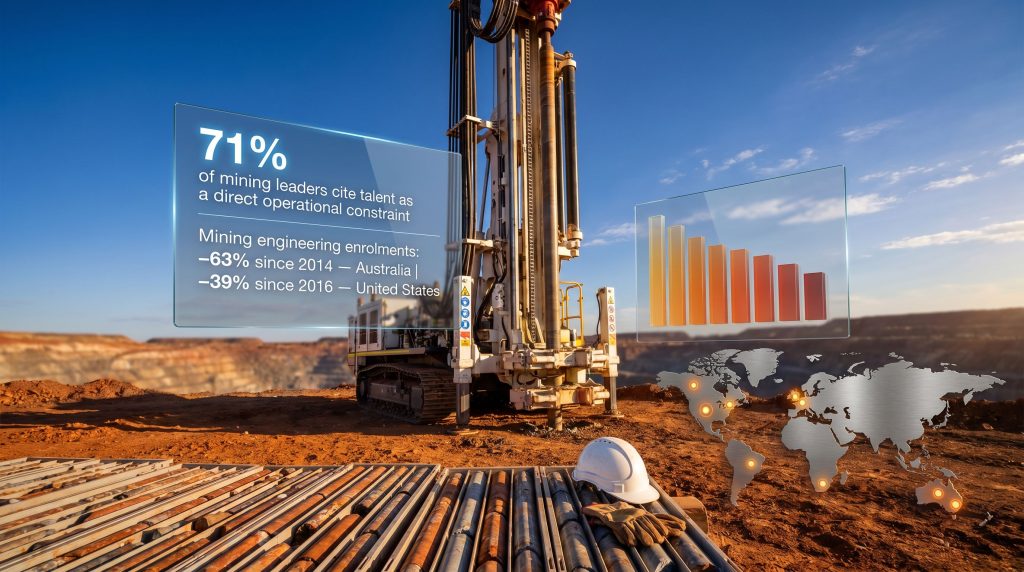
| Mining engineering enrolment decline | -63% since 2014 | Australia |
| Mining graduation decline | -39% since 2016 | United States |
| Mining workforce aged 55+ | ~1 in 5 workers | Canada (2022) |
| Mining tech share of engineering programs | Only 2% | Canada |
| Industry leaders citing talent as a constraint | 71% | Global |
| Leaders finding recruitment harder than two years prior | 86% | Global |
The Canadian figure on educational representation is particularly revealing. According to the Mining Industry Human Resources (MIHR) Council in Ottawa, mining technology programs account for just 2% of all engineering technologist programs in Canada, compared to 19% for computer engineering technician courses. This disparity illustrates precisely where educational investment, and by extension, where young people's career aspirations, are flowing. The MIHR has characterised Canada's mining education infrastructure as small, shrinking, and structurally unresponsive to the labour demands placed on it.
These figures are not abstract. A 63% collapse in mining engineering enrolments in Australia over roughly a decade represents a fundamental rupture in the graduate pipeline. A 39% decline in US mining graduations over a similar period translates directly into fewer qualified engineers, geologists, and technical supervisors available to support the drilling programs that critical mineral development depends on.
The Aging Workforce Problem: When Retirements Become a Crisis
The Demographic Pressure Building Beneath the Surface
With approximately one in five Canadian mining workers over the age of 55 as of 2022, the industry is entering a period of accelerated attrition that will intensify regardless of what happens to commodity prices or exploration budgets. This demographic reality is particularly acute in remote and frontier jurisdictions, where the combination of difficult working conditions and geographic isolation has historically limited the pool of candidates willing to relocate.
The retirement of experienced drillers and supervisors does more than reduce headcount. It depletes the tacit knowledge base that underpins safe and efficient operations. Field expertise — the ability to read ground conditions, anticipate equipment behaviour, and make real-time decisions in complex geological environments — cannot be transferred through a training manual or a short-course certificate. It accumulates over years of supervised field exposure, and when that supervisory layer retires, the transmission mechanism breaks.
Why Younger Workers Are Looking Elsewhere
The generational dimension of the mining drilling skills shortage is equally significant. Younger workers entering the labour market have broader career alternatives than previous generations, and many are choosing paths that do not involve remote rotational schedules, camp-based living arrangements, or physically demanding fieldwork.
The mining industry competes directly with construction, infrastructure, and the energy transition sector for technically skilled workers, often at a structural disadvantage in terms of perceived lifestyle appeal. In South Africa, Hethen Hira, head of investor relations at Pan African Resources, has noted that improved access to broader education has widened career options for many who might previously have entered the drilling industry by default. The same dynamic is visible in the United Kingdom, where a cultural retreat from extractive industry careers has coincided with the closure of multiple prestigious mining engineering programs. Furthermore, women in mining remain underrepresented across field roles, compounding an already restricted talent pool.
A Country-by-Country Breakdown of the Drilling Skills Gap
Australia
Australia's position is among the most exposed of any major mining jurisdiction. The 63% decline in mining engineering enrolments since 2014 has created a structural deficit in the graduate pipeline precisely at the moment when the country's critical minerals ambitions are accelerating. Junior exploration companies operating on tight budgets face a compounded disadvantage: they cannot match the wages offered by major miners, and they struggle to secure experienced crews under competitive long-term contractor agreements.
The result is that the companies taking on the highest-risk, most capital-efficient early-stage exploration work are systematically locked out of the talent required to execute it. Consequently, the broader junior exploration landscape faces growing operational constraints that extend well beyond financing challenges alone.
United States
A 39% decline in US mining graduations since 2016 has hollowed out the technical workforce at every level. Peter Major, a mining veteran born in Kellogg, Idaho, then known as the silver mine capital of the world, argues that efforts to revive domestic mining face a foundational constraint: the industry is short of bodies, and there is, in his view, no collective memory of how to mine.
Idaho, which once had deep local training infrastructure feeding its hard-rock mining industry, now lacks the vocational and technical programs that historically produced experienced miners. Major graduated from the Montana School of Mines in 1981, an institution that remains active alongside Colorado, but regional coverage is patchy and enrolment pressure persists across the country.
Major's view is that the industry will eventually return to on-the-job training as a practical necessity, not by choice but by exhaustion of alternatives. When companies are sufficiently desperate for workers, they will rebuild the internal training capacity that was dismantled during decades of outsourcing. He considers the mine site itself to be the most effective classroom.
Canada
The MIHR Council's assessment of Canada's mining education system as small, shrinking, and unresponsive to labour demand captures the structural problem precisely. Labour shortages are already extending exploration timelines and making it harder for junior companies to secure both qualified crews and available rigs. The demographic pressure from an aging workforce means conditions are likely to worsen before any recovery in training output materialises. According to workforce analysis from the RESA, skills and workforce planning represent one of the most pressing challenges across resource sectors regionally.
United Kingdom
The UK's retreat from mining education is among the most striking in the developed world. The Camborne School of Mines, part of the University of Exeter and one of the oldest and most respected mining engineering institutions in the world, suspended its mining engineering degree program for five years due to insufficient applicant numbers, resuming only in 2025.
Similar programs at Leeds, Nottingham, and the Royal School of Mines in London have been discontinued entirely. The loss of this institutional capacity takes decades to rebuild, if it can be rebuilt at all.
South Africa
South Africa presents a more contested picture. Peter Major argues that the African National Congress damaged mining education significantly by closing down technical colleges in the years following the end of apartheid in 1994, a policy he considers to have had lasting consequences for the industry's workforce capacity. He also points to mandatory contributions to government Sector Education and Training Authorities (SETAs) as a structural disincentive: companies that have already contributed to SETAs are reluctant to invest again in their own in-house programs.
Hira offers a partially contrasting view, suggesting that successful drilling companies will generate their own training demand and that established operators have always invested in building workforce capability, particularly as rigs become more mechanised. However, he acknowledges that declining interest in drilling careers is real in South Africa, as it is in the UK, driven by a preference for careers that do not involve manual labour in difficult physical conditions.
What the Shortage Is Costing the Industry
| Impact Category | Operational Consequence |
|---|---|
| Labour and contractor costs | Rising sharply as competition for skilled workers intensifies |
| Rig and crew lead times | Extended delays pushing back exploration program start dates |
| Exploration program scale | Programs trimmed or deferred due to crew unavailability |
| Project development timelines | Delayed by insufficient technical and supervisory personnel |
| Operational risk | Elevated where less experienced workers occupy senior roles |
The financial consequences are most visible in contractor day rates, which have been rising across major mining jurisdictions as the pool of qualified crews tightens. For junior miners operating under capital constraints, this compression is particularly damaging. It is not simply that costs are higher. It is that the combination of talent scarcity and rig availability — where major miners hold long-term contractor agreements that restrict access for smaller operators — creates a structural disadvantage that delays or reduces the scale of exactly the kind of early-stage exploration that drives new discovery.
"The skills shortage is not merely a labour market friction. It is a systemic constraint on the industry's capacity to discover and develop the mineral resources that the global energy transition requires, at the pace that transition demands."
The next major ASX story will hit our subscribers first
Technology's Role: Partial Solution, New Complexity
Increased mechanisation of drill rigs reduces the physical demands of field roles, broadens the potential talent pool, and can improve productivity per available worker. Remote monitoring and tele-operation systems allow some supervisory functions to be performed without requiring experienced personnel to be physically stationed at remote sites. These developments are real and meaningful. In addition, AI in drilling is beginning to augment operational decision-making in ways that were not possible even five years ago.
However, technology is not a substitute for skilled people. It is, in a fundamental sense, a skills multiplier: it increases what a smaller number of qualified workers can achieve, but it cannot eliminate the requirement for geological judgement, safety oversight, and operational expertise. More critically, automation and digital systems integration actively raise the technical bar for the workers who remain. Modern drill rig operators must now hold mechanical competencies alongside digital literacy, sensor data interpretation, and remote operation protocols.
Training programs that have not been updated to reflect these evolving requirements are producing graduates who are underqualified for current operational roles, regardless of their formal credentials. The technology transition, without a parallel investment in updated training infrastructure, risks widening the skills gap rather than closing it.
Building the Workforce the Industry Needs
Regional Training Hubs and Global Models
Harwood has pointed to emerging training centres in Chile, Peru, Canada, and Australia as a structural response to the shortage. Finland and Sweden are consistently cited as leading examples of sophisticated, nationally supported mining education ecosystems, with Finland described by Major as state of the art in terms of both training infrastructure and outcomes.
Major also identifies countries including the Democratic Republic of Congo and Ghana as having potential to develop into regional training centres given appropriate investment, while Hira points more broadly to less-developed countries with significant mineral endowments as having the opportunity to become the education and training hubs of the future. Furthermore, Australia's critical minerals strategy explicitly identifies growing a skilled workforce as a central priority for the sector's long-term competitiveness.
Restoring Apprenticeships and Structured Field Training
A renewed commitment to structured apprenticeship programs, combining formal instruction with supervised field experience across multiple seasons, is widely regarded as the most durable long-term solution to the mining drilling skills shortage. The key challenge is distributing the cost and accountability for workforce development more equitably across mining companies, drilling contractors, and technical institutions, rather than allowing it to fall by default to whichever party is most capital-constrained.
Modernising What Is Actually Taught
Integrating digital technologies, automation literacy, environmental management, and data analytics into drilling and mining engineering curricula is not optional. It is the baseline requirement for producing graduates who can function effectively in current operational environments. Industry-academic partnerships that embed real operational challenges into coursework improve both relevance and graduate retention. Modular credentialling pathways can also accelerate workforce entry for skilled workers transitioning from adjacent sectors such as oil and gas, civil construction, and geotechnical services.
Expanding the Talent Pool
Women remain significantly underrepresented across drilling and field operations roles. Targeted recruitment and retention programs represent an underutilised lever on the supply side of the workforce equation. Improving roster flexibility, career progression visibility, and working conditions more broadly can extend the appeal of drilling careers to demographics that have historically opted out. Scholarship programs and school-level industry awareness initiatives can shift career perceptions before post-secondary choices are made. Proper interpreting drill results also requires skilled personnel at every stage, further underscoring why workforce investment cannot be deferred.
Three Scenarios for the Next Decade
Scenario 1: Managed Recovery. Investment in training hubs, apprenticeship programs, and curriculum modernisation begins producing results within five to seven years. Technology adoption smooths short-term productivity impacts while the graduate pipeline recovers. The skills gap narrows gradually.
Scenario 2: Prolonged Constraint. Underinvestment in education continues. The industry relies on geographic labour mobility — moving skilled workers between jurisdictions — as a short-term fix. Costs remain structurally elevated, exploration activity is suppressed, and junior miners face persistent operational limitations across an extended period.
Scenario 3: Systemic Crisis. The retirement wave accelerates faster than any recovery in training output. Exploration activity contracts materially. Critical mineral discovery rates decline precisely when energy transition demand is accelerating. Project development timelines extend by years, with cascading consequences for commodity supply chains and downstream industrial capacity.
"Harwood has been direct on this point: rebuilding long-term capacity will require more than redistributing existing skilled labour across borders. It demands deliberate, sustained investment in local workforce capability, and without it, the industry risks a compounding deficit that constrains exploration, elevates operational risk, and delays project development at a global scale."
Frequently Asked Questions: Mining Drilling Skills Shortage
What is causing the mining drilling skills shortage?
A convergence of aging workforce demographics, declining university and vocational enrolments, competition from adjacent industries, eroded apprenticeship pathways, and rising technology skill requirements across increasingly sophisticated drill operations.
Which countries are most severely affected?
Australia, the United States, Canada, and the United Kingdom face the most extensively documented shortfalls, though the shortage is global in character, with remote jurisdictions and emerging mining regions particularly exposed.
How does the shortage affect junior exploration companies specifically?
Junior miners face delayed program starts, reduced drilling metres, higher contractor costs, and restricted access to both qualified crews and available rigs, particularly where major miners hold long-term equipment contracts that crowd out smaller operators.
Can automation solve the problem?
Partially. Automation reduces crew size requirements and physical demands, but raises the technical skill floor. It reduces the number of workers needed per program but cannot eliminate the requirement for geological judgement, safety management, and digital operational expertise.
How long will the shortage persist?
Without structural intervention, the shortage is projected to deepen through the late 2020s as retirements accelerate. With sustained, coordinated investment in training infrastructure, meaningful supply-demand rebalancing is estimated to take between five and ten years.
Want to Know Which ASX Explorers Are Making Major Discoveries Right Now?
Discovery Alert's proprietary Discovery IQ model delivers real-time alerts the moment significant mineral discoveries are announced on the ASX, cutting through the complexity of over 30 commodities to surface actionable opportunities — even as workforce constraints make successful exploration increasingly rare and valuable. Explore historic discoveries and their returns to understand what's at stake, then begin your 14-day free trial at Discovery Alert to position yourself ahead of the broader market.