June 12, 2026
Why Crushing Circuit Technology Has Become a Strategic Battleground in African Platinum Mining
The economics of hard-rock underground mining have always been governed by a deceptively simple principle: the more efficiently you can break, move, and process ore, the more competitive your operation becomes. In South Africa's platinum group metals (PGM) sector, where margins fluctuate with commodity price cycles and operational costs remain stubbornly elevated, this principle has taken on renewed urgency. The crushing circuit sits at the intersection of plant availability, metallurgical recovery, and total cost per tonne. Decisions made at this level reverberate across the entire production chain.
Against this backdrop, the deployment of Sandvik CH662 crushers in South Africa's platinum mining operations marks a meaningful inflection point, not just for a single project, but for how the continent's mining industry positions itself in relation to global technology standards.
When big ASX news breaks, our subscribers know first
South Africa's Platinum Geology and the Crushing Imperative
South Africa accounts for approximately 70 to 75% of global platinum supply, a dominance rooted in the geology of the Bushveld Igneous Complex (BIC), one of the largest layered mafic intrusions on Earth. Extending across the Limpopo, North West, and Mpumalanga provinces, the BIC hosts the majority of the world's known platinum group metal resources within discrete reef horizons, most notably the Merensky Reef, UG2 Reef, and Platreef.
What makes PGM mining geologically demanding is the hardness and abrasiveness of the host rock. Bushveld pyroxenites, norites, and anorthosites are dense, competent formations that impose significant mechanical stress on crushing equipment. Furthermore, unlike softer bulk commodities where throughput can be increased with relatively modest equipment investment, platinum ore demands robust secondary and tertiary crushing solutions capable of sustained performance under high-load, high-abrasion conditions.
The PGM supply constraints affecting South African producers amplify the importance of equipment selection considerably:
- Energy accounts for a substantial share of variable operating costs, and South Africa's ongoing electricity supply constraints under Eskom's load management framework make energy efficiency at the crusher level directly material to profitability.
- Labour costs are elevated relative to other global mining jurisdictions, making automation-driven productivity gains strategically valuable.
- Maintenance downtime translates directly into lost ore tonnes, and in a high-throughput secondary crushing circuit processing between 400 and 1,000 tonnes per hour, even marginal improvements in mechanical availability compound significantly over an annual operating cycle.
South African platinum mines typically operate within this throughput range, positioning them squarely within the design parameters of mid-range cone crusher platforms. This is the market context into which Sandvik's CH662 arrives.
What the CH662 Actually Changes: From Platform Evolution to Operational Advantage
Engineering Progression, Not Reinvention
The CH662 is best understood as a targeted generational upgrade of Sandvik's established CH660 cone crusher lineage rather than a ground-up redesign. This distinction matters operationally. By preserving the core architectural familiarity of the CH660 platform while introducing focused mechanical and digital improvements, Sandvik lowers the transition barrier for operations with existing CH660 installations. Maintenance teams, process engineers, and plant operators are not confronted with an entirely unfamiliar machine.
The substantive changes, however, are far from cosmetic.
| Component | CH660 Generation | CH662 Upgrade |
|---|---|---|
| Top Shell | Standard structural design | Reinforced for improved material distribution |
| Main Shaft | Previous-generation specification | Redesigned for enhanced load-bearing capacity |
| Spider Bushing | Standard wear resistance | Re-engineered for extended service intervals |
| Liner Backing System | Backing compound required | Steel-to-steel design, no backing compound |
The reinforced top shell addresses a well-known challenge in secondary crushing applications: uneven ore feed distribution across the crushing chamber. When feed material enters asymmetrically, differential wear across the mantle and concave liners accelerates, reducing liner life and compromising product size consistency. The redesigned shell geometry improves how ore distributes as it enters the chamber, directly influencing both throughput consistency and liner longevity.
The main shaft redesign targets the dynamic load conditions that are most severe in high-capacity secondary crushing, where large feed sizes and hard, competent ores generate significant impact forces during each compression cycle. A shaft engineered to handle these loads with greater integrity reduces the risk of fatigue-related failures over extended operating periods.
According to Sandvik Rock Processing's Capital Sales Engineer for static crushing, the upgraded top shell provides improved material distribution and greater structural strength, while the redesigned main shaft enhances reliability under high-capacity conditions. The spider bushing has also been re-engineered to improve wear resistance and extend service life intervals. (African Mining Market, June 2026)
The Backing Compound Elimination: A Quietly Significant Innovation
One of the less-discussed but operationally impactful advances in the CH662 is the elimination of liner backing compound. To understand why this matters, it helps to understand what backing compound actually does in a conventional cone crusher.
In traditional cone crusher designs, the manganese steel crushing liners (mantle and concave) are secured within the crusher using an epoxy or zinc-based backing compound poured between the liner and the supporting steel structure. This compound fills the void space and provides a load-distributing interface that prevents the liners from cracking or loosening under crushing forces. The problem is that once new liners are installed and the compound is poured, operators must wait for a curing period before the crusher can be returned to service.
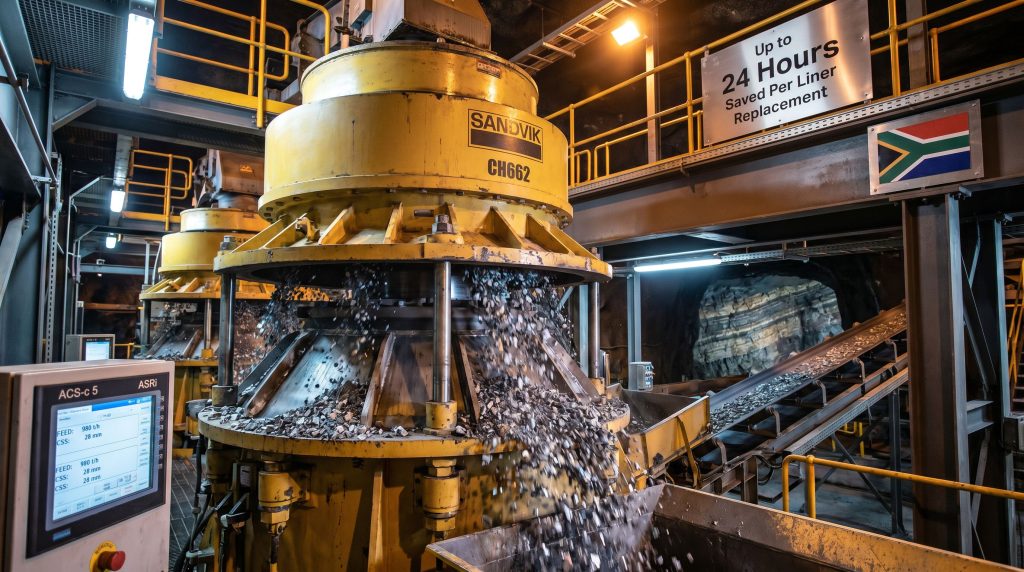
This curing wait can extend up to 24 hours per liner replacement cycle, according to Sandvik's own specification data. In a processing plant where the crusher is a critical production asset, this represents a meaningful block of lost availability time. Consider the compounding effect:
- A platinum concentrator performing four liner changes annually could lose up to 96 hours of crusher availability per year from curing time alone.
- At a processing rate of 600 tonnes per hour, those 96 hours represent approximately 57,600 additional tonnes of ore that could be processed annually through this single design improvement.
- At typical platinum head grades and recoveries, the revenue contribution of that additional ore throughput is not trivial.
The steel-to-steel liner design of the CH662 removes this curing dependency entirely. Liner changes can be completed and the machine returned to service without any waiting period, fundamentally changing the maintenance scheduling calculus for operations conducting frequent liner replacements.
ACS-c 5 ASRi: When Digital Integration Meets Remote Operations
The Automation Architecture
Cone crusher automation has evolved substantially over the past two decades, from basic hydraulic setting adjustment systems to sophisticated real-time monitoring and control platforms. The CH662's ACS-c 5 ASRi control system represents Sandvik's consolidation of previously separate crusher control functionalities into a unified, more intuitive automation architecture. In this respect, mining automation trends across the sector have clearly shaped this platform's design philosophy.
Core functional capabilities of the ACS-c 5 ASRi include:
- Automated closed-side setting (CSS) regulation, which continuously optimises the gap between the crushing liners to maintain target product size as liners wear.
- Real-time load and power monitoring, enabling operators to track crusher performance against design parameters continuously.
- Predictive fault detection and condition-based alerts, which flag developing mechanical issues before they escalate into unplanned stoppages.
- Integration with Sandvik's digital services platforms for remote diagnostics and performance analysis.
Why Remote Diagnostics Is a Game-Changer for Sub-Saharan Operations
The geographic realities of South African platinum mining create a specific operational challenge that automated remote monitoring is well positioned to address. Many PGM operations in the Limpopo province are located several hours from major urban service centres and OEM support hubs. When a crusher fault occurs on a conventional monitoring architecture, the response sequence is linear: the fault is identified on site, an OEM technician is dispatched, the technician travels to site, and diagnostic work begins upon arrival. Total response time can easily consume a full working shift.
Remote monitoring capability restructures this response model entirely. According to Sandvik Rock Processing's Business Line Manager for Crushing, the remote support capability allows fault-finding to begin immediately when an issue arises. By the time a field technician arrives on site, the diagnostic process is substantially advanced and the technician arrives with targeted repair knowledge rather than beginning from scratch. (African Mining Market, June 2026)
Remote monitoring is increasingly viewed not as a premium feature but as a baseline operational requirement for mining equipment deployed across sub-Saharan Africa's geographically dispersed operations. The cost of unplanned downtime in a critical crushing circuit frequently exceeds the investment in connected monitoring infrastructure many times over.
This shift in how OEM field service functions also has implications for total cost of ownership calculations. Faster fault resolution reduces lost production time. More targeted technician deployment reduces travel-related service costs. Furthermore, condition-based maintenance scheduling, enabled by continuous performance data, replaces calendar-based maintenance intervals with evidence-based interventions that can extend the life of wear components. These are the hallmarks of truly data-driven mining operations that leading producers are actively pursuing.
The Limpopo Deployment: Structure, Signals, and Strategic Implications
Project Configuration and EPC Channel Dynamics
The initial CH662 deployment in Limpopo involves two units configured in a duty/standby arrangement for a secondary crushing application within an underground mining expansion project. Factory acceptance testing was completed in Sweden during Q2 2026 before the units were shipped to South Africa. The order was placed through a major engineering, procurement and construction (EPC) contractor.
The EPC procurement channel is particularly significant. In large-scale African mining project development, EPC contractors increasingly function as de facto technology arbiters. They evaluate equipment specifications, simulate process flowsheets, and make equipment selections that then define plant configurations for operational lifespans measured in decades. Winning EPC relationships is therefore a commercially strategic priority for capital equipment OEMs operating in the African market.
Sandvik's use of its PlantDesigner simulation software to model multiple crushing circuit configurations before finalising the design for this project illustrates how OEM-EPC collaboration has deepened. Pre-commissioning simulation reduces process risk, allows metallurgical outcomes to be optimised on a digital twin before physical installation, and demonstrates technical credibility to EPC partners evaluating equipment suppliers.
Reframing African Mining's Technology Appetite
The persistent narrative that African mining operations lag behind other global regions in technology adoption is increasingly at odds with procurement reality. The Limpopo CH662 deployment, positioning the first units of this platform to reach Africa within an underground expansion project, is a data point that challenges this characterisation directly.
Sandvik's Business Line Manager for Crushing noted that this milestone order challenges longstanding perceptions about African mining's pace of technology adoption, pointing to growing industry interest in electrification, remote monitoring, and automation. (African Mining Market, June 2026)
The drivers behind this shift are structural rather than incidental. South African PGM producers operate within a competitive global cost environment where operational efficiency has become an existential priority. Advanced crushing technology that demonstrably improves plant availability, reduces maintenance downtime, and integrates with broader mine digitalisation strategies offers a clear return-on-investment case. AI-powered mining efficiency tools and connected equipment platforms are increasingly complementary in this context.
CH662 Market Positioning Across Africa's Crushing Landscape
The Mid-Range Processing Sweet Spot
A critical and often underappreciated insight about African mining's equipment requirements is the mismatch between the ultra-high-capacity crushing systems deployed in South American bulk commodity operations and the actual throughput demands of African mid-tier mining. South Africa's platinum operations, along with the continent's gold, chrome, manganese, and construction aggregates sectors, predominantly operate within the 400 to 1,000 t/h processing band.
| Criteria | CH662 Position |
|---|---|
| Target throughput range | 400 to 1,000 t/h |
| Primary application | Secondary, tertiary, and pebble crushing |
| Automation level | ACS-c 5 ASRi integrated control |
| Maintenance design | Backing-compound-free liner system |
| Warranty | 3-year standard warranty |
| Retrofit/rebuild options | Available across CH660 platform |
The CH662's design parameters align precisely with this market segment, making it relevant not only to platinum but to the broader spectrum of hard-rock African mining applications. Chrome operations in the Northern and Western limbs of the Bushveld Complex, manganese producers in the Kalahari Manganese Field, and gold operations across the Witwatersrand Basin all fall within this throughput range. In addition, energy-efficient mining design considerations are becoming central to equipment procurement decisions across all these sectors.
Sandvik's Three-Tier Upgrade Pathway
For operations with existing CH660-platform investments, Sandvik offers a structured upgrade pathway that reduces the capital commitment required to access CH662-generation capabilities:
- Retrofit: Targeted component upgrades applied to existing CH660-generation machines, allowing specific performance improvements without full machine replacement.
- Rebuild: Full mechanical refurbishment bringing an existing machine to CH662 specification, extending asset life while delivering generational capability improvements.
- New integrated smart crusher: Complete CH662 deployment with full ACS-c 5 ASRi digital integration from installation, the highest-capability option for greenfield or major expansion projects.
This tiered approach is commercially intelligent. It reduces the entry barrier for cost-constrained operations, preserves existing equipment capital value, and creates a pathway for incremental technology adoption that aligns with mining capital cycle realities. For a detailed overview of available platform options, Sandvik Rock Processing provides comprehensive specifications and configuration guidance directly.
The next major ASX story will hit our subscribers first
Frequently Asked Questions: Sandvik CH662 in South African Platinum Mining
What is the Sandvik CH662 cone crusher used for in platinum mining?
The CH662 is deployed primarily in secondary crushing applications within platinum processing circuits, where it reduces ore from primary crusher output sizes down to feed sizes suitable for milling. In the Limpopo deployment, the units are configured for secondary crushing within an underground mining expansion project.
How does the CH662 differ from the CH660?
The CH662 introduces a reinforced top shell for improved ore distribution, a redesigned main shaft for enhanced load-bearing capacity, a re-engineered spider bushing for extended wear life, and critically, a steel-to-steel liner design that eliminates the need for backing compound during liner changes. It also integrates the ACS-c 5 ASRi automation system, which was not available on the earlier platform.
What is the ACS-c 5 ASRi control system?
The ACS-c 5 ASRi is Sandvik's integrated crusher automation platform that consolidates multiple control functions into a single architecture. It provides automated closed-side setting regulation, real-time performance monitoring, condition-based alert systems, and remote diagnostics integration, enabling both on-site operators and off-site service teams to monitor and respond to crusher performance continuously.
How does removing backing compound reduce maintenance time?
Traditional cone crusher liner installations require a backing compound to be poured between the liner and steel structure, followed by a curing period before operation can resume. This curing wait can consume up to 24 hours per liner change. The CH662's steel-to-steel design eliminates this dependency, allowing maintenance crews to install new liners and return the machine to service without any curing delay.
What throughput range is the CH662 designed for?
The CH662 is engineered for the 400 to 1,000 tonnes per hour processing band, which aligns closely with the operating requirements of most African mid-tier mining operations across platinum, gold, chrome, manganese, and aggregates applications.
Is retrofit or rebuild available for existing CH660 installations?
Yes. Sandvik's three-tier upgrade strategy covers retrofit (component upgrades on existing machines), rebuild (full refurbishment to CH662 specification), and new integrated smart crusher deployment. All options are supported under Sandvik's three-year standard warranty framework. Further technical context on matching crushers for performance is available for engineers evaluating circuit configurations.
The Bigger Picture: Technology Investment as Operational and Strategic Signal
Capital equipment procurement decisions in the mining sector carry meaning beyond the immediate operational context. When a platinum operation commits to deploying next-generation crushing technology with integrated digital capabilities as part of an underground expansion project, it communicates confidence in the long-term economic viability of that asset.
In South Africa's PGM sector, where producers have faced sustained pressure from declining ore grades, rising depths of mining, volatile palladium and platinum price cycles, and persistent energy cost headwinds from Eskom supply instability, operational efficiency improvements at the crushing circuit level contribute directly to cost competitiveness. Better crusher availability reduces the effective cost per tonne of ore processed. More efficient automated setting regulation improves metallurgical recovery consistency downstream in the concentrator. And energy-efficient crushing, enabled by automated load management, supports ESG commitments and energy cost management simultaneously.
The deployment of Sandvik CH662 crushers in South Africa's platinum mining sector is therefore best understood not as a routine equipment order but as an early indicator of a broader technology adoption trajectory across African hard-rock mining. As EPC contractors incorporate CH662-class capabilities into their standard process design toolbox, and as operational data from the Limpopo deployment accumulates, the case for wider adoption across PGM, gold, chrome, and aggregates applications across the continent will only strengthen.
Disclaimer: Production estimates, throughput projections, and revenue impact calculations presented in this article are illustrative in nature and based on publicly available industry data and equipment specifications. They should not be interpreted as guaranteed operational outcomes. Readers should conduct independent assessments appropriate to their specific operational context before making capital equipment decisions.
Want to Capitalise on the Next Major ASX Mineral Discovery Before the Market Does?
Discovery Alert's proprietary Discovery IQ model delivers real-time alerts on significant ASX mineral discoveries across platinum group metals and beyond, translating complex geological and market data into actionable investment insights for both short-term traders and long-term investors. Explore how historic mineral discoveries have generated extraordinary returns and begin your 14-day free trial today to position yourself ahead of the broader market.