June 12, 2026
The Engineering Shift Redefining Surface Drilling
Heavy equipment electrification has followed a predictable pattern for most of the past decade: underground first, surface later. The logic was sound. Enclosed mining environments created immediate, measurable incentives to eliminate diesel combustion, from ventilation cost savings to occupational health compliance. Surface drilling, with its open-air exposure and perceived freedom from emission constraints, remained a diesel stronghold. That calculus is now changing, and changing rapidly.
Tightening air quality regulations in urban corridors, escalating ESG disclosure requirements, and the growing commercial viability of electric powertrains across heavy machinery categories are collectively dismantling the assumption that surface drilling equipment can remain exempt from electrification pressure. The introduction of the Sandvik all-electric top hammer surface drill rig marks the point at which this shift moves from conceptual to operational, reflecting the broader mining electrification shift now accelerating across the industry.
When big ASX news breaks, our subscribers know first
How the Commando DC310RiE Works: Architecture and Mechanical Logic
Core Power Delivery: The Electric Top Hammer System
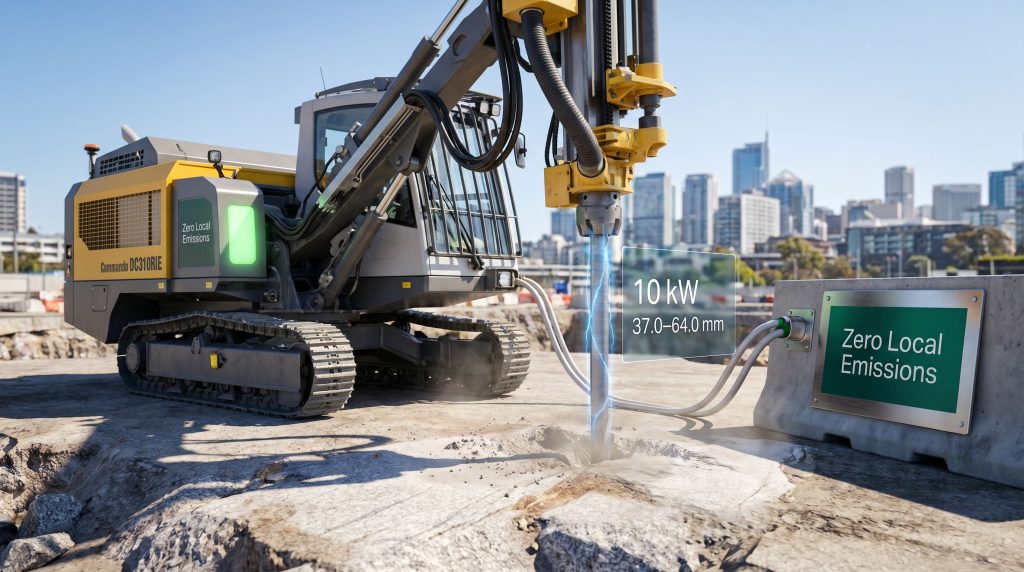
At its mechanical foundation, the Commando DC310RiE replaces every diesel-powered system in a conventional surface rig with an electric equivalent. The result is a drivetrain that produces zero local emissions throughout its operational cycle, with no exhaust gases released at the worksite under any drilling condition.
The rig's rock drill operates at 10 kW, delivering percussive energy through the drill string via the top hammer method. This approach transmits impact force from the surface downward through the steel rod assembly, contrasting with down-the-hole configurations where the hammer assembly travels with the drill bit to the working face.
Key confirmed technical specifications include:
| Specification | DC310RiE Value |
|---|---|
| Power system | Fully electric, zero local emissions |
| Rock drill power | 10 kW |
| Hole diameter range | 37.0–64.0 mm (1.5–2.5 in.) |
| Flushing air capacity | 3 m³/min |
| Maximum flushing pressure | 8 bar |
| Noise profile | Significantly reduced vs. diesel equivalents |
| Operator interface | Identical to existing diesel Commando models |
Top Hammer vs. Down-the-Hole: Understanding the Technical Distinction
The choice to build the DC310RiE around top hammer technology rather than DTH reflects a deliberate application focus. These two drilling methods serve fundamentally different operational profiles:
| Feature | Top Hammer | Down-the-Hole (DTH) |
|---|---|---|
| Energy transfer location | Surface, via drill string | At the bit face |
| Typical hole diameter | 30–115 mm | 75 mm and above |
| Optimal depth range | Shallow to medium | Deep, large-diameter |
| DC310RiE applicability | Primary method | Not applicable |
Top hammer surface drilling is inherently well-suited to electric power delivery. The percussive mechanism at the surface, rather than at depth, allows for tighter control of energy input through electric motor management systems, which can modulate power output with precision that hydraulic and diesel systems cannot easily replicate.
The 37.0–64.0 mm hole diameter range positions the rig squarely within construction, infrastructure, and light civil drilling applications. This covers bolt holes, rock anchor placements, and small-diameter blast holes that represent a large proportion of surface drilling volume in built environments. Furthermore, this drilling technology transformation aligns with broader advances reshaping how the industry approaches precision and efficiency.
Why Sandvik Is Moving Surface Drilling Toward Zero Emissions
The Decarbonisation Forces Reshaping Equipment Procurement
The transition to electric surface drilling equipment is not emerging in a regulatory or commercial vacuum. Several converging pressures are reshaping how mining and construction companies evaluate mobile combustion equipment. In addition, the mining decarbonisation benefits now extend well beyond environmental compliance into measurable financial returns.
-
Scope 1 emissions accountability: Mobile combustion equipment, including surface drill rigs, contributes directly to a company's reported Scope 1 greenhouse gas inventory. As science-based targets and net-zero commitments become standard in large company reporting, each diesel-powered asset represents a quantified liability.
-
Air quality regulation tightening: Particulate matter standards (PM2.5 and PM10) and nitrogen oxide limits are becoming more stringent across the EU, UK, Australia, and North America. Equipment operating in urban or peri-urban zones increasingly faces emission permit conditions that diesel rigs cannot meet.
-
ESG investment screening: The Mining IQ ESG Index 2025 evaluated more than 60 of the world's largest mining companies across 10 weighted indicators within six ESG pillars. Fleet decarbonisation is an increasingly prominent factor within the environmental assessment pillar, meaning equipment procurement decisions carry direct implications for institutional investment eligibility.
-
Fleet investment urgency: Research published in the Mining IQ Future Fleets Insights 2026 confirms that mining companies need to meaningfully accelerate investment in fleet decarbonisation if they are to achieve stated CO₂ reduction targets. The gap between current fleet composition and emission targets is widening in many organisations.
The Strategic Logic of Extending Electrification to the Surface
Sandvik's underground electrification programme established a proven template for electric drivetrain integration in heavy drilling equipment. The technical lessons from battery-electric and cable-electric underground platforms, including power electronics design, thermal management of components under sustained load, and operator interface integration, translate directly to surface applications.
The DC310RiE represents the first time Sandvik has applied this accumulated expertise to a top hammer surface product. The significance extends beyond one product line: it signals that electrification is no longer constrained to enclosed environments where emission control is operationally mandated. It is now commercially viable in open-air surface applications where the drivers are regulatory compliance and ESG positioning rather than ventilation engineering.
Underground electrification was initially justified by ventilation cost savings and confined-space safety requirements. Surface electrification is being justified by a different but equally compelling set of forces: emission permit compliance, urban noise ordinance requirements, and the growing financial materiality of ESG performance metrics in capital allocation decisions.
Target Environments: Where the DC310RiE Delivers Its Greatest Advantage
Five Operational Scenarios Where Zero Emissions Change the Equation
The DC310RiE has been engineered with a defined set of deployment environments where conventional diesel rigs face operational or regulatory limitations. These include:
-
Urban construction sites: Municipal air quality restrictions increasingly apply to diesel combustion equipment on city worksites. The DC310RiE eliminates exhaust emissions entirely, enabling operations in zones where diesel rigs would require special permitting or face outright exclusion.
-
Infrastructure projects in populated corridors: Bridge foundations, tunnel portals, and road infrastructure projects often operate in close proximity to residential areas. Zero-emission electric drilling removes a significant source of community complaint and regulatory exposure.
-
Indoor and semi-enclosed environments: Diesel fumes in partially enclosed structures present occupational health risks that require costly ventilation engineering. The DC310RiE eliminates this hazard category entirely.
-
Environmentally sensitive zones: National parks, water catchment areas, and heritage sites often impose strict controls on combustion equipment. An all-electric rig removes the emission component of these restrictions as an operational barrier.
-
Emission-controlled worksites: Sites operating under environmental permits that cap combustion engine use, or where carbon accounting is applied at the site level, benefit directly from the DC310RiE's zero local emission profile.
Acoustic Performance as a Competitive Differentiator
A frequently overlooked dimension of surface drilling electrification is the noise profile. Conventional diesel surface rigs generate both combustion noise and mechanical percussion noise simultaneously. The DC310RiE eliminates the combustion component entirely, producing a significantly reduced acoustic footprint compared to diesel equivalents.
This has practical commercial implications:
-
Night shift viability: Urban construction zones commonly operate under noise curfews that restrict diesel machinery after set hours. An electric rig with reduced noise output opens access to extended working hours in these environments.
-
Operator communication and safety: High ambient noise levels on conventional drill sites impair communication between crew members and reduce awareness of auditory safety signals. Lower noise levels directly improve on-site safety conditions.
-
Community relations: Noise complaints are a primary source of community opposition to urban drilling contracts. Reducing the acoustic impact of drilling operations is a measurable tool for maintaining social licence in built environments.
In practice, noise violations and emission breaches on urban construction contracts can trigger enforced work stoppages and financial penalties. An electric rig with a reduced acoustic and zero-emission profile directly reduces this category of operational and contractual risk, which carries real financial value in project economics.
DC310RiE vs. Diesel Commando: A Comparative Operational Assessment
Side-by-Side Performance Profile
The following comparison illustrates how the DC310RiE repositions the Commando platform across key operational dimensions:
| Operational Factor | Diesel Commando | Commando DC310RiE |
|---|---|---|
| Local emission output | High (diesel exhaust) | Zero |
| Noise level | High (combustion + mechanical) | Significantly reduced |
| Urban site suitability | Limited by regulations | High |
| Indoor/enclosed suitability | Not recommended | Suitable |
| Scope 1 emissions contribution | Negative (direct emissions) | Zero contribution |
| Operator retraining required | N/A | None required |
| Energy source | Diesel fuel | Grid or generator electricity |
| Drivetrain maintenance complexity | Engine servicing required | Reduced (no combustion engine) |
| ESG reporting impact | Negative | Positive |
The Operator Transition Advantage: Control Layout Continuity
One of the more strategically significant design decisions embedded in the DC310RiE is the deliberate preservation of the existing Commando control layout. Sandvik retained the identical operator interface across the transition from diesel to electric power. You can explore the full range of Sandvik surface drilling equipment to understand how this design philosophy extends across their broader product family.
This decision has direct cost implications for fleet operators considering electrification:
- Operators already trained on diesel Commando models require no retraining to operate the DC310RiE
- Retraining costs, including downtime, instructor hours, and productivity losses during learning curves, are eliminated as a barrier to fleet transition
- Crew familiarity with the control system means full productivity from the first operating day
- The transition risk typically associated with introducing new equipment platforms is substantially reduced
For large fleet operators managing dozens of surface drill rigs across multiple sites, the absence of retraining as a transition cost meaningfully reduces the total cost of electrification. This design philosophy reflects an understanding that operational adoption barriers, not just capital cost, determine the pace of fleet technology transitions.
ESG and Regulatory Implications of Zero-Emission Surface Drilling
Scope 1 Emissions: The Direct Inventory Reduction
Every diesel-powered surface drill rig in an operating fleet contributes measurable quantities of CO₂, PM2.5, PM10, and nitrogen oxides to a company's direct emissions inventory. Under established greenhouse gas accounting frameworks, these fall into Scope 1, the category of emissions most directly within a company's operational control and most heavily scrutinised by investors and regulators.
Replacing a diesel rig with the DC310RiE eliminates the direct emission contribution of that asset from the Scope 1 inventory. For companies with science-based emissions reduction targets or net-zero commitments, each electrified asset represents a verifiable, quantifiable reduction in reported emissions.
Air Quality Compliance: Present and Future
The regulatory trajectory across major mining jurisdictions points in one direction. Diesel emission standards for non-road mobile machinery (NRMM) are tightening progressively in the EU under Stage V regulations, in the UK under equivalent post-Brexit frameworks, and in Australian states under state-based environmental protection legislation. North American jurisdictions are applying similar pressure through EPA Tier 4 Final standards.
The DC310RiE's zero local emission operation provides:
- Automatic compliance with current air quality standards in all major jurisdictions
- Future-proofing against regulatory escalation without equipment replacement costs
- Elimination of the compliance monitoring burden associated with diesel emission systems
- Removal of the risk of emission-related operating licence conditions or restrictions
ESG Benchmarking and the Materiality of Fleet Decisions
The Mining IQ ESG Index 2025 provides a structured evaluation of how the world's largest mining companies perform across environmental, social, and governance dimensions. Within this framework, fleet composition and decarbonisation progress are becoming increasingly visible data points in the environmental pillar assessment.
Equipment procurement decisions, including the adoption of electric drill rigs, are no longer purely operational choices. They are becoming measurable inputs to sustainability reporting that institutional investors actively use in portfolio allocation and ESG-weighted investment screens. Mining companies that can demonstrate concrete, asset-level progress on fleet electrification are better positioned in sustainability-linked financing arrangements and green bond frameworks. Consequently, understanding the broader energy transition in mining provides essential context for evaluating why decisions like this carry such strategic weight.
The next major ASX story will hit our subscribers first
What the DC310RiE Reveals About the Future Trajectory of Surface Drilling
The Electrification Arc: From Underground to Open Air
The mining industry's electrification journey followed a sequenced path dictated by where the regulatory and economic incentives were strongest. Underground battery-electric vehicles achieved rapid adoption because ventilation cost savings alone could justify the capital premium in many deep mining operations. Surface electrification lacked this immediate economic forcing function.
The emergence of commercially specified electric surface drilling equipment, with hole diameter ranges and power outputs aligned with real construction and quarrying applications, indicates that the technology has matured past the demonstration phase. The DC310RiE is not a concept machine or a prototype. It is a production product with defined specifications targeting specific market segments. However, the renewable mining solutions supporting these electric platforms continue to evolve rapidly, which will further strengthen the commercial case for surface electrification.
Technology Pathways: Cable-Electric, Battery-Electric, and Hybrid Architectures
Surface electrification introduces a technology choice that underground operations largely resolved through tethered cable systems. Surface rigs can be powered through several architectures, each with distinct operational implications:
- Cable-electric (tethered grid connection): Provides continuous power without energy storage constraints, suited to fixed or predictable site layouts where cable management is feasible
- Battery-electric (onboard energy storage): Offers full operational mobility without cable restrictions but introduces battery capacity constraints and charging cycle planning requirements
- Hybrid electric-diesel: Enables electric operation in emission-sensitive zones while retaining diesel capability for remote, grid-independent sites
The DC310RiE's specific power architecture is not detailed in publicly available materials from the June 2026 announcement. Understanding which of these approaches Sandvik has implemented would be material to operators evaluating site-specific suitability and infrastructure requirements. For further context, Sandvik's development of battery-electric surface drill concepts offers useful background on the technology pathways being explored.
Competitive Landscape: Where Electric Surface Drilling Stands
The introduction of the Sandvik Commando DC310RiE positions Sandvik as an early mover in the commercially specified electric top hammer surface drill rig segment. The competitive environment for electric surface drilling equipment is still forming:
| OEM | Electric Surface Drill Offering | Development Stage |
|---|---|---|
| Sandvik | Commando DC310RiE | Launched (June 2026) |
| Epiroc | Battery/electric surface drill development | In progress |
| Atlas Copco legacy programmes | Various electrification initiatives | Ongoing |
Note: Competitive landscape data reflects publicly available information as of mid-2026. Readers should verify current product availability directly with manufacturers.
Being first to market with a fully specified, production-ready electric top hammer surface rig creates commercial reference points, customer relationships, and application data that later entrants will need to match. In capital equipment markets, the reputational and technical advantages of first-mover status in an emerging product category can compound over multiple product generations.
Frequently Asked Questions: Sandvik All-Electric Top Hammer Surface Drill Rig
What is the Sandvik Commando DC310RiE?
The Commando DC310RiE is Sandvik's first all-electric top hammer surface drill rig, engineered to deliver zero local emissions during operation. It is designed for construction, infrastructure, and emission-sensitive drilling applications, with a confirmed hole diameter range of 37.0–64.0 mm (1.5 to 2.5 inches).
What hole diameters can the DC310RiE drill?
The rig drills holes ranging from 37.0 mm to 64.0 mm in diameter, covering the majority of small-to-medium surface drilling requirements encountered in construction, infrastructure, and civil drilling applications.
Is operator retraining required to use the DC310RiE?
No. Sandvik has maintained the same control layout as its existing diesel Commando models, allowing operators to transition directly to the electric rig without any retraining requirement or productivity adjustment period.
What is the rock drill power output?
The rig is equipped with a 10 kW rock drill, providing the percussive energy required for top hammer drilling in the rig's target application range.
Where is the DC310RiE most suitable for deployment?
The rig is optimally suited for urban construction sites, emission-controlled worksites, indoor or semi-enclosed drilling environments, infrastructure projects in populated corridors, and sites subject to strict air quality or noise regulations.
How does the DC310RiE support ESG and emissions reduction goals?
By producing zero local emissions, the DC310RiE directly eliminates the Scope 1 greenhouse gas contribution of the drilling asset, supports compliance with current and anticipated air quality regulations, and provides measurable fleet decarbonisation progress for sustainability reporting purposes.
Key Takeaways: Sandvik Commando DC310RiE at a Glance
-
Sandvik's first all-electric top hammer surface drill rig, extending its electrification programme from underground to surface applications
-
Zero local emissions throughout operation, suitable for the most heavily regulated urban and environmentally sensitive worksites
-
Hole diameter range of 37.0–64.0 mm with a 10 kW rock drill and flushing air capacity of 3 m³/min at up to 8 bar
-
No operator retraining required, maintaining the same control layout as existing diesel Commando models to reduce fleet transition costs
-
Significantly reduced acoustic footprint versus diesel equivalents, enabling access to noise-restricted urban drilling contracts
-
Directly addresses Scope 1 emission reduction obligations, ESG reporting requirements, and air quality compliance across major global jurisdictions
-
Positions Sandvik as an early commercial mover in the electric top hammer surface drill segment at a point when competitive equivalents remain in development
Disclaimer: This article contains forward-looking assessments of market trends, regulatory trajectories, and competitive dynamics. These represent analytical observations based on publicly available information as of June 2026 and should not be interpreted as investment advice or guarantees of future outcomes. Readers should verify current product specifications, availability, and competitive information directly with manufacturers before making procurement decisions.
Ready to Capitalise on the Next Major Mining Shift Before the Market Does?
The electrification of surface drilling is reshaping the mining and resources sector in real time, and the companies best positioned to benefit are those discovered early. Discovery Alert's proprietary Discovery IQ model scans ASX announcements the moment they drop, delivering real-time alerts on significant mineral discoveries so subscribers can act ahead of the broader market — start your 14-day free trial at Discovery Alert today, or explore how historic discoveries have generated extraordinary returns for those who moved first.