June 12, 2026
India's Clean Energy Ambitions Are Only as Strong as Its Mineral Supply Chain
The global race to decarbonise electricity grids and modernise defence industries has placed a handful of obscure minerals at the centre of geopolitical strategy. For a country with India's scale of renewable energy ambition, the gap between what the ground holds and what the economy can actually produce has become one of the most consequential industrial policy challenges of the decade. Vanadium sits near the top of that challenge, a metal with a relatively low public profile but an outsized role in long-duration grid storage and high-strength steel alloys. The award of the NLC India critical mineral block in Telangana is therefore far more than a routine government auction outcome. It signals a deliberate, state-led effort to close a supply chain vulnerability that has persisted for years.
When big ASX news breaks, our subscribers know first
Why Vanadium Deserves More Attention Than It Gets
Among the minerals listed in India's critical and strategic minerals framework, vanadium occupies an unusual position. It is neither as well-known as lithium nor as politically charged as rare earths, yet its applications are strategically dense. In the energy storage sector, vanadium redox flow batteries (VRFBs) offer something lithium-ion chemistries structurally cannot: virtually unlimited cycle life without meaningful capacity degradation.
Where lithium-ion batteries typically face performance decline after 1,500 to 3,000 cycles, vanadium flow systems can operate through tens of thousands of cycles, making them particularly well-suited to daily charge-discharge cycling over multi-decade grid infrastructure lifespans. Furthermore, the critical minerals demand driving this sector continues to accelerate globally.
How Do Vanadium Flow Batteries Work?
This electrochemical durability stems from the fundamental design of VRFBs. Rather than intercalating ions into a solid electrode, vanadium flow systems store energy in liquid electrolytes held in external tanks. The vanadium ions cycle between four oxidation states (V²⁺, V³⁺, VO²⁺, and VO₂⁺) across a proton-exchange membrane, and because the electrolyte itself is the active material and is never consumed, capacity is theoretically recoverable indefinitely.
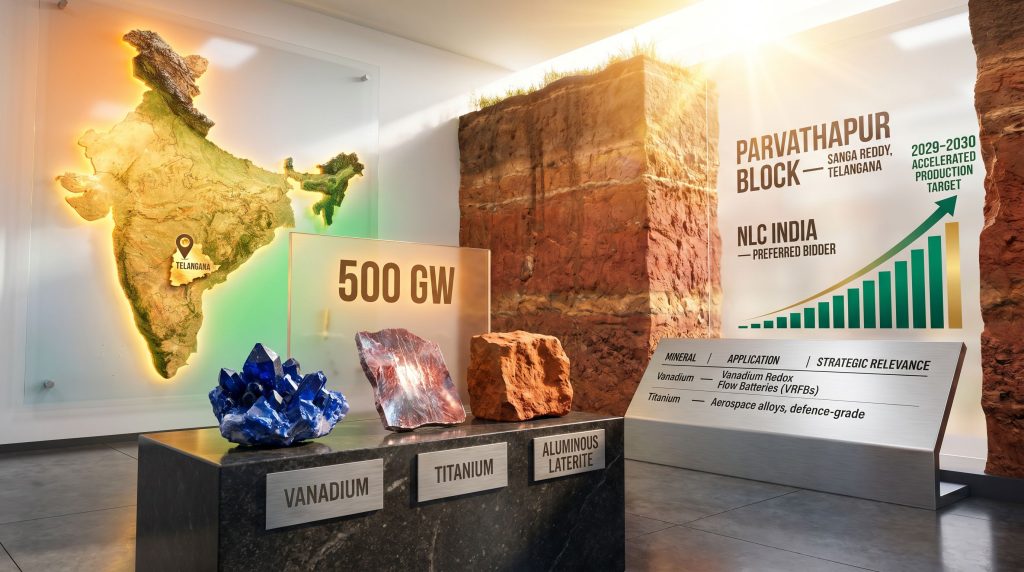
This characteristic makes VRFBs highly competitive for grid balancing applications where assets must operate continuously for 20 to 30 years without cell replacement. India's plan to reach 500 GW of non-fossil power capacity by 2030 will generate significant grid balancing requirements, particularly as variable solar and wind generation scales. Long-duration storage is a structural necessity for this target, and domestic vanadium production reduces the risk of supply disruption from the handful of countries, primarily China and Russia, that currently dominate global vanadium supply.
The Parvathapur Block: Geology, Mineralogy, and What Makes It Unusual
The Parvathapur vanadium, titanium, and aluminous laterite block in Sanga Reddy district, Telangana is a polymetallic resource target rather than a conventional single-element deposit. This distinction matters for understanding both its commercial potential and its processing complexity.
Lateritic deposits form through intense tropical weathering of primary igneous rocks over geological timescales. As silica and other soluble components leach out, less mobile elements including titanium, vanadium, and aluminium concentrate in the residual laterite horizon. In some laterite profiles, vanadium becomes enriched through adsorption onto iron oxyhydroxide phases such as goethite and ferrihydrite, a process driven by the geochemical affinity between vanadium and iron under oxidising supergene conditions.
Understanding the Mineralogical Complexity
This is a subtly important geological fact: vanadium in lateritic settings is often intimately associated with iron mineralogy, which affects the metallurgical pathway required to extract it economically. Advances in critical minerals processing technology are, however, making previously uneconomic extraction routes increasingly viable.
Titanium in laterites typically occurs as ilmenite or leucoxene, secondary alteration products of primary titaniferous minerals. These phases are physically separable through gravity and magnetic concentration methods, giving the Parvathapur block an added dimension as a potential titanium feedstock source for India's defence and pigment manufacturing sectors. The co-occurrence of aluminous laterite adds a third commercial dimension, as gibbsite and boehmite-rich laterites are directly processable as bauxite feedstocks, potentially integrating the block into domestic alumina and aluminium value chains.
| Mineral | Occurrence Form in Laterite | Key Processing Pathway | End-Use Sector |
|---|---|---|---|
| Vanadium | Adsorbed on iron oxyhydroxides | Hydrometallurgical leaching | VRFBs, steel alloying |
| Titanium | Ilmenite, leucoxene | Physical separation, chloride/sulphate process | Aerospace, pigments, medical |
| Aluminous Laterite | Gibbsite, boehmite | Bayer process | Aluminium, refractories |
NLC India's Strategic Repositioning: Beyond Lignite
NLC India Limited holds Navratna status among India's central public sector enterprises, a classification that grants enhanced financial and operational autonomy. Its core asset base is the Neyveli lignite complex in Tamil Nadu, one of Asia's most significant lignite deposits, which has underpinned decades of thermal power generation in southern India.
The company's diversification into critical minerals represents a structural pivot driven by two intersecting forces: the long-term decline of lignite's role in India's power mix as renewable penetration rises, and the emergence of critical minerals as a high-priority national industrial objective. NLC India has been actively exploring critical mineral auctions since the Ministry of Mines expanded its competitive tender programme.
Before the Telangana award, NLC India had already secured two mineral blocks through earlier Ministry of Mines auctions:
- The Semhardih phosphorite and limestone block in Chhattisgarh
- The Raipura phosphorite and limestone block, also in Chhattisgarh
Both earlier awards involved fertiliser-input minerals, which serve important agricultural supply chain functions but carry relatively limited strategic intensity compared to battery and defence-grade commodities. The Parvathapur block, consequently, represents a meaningful qualitative step up in the critical minerals hierarchy.
NLC India's balance sheet strength and established mine operating capability reduce execution risk in a way that smaller private entrants cannot easily replicate. For sovereign mineral strategy, this matters: state-owned enterprise involvement ensures that strategically sensitive resources remain within a nationally controlled framework even during the long pre-production development phase.
The CSIR-CECRI Partnership: Turning Mine Waste Into a Resource
One of the least-discussed dimensions of NLC India's critical minerals strategy is its approach to secondary resource recovery. The memorandum of understanding with the CSIR-Central Electrochemical Research Institute (CSIR-CECRI) in Karaikudi, Tamil Nadu, targets something that most mining investors overlook entirely: the extraction of rare earth elements and trace critical minerals from the overburden and tailings already generated by decades of lignite mining at Neyveli.
This is a technically and commercially interesting concept. Coal and lignite measures globally are increasingly recognised as carriers of anomalous REE concentrations, particularly in clay-rich and carbonaceous horizons where REEs adsorb onto organic matter and clay minerals during sedimentary diagenesis. The Neyveli lignite basin, given its age, depth of weathering, and the volume of overburden already extracted, could represent a substantial secondary resource if laboratory assays confirm commercially relevant concentrations.
What Are the Key Research Workstreams?
The key workstreams identified under the MoU include:
- Systematic geochemical characterisation of Neyveli overburden and tailings to quantify REE and trace element concentrations across stratigraphic intervals
- Technology development for hydrometallurgical or pyrometallurgical recovery pathways appropriate to the specific mineralogical hosts of those elements
- Methodology extension to NLC India's broader project portfolio, including newly acquired critical mineral blocks such as Parvathapur
The third workstream is particularly noteworthy. If CSIR-CECRI develops effective beneficiation protocols for vanadium extracted from lateritic iron oxyhydroxide phases, those methods would be directly applicable to the Parvathapur block's mineralogy, creating a technology-to-asset alignment across NLC India's expanding portfolio. In addition, strengthening rare earth supply chains domestically remains a parallel strategic objective for India.
Technical note: The challenge of processing vanadium from lateritic iron phases is distinct from conventional vanadium extraction from magnetite-hosted deposits or vanadiferous titanomagnetite ores. Laterite-hosted vanadium typically requires acidic leaching conditions to break the Fe-V association, followed by selective precipitation or solvent extraction to isolate vanadium from the iron-rich leach liquor. This is a field where applied research collaboration adds genuine value.
From Preferred Bidder to Operating Mine: The Execution Gap
Preferred bidder designation in India's Ministry of Mines auction framework is a critical milestone, but it is the beginning of a process, not its conclusion. Several regulatory and operational steps must be completed before any production can commence. A definitive feasibility study will ultimately be required to underpin project financing and production decisions.
Key stages in the post-auction pathway include:
- Formal execution of a composite licence or mining lease following due diligence and negotiation
- Environmental Impact Assessment (EIA) preparation and public consultation under the Environment Protection Act
- Forest Clearance, where the block intersects forest land classifications
- Telangana state government coordination and consent processes
- Detailed exploration drilling to upgrade resource confidence from inferred to indicated and measured categories
- Feasibility studies, beneficiation plant design, and infrastructure planning
- Environmental and mining plan approvals prior to commercial production
Each of these stages carries its own timeline uncertainty. In India's regulatory environment, the period between preferred bidder designation and commencement of commercial production for a greenfield mineral block has historically ranged from five to ten years or more, depending on project complexity, clearance velocity, and infrastructure readiness.
| Development Scenario | Core Assumption | Indicative Production Start |
|---|---|---|
| Accelerated | Streamlined clearances; proven beneficiation technology ready | 2029 to 2030 |
| Base Case | Standard regulatory timeline; concurrent technology development | 2031 to 2032 |
| Delayed | Clearance bottlenecks or technology gaps requiring extended R&D | 2033 and beyond |
Disclaimer: The above timeline scenarios are illustrative estimates based on comparable Indian mineral project development histories and do not represent forecasts or guidance from NLC India or any regulatory body.
The next major ASX story will hit our subscribers first
India's Broader Critical Minerals Auction Programme: Context and Scale
The Ministry of Mines' competitive auction programme operates under India's Mines and Minerals (Development and Regulation) Act, as amended to include critical and strategic mineral provisions. The programme targets more than 30 minerals identified as strategically sensitive, with selection criteria weighted toward minerals where India faces high import dependence and where domestic geological prospectivity has been established through prior surveys.
The Notice Inviting Tender (NIT) process invites technically and financially qualified bidders to compete on the basis of revenue share or exploration expenditure commitments. Preferred bidder status is awarded to the highest-qualified applicant, granting first-mover rights to negotiate binding lease terms with the relevant state government.
China's dominance of global critical mineral processing capacity, covering an estimated 60 to 85 percent of processing for several REEs and a substantial share of vanadium and titanium intermediate products, underpins the urgency of India's domestic resource development push. Indeed, China's export restrictions on critical minerals have demonstrated that geopolitical supply disruption risk is far from theoretical. China has shown willingness to use export controls as a foreign policy instrument, as evidenced by restrictions on gallium, germanium, and graphite exports implemented between 2023 and 2024.
For India, developing sovereign production capacity across a diversified critical minerals portfolio is therefore both an industrial competitiveness objective and a national security imperative.
What Investors and Policy Watchers Should Monitor
For those tracking India's critical minerals sector and the NLC India critical mineral block in Telangana's evolving portfolio, the following signposts will determine whether the Parvathapur award translates into tangible value:
- Formal lease execution for the Parvathapur block by the Ministry of Mines and Telangana state authorities
- Initial exploration drilling results from the block to establish a preliminary JORC- or Indian standard-compliant resource estimate
- CSIR-CECRI research outputs on REE concentrations in Neyveli overburden, which could quantify the secondary resource opportunity
- NLC India capital allocation disclosures in annual reports and investor presentations that signal the financial commitment level for critical minerals development
- Ministry of Mines auction pipeline announcements for subsequent rounds targeting vanadium, titanium, or REE blocks
- India's National Critical Minerals Mission milestones, including production targets and import substitution metrics for priority minerals
The Parvathapur block award is most accurately understood as the opening of a long development arc. The commercial and strategic value it ultimately delivers will depend on execution quality, regulatory velocity, and the maturation of beneficiation technology, none of which are fully within NLC India's control.
What is clear is that the NLC India critical mineral block in Telangana has positioned the company at the intersection of India's two most consequential industrial transitions: the shift from fossil fuels to renewable energy, and the shift from import dependence to domestic critical mineral production.
This article is intended for informational purposes only and does not constitute financial or investment advice. Timelines, scenarios, and assessments presented here reflect publicly available information and analytical inference. Readers should conduct independent due diligence before making investment decisions related to any company or mineral sector discussed.
Want To Stay Ahead of the Next Major Mineral Discovery?
Discovery Alert's proprietary Discovery IQ model delivers real-time alerts on significant ASX mineral discoveries — transforming complex mineral data into actionable investment insights for both short-term traders and long-term investors. Explore how historic discoveries have generated substantial returns on Discovery Alert's dedicated discoveries page, and begin your 14-day free trial today to position yourself ahead of the broader market.