June 12, 2026
When Geological Wealth Meets Cultural Identity: Alberta's Unresolved Coal Dilemma
Across western Canada's resource history, few conflicts have crystallised the tension between industrial ambition and ecological stewardship as sharply as the ongoing battle over metallurgical coal development in Alberta's eastern Rocky Mountain foothills. While much public attention focuses on oil sands debates in the province's north, a quieter but increasingly volatile confrontation has been building along the scenic southwestern corridor where the prairies meet the mountains. The Grassy Mountain coal mine Alberta opposition movement has grown from a niche environmental campaign into a genuine test of democratic governance, watershed science, and provincial identity, drawing together ranchers, musicians, Indigenous communities, and municipal governments in a coalition that has fundamentally altered the political calculus around coal development in the region.
When big ASX news breaks, our subscribers know first
The Eastern Slopes: A Landscape With Two Competing Futures
Alberta's Rocky Mountain foothills have never been treated the same way as the oil sands in the province's resource development calculus. The northern boreal forest, where bitumen extraction occurs, has historically attracted a pragmatic public acceptance rooted in economic necessity and geographic distance from most Albertans' daily lives. The eastern slopes, by contrast, are within weekend driving distance of Calgary, embedded in the province's recreational culture, and visually synonymous with Alberta's international identity.
This geographic and psychological distinction explains why coal development restrictions on the eastern slopes survived for nearly five decades while other resource industries expanded. The policy framework that governed the region for approximately 50 years was built around recognising that not all Alberta landscapes carry the same level of public tolerance for industrial disruption.
A critical but often misunderstood point in this debate is the difference between the two types of coal at stake:
- Thermal coal is combusted to generate electricity and is subject to Canada's coal power phase-out commitments
- Metallurgical coal (also called coking coal) functions as a chemical reducing agent in blast furnace steelmaking, not as a fuel source for power generation
- Grassy Mountain specifically targets metallurgical coal, placing it outside Canada's electricity-sector coal commitments but squarely inside the global steel supply chain
This distinction creates a regulatory grey zone. Canada has made firm commitments to phase out coal-fired power generation, but no equivalent commitment exists for metallurgical coal exports. The result is a policy environment where projects like Grassy Mountain can proceed through regulatory channels without technically contradicting national climate goals, even as communities downstream argue that the environmental risks are no less significant because of where the extracted coal ultimately ends up.
Metallurgical coal prices have remained elevated near historic highs following a sustained rally that began in 2021, driven primarily by steel production demand in Asia, particularly India and Southeast Asia. This commercial context has renewed investor interest in previously rejected coal projects across western Canada.
Volunteer petition canvasser Donna Clement, gathering signatures outside a Calgary sporting goods store, articulated a perspective that resonates widely across the province: that Alberta's international reputation is built not on its hydrocarbon sector alone, but on its mountains, waterways, and the ecosystems that sustain them. This sentiment is increasingly shaping how Albertans weigh resource project approvals against long-term identity and tourism value.
What Is the Grassy Mountain Coal Mine and Why Does It Keep Returning?
Project Overview: Scope, Scale, and Ownership
The Grassy Mountain project is situated in the Rocky Mountain foothills of southwestern Alberta and is designed as a metallurgical coal operation targeting the steel industry rather than power generation markets. It is backed by Northback Holdings, a Canadian-registered entity and subsidiary of Hancock Prospecting, an Australian mining conglomerate controlled by Gina Rinehart, broadly recognised as Australia's wealthiest individual.
The revised proposal, submitted following the project's 2021 rejection, incorporates two significant modifications:
- A reduction in the original project footprint of approximately 40%
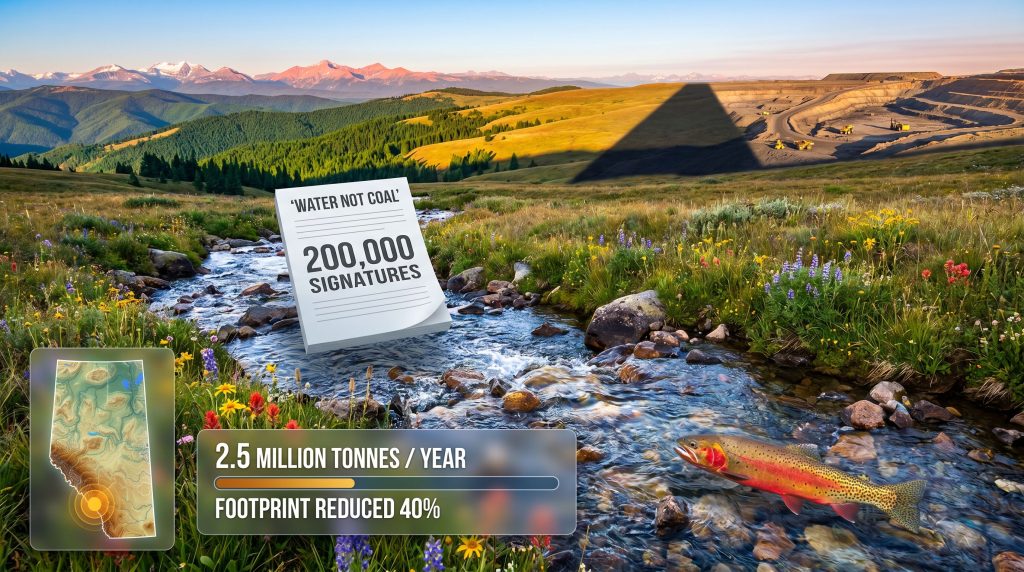
- A cut in planned annual extraction to 2.5 million tonnes per year, representing roughly half the originally proposed mining rate
The developer has also committed to burying selenium-bearing material during mining operations and constructing a purpose-built water treatment facility, arguing these measures eliminate the need for conventional tailings dams.
A Regulatory Timeline Built on Reversals
Few resource projects in Canadian history have experienced as volatile a regulatory journey as Grassy Mountain. Understanding why the project keeps returning requires tracing the instability of Alberta's coal policy framework itself.
| Year | Regulatory Development |
|---|---|
| Pre-2020 | Eastern Rockies coal development confined to designated zones for approximately 50 years |
| 2020 | Alberta temporarily removed long-standing restrictions; new lease sales initiated in previously protected areas |
| 2021 | Province suspended new lease sales following substantial public backlash; federal-provincial review panel rejected Grassy Mountain |
| 2025 | Restrictions lifted again by Alberta regulators; federal environmental assessment terminated at proponent's request in December 2025 |
| 2026 | Revised application submitted; two-year public feedback and regulatory review process begins |
Each policy reversal has effectively reset the regulatory clock for projects like Grassy Mountain, providing renewed commercial opportunity without requiring proponents to fundamentally resolve the environmental concerns that drove earlier rejections. This pattern is a source of deep frustration for opponents, who argue that the revolving door of policy changes has prevented the scientific and community concerns raised in 2021 from being treated as settled matters.
Why the 2021 Rejection Remains Central to the Debate
The joint federal-provincial review panel's 2021 decision established an explicit and well-documented basis for rejection. The panel found that adverse environmental effects on surface water quality and westslope cutthroat trout habitat outweighed the project's economic benefits, and formally concluded the development was not in the public interest.
That determination has not been overturned or revised. Instead, the regulatory pathway has been reopened through policy changes at the provincial level, leaving the 2021 findings standing as the most recent comprehensive scientific assessment of the project's impacts, and creating a situation where critics argue the science has not changed but the political environment has.
Following the rejection, Hancock Prospecting launched a C$2 billion (approximately US$1.4 billion) damages claim against the Canadian government. Furthermore, this legal action through trade dispute mechanisms introduces a dimension well beyond typical resource project disputes, placing bilateral trade law in direct tension with domestic environmental decision-making.
Who Is Opposing the Grassy Mountain Coal Mine, and Why?
A Coalition Broader Than Conventional Environmentalism
The Grassy Mountain coal mine Alberta opposition coalition is among the most diverse in the province's resource governance history. It does not fit the conventional framing of environmentalists versus industry, and understanding its breadth is essential to grasping why the project faces such entrenched resistance.
- Rural landowners and ranchers are concerned about selenium entering the Oldman River watershed, which feeds irrigation and drinking water systems across southern Alberta
- Commercial and recreational fishers are focused on documented threats to westslope cutthroat trout, already under pressure in the region
- First Nations communities, including Siksika and Kainai Nation, have raised formal concerns about watershed integrity and the protection of culturally significant sites
- Municipal governments, including the City of Lethbridge, have publicly opposed the project on downstream water security grounds
- Environmental organisations such as CPAWS Southern Alberta have maintained sustained opposition on both ecological and procedural grounds
- Cultural figures, most prominently country music artist Corb Lund, have given the movement mainstream visibility and public legitimacy
Lund, a 57-year-old Albertan who has won the Canadian equivalent of a Grammy alongside multiple Canadian Country Music Association awards, has described his engagement with the Grassy Mountain issue as the only political stance he has taken in three decades in the public eye. His reasoning, as publicly expressed, centres on a fundamental cost-benefit assessment: the risks to water and wildlife are disproportionately high relative to the economic returns that would accrue primarily to foreign shareholders rather than Albertan communities.
The Water Not Coal Petition: Scale and Mechanics
The citizen initiative now known as Water Not Coal represents one of the most significant grassroots mobilisations in Alberta's recent political history:
- More than 200,000 signatures gathered as of mid-2026
- Approximately 178,000 verified signatures required to trigger formal government consideration
- Around 3,000 volunteers canvassed across Alberta during winter and spring months
- Petition formally submitted to Elections Alberta
- Premier Danielle Smith has publicly indicated the question would be added to an October 19 referendum ballot if the petition qualifies
Norma Dougall, a canvasser who owns property near the proposed mine site, was part of the first public hearings on the project years ago and describes the experience of seeing it revived as a shock. She has publicly expressed the view that water represents a more fundamental long-term resource than coal, particularly coal extracted by a foreign company for export to Asian markets, and has stated her goal is a permanent ban to prevent the issue from cycling repeatedly through the regulatory system.
What Are the Core Environmental Risks Driving Opposition?
Selenium Contamination: A Technically Complex Threat
Selenium is a trace element that occurs naturally in the rock formations associated with coal deposits. When open-cut mining exposes these formations to weathering processes, selenium leaches into nearby waterways through drainage and surface runoff. What makes selenium particularly problematic in aquatic ecosystems is its toxicity at concentrations that would be considered negligible for many other contaminants.
Key characteristics of selenium contamination risk in the Grassy Mountain context include:
- Selenium is bioaccumulative, concentrating up the food chain rather than dispersing harmlessly
- Even at low aquatic concentrations, selenium disrupts fish reproduction and has been documented causing skeletal deformities and population collapse in affected waterways
- Alpine watershed environments present unique technical challenges for selenium management because cold temperatures, high seasonal variability in water flow, and complex hydrology complicate treatment system performance
- The long-term reliability of selenium burial and water treatment approaches at commercial scale in comparable settings remains contested among researchers
A study examining Alberta coal mines specifically documented serious threats to fish populations from mining-related water quality changes in comparable catchments, providing a local evidence base that reinforces the concerns raised in the 2021 review panel findings.
Westslope Cutthroat Trout and the Headwater Habitat Question
The westslope cutthroat trout occupies a specific ecological niche that makes it both an important conservation target and a sensitive indicator species for watershed health. Remaining populations are concentrated in undisturbed headwater streams of the eastern Rockies, precisely the hydrological zone most directly affected by the proposed mine footprint.
The 2021 review panel's explicit citation of this species as a grounds for rejection was not arbitrary. Westslope cutthroat trout require cold, clean, well-oxygenated water with low sediment loads, conditions that are difficult to maintain in the immediate vicinity of large-scale surface mining operations. Habitat fragmentation, altered flow regimes, and even marginal increases in suspended sediment or dissolved minerals can disrupt spawning success and juvenile survival rates significantly.
The Oldman River Watershed: Downstream Consequences at Scale
The hydrological connectivity of Rocky Mountain headwater systems is a technical reality that opponents argue is underweighted in proponent assessments. The Oldman River system:
- Supplies water to a significant portion of southern Alberta's agricultural sector
- Serves municipal water needs for communities including Lethbridge, a city of approximately 100,000 people
- Connects headwater tributaries near the mine site to downstream users across hundreds of kilometres
- Supports irrigation districts that represent substantial agricultural economic value for the region
When ranchers and irrigation districts downstream of the proposed mine identify water security as their primary concern, they are making a practical economic argument grounded in their dependence on the hydrological integrity of a system that originates in the foothills directly affected by the project.
How Does the Developer Respond to Environmental Concerns?
Northback's Position on Environmental Mitigation
Northback Holdings CEO Mike Young has publicly addressed both the environmental concerns and the foreign ownership dimensions of the project. On the environmental side, the company's revised proposal centres on three key modifications:
- A 40% reduction in the original project footprint
- Annual extraction rate reduced to 2.5 million tonnes, roughly half the originally proposed rate
- Commitment to selenium burial combined with a purpose-built water treatment facility, which Northback argues removes the need for conventional tailings dams
The developer's argument is that these modifications substantively address the specific concerns raised in the 2021 rejection, particularly around water quality management, and that the revised application represents a materially different proposal rather than a resubmission of the previously rejected project.
The Foreign Ownership Dimension
Young has stated publicly that being owned by a foreign company does not diminish or alter the legal and environmental obligations the operation must meet under Canadian law, and that Northback intends to meet those obligations in full as a Canadian-registered company.
Critics contest this framing on economic rather than legal grounds. The core argument is that regardless of legal compliance obligations, the financial returns from the operation would flow primarily to Australian shareholders, while the environmental risks and long-term stewardship responsibilities remain with Alberta's communities and public institutions. This distinction between legal accountability and economic benefit distribution sits at the heart of the foreign ownership debate.
Gina Rinehart, through her Hancock Prospecting entity, has not publicly responded to media requests for comment on the controversy.
The next major ASX story will hit our subscribers first
Canada's Metallurgical Coal Sector in 2026: Context and Scale
Where Canada and Alberta Sit in the Global Market
Understanding the commercial forces driving renewed interest in the Grassy Mountain project requires situating Canada within the global metallurgical coal landscape. In addition, examining the global steel outlook provides essential context for why investors remain drawn to Canadian metallurgical coal assets despite regulatory uncertainty.
| Metric | Detail |
|---|---|
| Canada's global rank in met coal production | 8th largest producer worldwide |
| Alberta's domestic rank | 2nd, behind British Columbia |
| Price environment | Near historic highs following post-2021 rally |
| Primary demand driver | Steel production in Asia, particularly India and Southeast Asia |
| Regulatory status | No national phase-out commitment for metallurgical coal, unlike thermal coal |
The steel industry's dependence on metallurgical coal as a chemical input rather than a fuel source is an important technical nuance. In conventional blast furnace steelmaking, coking coal undergoes a chemical transformation into coke, which then reacts with iron ore to produce liquid iron. This chemical role means that metallurgical coal cannot simply be replaced by renewable energy in the same way that thermal coal can be displaced by wind and solar power in electricity generation.
Alternative steelmaking technologies, including electric arc furnaces and hydrogen-based direct reduction processes, are advancing. However, their current market penetration remains limited and the transition to a metallurgical coal-free steel industry is widely understood to be a decades-long process rather than an imminent shift. Consequently, efforts around mining decarbonisation have become increasingly central to how the industry frames its long-term social licence.
The Referendum Mechanism and Alberta's Democratic Test
How Alberta's Citizen Initiative Process Works
Alberta's petition system provides a formal democratic pathway for citizens to compel government consideration of policy questions outside the legislative cycle. The mechanics are straightforward but the threshold is meaningful:
- Citizens collect verified signatures from registered Alberta residents
- The required threshold of approximately 178,000 verified signatures represents a substantial mobilisation requirement in a province of roughly 4.7 million people
- If the threshold is met, the question is presented to cabinet for a decision on whether to act or place it before voters
- Premier Smith has publicly confirmed the question would go to the October 19 ballot if the petition qualifies
- If successful, the referendum question would sit alongside up to 10 other questions on the same ballot
The Water Not Coal campaign's reported total of over 200,000 signatures suggests the threshold will be met, provided verification processes confirm the required number of eligible signatories.
The Smith Government's Political Dilemma
The governing United Conservative Party under Premier Danielle Smith faces a structural political tension. The government's 2025 decision to lift coal restrictions was consistent with its broadly pro-development resource policy orientation. However, the verified petition mechanism now creates a situation where overriding the democratic process would carry significant political costs.
The outcome of a referendum, if held, would carry precedential weight extending well beyond the Grassy Mountain project. A successful moratorium vote could effectively reinstate pre-2020 coal policy constraints through democratic rather than legislative means, creating a durable political barrier to eastern slopes coal development that future governments would find difficult to reverse.
Conversely, regulatory approval of the Grassy Mountain project, with or without a referendum, would signal that revised environmental mitigation plans can overcome prior scientific rejection. This could potentially open pathways for the separately proposed Valory Resources metallurgical coal project in the same region and for future applications across the eastern slopes. Furthermore, broader questions of mining sustainability will continue to shape how regulators and communities evaluate such proposals over time.
The Trade Law Dimension: A Precedent With International Reach
When Resource Project Rejections Trigger Billion-Dollar Trade Claims
Hancock Prospecting's C$2 billion damages claim against Canada introduces a dimension that extends far beyond Alberta's borders. The claim arises from the 2021 panel rejection and argues, in essence, that the regulatory decision caused quantifiable economic harm to a foreign investor.
This case is being monitored not only by Alberta stakeholders but by trade lawyers, environmental policy analysts, and resource governance researchers across Canada and internationally, for a straightforward reason: if trade law constrains how Canada can respond to foreign-backed resource project applications, it creates a chilling effect on future environmental decision-making.
The intersection of international investment protection agreements, domestic environmental assessment law, and citizen referendum mechanisms in this single case makes Grassy Mountain coal mine Alberta opposition arguably one of the most complex resource governance test cases in Canada's recent history.
The outcome will influence how policymakers, legal practitioners, and resource companies interpret the limits of regulatory authority over foreign-backed projects across multiple sectors and jurisdictions.
Frequently Asked Questions: Grassy Mountain Coal Mine Alberta Opposition
What is the Grassy Mountain coal mine?
A proposed metallurgical coal operation in the Rocky Mountain foothills of southwestern Alberta, backed by Northback Holdings, the Canadian subsidiary of Australian mining company Hancock Prospecting, controlled by Gina Rinehart.
Why was Grassy Mountain previously rejected?
A joint federal-provincial review panel rejected the project in 2021, finding that environmental harms to surface water quality and westslope cutthroat trout habitat outweighed the economic benefits, and that the project was not in the public interest.
What is the Water Not Coal petition?
A citizen-led initiative that has gathered more than 200,000 signatures calling for a moratorium on new coal development in Alberta's eastern Rockies. Surpassing approximately 178,000 verified signatures triggers formal government consideration or a public referendum.
What environmental risks does the mine pose?
The primary concerns include selenium leaching into the Oldman River watershed, destruction of westslope cutthroat trout habitat, and long-term water quality degradation affecting agriculture, drinking water, and downstream ecosystems across southern Alberta.
How has the developer modified the proposal?
Northback has reduced the project footprint by 40%, cut the annual extraction rate to 2.5 million tonnes, and committed to selenium burial and a water treatment facility to address earlier environmental objections.
What is the current regulatory status?
As of late 2025, the federal environmental assessment was terminated at the proponent's request. The revised application is subject to a two-year public feedback and regulatory review process before any further hearing.
This article is based on publicly available reporting and regulatory documentation. It does not constitute financial or investment advice. Forward-looking elements, including referendum outcomes, regulatory decisions, and trade dispute resolutions, remain subject to significant uncertainty and should not be relied upon as predictions of future events.
Want to Stay Ahead of Major Mineral Discoveries on the ASX?
While Alberta's coal governance debate illustrates how swiftly the regulatory and commercial landscape around resources can shift, Discovery Alert's proprietary Discovery IQ model delivers real-time alerts the moment significant mineral discoveries are announced on the ASX — cutting through market complexity across more than 30 commodities to surface actionable opportunities for both short-term traders and long-term investors. Explore how historic discoveries have generated substantial returns on Discovery Alert's dedicated discoveries page, and begin your 14-day free trial today to position yourself ahead of the broader market.