August 13, 2026
The Invisible Infrastructure That Shapes Mining Profitability
Before a single ounce of copper reaches a smelter or a tonne of iron ore boards a bulk carrier, it travels along a system that most investors and observers rarely think about: the conveyor belt. These continuous mechanical arteries move hundreds of millions of tonnes of material annually across some of the world's most remote and demanding environments. Yet for all their operational centrality, conveyor systems have historically been managed reactively, maintained by crews conducting manual inspections, and replaced only when failure became unavoidable.
That approach is becoming untenable. As tier-one miners face simultaneous pressure from energy cost volatility, Scope 3 emissions reporting obligations, and the compounding financial consequences of unplanned downtime, the conveyor belt has quietly moved from a background utility to a frontline strategic asset. The deployment of BHP AI conveyor operations with BOTON represents one of the most technically substantive examples of this shift occurring anywhere in the global mining industry today.
When big ASX news breaks, our subscribers know first
Why Conveyor Systems Have Become a Strategic Priority for Major Miners
The Hidden Cost of Conveyor Inefficiency in Large-Scale Mining
Conveyor systems rank among the highest continuous energy consumers on any operating mine site. Unlike haul trucks or processing equipment that cycle on and off, conveyors run around the clock, often spanning several kilometres of terrain, and their energy draw is relentless. A belt running in a degraded state, whether misaligned, partially torn, or loaded unevenly, does not simply consume more energy in isolation. It compounds costs across multiple dimensions simultaneously.
Unplanned conveyor stoppages generate cascading losses that extend well beyond the immediate production halt:
- Lost throughput volumes during the stoppage window, directly reducing saleable production
- Elevated energy consumption during restart cycles, when motors draw peak power to overcome belt inertia
- Accelerated mechanical wear from the stoppage-restart cycle itself, shortening component lifespans
- Labour mobilisation costs for emergency repair crews, particularly at remote operations
- Potential secondary damage to downstream processing equipment when feed supply is disrupted
For a mining operation of BHP's scale, where individual conveyor networks can service operations producing hundreds of thousands of tonnes per day, even marginal improvements in belt uptime translate into material financial outcomes across multiple jurisdictions.
From Procurement to Strategic Partnership: A Structural Shift in Supplier Models
The traditional mining procurement model treated equipment suppliers as delivery counterparties. A specification was issued, equipment was supplied, and the operational management burden transferred entirely to the mine operator. Innovation cycles were slow, warranty obligations were finite, and post-delivery engagement was largely transactional.
That model is being systematically dismantled by the operational and regulatory demands now facing tier-one miners. Furthermore, data-driven mining operations are increasingly reshaping how these supplier relationships are structured and evaluated. The BHP AI conveyor operations with BOTON partnership represents the emerging alternative: a co-development framework where technology risk, innovation investment, and sustainability accountability are distributed across both parties rather than sitting entirely with the operator.
The transition from vendor to strategic partner is not merely a commercial arrangement. It reflects a recognition that the specialist knowledge required to optimise intelligent conveyor systems, encompassing belt engineering, AI inference architecture, and lifecycle carbon methodology, cannot be efficiently developed in-house by miners whose core competency lies in extraction and processing.
What Is the BHP-BOTON Global Framework Agreement?
Scope and Strategic Intent of the Partnership
The Global Framework Agreement formally restructures the BHP-BOTON relationship across three interconnected pillars:
- Intelligent automation: Co-development and deployment of AI, robotic, and sensing technologies embedded directly into conveyor infrastructure
- Lower-carbon operations: Joint investigation of full-lifecycle carbon tracking, supply chain emissions methodology, and circularity solutions for used belt materials
- Expanded service capability: Establishment and scaling of localised technical support infrastructure positioned across BHP's key operating regions
Prior to this agreement, BOTON's role was defined by product supply. The new framework repositions the company as a co-developer and long-term operational partner, with shared accountability for performance outcomes that extend well beyond the point of equipment delivery.
BHP's announcement of the agreement describes the partnership as advancing the next generation of mining conveyor solutions, framing it as a convergence of productivity improvement, decarbonisation ambition, and long-term operational value creation across the company's global asset base. BHP's Chief Commercial Officer Rag Udd characterised the initiative in precisely these terms.
BOTON Chairman Bao Zhifang characterised the agreement as a milestone in the company's evolution from product supplier to strategic partner, describing it as the foundation for the next phase of the two organisations' collaboration.
What AI Technologies Are Being Applied to BHP's Conveyor Systems?
A Technical Breakdown of the Intelligent Conveyor Stack
The technology suite being developed and deployed under the BHP-BOTON framework addresses the primary failure modes that drive unplanned conveyor downtime across large-scale mining operations.
| Technology | Function | Operational Benefit |
|---|---|---|
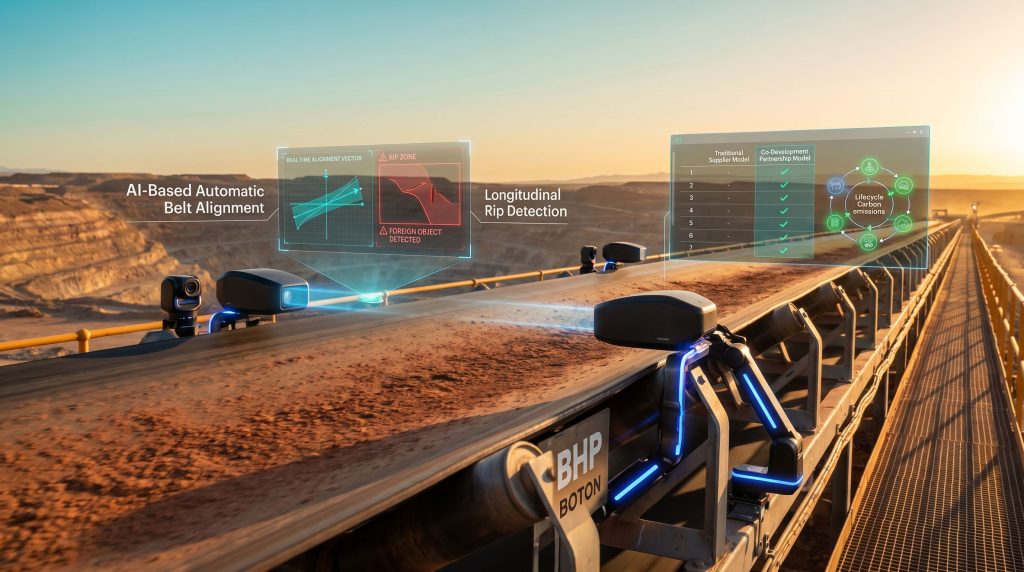
| AI-Based Automatic Belt Alignment | Detects and corrects lateral belt drift in real time | Prevents edge wear, reduces unplanned shutdowns |
| Longitudinal Rip Detection | Identifies tears running along the belt length before they propagate | Avoids catastrophic belt failure and extended downtime |
| X-Ray Digital Scanning | Provides subsurface imaging of belt integrity not visible externally | Enables predictive maintenance before surface damage appears |
| Robotic Inspection Systems | Automates physical inspection across long conveyor runs | Removes personnel from hazardous zones, improves inspection frequency |
| Computer Vision Systems | Detects spillage, oversized material, and foreign objects in real time | Triggers automatic operational responses without human intervention |
A Step-by-Step View of How AI Conveyor Systems Actually Operate
Understanding how these systems function in practice clarifies why the integrated hardware-software approach being pursued through BHP AI conveyor operations with BOTON is technically superior to retrofit software deployments. In addition, AI-powered mining efficiency gains from similar hardware-native approaches have already been demonstrated across other operational contexts:
- Sensor arrays and camera networks are installed at regular intervals along the conveyor structure, continuously capturing operational data across multiple parameters simultaneously
- AI inference engines process incoming data streams in real time, comparing live readings against trained baseline models derived from historical operational patterns
- Anomaly detection algorithms flag deviations, including misalignment trends, rip propagation signatures, and foreign object presence, before they escalate into failure events
- Automated response protocols either execute mechanical corrections directly (such as belt realignment actuators) or generate prioritised maintenance alerts for human review
- Centralised data logging builds a continuous operational record that feeds predictive maintenance scheduling, remaining-life modelling, and capital replacement planning
A critical technical nuance that is not widely appreciated outside specialist belt engineering circles: longitudinal rip detection is particularly challenging because tears can propagate rapidly along the full belt length once initiated, turning a localised material damage event into a catastrophic failure within minutes. X-ray scanning addresses a related problem, identifying subsurface steel cord damage that is completely invisible to surface-level camera inspection but that will eventually cause belt separation under load. These are failure modes where the consequences of detection lag are asymmetric and severe.
Where Is This Technology Being Piloted First?
BHP's Escondida copper operation in northern Chile serves as the primary proving ground for the initial AI conveyor technology deployment. Escondida is one of the largest copper mines in the world by production volume, and its operational scale and complexity make it an ideal environment for validating intelligent conveyor systems before broader rollout across BHP's global portfolio. The Chile copper supply gap context makes this pilot site particularly significant for the industry's long-term supply outlook.
The validate-at-scale-then-deploy approach reflects sound risk management for technology adoption in critical infrastructure. Escondida's operational intensity means that performance benchmarks established there carry credibility across different geological settings, climatic conditions, and throughput profiles.
How Does This Fit Into BHP's Broader AI and Automation Strategy?
AI as an Operational Reliability Tool Across BHP's Asset Base
BHP has been systematically deploying computer vision and AI-based monitoring systems across its operational infrastructure for several years, targeting autonomous anomaly detection as a core reliability improvement mechanism. Consequently, AI transforming mining practices more broadly has become a defining strategic theme across the sector. The BOTON partnership accelerates this trajectory in a structurally important way: rather than applying AI as an aftermarket software layer on top of existing hardware, the intelligence capability is being co-developed and embedded directly into the conveyor equipment and service model itself.
This distinction matters more than it might initially appear. Retrofit AI deployments are inherently constrained by the sensor architecture and data accessibility of the underlying hardware. When the equipment supplier co-develops the intelligence layer, sensor placement, data resolution, and system integration can be optimised from the ground up for the specific detection objectives, producing fundamentally better performance outcomes.
The Safety Dimension of Intelligent Conveyor Systems
Manual belt inspection, which involves personnel physically walking extended conveyor runs to identify damage or misalignment, carries inherent occupational health and safety risks in mining environments. Confined spaces, moving belt sections, and remote locations create exposure scenarios that automated robotic inspection systems eliminate entirely.
Beyond removing hazard exposure, automated systems inspect more frequently and consistently than human crews. A robotic inspection system operating continuously captures a richer operational dataset than periodic manual inspections, enabling predictive maintenance models to operate on higher-quality inputs.
What Is the Carbon Reduction Dimension of the BHP-BOTON Partnership?
Full-Lifecycle Carbon Tracking for Conveyor Systems
The sustainability component of the BHP AI conveyor operations with BOTON agreement targets a challenge that the broader mining industry has not yet resolved at scale: tracking the complete carbon footprint of conveyor belt systems from raw material extraction through manufacturing, operational life, and end-of-life disposal or recycling.
This is technically demanding because conveyor belts incorporate multiple carbon-intensive material streams:
- Steel cord reinforcement: Produced through energy-intensive steelmaking processes with substantial embedded carbon
- Synthetic rubber compounds: Derived from petrochemical feedstocks with complex upstream emission profiles
- Textile reinforcement layers: Manufactured through processes that vary significantly in carbon intensity across different producing regions
Scope 3 emissions, which encompass the carbon footprint generated across a company's entire value chain rather than at its own operating facilities, are increasingly subject to mandatory disclosure requirements from financial regulators and sustainability reporting frameworks in multiple jurisdictions. For major miners, this regulatory trajectory creates direct contractual pressure on suppliers to provide auditable, granular emissions data across the full product lifecycle, not merely at point of sale.
The Circularity Challenge in Conveyor Belt End-of-Life Management
Used conveyor belts represent a significant and largely unsolved waste stream for large-scale mining operations. Steel cord belts in particular are difficult to recycle because the rubber and steel components are bonded under high pressure and require specialised processing to separate. The BHP-BOTON partnership includes investigation of recycling and circularity solutions for used belts, which, if successfully developed, would address a material gap in the industry's sustainability performance.
It is important to note that the current agreement commits both parties to investigating these capabilities. No binding delivery timelines or quantified emissions reduction targets have been established at this stage, reflecting the early-development nature of full-lifecycle carbon methodology for industrial conveyor systems.
Why Scope 3 Disclosure Is Reshaping Supplier Relationships
The regulatory trajectory around Scope 3 emissions disclosure is accelerating across multiple major financial markets simultaneously. However, broader mining decarbonisation trends suggest that lifecycle emissions accountability will eventually extend well beyond conveyor systems to every major equipment category on site. Investors with sustainability mandates are increasing their scrutiny of value chain emissions data, and reporting frameworks are progressively tightening verification standards.
For a major miner operating at BHP's scale, the inability to provide granular Scope 3 data from key suppliers creates both regulatory risk and investor relations exposure. BOTON's commitment to developing lifecycle carbon tracking capability signals that major equipment suppliers are recognising this shift and adapting their service propositions accordingly. Suppliers that cannot provide verifiable emissions data across the full product lifecycle will increasingly find themselves at a competitive disadvantage in procurement decisions made by sustainability-committed operators.
The next major ASX story will hit our subscribers first
How Is BOTON Expanding Its Service Infrastructure?
Local Service Presence Across BHP's Key Mining Regions
The partnership includes BOTON establishing and expanding frontline service stations in Australia and Thailand, positioning maintenance and AI system support teams closer to BHP's operating footprint. This geographic positioning directly addresses one of the most significant operational risks associated with deploying sophisticated AI and robotic systems at remote mine sites: the logistical challenge of accessing specialist technical support when faults occur.
Remote mining operations face response time constraints that carry substantial financial implications. A conveyor fault requiring specialist technical intervention that cannot be resolved within hours can translate into production losses measured in tens of thousands of tonnes of ore, with corresponding revenue and processing cost consequences. Embedded regional service capability fundamentally changes this risk profile. Australian Mining's coverage of the partnership highlights how this localised support model is being positioned as a key differentiator in the next generation of conveyor technology deployment.
What This Partnership Signals About the Future of Mining Supplier Relationships
The Co-Development Model: A New Value Architecture for Mining Supply Chains
| Dimension | Traditional Supplier Model | Co-Development Partnership Model |
|---|---|---|
| Supplier Role | Product vendor | Strategic technology partner |
| Innovation Responsibility | Operator-led | Jointly shared |
| Emissions Accountability | Point-of-sale only | Full lifecycle |
| Service Model | Reactive maintenance | Proactive, in-region embedded support |
| Contract Structure | Transactional procurement | Framework agreement with joint programmes |
| Technology Integration | Retrofit software | Hardware-native intelligence |
The BHP AI conveyor operations with BOTON framework offers a replicable template for how tier-one miners can accelerate technology deployment while distributing innovation costs and capturing supplier domain expertise that would be prohibitively expensive to develop internally.
Scope 3 reporting pressure will likely push other large-scale operators toward similar lifecycle tracking partnerships with major equipment suppliers across multiple commodity categories and asset classes. The Escondida pilot model, validating at scale before global deployment, provides a risk-managed pathway that other operators can adapt to their own portfolio structures and technology readiness levels.
Disclaimer: This article is intended for informational purposes only and does not constitute financial or investment advice. Forecasts, strategic outcomes, and technology performance referenced herein are subject to material uncertainty. Readers should conduct independent research before making any investment decisions.
Frequently Asked Questions: BHP AI Conveyor Operations With BOTON
What is the BHP and BOTON Global Framework Agreement?
It is a formal strategic partnership that expands BOTON's role beyond conveyor belt supply to include co-development of AI and robotic conveyor technologies, full-lifecycle carbon tracking initiatives, and expanded in-region service support across BHP's global mining operations.
What AI technologies are being deployed on BHP's conveyor systems?
The partnership is developing AI-based automatic belt alignment, longitudinal rip detection, X-ray digital scanning, robotic inspection systems, and computer vision platforms capable of detecting spillage, oversized material, and foreign objects in real time.
Where is the AI conveyor technology being piloted first?
The initial deployment is underway at BHP's Escondida copper mine in northern Chile, with plans to scale validated technologies across BHP's broader global operations once performance benchmarks are established.
How does the partnership address carbon emissions?
BHP and BOTON are investigating a joint Supply Chain Partner Programme to track carbon emissions across the full conveyor lifecycle, covering raw material sourcing, manufacturing, operation, and end-of-life recycling, directly supporting Scope 3 emissions disclosure requirements.
Why is BOTON expanding service operations in Australia and Thailand?
Localised service infrastructure reduces response times for maintenance and technical support, which is critical for minimising downtime costs and enabling the deployment and ongoing operation of new AI and robotic conveyor systems at BHP's regional operations.
What does this partnership mean for the future of mining supplier relationships?
It reflects a structural industry shift from transactional equipment procurement toward co-development models where suppliers share responsibility for operational performance, technology innovation, and sustainability outcomes across the full asset lifecycle.
Want To Spot The Next Major ASX Mining Discovery Before The Market Does?
Discovery Alert's proprietary Discovery IQ model scans ASX announcements in real time, instantly converting complex mineral data across 30-plus commodities into clear, actionable insights for both short-term traders and long-term investors — the same way cutting-edge technology is reshaping operational efficiency across the mining sector. Start your 14-day free trial today, or explore Discovery Alert's discoveries page to see how historic mineral discoveries have delivered extraordinary returns for investors positioned ahead of the market.