June 4, 2026
The Hidden Engineering Challenge Holding Back Open-Pit Mine Automation
For decades, the mining industry has pursued a deceptively simple ambition: remove people from the most dangerous places while simultaneously improving the productivity of the machinery that replaces them. Underground automation has made meaningful progress, but the open-pit environment presents a fundamentally different set of challenges. Larger operating areas, dynamic blast sequencing, unpredictable bench geometry, and the need to coordinate multiple machine types across vast terrain have consistently made surface drilling one of the hardest domains to fully automate at scale.
That difficulty is precisely why the joint development agreement between Sandvik and Rio Tinto targeting Sandvik and Rio Tinto autonomous open-pit drilling capability represents something worth examining in technical and strategic depth. This is not a standard equipment procurement arrangement. It is a co-development programme aimed at solving one of the genuinely unsolved engineering problems in large-scale surface mining: making multiple drill rig models, built on different control architectures, operate cohesively within a shared autonomous platform.
When big ASX news breaks, our subscribers know first
What the Partnership Actually Involves
The collaboration centres on integrating Sandvik's i-series surface drill rigs with Rio Tinto's proprietary Autonomous Drilling System, referred to within Rio Tinto as ADS. The objective extends beyond making a single rig model autonomous. The partnership is specifically designed to build interoperable capability across multiple rig types and multiple mine sites simultaneously, a level of sophistication that distinguishes this effort from earlier, more isolated automation deployments.
Sandvik's contribution to the integration rests heavily on its AutoMine platform, an automation and remote-control system developed for surface drilling applications. AutoMine manages the sequence of autonomous drilling operations by coordinating onboard sensors, navigation systems, and machine learning algorithms that interpret real-time data from the rig's interaction with rock. The system allows a drill rig to execute hole positioning, penetration, and retraction cycles without requiring an operator physically present on the machine.
The i-series rigs were selected as the integration platform because their onboard architecture offers a compatible foundation for connecting with Rio Tinto's ADS software layer. However, aligning two independently developed control systems is not a straightforward software update. It involves resolving fundamental differences in how each system classifies operational states, handles exception conditions, and communicates machine status across a network.
Rio Tinto's Autonomous Drill Fleet: What Already Exists
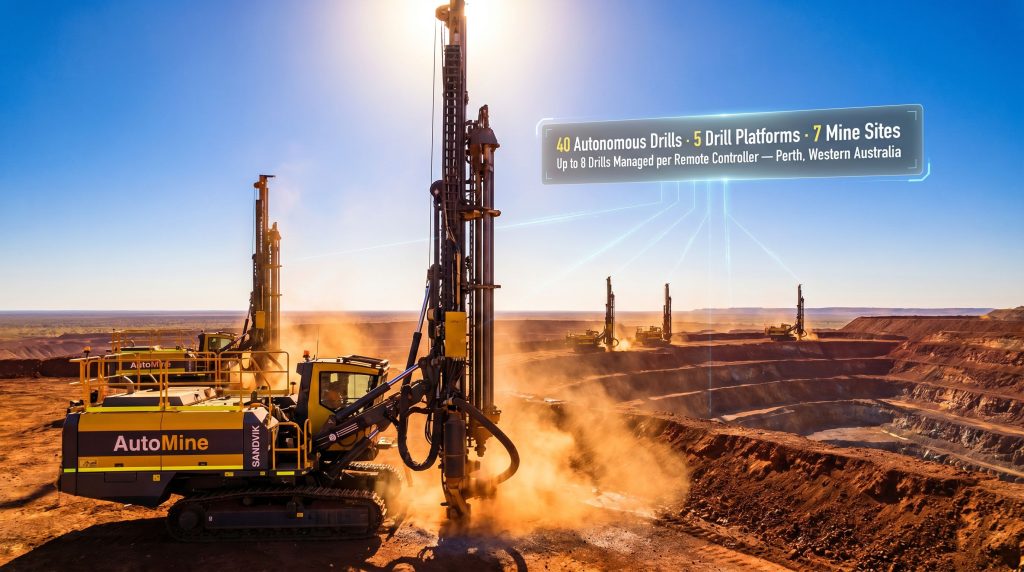
Understanding what Rio Tinto has already built is essential context for appreciating the ambition of the next phase. The company currently operates one of the largest autonomous drill fleets anywhere in the world, concentrated within its Pilbara iron ore operations in Western Australia. Furthermore, AI-powered mining efficiency across platforms like these has become an increasingly critical driver of competitive advantage in the sector.
| Metric | Current Rio Tinto Autonomous Drill Fleet |
|---|---|
| Number of autonomous drills | 40 |
| Drill platforms covered | 5 |
| Mine sites operating autonomously | 7 |
| Drills managed per remote controller | Up to 8 |
| Remote operations hub location | Perth, Western Australia |
From a single console at Rio Tinto's Operations Centre in Perth, a controller can manage shift activity across up to 8 drills simultaneously, spread across several geographically separate mine sites. This centralised intelligence and decentralised execution model fundamentally changes the economics of drill fleet management. Fewer personnel are required at remote sites, supervision quality becomes more consistent, and response times to operational exceptions can actually improve when experienced controllers are managing multiple rigs from a purpose-built command environment rather than sitting in a cab at a single machine.
This operational model did not appear overnight. Rio Tinto developed its autonomous drilling capability progressively, drawing heavily on lessons from its AutoHaul autonomous haulage programme, which became the world's first heavy-haul autonomous rail network. The discipline of building reliable remote operations infrastructure, validating safety protocols for unmanned heavy equipment, and training operators to supervise rather than directly control machinery transferred meaningfully from haulage into drilling contexts.
The Two-Phase Development Roadmap
Engineering Integration in Finland
The initial phase of development is planned to take place at Sandvik's engineering and manufacturing facilities in Finland, where the company maintains its primary R&D infrastructure for surface drilling equipment. This controlled environment allows engineers from both organisations to work through the technical integration challenges without the added complexity of live mine site conditions.
The core engineering task involves aligning Sandvik's rig control architecture with Rio Tinto's ADS software layer. Key milestones during this phase are expected to include:
- Establishing communication protocols between Sandvik's onboard systems and the ADS platform
- Validating autonomous drill cycle execution across representative ground conditions
- Developing interoperability frameworks that can be extended to additional rig models beyond the initial i-series platform
- Building the data feedback infrastructure that will support iterative improvement during field trials
Field Trials at Rio Tinto's Perth Operations Centre
Once the engineering integration reaches sufficient maturity, testing transitions to live operational conditions managed through Rio Tinto's Operations Centre in Perth. This shift from controlled laboratory conditions to real-world mine environments is where autonomous systems face their most demanding tests.
Variable geology, dust accumulation on sensors, irregular bench geometry, and the need to coordinate autonomous drills with other autonomous equipment such as haul trucks and dozers all introduce failure modes that simply cannot be replicated in a Finnish engineering facility. The field trial phase is designed to stress-test every assumption made during the integration work and generate the performance data needed to refine both software and hardware before broader deployment.
Technical note: Real-world field trials in the Pilbara environment are particularly demanding because the iron ore operations involve extremely high bench utilisation rates, tight blast scheduling windows, and dust conditions that can degrade sensor performance. Any autonomous system deployed here must perform reliably under conditions that would challenge even experienced human operators.
Why Interoperability Is the Defining Technical Challenge
The most technically ambitious aspect of this collaboration is the interoperability objective. Most autonomous drilling deployments to date have involved a single rig model operating on a purpose-built control system developed specifically for that machine. Extending autonomous control across multiple drill models from potentially different manufacturers, on a shared platform, is an entirely different engineering proposition.
The difficulty stems from several compounding factors:
- Different rig architectures mean different sensor suites, actuator configurations, and onboard computing environments that do not share common interfaces.
- Proprietary control system logic developed independently by different manufacturers uses incompatible state machine structures and exception-handling frameworks.
- Calibration requirements differ between rig types, meaning the autonomous platform must dynamically adjust its performance models depending on which machine it is managing.
- Safety validation processes must be repeated for each new rig type added to the platform, as regulatory and operational safety cases are machine-specific.
The analogy to autonomous haulage is instructive. Mixed-fleet autonomous truck operations, where vehicles from different manufacturers share a common traffic management and collision avoidance layer, took considerable time and deliberate standardisation effort to achieve. Surface autonomous drilling is at an earlier stage of that same journey. In addition, mining automation transformation across haulage and drilling domains continues to accelerate as operators commit to larger co-development programmes.
Autonomous Drilling vs. Autonomous Haulage: A Maturity Comparison
| Dimension | Autonomous Haulage | Autonomous Drilling |
|---|---|---|
| Industry maturity | Advanced, commercially deployed at scale | Emerging, limited multi-site deployments |
| Interoperability across OEMs | Limited but improving | Early-stage development |
| Remote operation capability | Well established | Developing rapidly |
| Regulatory frameworks | More defined | Still evolving |
| Primary safety benefit | Collision avoidance | Blast-zone personnel removal |
The table above highlights that autonomous drilling is roughly one technology generation behind autonomous haulage in terms of commercial readiness and regulatory clarity. This gap represents both a challenge and an opportunity. Operators who invest in building autonomous drilling capability now are positioning themselves ahead of what is likely to become an industry standard within the next decade.
The next major ASX story will hit our subscribers first
The Technical Components of an Autonomous Drilling System
Core Technologies Enabling Surface Drill Automation
A functional autonomous drilling system integrates several distinct technology layers, each addressing a different aspect of the drilling operation:
- Positioning and navigation: High-precision GPS-RTK systems combined with terrain mapping algorithms enable drill rigs to locate and verify hole positions to centimetre-level accuracy, directly improving blast fragmentation outcomes.
- Drill parameter optimisation: Real-time feedback from downhole sensors allows the system to adjust feed force, rotation speed, and air pressure dynamically as the drill bit encounters variations in rock hardness. This is the equivalent of an experienced driller reading ground conditions, but executed algorithmically at a speed and consistency no human can match.
- Collision avoidance and proximity detection: LiDAR, radar, and camera arrays create a 360-degree awareness envelope around the machine, enabling it to detect personnel, vehicles, and obstacles within the active pit environment.
- Remote monitoring dashboards: Multi-rig, multi-site visibility allows controllers at a central hub to monitor performance metrics, identify deviations from planned drilling patterns, and intervene remotely when required.
- Machine health telemetry: Predictive maintenance in mining signals generated by autonomous rigs are integrated into control loops, flagging potential mechanical failures before they cause unplanned downtime.
Why Open-Pit Drilling Is Harder to Automate Than Underground Drilling
Underground automation benefits from a constrained physical environment. Tunnels define movement corridors, positions are more predictable, and the range of possible machine interactions is limited. Open-pit surface drilling, however, operates in a far more dynamic space.
Key complexities unique to surface environments include the coordination challenge between autonomous drills and other autonomous equipment types, the impact of weather and sunlight angle changes on optical and LiDAR sensor performance, and the requirement to manage dynamic blast pattern updates in real time as geological conditions deviate from pre-drill models.
Multi-rig coordination at scale, where several autonomous drills operate simultaneously within the same pit section while respecting blast sequence priorities and equipment exclusion zones, remains the defining unsolved problem in surface drill automation. The broader application of AI in drilling and blasting continues to evolve rapidly as operators demand more integrated solutions.
How This Reshapes the Operator's Role
The transition from machine-based operators to remote supervisors managing multiple rigs simultaneously is not simply a workflow change. It represents a fundamental redefinition of the skills that mining operations require. Drill operators in an autonomous fleet environment need capabilities that include:
- Interpreting real-time performance data streams across multiple machines simultaneously
- Recognising anomalous drilling signatures that may indicate unexpected geological conditions or mechanical issues
- Managing exception events remotely, including overriding autonomous decisions when contextual factors are not fully captured by onboard sensors
- Coordinating with blast planning teams to ensure autonomous drill outputs align with fragmentation requirements
This skill evolution has significant implications for workforce planning at remote mine sites and for training programmes that currently focus on direct machine operation rather than systems supervision.
The Vendor-Operator Co-Development Model and Its Industry Implications
The structural dynamic of this collaboration is as significant as its technical content. Traditional mining equipment procurement involves an operator specifying requirements and an OEM delivering a product. The Sandvik and Rio Tinto arrangement inverts part of that model by embedding the operator directly into the development process.
This approach accelerates technology development because the operator provides real operational data, genuine use cases, and live testing environments that no OEM can replicate independently. In return, the OEM gains validated performance evidence and a reference customer whose operational scale lends credibility to the resulting technology. Consequently, data-driven mining operations of this kind are increasingly viewed as the template for how major miners and equipment suppliers will structure their partnerships going forward.
The competitive pressure this creates on other drill equipment manufacturers is substantial. If this collaboration successfully demonstrates multi-rig, multi-model autonomous drilling at commercial scale, as reported by Mining Technology, it will establish a capability benchmark that competitors will need to match to remain relevant to large mining operators.
Industry perspective: The broader trajectory of mining automation suggests that operators who can demonstrate autonomous drilling capability will eventually face lower insurance costs, reduced workforce accommodation expenses at remote sites, and more consistent drill-hole quality translating into measurable improvements in blasting efficiency and downstream processing costs.
Frequently Asked Questions
What is Rio Tinto's Autonomous Drilling System?
Rio Tinto's ADS is a proprietary control platform enabling drill rigs to execute complete drilling cycles, including hole positioning, penetration control, and retraction, with minimal human involvement. The system is managed remotely from the company's Operations Centre in Perth, where controllers can supervise multiple rigs across several mine sites from a single workstation.
What makes Sandvik's AutoMine platform relevant for autonomous surface drilling?
AutoMine is designed to manage the full operational sequence of a surface drill rig autonomously. It integrates navigation, drilling parameter control, and safety response functions into a unified system that eliminates the requirement for an operator to be physically present on the machine during normal operations.
Where will development and testing take place?
Engineering integration work is planned to begin at Sandvik's facilities in Finland. Subsequent field trials will be conducted through Rio Tinto's Operations Centre in Perth, Western Australia, using live operational mine environments for real-world system validation.
What does interoperability mean in autonomous drilling terms?
Interoperability refers to the capability for drill rigs built on different mechanical and control architectures to operate cohesively within a single autonomous management platform. Achieving this would allow operators to manage mixed-brand drill fleets through unified software rather than maintaining separate autonomous systems for each rig type.
What are the primary benefits of autonomous open-pit drilling?
The principal advantages include removing personnel from blast-zone hazard areas, enabling extended operational hours without fatigue-related performance degradation, improving drill-hole positional accuracy to enhance blast fragmentation quality, and allowing centralised remote management of large multi-site drill fleets from a single control facility.
What This Partnership Signals for Mining's Autonomous Future
The collaboration between Sandvik and Rio Tinto is best understood not as a single technology project but as a reference point for where large-scale open-pit mining is heading. The milestones most worth watching in the near term include the completion of the engineering integration phase in Finland, the results of initial field trials at the Perth Operations Centre, and any announcements regarding the expansion of interoperability testing to additional rig models beyond the i-series platform.
Longer term, the data generated by autonomous drill fleets of this kind has value that extends well beyond operational efficiency. Continuous downhole sensor data from autonomous rigs, collected at a density and consistency impossible to achieve with human-operated equipment, has the potential to materially improve geological models and resource estimation accuracy. Sandvik and Rio Tinto's autonomous open-pit drilling programme, as outlined in Sandvik's own announcements, represents that secondary value — the conversion of drilling operations into a continuous geological intelligence feed — which may ultimately prove as commercially significant as the direct productivity gains.
Disclaimer: This article contains forward-looking assessments regarding technology development timelines and industry trends. These represent informed analysis based on publicly available information and should not be interpreted as investment advice or guarantees of future commercial outcomes. Technology development timelines in the mining sector are subject to technical, regulatory, and operational variables that can materially alter anticipated outcomes.
Want to Track the Next Major ASX Mining Discovery Before the Market Catches On?
Discovery Alert's proprietary Discovery IQ model scans ASX announcements in real time, delivering instant alerts on significant mineral discoveries — from emerging exploration plays to potentially transformative finds — so investors can act with confidence rather than hindsight. Explore historic discovery returns on Discovery Alert's dedicated discoveries page and begin a 14-day free trial to position ahead of the broader market.