June 4, 2026
The Executives Redefining Power in Africa's Mining Sector
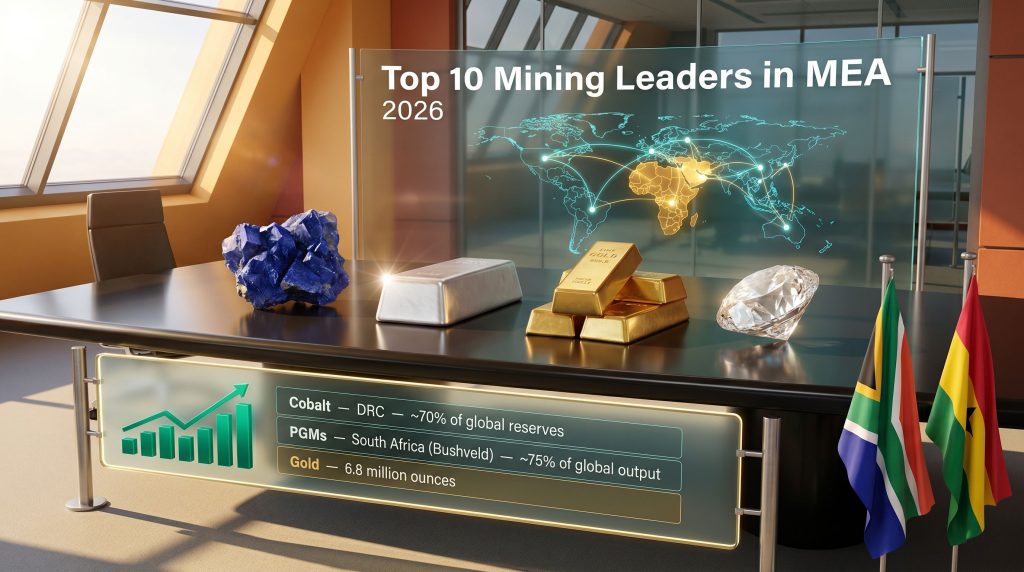
Few industries reveal the structural tensions of the modern global economy as clearly as mining in the Middle East and Africa. Understanding who sits among the top 10 mining leaders in MEA requires looking well beyond headline production numbers. The region sits atop geological wealth that the rest of the world urgently needs, yet extracting and delivering that wealth requires navigating sovereign risk, infrastructure constraints, shifting capital market expectations, and the accelerating demands of the energy transition.
The executives who manage this complexity successfully are not simply running large businesses. They are making decisions that cascade across global supply chains, national economies, and technology sectors simultaneously. Furthermore, for context on how North America mining leaders approach similar challenges, the contrast with MEA is particularly instructive.
Reserve growth trajectories, balance sheet discipline under commodity price pressure, workforce outcomes across some of the world's most challenging operating environments, and the ability to reposition portfolios before cycles turn are all meaningful signals of genuine leadership quality. What follows is an assessment of the top 10 mining leaders in MEA whose decisions are shaping the region's resource sector in 2026, ranked by strategic influence and operational consequence.
When big ASX news breaks, our subscribers know first
The Geological Foundation That Makes MEA Irreplaceable
Before examining the individuals, it is worth understanding why MEA commands such disproportionate attention from global capital markets and industrial supply chains.
| Commodity | Primary MEA Jurisdiction | Approximate Global Supply Share | Key Industrial Application |
|---|---|---|---|
| Cobalt | Democratic Republic of Congo | ~70% of global reserves | Lithium-ion batteries |
| Platinum Group Metals | South Africa (Bushveld Complex) | ~75% of global PGM output | Catalytic converters, hydrogen fuel cells |
| Gold | South Africa, West Africa, DRC | Top global producing region | Electronics, store of value |
| Iron Ore | South Africa (Northern Cape) | Significant seaborne volumes | Steel for Asia and Europe |
| Diamonds | Botswana, Namibia | Major global gem supply | Industrial and luxury markets |
| Thermal Coal | South Africa | Domestic baseload power | Eskom energy security |
The Bushveld Complex in South Africa's Limpopo province is arguably the most mineralogically significant geological structure on earth, hosting the planet's largest known deposits of platinum, palladium, rhodium, and chrome within layered igneous intrusions. Similarly, the Birimian greenstone belt stretching across West Africa represents one of the world's most prolific gold-bearing geological terrains. Understanding the geology explains why these executives wield influence that extends far beyond their company balance sheets.
What Genuine Strategic Leadership Looks Like in MEA Mining
The criteria for inclusion on this list extend well beyond asset scale. The most influential top 10 mining leaders in MEA are assessed across four dimensions:
- Portfolio significance in relation to energy transition and established commodity demand
- Operational complexity managed across multiple sovereign jurisdictions simultaneously
- Capital allocation discipline during periods of commodity price volatility
- Transformation credentials, including evidence of restructuring, acquisition integration, or strategic divestment at scale
In addition, the mining geopolitical landscape continues to influence how these executives position their organisations for the decade ahead.
#10: Beyers Nel, Harmony Gold Mining
Building on Deep Roots Across South Africa's Toughest Ground
Beyers Nel's appointment as Group Chief Executive Officer of Harmony Gold on 1 January 2025 came after more than two decades building technical and operational expertise across some of South Africa's most demanding mining environments. His tenure as Group Chief Operating Officer from January 2023 provided direct preparation for the top role at a company whose operations extend from conventional underground mines to ultra-deep level workings.
A past President of the Association of Mine Managers of South Africa, Nel's credentials reflect both technical depth and industry-wide influence. His first quarter results as CEO were immediately notable: a 60% year-on-year improvement in operating free cash flow across nine underground operations demonstrated that operational discipline, not strategic repositioning, was his primary early lever.
Key facts:
- CEO appointment: 1 January 2025
- Predecessor: Peter Steenkamp
- Company tenure: Since 2003
- Operating free cash flow improvement (Q1 2025): +60% year-on-year
- Underground operations managed: Nine across South Africa
Harmony Gold is among the largest gold employers on the continent, which means Nel's decisions on labour productivity, energy management, and capital allocation carry significant social and economic weight beyond shareholder returns.
#9: Ian Cockerill, Endeavour Mining
Five Decades of African Mining Experience Meets West Africa's Most Complex Terrain
Ian Cockerill brings close to 50 years of mining experience to his role as Chief Executive Officer of Endeavour Mining, appointed in January 2024. His career began in South Africa in 1975 and has encompassed CEO-level positions at both Gold Fields and Anglo Coal, giving him a perspective on African mining cycles that few active executives can match.
His academic credentials bridge technical geology and production-scale management: a BSc in Geology from London University and an MSc in Mineral Production Management from the Royal School of Mines. That combination is particularly relevant in West Africa, where ore body complexity, government relations, and London capital market credibility must all be managed concurrently.
Endeavour's portfolio spans four West African countries, each with distinct political and regulatory dynamics:
- Senegal
- Côte d'Ivoire
- Mali
- Burkina Faso
The Birimian greenstone belt running through these jurisdictions hosts gold mineralisation within Precambrian volcanic sequences. Navigating permitting, community agreements, and infrastructure logistics across four sovereigns simultaneously is an operational challenge that demands both technical and diplomatic capability. For further context, African mining finance trends are increasingly shaping how operators like Endeavour access capital across these jurisdictions.
#8: Mike Teke, Seriti Resources
Holding Two Competing Futures in Balance
Mike Teke co-founded Seriti Resources in 2018 through a strategically significant acquisition of thermal coal assets from Anglo American, building the company into one of South Africa's most substantial Black-owned mining enterprises. Long-term supply agreements with Eskom, South Africa's state-owned electricity utility, embed Seriti within the country's near-term energy security architecture.
Teke's industry footprint extends far beyond Seriti itself. He served as President of the Minerals Council South Africa from 2013 to 2017, and in August 2025 was appointed Chairman of FutureCoal globally, a position that places him at the centre of international dialogue around coal's role in energy transitions across developing economies.
The tension Teke is managing at Seriti is one of the defining strategic challenges in African mining: how to maintain the thermal coal operations that keep the lights on for millions of South Africans while simultaneously building the renewable energy infrastructure that will eventually replace them.
Seriti Green Developments represents the company's energy transition vehicle, pursuing renewable generation projects as a deliberate long-term hedge against coal demand decline. This dual-track strategy is unusual in its transparency and is closely watched across the continent.
The next major ASX story will hit our subscribers first
#7: Nompumelelo Zikalala, Kumba Iron Ore
Sustaining Profitability Through the Iron Ore Price Cycle
Nompumelelo Zikalala leads Kumba Iron Ore, an Anglo American majority-owned subsidiary and the largest iron ore producer on the African continent. The company's flagship operations, the Sishen and Kolomela mines in South Africa's Northern Cape province, produce premium lump ore that commands pricing premiums in export markets due to its elevated iron content and low contaminant levels.
Premium lump ore is a metallurgically significant product category in iron ore markets. Higher lump ratios reduce the need for sintering in blast furnace preparation, lowering steel producers' energy consumption and emissions intensity. This quality premium has helped Kumba maintain pricing power even during periods when benchmark iron ore prices have declined.
Zikalala has kept Kumba profitable through a sustained period of iron ore price pressure, maintaining its position as a core earnings contributor within Anglo American's restructured portfolio. Her regular keynote presence at the Mining Indaba conference reflects both her operational standing and her profile as one of the most prominent women in African executive mining leadership.
#6: Mike Fraser, Gold Fields
Rebuilding Strategic Clarity After a Leadership Gap
Gold Fields entered 2024 after nearly a year without a permanent CEO. Mike Fraser's arrival on 1 January 2024 ended that uncertainty and his strategic response was swift. He anchored the company's future around four long-life mines, placed underperforming assets on the market, and focused capital on reserve extension at the company's most productive operations.
In Ghana, the results have been tangible. Tarkwa's reserves grew by 70% under Fraser's stewardship, a material improvement in a mine life profile that underpins the company's long-term production outlook. An agreement to hand back the Damang mine to the Ghanaian government resolved a longstanding portfolio question.
A proposed joint venture combining Tarkwa with AngloGold Ashanti's neighbouring Iduapriem mine was paused in May 2025 following AngloGold's withdrawal. However, Fraser has maintained that the industrial logic for eventual consolidation of these two neighbouring operations remains sound. His target of 3 million ounces of annual production by 2030 would place Gold Fields among the continent's largest gold producers by output.
#5: Richard Stewart, Sibanye-Stillwater
Stewarding the World's Most Employment-Intensive PGM Business
Richard Stewart became Chief Executive Officer of Sibanye-Stillwater on 1 October 2025, taking charge of one of the three largest platinum group metals producers in the world and the single largest mining employer headquartered anywhere on the African continent. The company's workforce of more than 72,000 people represents an employment footprint with significant consequences for South Africa's Mpumalanga and North West provinces.
PGM operations in the Bushveld Complex produce platinum, palladium, and rhodium across layered chromitite reefs at depths that require highly mechanised extraction methods combined with intensive conventional mining techniques. The UG2 and Merensky reefs that host most Bushveld PGM mineralisation present distinct metallurgical challenges that influence plant design and recovery rates across the complex.
Sibanye-Stillwater's commodity profile positions it as a dual beneficiary of both legacy automotive demand and emerging clean energy infrastructure:
- Platinum and palladium in catalytic converters for internal combustion vehicles
- Platinum as a key catalyst in hydrogen fuel cell technology for clean energy
Stewart joined Sibanye-Stillwater in 2014 and progressed through business development, operational, and COO roles before being named CEO designate in March 2025. His internal trajectory reflects the company's preference for deep institutional knowledge at its leadership level.
#4: Mark Hill, Barrick Mining
The IPO Proposal That Could Reshape Global Gold Mining Geography
Mark Hill was confirmed as permanent President and Chief Executive Officer of Barrick Mining in February 2026, following an interim period in the role from September 2025. He joined Barrick in 2006 and has accumulated three decades of experience across corporate strategy, business development, and project execution. According to GlobalData's analysis of global mining companies by market cap, Barrick consistently ranks among the world's most influential gold producers.
Barrick's African footprint spans four countries with distinct geological and regulatory profiles:
| Country | Nature of Operations |
|---|---|
| Tanzania | Significant producing mines including Bulyanhulu and North Mara |
| Mali | Loulo-Gounkoto complex, one of West Africa's largest gold operations |
| Zambia | Lumwana copper mine |
| Democratic Republic of Congo | Kibali gold mine, one of Africa's largest |
Hill's proposal to list Barrick's North American gold assets through an IPO would effectively concentrate the remaining company around its African and international portfolio. The strategic logic is that African assets carry different capital market narratives than North American ones, and separating them could unlock valuation premiums currently obscured within a geographically mixed portfolio.
#3: Alberto Calderon, AngloGold Ashanti
Portfolio Conviction and the Economics of Independence Over Consolidation
Alberto Calderon has led AngloGold Ashanti since September 2021, navigating the company through geographic expansion into North America while preserving its dominant production base across Africa. His academic background, including a doctorate, combined with prior executive experience in petroleum and aluminium, brings a cross-industry strategic lens to gold portfolio management.
African assets remain central to AngloGold Ashanti's production profile. Mponeng in South Africa, the deepest gold mine on earth at more than 4 kilometres below surface, requires extraordinary geotechnical engineering, refrigeration, and logistics systems that few operators in the world have the capability to manage. The company produced more than 2.6 million ounces across 10 operating countries in 2024.
Calderon's decision to develop the Iduapriem mine in Ghana as a standalone operation rather than proceed with a joint venture alongside Gold Fields' neighbouring Tarkwa mine reflects a conviction that Iduapriem's independent development pathway generates greater net present value. This is a position with multi-decade consequences for Ghana's gold sector and for the competitive dynamics between AngloGold Ashanti and Gold Fields across West Africa.
#2: Natascha Viljoen, Newmont Corporation
Leading the World's Largest Gold Company From an African Operational Foundation
Natascha Viljoen made history on 1 January 2026 when she became the first woman appointed to lead Newmont Corporation, the world's largest gold producer by output. Her ascent from Chief Operating Officer, a role she held from 2023 during which she managed the integration of major portfolio acquisitions, to the top executive position reflects both demonstrated operational capability and institutional confidence at board level.
Newmont produced 6.8 million ounces of gold in 2024, with significant volumes derived from its West African operations in Ghana. Viljoen's career was built across southern Africa, with senior leadership roles at Anglo American Platinum, BHP, and Lonmin spanning platinum group metals, base metals, and gold. That operational grounding in African mining conditions informs her approach to Newmont's African assets at the most granular level.
Key profile data:
- CEO appointment: 1 January 2026
- 2024 global gold production: 6.8 million ounces
- Previous operational roles: Anglo American Platinum, BHP, Lonmin
- Geographic foundation: Southern and West Africa
- Commodity breadth: Gold, silver, copper, zinc
As the leader of the world's largest gold company with material West African operations, Viljoen's production, capital allocation, and sustainability decisions carry consequences that extend well beyond any individual mine or country portfolio. Furthermore, Australia's mining leaders operating in similarly complex environments offer a comparable case study in navigating multi-jurisdictional portfolios.
#1: Duncan Wanblad, Anglo American
A Century-Old Company Reborn Through Structural Conviction
The most strategically influential mining executive operating across MEA in 2026 is Duncan Wanblad, Chief Executive Officer of Anglo American. His tenure, which began in April 2022 following more than 30 years with the company across copper operations, group strategy, and the executive committee, has produced one of the most significant restructuring programmes in Anglo American's 100-year history.
Wanblad divested diamond, nickel, coal, and platinum assets with a deliberate intent: to concentrate Anglo American's portfolio around copper and iron ore, the two commodities most aligned with long-term infrastructure and energy transition demand. In 2024, he rejected a major takeover approach from BHP, defending Anglo American's independence and his strategic plan under considerable market pressure.
The MEA portfolio he oversees encompasses three of the continent's most strategically significant operations:
- De Beers – diamond operations across Botswana and Namibia, covering a substantial portion of global gem supply
- Kumba Iron Ore – South Africa's Northern Cape, supplying premium lump ore to European and Asian steel producers
- Anglo American Platinum – the Bushveld Complex, one of the world's highest-concentration PGM producing districts
Wanblad holds a BSc in Mechanical Engineering and a Graduate Diploma in Industrial Engineering from the University of the Witwatersrand and is a Fellow of the Royal Academy of Engineering. That engineering foundation, combined with three decades of operational and strategic experience within one of mining's most complex multi-commodity portfolios, informs a decision-making style that prioritises long-cycle structural positioning over short-term market reaction.
Anglo American's MEA footprint under Wanblad's leadership touches cobalt-adjacent copper supply chains in Zambia, the global diamond market through De Beers, premium iron ore flows to Asian steel producers, and PGM supply chains for both automotive and clean hydrogen applications. Few executives anywhere in global mining hold equivalent breadth of commodity and geographic influence simultaneously.
His ranking at the top of this list reflects not just the scale of assets under his oversight, but the quality and consequence of the strategic decisions he has made under pressure during a period of exceptional volatility across commodities, geopolitics, and capital markets.
The Leadership Patterns Defining MEA Mining's Next Decade
Examining the top 10 mining leaders in MEA as a group reveals several structural patterns that are likely to shape the region's resource sector through the remainder of this decade. Similarly, Canada's mining leaders are navigating comparable structural forces in a very different geological and regulatory context.
- Commodity concentration is accelerating. Leaders are increasingly aligning portfolios around copper, gold, and PGMs at the expense of thermal coal and lower-grade bulk materials.
- Internal succession is preferred. The majority of CEOs on this list were promoted from within their organisations, reflecting boards' preference for deep institutional knowledge over external transformation hires.
- West Africa's political complexity is a competitive differentiator. Executives who can manage operations across multiple West African sovereigns while maintaining London capital market credibility represent a genuinely rare capability set.
- ESG accountability is structural, not reputational. Each of these leaders manages sustainability commitments that are embedded in financing terms, government agreements, and institutional investor mandates.
- Leadership demographics are shifting. The appointments of Natascha Viljoen at Newmont and Nompumelelo Zikalala at Kumba Iron Ore reflect a structural evolution in who holds executive authority across global mining's most significant organisations.
For those seeking a broader view of where MEA fits within the global mining company rankings by market capitalisation and regional influence, the Middle East's emerging resource ambitions add an additional strategic dimension to this already complex picture.
Disclaimer: This article is intended for informational purposes only and does not constitute financial or investment advice. All production figures, reserve estimates, and strategic timelines referenced reflect publicly available information as of mid-2026 and are subject to change. Readers should conduct independent due diligence before making any investment decisions related to companies or individuals mentioned herein.
Want to Stay Ahead of the Next Major Mineral Discovery on the ASX?
While the executives reshaping MEA's mining sector command influence over some of the world's most significant commodity deposits, Discovery Alert's proprietary Discovery IQ model scans ASX announcements in real time — instantly identifying significant mineral discoveries across gold, copper, PGMs, and more than 30 other commodities before the broader market has time to react. Explore historic examples of what major mineral discoveries have delivered for investors and begin your 14-day free trial today to position yourself at the forefront of the next significant find.