June 4, 2026
The Compliance Architecture Behind EU Carbon Border Rules
Carbon pricing policy has historically focused on domestic industrial operators, binding them to emission caps and allowance markets designed to drive decarbonisation within national or regional boundaries. For decades, the structural blind spot in this model was the treatment of imports: goods manufactured outside the regulated zone could enter markets without bearing any equivalent carbon cost, creating an asymmetry that undermined both environmental goals and competitive fairness. The Carbon Border Adjustment Mechanism, known as CBAM, was designed specifically to close that gap. With its definitive phase now active, the obligation has moved from monitoring to money, and CBAM certificate assessments have become one of the most consequential compliance tasks for EU importers in 2026.
When big ASX news breaks, our subscribers know first
From Transitional Monitoring to Real Financial Liability
The Regulatory Journey to the Definitive Phase
CBAM did not arrive as a complete system. The regulation, formally established under EU Regulation 2023/956, was introduced in two distinct phases. The transitional phase, running from October 2023 through the end of 2025, functioned primarily as a data collection exercise. Importers were required to report the embedded emissions in their covered goods but faced no financial consequences. There were no certificates to purchase, no obligations to surrender, and no carbon costs to pay.
The transitional period served as a dry run, allowing both regulators and industry to develop the infrastructure, data pipelines, and verification processes that the definitive phase would demand.
The definitive phase, which commenced at the start of 2026, changed this entirely. Importers of covered goods are now required to purchase CBAM certificates, have their embedded emissions independently verified, and surrender certificates matching those verified emissions annually. The financial stakes are real, and errors in CBAM certificate assessments carry direct cost consequences rather than mere administrative penalties.
Which Goods Are Covered and Why Scope Matters
CBAM currently applies to six product categories, each selected on the basis of their carbon intensity and carbon leakage risk:
- Steel and iron
- Cement
- Aluminium
- Fertilizers
- Hydrogen
- Electricity
The concept of embedded emissions is central to how CBAM certificate assessments are structured. Embedded emissions refer to the greenhouse gases released during the production of a good, including both the direct combustion of fuels within the manufacturing process and, in certain categories, the indirect emissions from the electricity consumed during production.
Not all six categories are treated identically in this regard. Steel, cement, and fertilizers are subject to assessments of both direct and indirect emissions in specific circumstances. Aluminium is notable because both production pathways are captured, reflecting the electricity intensity of primary aluminium smelting. Hydrogen and electricity imports have their own tailored calculation frameworks. Understanding which emission scopes apply to each category is a prerequisite for accurate CBAM certificate assessments.
Furthermore, the EU steel action plan has introduced additional considerations for how steel and iron imports are assessed under the regulation, particularly as European policymakers align industrial competitiveness goals with carbon border obligations.
Compliance Callout: Importers operating across multiple covered categories face compounding certificate obligations. A single shipment of aluminium-reinforced steel components may trigger layered embedded emissions calculations across both product classifications, requiring separate methodological treatment before the totals can be consolidated.
How Does a CBAM Certificate Assessment Actually Work?
Step 1: Confirming Whether Imports Are in Scope
The first task in any CBAM certificate assessment is verifying that the goods in question fall under the regulation's product scope. CBAM uses Combined Nomenclature (CN) codes to define covered goods precisely. A CN code classification analysis is not a one-time exercise; product specifications, processing stages, and trade descriptions all affect how goods are classified.
Importantly, the definitive phase contains no minimum volume threshold. Every tonne of covered goods imported into the EU triggers an obligation, regardless of shipment size or importer scale. This makes compliance relevant even for smaller trade flows that might have previously been treated as administratively immaterial.
Step 2: Calculating Embedded Emissions
Once scope is confirmed, importers must determine the embedded emissions figure that will underpin their certificate obligation. Two pathways exist:
- Verified actual emissions data sourced directly from the producing facility, captured through supplier-level monitoring and reporting systems, and subsequently verified by an accredited third party.
- EU default values, which are published by the European Commission and represent conservative estimates of emissions per tonne of production for each covered good.
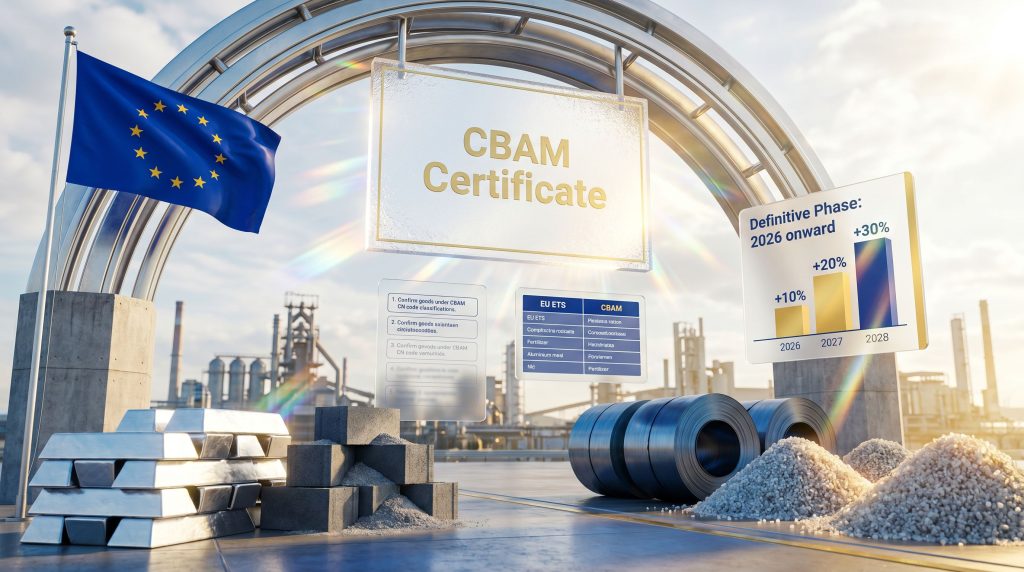
The financial incentive to use actual data rather than defaults is substantial and grows over time. Default values carry a surcharge that escalates progressively through the early definitive phase:
| Year | Default Value Surcharge Applied to Embedded Emissions |
|---|---|
| 2026 | +10% above actual embedded emissions baseline |
| 2027 | +20% above actual embedded emissions baseline |
| 2028 | +30% above actual embedded emissions baseline |
This ratcheting structure means that importers who delay investment in supplier emissions data collection face a compounding cost disadvantage. By 2028, an importer relying entirely on default values could be purchasing up to 30% more certificates than a competitor with verified actual data, on an identical physical import volume. In addition, considerations around green steel pricing are becoming increasingly relevant here, as the premium placed on low-emission steel production directly influences the embedded emissions figures that underpin certificate calculations.
Step 3: Applying Carbon Price Deductions for Origin Country Carbon Costs
One of the less understood features of CBAM certificate assessments is the deduction mechanism for foreign carbon prices. If an exporting country has a qualifying carbon pricing scheme in place and the producing facility has demonstrably paid a carbon price on the embedded emissions within the imported goods, that cost can be deducted from the EU CBAM obligation.
This provision exists to prevent double-counting of carbon costs, recognising that some trade partners have active emissions trading or carbon tax frameworks. The UK Emissions Trading Scheme is among the systems that may qualify for partial deductions, subject to verification requirements. However, claiming these deductions without robust documentation is one of the most common compliance errors observed in early CBAM implementation, and regulators have signalled a low tolerance for unsupported deduction claims.
Step 4: Calculating Certificate Requirements and Understanding Price Derivation
The mathematical core of a CBAM certificate assessment is straightforward: the verified embedded emissions figure in tonnes of CO₂ equivalent (tCO₂e), multiplied by the applicable certificate price expressed in euros per tonne, produces the financial obligation. Deductions for verified foreign carbon costs are then subtracted from this total.
The certificate price is derived from the EU Emissions Trading System. Specifically, it is calculated from the volume-weighted average price of European Union Allowance (EUA) auctions conducted within the relevant reporting period. This creates a direct pricing linkage between the EU carbon market and import costs, meaning that EU ETS price movements feed immediately into CBAM certificate obligations.
Step 5: Verification by an Accredited Third Party
All embedded emissions data submitted under the definitive phase must be verified by an accredited verifier before it can be used in certificate surrender calculations. Verification failures do not simply result in administrative notes; they can trigger a mandatory reassignment to default values, eliminating any carbon price deductions previously claimed and potentially doubling or tripling the certificate obligation for affected imports.
How Is the CBAM Certificate Price Determined?
The EU ETS as the Pricing Anchor
CBAM does not operate an independent carbon market. It does not generate new allowances, run its own auctions, or establish a separate price-discovery mechanism. Instead, it mirrors the EU ETS price for imported goods, ensuring that importers face a carbon cost equivalent to what an EU-based producer would pay for the same quantity of emissions.
The official CBAM certificate price for each quarter is published by the EU in the week following the close of that quarter. This backward-looking design means that for the entire duration of a reporting period, importers cannot know the exact price at which their certificates will ultimately be settled. That information gap creates material cost uncertainty for procurement teams and financial planners attempting to model import costs in real time.
Two Price Constructs That Bridge the Information Gap
To address this structural uncertainty, two daily price indicators have been developed to support importers in tracking and projecting certificate costs before the official EU confirmation:
| Price Construct | What It Measures | Calculation Basis | Publication Frequency |
|---|---|---|---|
| CBAM Certificate Index | Projected final certificate price at end of current reporting period | Weighted blend of cleared auction prices plus forward-looking EUA price estimates for remaining scheduled auctions in the period | Daily |
| CBAM Certificate Builder | Volume-weighted average of cleared EUA auctions within the current reporting period | Running average of eligible EUA auctions completed to date in the period only | Daily |
The Index serves a forward-looking planning function, projecting where the final certificate price is likely to land based on cleared results and end-of-day EUA prices applied to remaining auction volumes. The Builder, by contrast, tracks cost already accumulated within the current period, functioning as a real-time ledger of locked-in price exposure.
Both indicators are denominated in euros per tonne of CO₂ equivalent. Historical data has been backfilled to January 7, 2026, which corresponds to the first EUA auction conducted after the definitive phase of CBAM commenced. This provides market participants with a continuous data series aligned with the regulatory start point.
The reporting period structure itself also shifts in 2027. Throughout 2026, CBAM operates on quarterly reporting periods, meaning certificate prices are confirmed once every three months. From 2027 onward, reporting periods shift to weekly intervals, dramatically increasing the frequency of price confirmations and the complexity of compliance assessments. This transition from quarterly to weekly pricing will require importers to upgrade their monitoring infrastructure considerably.
Key Insight: The gap between when a shipment arrives and when the official certificate price is confirmed creates material financial uncertainty. Daily price indicators allow importers to model that uncertainty with a methodology-backed reference point, supporting better procurement decisions and more accurate cost forecasting throughout each reporting period.
Compliance Risks in Complex Supply Chains
The Multi-Origin Problem
Real-world supply chains rarely source from a single country. A European steel distributor importing hot-rolled coil from multiple origins simultaneously may face a scenario where one supplier operates under a qualifying carbon pricing scheme, a second does not, and a third lacks sufficient data to support anything other than default values. Each origin requires a separate embedded emissions calculation. Each deduction claim requires independent documentation. The results must then be consolidated into a single certificate surrender obligation.
Moreover, the iron ore tariff impact of US trade policy has further complicated multi-origin sourcing decisions, with some importers shifting supply chains in ways that inadvertently alter the emissions profiles and carbon pricing eligibility of their covered goods.
Hypothetical Scenario: A mid-sized EU steel distributor sources hot-rolled coil from three countries, one with a qualifying carbon pricing scheme, one without, and one using EU default values. The compliance team must run three separate embedded emissions calculations, apply one carbon price deduction, and reconcile the results into a single certificate surrender figure. Without robust data infrastructure, the risk of miscalculation at each stage compounds across the entire shipment portfolio.
The Upstream Dependency Problem
Perhaps the most operationally underappreciated aspect of CBAM certificate assessments is the dependency on supplier behaviour. Importers cannot produce verified actual emissions data independently; they are entirely reliant on their suppliers' willingness and capability to monitor, record, and disclose facility-level emissions. For suppliers in countries where carbon reporting is not mandated, this represents a significant change in data governance expectations.
Importers who fail to embed CBAM data disclosure requirements into procurement contracts before the 2026 compliance year will find themselves defaulting to EU default values, and paying the associated surcharges, simply because they lacked contractual leverage over upstream data flows. This challenge is particularly acute for sectors undergoing broader transformation; for instance, a steel decarbonisation partnership between major producers and raw material suppliers can dramatically improve the quality of emissions data available for CBAM purposes.
Building a CBAM Certificate Assessment Framework
Organisational Structure and Ownership
Effective CBAM compliance is not a single-function responsibility. It sits at the intersection of trade compliance, procurement, finance, and sustainability, and requires coordinated data flows between all four. Organisations that assign CBAM ownership to a single team without cross-functional integration tend to encounter gaps in emissions data collection, misaligned cost modelling assumptions, and incomplete verification documentation.
A Practical Eight-Step Compliance Checklist
The following sequence provides a structured approach for EU importers conducting CBAM certificate assessments:
- Confirm that goods are covered under CBAM using CN code classifications.
- Obtain verified embedded emissions data from each relevant supplier.
- Establish whether a qualifying foreign carbon price was paid and gather all supporting documentation.
- Apply the applicable CBAM certificate price, using daily price indicators for forward cost modelling.
- Calculate the gross certificate obligation: embedded emissions in tCO₂e multiplied by the certificate price in €/tCO₂e.
- Deduct the verified foreign carbon price paid where applicable and documented.
- Submit verified emissions data through the CBAM Registry before the annual deadline.
- Surrender the required number of CBAM certificates by the compliance deadline.
Consequently, organisations that build this framework early are better positioned to absorb the transition to weekly reporting periods in 2027 without significant operational disruption.
The next major ASX story will hit our subscribers first
CBAM vs. EU ETS: Understanding the Structural Relationship
CBAM is not an independent carbon market. It does not issue allowances, run auctions for imported goods, or function as a parallel trading system. Its sole pricing mechanism is a pass-through from the EU ETS, calculated as a period-average of EUA auction results. This design choice was deliberate: it ensures competitive equivalence between domestically produced goods, which bear ETS obligations, and imported goods, which now bear CBAM obligations calculated on the same price basis.
Furthermore, the broader push towards a critical raw materials transition across Europe underscores why CBAM's scope is expected to expand over time, as additional carbon-intensive supply chains come under regulatory scrutiny.
| Dimension | EU ETS (Domestic Producers) | CBAM (EU Importers) |
|---|---|---|
| Who pays | EU-based industrial operators | EU-registered importers (authorised declarants) |
| Price basis | EUA auction price | EUA auction price (quarterly/weekly average) |
| Verification | Accredited verifier required | Accredited verifier required (definitive phase) |
| Adjustment for prior carbon costs | Not applicable | Deduction available for foreign carbon prices paid |
| Reporting period | Annual | Quarterly in 2026, weekly from 2027 onward |
Frequently Asked Questions: CBAM Certificate Assessments
What is a CBAM certificate and how is its price set?
A CBAM certificate represents one tonne of CO₂ equivalent embedded in covered imported goods. Its price is derived from the volume-weighted average of EUA auctions, calculated on a quarterly basis throughout 2026 and transitioning to a weekly average from 2027 onward. Official prices are confirmed and published by the EU in the week after each reporting period closes.
Who is required to surrender CBAM certificates?
Only authorised declarants, meaning EU-registered importers who have been formally approved through the CBAM Registry, are permitted to import covered goods and carry the obligation to surrender certificates corresponding to their verified embedded emissions.
Can importers reduce their certificate obligation?
Yes, provided a carbon price has been legally paid in the country of origin on the embedded emissions within the imported goods. The deductible amount must be documented and verified in accordance with regulatory requirements. Overclaiming without adequate documentation is a significant compliance risk.
What is the penalty for using default emissions values?
Using EU default values rather than verified actual data results in a surcharge on the embedded emissions calculation. That surcharge increases from 10% in 2026, to 20% in 2027, and 30% in 2028 for applicable goods, making default reliance progressively more expensive relative to verified data.
What distinguishes the CBAM Certificate Index from the CBAM Certificate Builder?
The CBAM Certificate Index projects the expected final certificate price at the close of the current reporting period, incorporating both cleared auction results and estimated prices for remaining scheduled auctions. The CBAM Certificate Builder tracks the running volume-weighted average of EUA auctions already cleared within the current period, providing a real-time view of cost already accumulated. Both are published daily and denominated in €/tCO₂e.
This article is intended for informational purposes only and does not constitute legal, financial, or compliance advice. CBAM regulations are subject to change, and importers should seek independent legal and regulatory guidance specific to their circumstances. Forecasts and projections referenced herein involve inherent uncertainty and should not be relied upon as definitive cost predictions.
Want to Stay Ahead of the Commodity and Mining Discoveries Driving the Green Transition?
As CBAM reshapes global demand for low-emission metals like steel, aluminium, and hydrogen, the underlying mineral discoveries powering these supply chains are creating significant investment opportunities on the ASX — Discovery Alert's proprietary Discovery IQ model delivers real-time alerts the moment significant discoveries are announced, helping investors act before the broader market catches on. Explore historic discovery returns on Discovery Alert's discoveries page and begin a 14-day free trial to position yourself ahead of the next major find.