June 5, 2026
The Hidden Physics Behind Plateau Maintenance at Giant Condensate Fields
Among the most technically demanding challenges in upstream petroleum engineering, maintaining productive life at mature gas-condensate accumulations stands apart. Unlike conventional oil reservoirs, where pressure depletion follows relatively predictable decline curves, gas-condensate systems carry an additional and largely irreversible threat: the permanent loss of liquid hydrocarbons within the reservoir rock itself. Understanding this mechanism is essential to appreciating why infrastructure projects focused on gas reinjection represent some of the highest-value capital investments an operator can make in a maturing field.
This is the technical and commercial reality underpinning the Karachaganak gas reinjection at KEP-1B project, one of the world's most significant gas-condensate accumulations, located in northwest Kazakhstan. With first gas reinjection now commenced at the project, the engineering logic, reservoir science, and production economics behind this milestone deserve a thorough examination.
When big ASX news breaks, our subscribers know first
What Happens to a Gas-Condensate Reservoir When Pressure Falls
The Retrograde Condensation Problem
In a conventional gas reservoir, declining pressure causes gas to expand and flow toward producing wells in a broadly predictable fashion. Gas-condensate systems behave very differently. These reservoirs contain hydrocarbons that exist as a single-phase gas at initial reservoir conditions, but carry dissolved heavier components, the condensate fraction, that will separate out as liquids when pressure drops below a specific threshold known as the dew-point pressure.
The counterintuitive behaviour of these systems is called retrograde condensation. As pressure declines through production, liquid hydrocarbons begin to drop out directly within the pore spaces of the reservoir rock. These droplets reduce relative permeability to gas, impede further flow, and in many cases become permanently unrecoverable. This is not analogous to a surface separator producing liquids from gas; the dropout occurs underground, beyond any intervention.
"Once reservoir pressure falls below the dew point, retrograde liquid dropout in the pore network is largely irreversible. The condensate becomes immobile at low saturations, trapped by capillary forces. This can represent the permanent loss of some of the most valuable hydrocarbons in the system."
Why Reinjection Is the Preferred Pressure Maintenance Strategy
Several pressure maintenance strategies exist for gas-condensate fields, including water injection and simple blowdown, but gas reinjection offers the most technically aligned solution. Reinjecting dry or partially processed gas back into the reservoir performs two simultaneous functions, and furthermore delivers ESG and regulatory co-benefits:
- It maintains pore pressure above the dew point, preventing retrograde dropout
- It sweeps additional condensate toward producing wells, improving overall recovery efficiency
- It avoids the compatibility issues that water injection can introduce in carbonate reservoir systems
- It reduces surface flaring volumes, which carries increasing ESG and regulatory significance
The trade-off is straightforward: gas that could potentially be monetised through export is instead redirected underground. At Karachaganak, where associated condensate commands premium pricing as a high-quality export liquid, this trade-off strongly favours reinjection. Protecting one barrel of surface condensate through pressure maintenance generates substantially more revenue than selling the equivalent energy content as gas.
Karachaganak Field: Scale, Geology, and Reservoir Complexity
A World-Class Accumulation With Demanding Engineering Conditions
Karachaganak was discovered in 1979 and has since been established as one of the largest gas-condensate fields on the planet. Its resource endowment is formidable. Understanding the global importance of oil and condensate resources helps contextualise why a field of this scale attracts such sustained capital investment.
| Parameter | Metric |
|---|---|
| Discovery Year | 1979 |
| Areal Extent | Over 280 sq km |
| Liquids HIIP | ~13.6 billion barrels |
| Gas HIIP | ~59.4 trillion cubic feet |
| Gross Condensate Reserves | Over 2.4 billion barrels |
| Gross Gas Reserves | ~16 trillion cubic feet |
| Location | Northwest Kazakhstan |
The field occupies a carbonate reservoir, a rock type that typically exhibits high natural fracture intensity. While fractures can enhance permeability and well productivity, they also create preferential flow paths that complicate reservoir management, particularly during reinjection operations where injected gas can bypass target zones through fracture networks rather than sweeping the matrix pore volume.
A further engineering complication is the field's classification as a sour gas system, meaning it contains elevated concentrations of hydrogen sulphide (H₂S) and carbon dioxide (CO₂). Sour service conditions impose significant constraints on materials selection throughout the surface infrastructure. Compression equipment, pipelines, and wellhead components must be fabricated from specialised alloys capable of resisting sulphide stress cracking, a form of hydrogen embrittlement that can cause catastrophic failure in standard carbon steel under sour conditions. This adds both cost and engineering complexity to any capital project at the field.
Production Context and the Reinjection Intensity Ratio
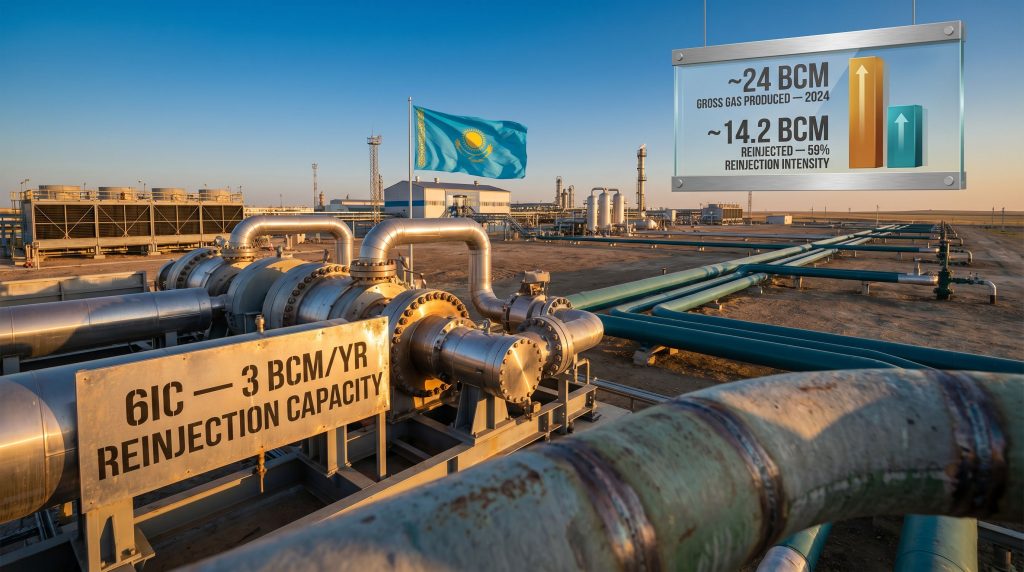
The scale of gas reinjection already underway at Karachaganak places the field among the most reinjection-intensive operations globally. In 2024, KPO produced approximately 24 billion cubic metres (bcm) of associated gas, of which roughly 14.2 bcm was reinjected back into the reservoir. This yields a reinjection intensity ratio of approximately 59%, meaning that for every unit of gas produced at the wellhead, more than half was redirected underground for pressure maintenance rather than processed for surface sales.
A reinjection intensity of 59% reflects a deliberate strategic choice to prioritise condensate plateau extension over gas revenue maximisation. At fields of this scale, the liquid economics overwhelmingly justify this allocation, particularly given the condensate's export value via the Caspian Pipeline Consortium (CPC) route to Novorossiysk on the Black Sea.
The KEP-1B Project: Engineering Architecture and Component Logic
Sanctioning, Timeline, and Current Status
KEP-1B received formal project sanction in November 2022 under the field's production sharing agreement (PSA) framework, with an implementation window extending through to 2028. By late February 2026, the project had reached approximately 98% physical completion, with partial commissioning activities commencing in March 2026. Full commissioning remains targeted for the end of 2026, representing a shift from an earlier first-quarter 2026 target as execution timelines adjusted to reflect contractor cost pressures and the broader complexity of operating in a high H₂S environment.
The project is not a standalone development but rather the latest in a sequence of modular expansion phases, each building incrementally on prior infrastructure rather than replacing it.
The Five Integrated Infrastructure Components
KEP-1B is structured around five interconnected infrastructure workstreams, each addressing a specific operational requirement:
1. The Sixth Injection Compressor (6IC)
The centrepiece of KEP-1B, the 6IC is rated at approximately 3 bcm per year of incremental reinjection capacity. High-pressure gas compression in a sour service environment demands specialised rotor metallurgy, dry gas seal systems resistant to H₂S degradation, and redundant safety instrumentation. The compressor integrates into the existing compression train sequence, adding capacity without requiring the decommissioning of earlier stages.
2. Gas Dehydration Unit
Before compressed gas can be injected at depth, water vapour must be removed from the gas stream. At high pressures and low temperatures, water and hydrocarbons form solid hydrate plugs capable of blocking pipelines and damaging compressor internals. Dehydration typically employs glycol absorption or molecular sieve technology to strip water vapour below the hydrate formation threshold, ensuring reliable injection operations throughout the well's pressure and temperature envelope.
3. Gathering Network Expansion
The gathering network collects raw gas from producing well clusters across the field's surface footprint and routes it toward the processing and compression facilities. Expansion of this network enables additional well connections as the field's productive area evolves, ensuring that incremental volumes can be captured and processed rather than flared or vented.
4. Reinjection Network Expansion
Distinct in function from the gathering system, the reinjection network carries compressed, treated gas from surface facilities to designated injection wells. The engineering challenge here is maintaining sufficient wellhead injection pressure to overcome the back-pressure presented by the reservoir at depth, a consideration that becomes increasingly demanding as reservoir pressure is sustained at higher levels through successful reinjection.
| Network Type | Direction of Flow | Key Engineering Challenge |
|---|---|---|
| Gathering Network | Well to Processing Facility | Sour service materials, pressure ratings |
| Reinjection Network | Processing Facility to Injection Well | Overcoming reservoir back-pressure, injection well integrity |
5. Associated Utilities and Infrastructure
Supporting the new compression train requires upgrades to electrical power supply systems, process control and safety instrumentation, and integration with the broader Karachaganak Processing Complex (KPC). These utilities are often underestimated in project complexity discussions but represent critical enabling infrastructure for safe and reliable operation.
The Expansion Project Sequence: Building on Prior Infrastructure
KEP-1B does not exist in isolation. It is the latest iteration in a deliberate, phased compression expansion strategy that has progressively increased the field's reinjection capacity over multiple investment cycles.
| Project Phase | Key Infrastructure Element | Primary Strategic Objective |
|---|---|---|
| Early development phases | Fourth Injection Compressor (4IC) | Establishing baseline reinjection capacity |
| Interim expansion works | Fifth trunkline, additional injection wells | Expanding well and pipeline network reach |
| KEP-1A | Parallel development and optimisation works | Production and processing efficiency |
| KEP-1B (current) | Sixth Injection Compressor, dehydration, network expansion | Reinjection volume uplift, condensate plateau extension |
This modular approach reflects established best practice for managing giant fields. Rather than committing to a single large infrastructure tranche that may not align with evolving reservoir behaviour, successive incremental projects allow operators to calibrate investment against actual production performance and updated reservoir models.
The parallel execution of KEP-1A and KEP-1B suggests KPO and its joint venture partners have adopted a multi-stream development philosophy, advancing complementary workstreams simultaneously to compress overall development timelines.
Joint Venture Governance and Execution Risk Dynamics
The KPO Ownership Structure
The field is operated by Karachaganak Petroleum Operating BV (KPO), a joint venture governed under a production sharing agreement with the Republic of Kazakhstan.
| Partner | Equity Stake |
|---|---|
| Eni SpA | 29.25% |
| Shell plc | 29.25% |
| Chevron | 18.00% |
| Lukoil | 13.50% |
| KazMunayGas | 10.00% |
KazMunayGas's 10% equity participation reflects Kazakhstan's broader framework for maintaining a national interest in the country's most significant hydrocarbon developments. The PSA structure governs cost recovery mechanisms, profit-sharing arrangements, and the approval processes required for major capital projects like KEP-1B.
Execution Complexity in a Multi-Partner, Sour-Service Environment
Multi-partner joint ventures introduce capital approval layers that can extend sanctioning timelines relative to single-operator projects. Each major expenditure commitment requires alignment across partners with different cost recovery positions, fiscal frameworks, and strategic priorities. For KEP-1B, this governance complexity combined with contractor cost inflation in Central Asian project environments and the technical demands of sour-service high-pressure compression contributed to the timeline evolution observed between original targets and current commissioning schedules.
It is worth noting that cost overruns and schedule shifts in projects of this nature are not unusual. High H₂S environments impose quality assurance requirements that extend fabrication and inspection timelines, and remote location logistics in northwest Kazakhstan add further execution friction. Consequently, the end-2026 commissioning target reflects a pragmatic recalibration rather than a fundamental execution failure.
The next major ASX story will hit our subscribers first
Production Impact: What KEP-1B Means for Condensate Yields
Quantifying the Plateau Extension Effect
The 6IC's rated capacity of approximately 3 bcm per year of incremental reinjection represents a meaningful addition to Karachaganak's existing reinjection programme. Measured against the 2024 baseline of 14.2 bcm reinjected, full KEP-1B commissioning could potentially increase annual reinjection volumes by more than 20%, providing a substantially larger pressure maintenance buffer.
The production impact is not expressed as an incremental rate increase but rather as plateau protection: sustaining current condensate output rates for longer than would be achievable under natural reservoir pressure decline. Monitoring the current crude oil prices and condensate valuations remains essential for operators assessing the ongoing economics of this reinjection strategy.
| Scenario | Reservoir Pressure Trajectory | Condensate Yield Impact | Productive Plateau Duration |
|---|---|---|---|
| Without KEP-1B reinjection uplift | Accelerating decline below dew point | Increased retrograde dropout, reduced surface yields | Shortened |
| With KEP-1B fully commissioned | Stabilised above dew-point threshold | Plateau levels protected | Extended |
The above scenarios are illustrative projections based on established reservoir engineering principles for gas-condensate systems. Actual production outcomes depend on reservoir heterogeneity, injection well performance, and ongoing KPO reservoir management decisions.
Condensate Export Economics and the CPC Route
Karachaganak condensate is exported via the Caspian Pipeline Consortium pipeline to the Black Sea terminal at Novorossiysk, one of the primary export corridors for Kazakhstan's upstream production alongside Tengiz and Kashagan. Sustaining the condensate production plateau through effective pressure maintenance directly supports Kazakhstan's hydrocarbon export volumes and the fiscal revenues that flow from them.
For the JV partners, each barrel of condensate protected from premature reservoir dropout through KEP-1B's reinjection uplift represents high-margin liquid revenue that would otherwise be irretrievably lost.
Broader Implications: Gas Management Strategy and ESG Considerations
Reinjection Versus Monetisation: A Strategic Balance
The decision to reinject nearly 60% of produced gas rather than monetising it reflects a sophisticated value hierarchy. At current condensate-to-gas price ratios, the economic value of protecting liquid production far outweighs the foregone gas revenue from reinjection volumes. However, as the field matures and reservoir pressure management requirements evolve, the calculus may shift.
Future phases of field life could see greater proportions of produced gas redirected toward export, domestic supply, or potential pathways with LNG market implications, as reinjection needs stabilise or decline.
This optionality is one of the underappreciated strategic assets of a field like Karachaganak: the same gas volumes that function as a pressure maintenance tool today could become a monetisable commodity in future field life stages.
Flaring Reduction as a Co-Benefit
Routing produced gas into a reinjection programme rather than flaring it delivers measurable environmental co-benefits. As international operators face increasing scrutiny over flaring practices from both investors and host governments, reinjection infrastructure that absorbs gas which might otherwise be vented or combusted represents a concrete operational improvement.
This dimension of KEP-1B's value proposition, while secondary to the primary production economics, is increasingly relevant to the ESG reporting frameworks of the major international partners within the KPO joint venture.
Frequently Asked Questions: Karachaganak Gas Reinjection and the KEP-1B Project
What is the KEP-1B project at Karachaganak?
KEP-1B is the current phase of the Karachaganak Expansion Project, formally sanctioned in November 2022. It centres on a sixth injection compressor rated at approximately 3 bcm per year, supported by a gas dehydration unit, gathering network expansion, and reinjection network expansion. The project's purpose is to increase gas reinjection volumes and extend the field's condensate production plateau.
Why does Karachaganak reinject so much of its produced gas?
Karachaganak is a gas-condensate reservoir where allowing pressure to fall below the dew-point threshold triggers retrograde condensate dropout within the reservoir rock, permanently trapping valuable liquid hydrocarbons. Reinjecting gas maintains pore pressure above this threshold, protecting condensate mobility and surface yields. The economics strongly favour this approach given condensate's value relative to gas.
How much gas does Karachaganak currently reinject?
In 2024, KPO reinjected approximately 14.2 bcm against gross gas production of roughly 24 bcm, a reinjection intensity of approximately 59% of total gas produced at the field.
What is the new compressor's capacity?
The sixth injection compressor at the core of the Karachaganak gas reinjection at KEP-1B project is rated at approximately 3 billion cubic metres per year of additional reinjection capacity.
When will KEP-1B be fully commissioned?
Full commissioning is targeted for the end of 2026. The project reached approximately 98% physical completion by late February 2026, with partial commissioning beginning in March 2026. Those tracking the crude oil market update will note that commissioning timing intersects with a period of considerable price volatility across global energy markets.
What makes sour gas compression technically demanding?
High concentrations of hydrogen sulphide require specialised materials throughout the compression train to prevent sulphide stress cracking, a form of hydrogen embrittlement that can cause sudden failure in standard carbon steel. This imposes stringent materials specifications, extended inspection regimes, and more complex safety instrumentation, all of which contribute to project cost and timeline complexity. Furthermore, operators tracking WTI and Brent futures will recognise that such technical demands ultimately reinforce the long-term value of protecting premium condensate yields at fields like Karachaganak.
Want to Identify the Next Major Resource Discovery Before the Market Does?
Discovery Alert's proprietary Discovery IQ model delivers real-time alerts on significant ASX mineral discoveries, translating complex geological and commodity data into actionable investment insights for both short-term traders and long-term investors. Explore historic examples of exceptional discovery returns and begin your 14-day free trial today to position yourself ahead of the broader market.