June 5, 2026
When Ore Grade Becomes a Competitive Weapon: The Kipushi Zinc Story
In base metals mining, the difference between a good operation and a generational asset often comes down to a single geological variable: ore grade. Most of the world's zinc mines process rock containing between three and ten percent zinc by weight. That grade determines everything downstream, from processing costs to concentrate quality to profitability across commodity price cycles. When a deposit exists at multiples of that threshold, it does not simply perform better than its peers. It operates in an entirely different economic category.
That is the context in which the Ivanhoe Kipushi zinc output record set in May 2026 deserves to be understood. The numbers are striking on their own terms, but their true significance only emerges when placed within the broader framework of what high-grade ore bodies mean for long-run production economics and global supply dynamics.
When big ASX news breaks, our subscribers know first
Decoding the May 2026 Numbers: What the Metrics Actually Reveal
Grade, Recovery, and Throughput as a Combined System
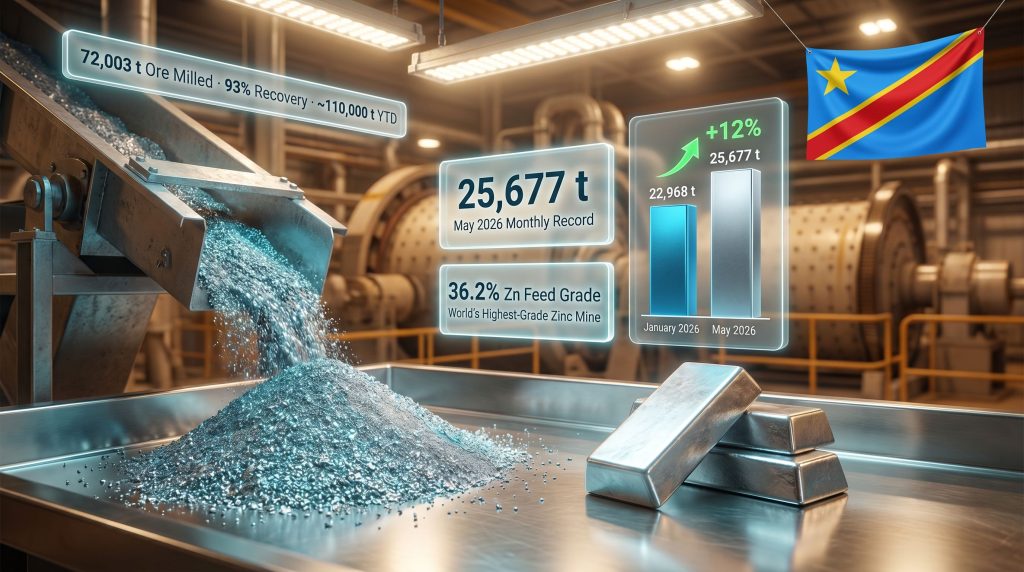
Kipushi's May 2026 performance cannot be assessed through any single figure in isolation. The monthly record of 25,677 tonnes of zinc in concentrate was the product of three operational metrics converging simultaneously at exceptional levels.
| Operational Metric | Kipushi May 2026 | Typical Global Zinc Mine |
|---|---|---|
| Plant Feed Grade (% Zn) | 36.2% | 3% to 10% |
| Monthly Ore Milled (tonnes) | 72,003 | Varies widely by operation |
| Metallurgical Recovery Rate | 93% | 75% to 88% typical range |
| Monthly Zinc in Concentrate (t) | 25,677 | Varies by scale and grade |
A plant feed grade of 36.2% zinc is not incrementally better than the global average. It is categorically superior, representing ore that is roughly three to ten times richer than what most commercial zinc operations process. This grade advantage compresses the volume of rock that needs to be mined, moved, crushed, and processed per tonne of payable zinc produced, directly reducing unit operating costs at every stage of the value chain.
The 93% metallurgical recovery rate achieved through Kipushi's flotation concentrator is equally noteworthy. Recovery rates in zinc processing typically fall between 75% and 88% at well-run operations. Exceeding 90% consistently signals that the ore mineralogy is well-suited to the processing circuit, that flotation reagent regimes are precisely calibrated, and that concentrator availability is high. Understanding ore mineralogy and economics helps explain why each percentage point of recovery above the industry average represents additional payable zinc extracted from the same tonne of ore, compounding the grade advantage already present in the ore body itself.
The Throughput Dimension: 72,003 Tonnes of Ore Milled
Processing 72,003 tonnes of ore through the concentrator in a single month at those grades and recovery rates is the operational achievement that ties the record together. High grades and high recoveries are meaningless if mill availability or throughput is constrained. The combination of all three metrics at record or near-record levels simultaneously suggests the operation has reached a phase of genuine process stability rather than capitalising on a transient favourable event.
For investors and industry analysts, consistent co-optimisation across grade, recovery, and throughput is a hallmark of operational maturity. It is far more difficult to sustain than any individual peak metric.
How May 2026 Fits Into Kipushi's Own Production Trajectory
A 12% Leap Over the Prior Monthly Benchmark
The previous monthly record at Kipushi stood at 22,968 tonnes of zinc in concentrate, set in January 2026. According to Ivanhoe Mines' official announcement, the May result of 25,677 tonnes represents an uplift of approximately 2,709 tonnes, or roughly 12%, achieved within the same calendar year. That rate of improvement within a short period at an already high production base is operationally significant.
| Production Metric | Figure |
|---|---|
| Previous Monthly Record (January 2026) | 22,968 t zinc in concentrate |
| New Monthly Record (May 2026) | 25,677 t zinc in concentrate |
| Absolute Improvement | +2,709 t |
| Percentage Improvement | +12% |
| Year-to-Date Output (January to May 2026) | approximately 110,000 t zinc |
| Implied Annualised Run-Rate | approximately 264,000 t zinc |
| 2026 Full-Year Guidance Range | 240,000 t to 290,000 t zinc |
| Guidance Midpoint | approximately 265,000 t zinc |
Tracking at the Guidance Midpoint: What This Signals
With year-to-date output of approximately 110,000 tonnes through the end of May, Kipushi's annualised production rate sits at roughly 264,000 tonnes, placing the operation almost precisely at the midpoint of its 2026 guidance range of 240,000 to 290,000 tonnes. For a mine that only returned to production in 2023 after decades of care and maintenance, tracking at guidance midpoint this early in the operational ramp-up represents a meaningful signal of production confidence.
It is worth noting that guidance midpoint tracking does not guarantee full-year delivery. Factors including unplanned maintenance events, geological variability in ore feed, or infrastructure constraints could affect the second half of the year. Investors should treat forward-looking production metrics with appropriate caution, as they represent management expectations rather than confirmed outcomes.
The Economics of Extreme Grade: Why 36.2% Zinc Changes Everything
Ore Grade as the Master Variable in Mining Economics
In zinc mining, as across most base metals, ore grade is the most powerful determinant of all-in sustaining cost per tonne of payable metal. The relationship is not linear but geometric: doubling the grade at similar throughput effectively halves the cost of production per unit of metal, before accounting for processing efficiencies that tend to improve alongside grade. Furthermore, cut-off grade economics play a crucial role in determining which portions of an ore body are economically viable to mine at any given commodity price.
At 36.2% zinc, Kipushi's ore body occupies a position that few operations in the history of global zinc mining have matched. The Big Zinc ore body at Kipushi was first identified decades ago and recognised as one of the richest zinc deposits ever discovered. Its revival under Ivanhoe Mines has brought modern processing infrastructure to bear on what is fundamentally a once-in-a-generation geological endowment.
Ore grade is to mining what location is to real estate. You can optimise everything else, but the underlying geological asset either has it or it does not. Kipushi has it at a level that places the operation in a category almost entirely by itself globally.
What High-Grade Ore Means for Processing Costs
- Lower strip ratios or mining volumes per tonne of contained zinc, reducing haulage and energy consumption.
- Smaller concentrator throughput requirements to achieve equivalent metal output, lowering reagent and power costs per tonne.
- Higher-quality zinc concentrate, which can attract better offtake terms and lower penalties from smelters.
- Greater margin resilience during zinc price downturns, as the cost base remains structurally lower than peers.
The Flotation Circuit and Why Recovery Efficiency Matters at This Grade
Zinc is extracted from crushed and milled ore through a process called froth flotation, where zinc sulphide minerals are selectively attached to air bubbles and separated from gangue material. At grades as high as 36.2%, the flotation circuit needs to be carefully managed to avoid over-concentration or misallocation of reagents. Achieving a 93% recovery rate at this grade level indicates the concentrator design and operational protocols are well-matched to Kipushi's specific ore mineralogy, which is predominantly sphalerite-dominant.
This matters for an often-overlooked reason: high ore grades can sometimes create processing challenges rather than simply advantages, particularly if the mineralogy is complex or if liberation of zinc minerals from host rock requires fine grinding that increases energy consumption. The fact that Kipushi is consistently achieving recovery rates above 90% suggests the ore is responding well to the processing circuit at the current grind size settings.
Tailings Infrastructure: The Infrastructure Decision That Protects Long-Term Output
Why the Second TSF Is More Than a Compliance Exercise
Construction of Kipushi's second tailings storage facility is reported to be more than 90% complete as of June 2026, with the first deposit of tailings expected from October 2026. The facility, including its Paddock 2B extension and the lining of the existing TSF, is designed to comply with the Global Industry Standard on Tailings Management (GISTM).
The GISTM, developed following major tailings facility failures at operations globally, represents the current global benchmark for responsible tailings management. Its requirements span:
- Engineer of Record accountability for ongoing design and monitoring.
- Regular independent review of facility stability and performance.
- Emergency preparedness planning aligned with downstream community exposure.
- Transparency and public disclosure of monitoring data.
- Long-term post-closure planning integrated into the facility design from the outset.
For an operation located in the Democratic Republic of Congo, meeting GISTM standards is not merely a regulatory box-ticking exercise. It has practical consequences for institutional investor eligibility, offtake partner requirements, and insurance underwriting. An increasing number of major global zinc smelters and commodity trading houses require suppliers to meet recognised environmental and social standards as a precondition for long-term offtake agreements.
The Paddock 2B Extension and Capacity Planning
The inclusion of the Paddock 2B extension in the new TSF's design reflects forward-looking capacity planning consistent with an operation targeting sustained high throughput. As production volumes increase, tailings accumulation rates rise proportionally. Building excess capacity into the TSF now avoids the need for reactive expansions later, which tend to be more costly and time-consuming to permit and construct.
The DRC as a Zinc Production Jurisdiction: Context and Considerations
Emerging Base Metals Significance
The Democratic Republic of Congo is most widely recognised globally as a dominant source of cobalt and copper. Its re-emergence as a significant zinc producer through the Kipushi operation adds a new dimension to the country's role in global base metals supply. The DRC mineral wealth extends well beyond its established copper and cobalt profile, with the Copperbelt geology extending into zinc mineralisation systems, of which Kipushi's Big Zinc deposit is the most exceptional known example.
Global Zinc Supply Dynamics and Where Kipushi Fits
Zinc's primary industrial application remains the galvanisation of steel for construction, infrastructure, and automotive manufacturing. It is also present in dry cell batteries and is increasingly discussed in the context of zinc-air battery technologies being explored as grid-scale energy storage alternatives. Global zinc production trends indicate that against this demand backdrop, step-changes in production from major operations carry meaningful weight in supply-demand modelling.
At an implied annualised production rate approaching 264,000 tonnes, Kipushi would rank among the larger individual zinc-producing mines globally, in a market where total refined zinc consumption runs at approximately 14 million tonnes per year according to the International Lead and Zinc Study Group.
The next major ASX story will hit our subscribers first
Step-by-Step: Kipushi's Path from Rock to Record Zinc Concentrate
Understanding how the monthly record is actually generated requires tracing the ore through each stage of the processing chain.
- Underground Ore Extraction – High-grade zinc ore is extracted from the Big Zinc ore body deep underground at Kipushi, using modern mechanised mining methods suited to the deposit geometry.
- Primary Crushing – Run-of-mine ore is crushed to reduce particle size before entering the milling circuit, liberating zinc-bearing minerals from host rock.
- Milling to Liberation Size – The crushed ore is milled to a target particle size that achieves adequate liberation of sphalerite minerals without excessive energy consumption. In May 2026, this circuit processed 72,003 tonnes of ore.
- Froth Flotation – Milled ore slurry is conditioned with reagents and passed through flotation cells where zinc sulphide minerals attach to air bubbles and are skimmed off as concentrate. The 93% recovery rate achieved in May reflects the efficiency of this stage.
- Concentrate Dewatering and Dispatch – Zinc concentrate is filtered, dried, and prepared for transport to smelters under offtake agreements.
- Tailings Management – Process water and residual gangue material are directed to the tailings storage facility, with the second TSF approaching completion to accommodate ongoing production growth.
Frequently Asked Questions: Ivanhoe Kipushi Zinc Output Record
What is the Kipushi mine and where is it located?
Kipushi is an underground zinc mine located in the Democratic Republic of Congo, operated by Ivanhoe Mines. It hosts one of the world's highest-grade zinc ore bodies, known as the Big Zinc deposit.
How much zinc did Kipushi produce in May 2026?
Kipushi produced 25,677 tonnes of zinc in concentrate in May 2026, setting a new monthly production record for the operation.
What was the previous monthly production record at Kipushi?
The prior monthly record was 22,968 tonnes, achieved in January 2026. The May 2026 result exceeded this by approximately 12%.
What is Kipushi's 2026 annual zinc production guidance?
Ivanhoe Mines has guided for between 240,000 and 290,000 tonnes of zinc in concentrate for the full year 2026, with the midpoint at approximately 265,000 tonnes.
What does zinc in concentrate mean, and how is it measured?
Zinc in concentrate refers to the quantity of contained zinc metal within the zinc-rich concentrate produced by the processing plant. It is calculated by multiplying the volume of concentrate produced by its zinc assay grade. It differs from refined zinc, which requires further smelting and refining.
Why is Kipushi considered the world's highest-grade zinc mine?
Kipushi processes ore at an average plant feed grade of 36.2% zinc, which is three to ten times higher than the 3% to 10% grades typical of commercial zinc operations globally, making it categorically exceptional within the industry.
What is the Global Industry Standard on Tailings Management?
The GISTM is the internationally recognised benchmark for responsible design, operation, and closure of tailings storage facilities. It was developed in response to high-profile tailings dam failures and sets requirements around engineering oversight, monitoring, transparency, and emergency preparedness.
How does Kipushi's ore grade compare to other zinc mines globally?
Most commercially viable zinc mines operate at grades between 3% and 10% zinc. Kipushi's 36.2% feed grade places it in a tier essentially by itself, with no comparable large-scale operation known to consistently process ore at similar grades anywhere in the world. Definitive feasibility studies conducted prior to the mine's restart confirmed the exceptional nature of the deposit's grade profile and its implications for long-term cost competitiveness.
Key Takeaways: What the Kipushi Record Reveals About High-Grade Zinc Mining
- The Ivanhoe Kipushi zinc output record of 25,677 tonnes in May 2026 reflects the simultaneous optimisation of grade, recovery, and throughput rather than any single operational factor.
- A 36.2% plant feed grade and 93% metallurgical recovery rate represent performance metrics that structurally separate Kipushi from virtually all other zinc operations globally.
- Year-to-date output of approximately 110,000 tonnes through May positions the operation at the midpoint of its 240,000 to 290,000 tonne annual guidance range, implying tracking at approximately 264,000 tonnes on an annualised basis.
- The second tailings storage facility, more than 90% complete and targeting GISTM compliance, demonstrates infrastructure planning aligned with both long-term production growth and international environmental standards.
- Kipushi's ore grade advantage functions as a structural cost moat that should compound across zinc price cycles, offering greater resilience during price downturns than peers operating at conventional grades.
- The DRC's role as a base metals producer extends beyond its established copper and cobalt profile, with Kipushi increasingly relevant to global zinc supply security as industrial and emerging battery-adjacent demand evolves.
Readers seeking broader context on global zinc mining operations and base metals market dynamics are encouraged to review industry coverage published by Mining Weekly, available at miningweekly.com. This article contains forward-looking statements and production metrics derived from publicly available company announcements. Past production records do not guarantee future performance. Investors should conduct their own due diligence before making investment decisions based on mining production data.
Want to Identify the Next High-Grade Discovery Before the Market Does?
Discovery Alert's proprietary Discovery IQ model scans ASX announcements in real time, instantly flagging significant mineral discoveries — including high-grade base metals opportunities — and translating complex geological data into actionable investment insights. To understand how historic discoveries have generated exceptional returns for early-positioned investors, explore Discovery Alert's dedicated discoveries page and begin your 14-day free trial today.