
August 21, 2026
The Hidden Architecture Behind Industrial Net Zero: Why the Residual Gap Matters
When large industrial companies publish net zero commitments, the headline numbers tend to dominate the conversation. Percentage reductions from baselines, renewable energy milestones, and capital spending pledges all compete for investor attention. What receives far less scrutiny is the structural gap that persists even after decades of genuine abatement work: the residual emissions that no commercially available technology can yet eliminate. This is precisely where the BHP carbon credits net zero plan becomes critically important to understand.
This gap is not a footnote. For mining companies operating complex, geographically dispersed asset portfolios, it is arguably the most important number in the entire climate disclosure. It determines how much a company will eventually depend on voluntary carbon markets, what quality of credits it will seek, and whether its net zero architecture will survive the scrutiny of institutional investors and regulators through to 2050.
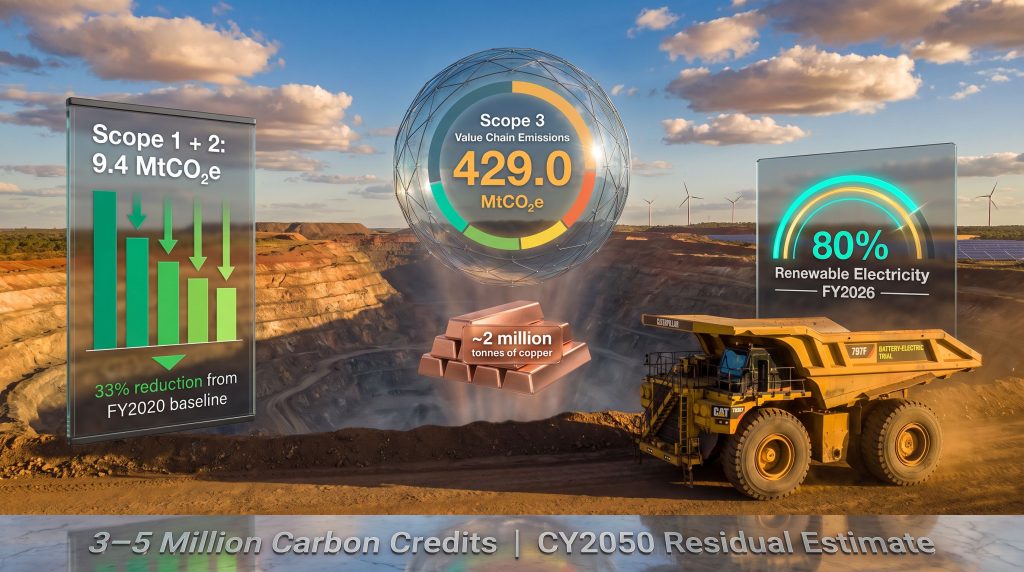
BHP's FY2026 Annual Report puts a specific figure on this gap for the first time at this level of precision: between 3 million and 5 million tonnes of CO₂ equivalent in residual operational emissions that the company estimates may still exist by the time its CY2050 net zero deadline arrives. Understanding what drives that range, and why it cannot simply be engineered away, reveals something important about the entire hard-to-abate industrial sector.
When big ASX news breaks, our subscribers know first
A Two-Speed Climate Strategy: Near-Term Abatement vs. Long-Term Hybrid Offsets
BHP's net zero framework operates on two distinct tracks that are frequently conflated in public commentary, a conflation that can seriously mislead analysis.
The FY2030 medium-term target requires a minimum 30% reduction in Scope 1 and Scope 2 emissions from the FY2020 adjusted baseline. Critically, this target is an abatement-only commitment. Voluntary carbon credits purchased on open markets play no role in BHP's projected pathway to this milestone. Even regulatory compliance credits, such as Australian Carbon Credit Units used for mandatory obligations, are explicitly excluded from counting toward FY2030 progress. The company has indicated that voluntary credits could only function as a contingency if an unforeseen shortfall occurs, not as a planned instrument.
The CY2050 operational net zero goal operates under different rules. This longer-horizon target explicitly incorporates carbon credits as a residual mechanism for emissions that cannot be eliminated through available technology. This is a hybrid model: structural operational reduction drives the vast majority of progress, while market-based instruments address what remains.
This two-speed architecture is consistent with guidance from the Science Based Targets initiative (SBTi), which generally distinguishes between near-term targets that must be met through genuine reductions and long-term net zero goals that can incorporate high-quality removals for residual hard-to-abate tonnes. Furthermore, broader trends in mining electrification and decarbonisation are reshaping how companies like BHP approach these structural challenges.
The distinction matters enormously for carbon market participants. BHP is not signalling an intention to offset its way to compliance in the near term. It is signalling future demand for high-integrity carbon removals in the 2040s and beyond, which is a materially different signal for credit market pricing and project pipeline development.
BHP's Current Emissions Profile: Progress, Setbacks, and Methodology Complexity
BHP reported 9.4 MtCO₂e in combined Scope 1 and Scope 2 emissions from operated assets in FY2026, representing a 33% reduction from the FY2020 adjusted baseline of approximately 14.1 MtCO₂e. That headline reduction is genuine and substantial. However, FY2026 emissions were approximately 1% higher than FY2025 on an adjusted basis, signalling that the path to further reduction is neither linear nor straightforward.
Two operational drivers pushed emissions upward during the year:
- BHP Mitsubishi Alliance (BMA): Higher material movement volumes combined with mining activity in geologically more methane-intensive zones elevated Scope 1 fugitive emissions. This is a particularly important detail: methane intensity in underground coal seams is not uniform. As mining progresses into different geological formations, the methane content per tonne of coal extracted can shift materially, creating emissions variability that is difficult to plan around in advance.
- NSW Energy Coal (NSWEC): Increased production output intersected with a revised fugitive methane calculation model, both contributing to higher reported figures.
Partially offsetting these increases were stable performance at Western Australia Iron Ore and Escondida, along with the temporary suspension of Western Australia Nickel operations.
BHP also changed its Scope 2 calculation methodology for Australian operations, adopting a national residual mix factor (RMF) where available. This methodological shift retroactively revised the FY2025 comparison, moving the reported reduction against the FY2020 baseline from 36% to 34%. Transparency around methodology changes is a credibility signal, but it does create complications for external analysts attempting direct year-on-year comparisons.
| Emissions Metric | FY2020 Baseline | FY2025 (Adjusted) | FY2026 | YoY Change |
|---|---|---|---|---|
| Scope 1 + 2 (MtCO₂e) | ~14.1 | ~9.3 | 9.4 | +1% |
| Reduction from baseline | — | ~34% | ~33% | — |
| Scope 3 (MtCO₂e) | — | 423.7 | 429.0 | +1% |
The Scope 3 Problem: Emissions 45 Times Larger Than BHP Can Directly Control
BHP's FY2026 Scope 3 emissions totalled 429.0 MtCO₂e, rising approximately 1% from 423.7 MtCO₂e in FY2025. This figure is roughly 45 times larger than BHP's entire operational Scope 1 and 2 footprint, a scale disparity that fundamentally reshapes how the company's total climate impact should be assessed.
The breakdown of Scope 3 sources illustrates why this category is so structurally resistant to direct action:
| Scope 3 Category | Approximate Share |
|---|---|
| Iron ore and steelmaking coal downstream processing | ~85% |
| Energy coal combustion | ~10% |
| Direct suppliers | ~2% |
| Upstream and downstream shipping | ~1% |
The dominant category, downstream processing of iron ore and steelmaking coal into steel, sits entirely outside BHP's operational jurisdiction. Addressing it requires customers to transition to lower-emissions steelmaking pathways, including green hydrogen-based direct reduction ironmaking or increased electric arc furnace utilisation. Both technologies exist but remain at various stages of commercial scaling globally.
BHP's separate goal to achieve net zero Scope 3 emissions by 2050 is consequently described by the company itself as carrying significant uncertainty, contingent on third-party technology adoption and the commercial viability of those technologies at mass scale. This is an honest acknowledgement that separates well-constructed climate disclosure from aspirational marketing. According to BHP's operational GHG emissions disclosures, the company continues to refine its measurement and reporting frameworks as part of this commitment.
Why Diesel and Methane Create BHP's Permanent Residual Problem
Understanding why BHP projects a 3-5 MtCO₂e residual gap in 2050 requires understanding the specific nature of two emissions sources that current technology cannot fully resolve.
Diesel Displacement: The Largest Remaining Lever
Heavy diesel-powered equipment, including haul trucks, dozers, and locomotives, represents BHP's single largest remaining opportunity for Scope 1 emissions reduction. The challenge is not conceptual but logistical and technological. Battery-electric alternatives exist and are being tested, but their readiness for broad fleet deployment at mining scale remains years away.
BHP commenced trials of Caterpillar battery-electric haul trucks at Jimblebar in Western Australia in March 2026, and began parallel trials of Wabtec FLXdrive battery-electric locomotives at Port Hedland during FY2026. Despite these milestones, BHP does not anticipate broad fleet deployment until after FY2030 due to a combination of barriers:
- Charging infrastructure requirements at remote mine sites
- Power grid capacity and integration at operations often located far from established networks
- Mine planning and logistics redesign to accommodate vehicle charging cycles
- Workforce retraining and new maintenance capability requirements
- Technology maturity for the heaviest equipment classifications
- Commercial availability at the scale required by a global mining operation
In addition to battery-electric solutions, hydrogen-powered mining trucks are emerging as a complementary pathway for heavy haulage applications where battery technology faces inherent limitations.
Methane: The Open-Cut Mine Problem That Has No Current Solution
Methane accounted for approximately 12% of BHP's combined Scope 1 and Scope 2 emissions in FY2026. This proportion understates methane's strategic significance, because unlike diesel emissions, which have a clear eventual technological pathway, fugitive methane from open-cut mining operations currently has no proven, commercially scalable abatement solution anywhere in the world.
Underground BMA operations can capture drainage methane where safe and operationally feasible, and this practice continues. However, open-cut mines present a fundamentally different geological and atmospheric challenge: the methane is dispersed over large surface areas rather than concentrated in enclosed spaces where capture equipment can be deployed.
BHP initiated a proof-of-concept trial for novel methane gas drainage at an operating open-cut mine during FY2026, with continuation planned into FY2027. This trial-stage positioning underscores that a commercial solution is likely a decade or more away, if it emerges at all. If open-cut methane abatement technology fails to reach commercial scale by 2050, the upper end of BHP's residual emissions estimate becomes the more likely scenario.
This is a critical but underappreciated dynamic in BHP's climate planning. The geological variability of methane content across different coal seams means that even the best-performing underground capture systems deal with variable feedstocks. For open-cut operations, the absence of any proven capture mechanism means BHP is essentially planning to hold this emissions source constant until a technology that does not yet commercially exist is deployed.
Renewable Electricity: The One Lever Already at Scale
Against the complexity of diesel and methane challenges, BHP's renewable electricity progress stands out as the most mature component of its decarbonisation strategy. The company reported 80% renewable electricity usage across its globally operated assets in FY2026, a significant achievement for a portfolio spanning multiple continents and grid environments.
The expansion of renewable energy in mining has been central to BHP achieving this milestone ahead of many industry peers. The transition of BMA steelmaking coal mines in Queensland to 100% renewable power from July 2026 is particularly notable. These operations are among BHP's most emissions-intensive assets, and securing full renewable power supply for them represents a meaningful structural reduction that will flow through to future Scope 2 reporting.
The next major ASX story will hit our subscribers first
BHP's Financial Foundation: How Copper Profits Fund the Climate Transition
BHP's FY2026 financial results provide crucial context for assessing the credibility and sustainability of its decarbonisation capital programme. The company reported US$13.2 billion in underlying attributable profit, a 30% year-on-year increase that exceeded analyst consensus estimates cited by Reuters of US$12.66 billion.
| Financial Metric | FY2026 Result |
|---|---|
| Underlying attributable profit | US$13.2 billion (+30% YoY) |
| Attributable profit | US$9.8 billion |
| Copper operating earnings | US$18.19 billion |
| Iron ore operating earnings | US$14.53 billion |
| Dividends declared | US$1.72 per share (US$8.7 billion total) |
| Dividend payout ratio | 66% of underlying attributable profit |
For the first time in BHP's history, copper surpassed iron ore as the company's largest single earnings contributor. Copper, including gold and uranium byproducts, generated US$18.19 billion in operating earnings versus iron ore's US$14.53 billion. BHP produced approximately 2 million tonnes of copper for the second consecutive year.
This shift in earnings composition creates a strategic alignment that deserves attention. Copper investment opportunities are becoming increasingly central to the global electrification infrastructure story, from grid cables and transformer windings to electric vehicle motors. For those evaluating copper investment opportunities in this context, BHP's earnings trajectory is a compelling data point. Higher copper earnings, furthermore, generate the capital needed to fund the estimated at least US$4 billion in incremental nominal capital expenditure that BHP expects to deploy on operational decarbonisation during the 2030s.
BHP shares rose 2.65% to A$63.85 on August 18, 2026, reflecting positive investor sentiment toward both the financial outperformance and the higher dividend of US$1.72 per share, the company's highest payout in four years.
The Carbon Credit Estimate: What 3-5 Million Tonnes Means for Voluntary Markets
The BHP carbon credits net zero plan discloses that the company may require between 3 million and 5 million carbon credits to offset residual CY2050 operational emissions, carrying implications that extend well beyond a single company's balance sheet planning.
For voluntary carbon markets, this figure represents a concrete demand signal from one of the world's largest mining companies for high-integrity removal credits in the 2040s and beyond. Several dimensions of this signal merit analysis.
Credit Quality Requirements
BHP has referenced nature-based solutions and is actively developing internal methodologies for nature-based carbon credit generation. The company's emphasis on high-quality credits suggests a clear preference for instruments with strong additionality, robust permanence characteristics, and credible third-party verification. As the voluntary carbon market continues to evolve its integrity standards through bodies such as the Integrity Council for the Voluntary Carbon Market (ICVCM), BHP's eventual purchasing criteria will likely align with Core Carbon Principles or equivalent high-bar frameworks.
Carbon dioxide removal (CDR) technologies, including direct air capture and enhanced rock weathering, may also become relevant as these markets mature toward 2050, potentially offering BHP an alternative to nature-based credits if removal cost curves fall sufficiently.
How Technology Trajectories Will Shape Credit Demand
The 3-5 MtCO₂e range is not fixed. BHP has explicitly acknowledged that the estimate will be revised as technology develops. Two scenarios bracket the plausible range:
- If battery-electric mining equipment achieves broad commercial deployment ahead of the current post-FY2030 timeline, and if open-cut methane abatement technology reaches commercial scale, BHP's residual emissions in 2050 could fall below 3 MtCO₂e, reducing credit demand accordingly.
- If diesel displacement is further delayed, or if the open-cut methane problem remains unresolved, residual emissions could exceed 5 MtCO₂e, pushing credit demand higher than the current upper estimate.
A Demand Signal for the Broader Sector
BHP is not unique in facing this structural challenge. Across the global mining, cement, steel, and chemicals industries, hard-to-abate emissions represent a persistent residual that even aggressive operational decarbonisation cannot fully eliminate with currently available technology. The escalating critical minerals demand driven by the energy transition further complicates the picture, as increased production volumes can push emissions higher even as per-unit intensity improves.
BHP's transparent quantification of its expected residual gap adds to a growing body of corporate disclosures confirming that voluntary carbon markets will face sustained structural demand from industrial buyers in the decades ahead. This dynamic has implications for carbon credit pricing trajectories, the scale of project development pipelines required to meet future demand, and the credibility standards that sophisticated corporate buyers will impose on credit sellers. According to the Australian Government's net zero framework, robust integrity mechanisms are essential for ensuring that offset-based claims genuinely contribute to emissions reductions.
Frequently Asked Questions: BHP Carbon Credits and Net Zero Plan
What is BHP's net zero target for operational emissions?
BHP's primary net zero goal covers Scope 1 and Scope 2 greenhouse gas emissions from its operated assets, targeting net zero by CY2050. A separate and distinct goal addresses Scope 3 value chain emissions by the same year, though this carries substantially greater uncertainty due to its dependence on customer-side technology adoption.
Does the BHP carbon credits net zero plan use offsets to meet the FY2030 target?
No. BHP's FY2030 target, a minimum 30% reduction in Scope 1 and 2 emissions from the FY2020 baseline, is designed to be achieved entirely through direct abatement. Voluntary carbon credits are excluded from the projected pathway, and regulatory compliance credits are explicitly not counted toward this target.
How many carbon credits might BHP need by 2050?
BHP's FY2026 Annual Report estimates that between 3 million and 5 million carbon credits may be required to offset residual operational emissions that cannot be eliminated through available technology by CY2050. This is a planning estimate subject to revision as technology matures, not a committed purchasing obligation.
Why can't BHP eliminate all emissions through abatement alone?
Two primary hard-to-abate sources explain the residual gap. First, fugitive methane from open-cut mining operations has no proven, commercially scalable abatement technology currently available. Second, diesel combustion in heavy mining equipment is being addressed through battery-electric trials, but broad fleet deployment is not expected until after FY2030, leaving residual diesel emissions through the transition period and potentially beyond for the heaviest equipment classes.
What were BHP's total reported emissions in FY2026?
BHP reported 9.4 MtCO₂e in combined Scope 1 and Scope 2 operational emissions, and 429.0 MtCO₂e in Scope 3 value chain emissions for FY2026.
Key Takeaways for Investors and Carbon Market Participants
- BHP's net zero plan is a phased, technology-first model where carbon credits function as a residual backstop for 2050, not a near-term compliance mechanism.
- The 3-5 million tonne credit estimate represents a material future demand signal for voluntary carbon markets, particularly for high-integrity nature-based and removal-based credits.
- FY2026 showed a 1% year-on-year increase in adjusted operational emissions, driven by geological methane variability at BMA and revised calculation methodology at NSWEC.
- The open-cut mine methane problem is the least-discussed but potentially most consequential factor in determining where BHP's 2050 residual emissions ultimately land.
- BHP's growing copper earnings base provides the financial foundation to sustain the at least US$4 billion decarbonisation capital programme planned for the 2030s.
- The structural link between copper revenue growth and decarbonisation investment capacity creates a self-reinforcing model that deserves attention from both ESG-focused and commodity-focused investors.
This article contains forward-looking estimates and planning figures drawn from BHP's FY2026 Annual Report and associated disclosures. Emissions projections, carbon credit demand estimates, and technology deployment timelines are subject to material revision as circumstances change. Nothing in this article constitutes financial or investment advice. Readers should conduct independent research and consult qualified advisers before making investment decisions.
Want to Stay Ahead of the Next Major Mineral Discovery on the ASX?
Discovery Alert's proprietary Discovery IQ model scans ASX announcements in real time, instantly identifying significant mineral discoveries across more than 30 commodities — including the copper and critical minerals driving the global energy transition — and delivering actionable insights directly to subscribers. Explore how historic discoveries have generated substantial returns on Discovery Alert's dedicated discoveries page, and begin your 14-day free trial today to position yourself ahead of the broader market.