August 21, 2026
When Credit Becomes the Commodity: Understanding Trade Finance Fragility
In the world of bulk commodity trading, the actual physical goods being moved are often secondary to the financial infrastructure moving them. Iron ore, aluminium, coal, and crude oil change hands on the basis of trust, documentation, and revolving lines of credit that most outside observers never see. This hidden financial architecture is what makes high-volume commodity trading possible at thin margins, and it is precisely what makes firms operating within it so structurally exposed when that trust breaks down.
The situation unfolding around Radiant World layoffs and lenders back away headlines offers a rare, real-time window into how quickly this architecture can collapse, and what the downstream consequences look like for markets, counterparties, and the broader iron ore trading ecosystem.
When big ASX news breaks, our subscribers know first
The Financial Engine Behind Iron Ore Trading
How Credit Fuels Commodity Volume
To understand the scale of what is happening, it helps to first understand how firms like Radiant World actually operate. Unlike traditional manufacturers or retailers, commodity trading houses rarely own what they sell in the conventional sense. Their business model is built on the velocity of transactions, funded almost entirely through external credit.
The core instruments at work include:
- Letters of credit (LCs): Bank-issued documents that guarantee payment to a seller once specific conditions are met, typically the presentation of authenticated shipping and trade documents
- Revolving credit facilities: Pre-approved credit lines that reset as trades settle, allowing firms to fund new transactions continuously
- Trade receivables financing: Short-term lending secured against invoices, dependent entirely on the authenticity of the underlying paperwork
- Counterparty trust: The informal but essential confidence that other firms in the supply chain will honour their commitments
Each of these mechanisms relies on one foundational assumption: that the documents underpinning the trades are genuine. When that assumption is challenged, the entire funding structure becomes suspect simultaneously.
The Scale of Radiant World's Trading Operation
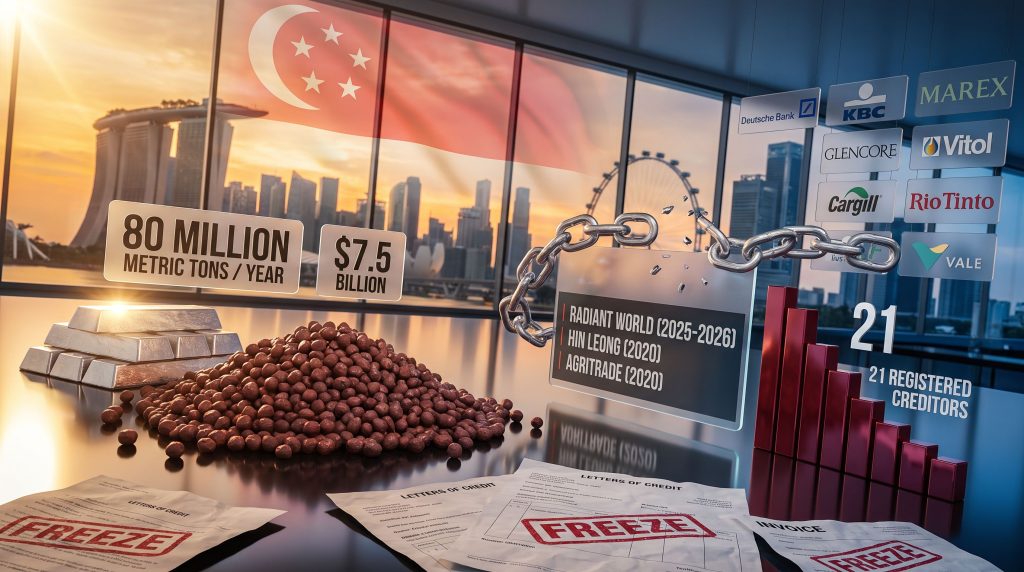
Radiant World, founded by Pinkesh Nahar in the early 2000s, reportedly handles more than 80 million metric tons of iron ore annually. At current SGX benchmark prices, that volume carries a notional value exceeding $7.5 billion per year, making it one of the more significant mid-to-major tier trading operations in the Asian iron ore market. Understanding iron ore price trends helps contextualise the enormous financial stakes involved at this volume.
To place that in context:
| Trading House | Annual Iron Ore Volume | Approximate Market Position |
|---|---|---|
| Glencore (marketing division) | ~95 million MT | Major tier |
| Radiant World | ~80 million MT | Mid-to-major tier |
| Cargill | 60-70 million MT | Mid tier |
This is not a marginal player. A firm moving 80 million metric tons annually is a meaningful participant in Asian iron ore price discovery, logistics, and the credit flows that connect major miners to steel mills across China and Southeast Asia.
"When a trading house of this scale faces simultaneous credit withdrawal from multiple financial institutions, the consequences reach well beyond its own balance sheet, touching counterparties, logistics providers, and the pricing mechanisms that smaller buyers depend on."
What Triggered the Radiant World Crisis
Allegations of Document and Invoicing Irregularities
The immediate catalyst for the current situation involves allegations of irregularities in trade documentation and invoicing related to iron ore transactions. Radiant World has publicly characterised these claims as inaccurate and without substantiation. Despite this denial, the market's response has been immediate and severe, suggesting that lenders and counterparties are operating on a precautionary basis rather than waiting for formal legal determinations.
This is a critical nuance. In commodity trade finance, the threshold for action is not proof of wrongdoing. It is the possibility of compromised document integrity, which is enough to make the underlying collateral of an entire credit relationship unreliable.
Police Involvement Escalates the Risk Profile
The Singapore Police Force has confirmed it received reports about the company and is actively investigating the allegations. For a firm headquartered in Singapore, police involvement in this jurisdiction is particularly consequential. Singapore functions as the primary hub for iron ore and base metals trading across Asia, and its regulatory environment carries significant weight with international financial institutions.
The transition from a commercial dispute to an active police investigation crosses a threshold that most institutional lenders treat as a near-automatic trigger for precautionary credit suspension. Furthermore, commodity market volatility of this nature tends to ripple outward, affecting adjacent markets and counterparties well beyond the firm at the centre of the investigation.
The Self-Reinforcing Credit Withdrawal Dynamic
Perhaps the most structurally important aspect of the Radiant World layoffs and lenders back away situation is how credit withdrawal operates in commodity markets. Unlike corporate lending where restructuring conversations can occur over months, trade finance credit tends to evaporate in days.
The mechanism works as follows:
- Initial allegations emerge regarding document integrity
- One or two lenders freeze accounts or suspend credit as a precautionary measure
- Other market participants observe the withdrawal and reassess their own exposure
- The reputational signal of being frozen out by a major bank outweighs the commercial relationship for remaining counterparties
- Credit withdrawal becomes nearly universal, regardless of individual lenders' independent evidence
- The firm's ability to fund new trades collapses, creating actual insolvency risk even if the underlying allegations are unresolved
This dynamic has a historical precedent that casts a long shadow over the current situation.
Historical Parallels: Singapore's Commodity Trading Vulnerabilities
The Hin Leong Collapse as a Reference Framework
The collapse of Hin Leong Trading in 2020 remains the most studied example of how quickly Singapore-based commodity trading firms can unravel when document integrity is questioned. Hin Leong, one of Asia's largest oil traders at the time, accumulated liabilities exceeding $3.5 billion before entering liquidation proceedings, with allegations of hidden losses and fabricated trade documents at the centre of its downfall.
The structural parallels to the Radiant World situation are notable:
| Factor | Radiant World (2025-2026) | Hin Leong (2020) | Agritrade (2020) |
|---|---|---|---|
| Primary Allegation | Document/invoice irregularities | Oil inventory fraud | Debt concealment |
| Lender Response | Accounts frozen, credit suspended | Full credit withdrawal | Credit suspension |
| Regulatory Action | Singapore Police investigation | SPF + MAS investigation | SPF investigation |
| Scale of Operations | 80M+ MT iron ore/year | Major fuel oil trader | Coal and fuel trading |
| Outcome (at time) | Ongoing / unresolved | Liquidation proceedings | Liquidation |
"The early-stage indicators at Radiant World, including police reports, frozen accounts, distressed inventory liquidation, and staff reductions, mirror the initial phases of previous Singapore commodity trading collapses. Whether the outcome diverges depends largely on the firm's capacity to restore creditor confidence before liquidity is exhausted."
Why Iron Ore Is Particularly Vulnerable to Document Risk
Iron ore trading carries specific structural vulnerabilities that make it more exposed to document-related credit risk than many other commodities. Transactions are typically settled through letters of credit and trade receivables instruments that derive their entire validity from the authenticity of underlying documentation, including bills of lading, inspection certificates, and weight reports.
When the authenticity of any of these documents is questioned, the collateral basis of the entire credit structure becomes legally and commercially unreliable. Lenders cannot determine which transactions are backed by legitimate documentation and which are not, creating an immediate and unresolvable uncertainty that makes continued lending untenable from a risk management perspective. The broader China steel and iron ore market, which depends heavily on reliable intermediaries, is consequently exposed to knock-on disruptions whenever a major trading house faces this kind of crisis.
How Lenders and Counterparties Have Responded
Banking and Brokerage Withdrawals
The financial retreat from Radiant World has been broad and rapid. Deutsche Bank and KBC Group NV have reportedly frozen certain Radiant World Singapore bank accounts, while additional unnamed lenders have suspended credit lines. Marex Group, a significant commodities broker, has reportedly frozen all Radiant World accounts following the emergence of the allegations. All three institutions declined to comment publicly.
Major Trading Houses and Miners Reduce Exposure
The counterparty retreat extends well beyond the banking sector. Several of the world's largest commodity trading firms and iron ore miners have reportedly reduced or ceased their business dealings with Radiant World:
| Counterparty | Reported Action |
|---|---|
| Deutsche Bank | Froze Singapore bank accounts |
| KBC Group NV | Froze Singapore bank accounts |
| Marex Group | Froze all Radiant World accounts |
| Glencore | Reduced or ceased business |
| Vitol | Reduced or ceased business |
| Cargill | Reduced or ceased business |
| Rio Tinto | Reduced or ceased business |
| Vale | Reduced or ceased business |
The number of creditors with formally registered claims against Radiant World's Singapore operating entity has reportedly more than doubled since early 2025, with at least 21 registered creditors now holding claims against the firm's assets. This escalation in formal creditor positions represents a significant tightening of the firm's legal and financial exposure.
Emergency Responses: Inventory Sales and Staff Reductions
Selling Aluminium Inventory Under Distress
Faced with acute liquidity pressure, Radiant World has sold a substantial portion of its aluminium inventory to STG, a trading company backed by principals of U.S. hedge fund Squarepoint. Distressed inventory sales of this nature typically occur at discounts to prevailing market prices, compounding the firm's financial deterioration rather than resolving it.
The cross-commodity nature of this sale is itself informative. It indicates that Radiant World had diversified its trading book beyond iron ore into base metals, a common strategy among mid-tier trading houses seeking yield in adjacent markets. The forced liquidation of aluminium inventory by a firm of this size can also introduce temporary downward pressure on spot prices at affected delivery locations, creating a secondary market signal that extends beyond the firm's own financial situation.
Workforce Reductions Signal Operational Contraction
Back-office operations staff at Radiant World's Dubai office were among the first employees to be let go, with Bloomberg reporting layoffs across multiple global offices. The firm operates across Singapore, Dubai, Shanghai, London, Geneva, Connecticut, and Mumbai, employing more than 100 people according to its website. A company spokesperson declined to comment on the scale or scope of the redundancies.
The departure of Radiant World's Head of Refined Metals, Adhitya Sethaputra, less than two years after joining, preceded the current crisis. In commodity trading, senior executive exits in the months before a liquidity event often function as leading indicators of internal instability that has not yet become publicly visible.
The next major ASX story will hit our subscribers first
Broader Market Implications
Concentration Risk in Mid-Tier Iron Ore Intermediation
The iron ore supply chain depends on a relatively small number of mid-tier trading houses to bridge the gap between major miners such as Rio Tinto, Vale, and BHP on one side, and smaller steel mills across China and Southeast Asia on the other. The sudden contraction of a firm handling more than 80 million metric tons annually creates a structural intermediation gap.
Smaller steel producers that rely on trading house relationships rather than direct miner contracts may find iron ore access tightening in the short term. This is not a widely discussed dimension of the Radiant World layoffs and lenders back away situation, but it carries real implications for procurement cost and availability at the mill level. Indeed, the global iron ore market impact of such disruptions can reverberate well beyond the immediate parties involved.
Price Discovery and Futures Market Liquidity
Large trading houses contribute to iron ore price discovery through their participation in SGX iron ore futures markets. A significant participant being frozen out of account access and trading capacity does not disappear from the market cleanly; it creates asymmetric liquidity withdrawal that can widen bid-ask spreads and introduce short-term pricing volatility for benchmark contracts.
This is particularly relevant for market participants who use SGX iron ore futures for hedging physical exposure, as a reduction in trading house participation can temporarily degrade the quality of the hedge relationship. Furthermore, commodity price impacts of this kind can cascade into mining company performance metrics across the sector.
The Structural Lesson: Why Trade Finance Risk Is Underappreciated
The Radiant World situation illustrates a risk dynamic that receives far less attention than equity market volatility or credit rating downgrades: the speed and totality with which commodity trade finance can collapse when document integrity is questioned.
Several structural lessons emerge from the current situation:
- Leverage amplifies document risk: Firms operating at high volume on thin margins have minimal buffer to absorb the sudden withdrawal of credit facilities that fund every transaction
- Precautionary withdrawal is rational at the individual level but catastrophic at the systemic level: Each lender withdrawing individually to protect its own exposure creates a collective outcome that may exceed what the underlying risk actually warrants
- Diversification into multiple commodities does not provide liquidity protection: Radiant World's aluminium exposure did not hedge its iron ore credit risk; it became an asset available for distress liquidation
- Regulatory involvement is a near-irreversible signal: Once a police investigation is confirmed, the reputational and compliance risk of continued exposure typically outweighs commercial considerations for institutional counterparties
- Senior talent departure precedes visibility: The exit of key personnel is often a leading indicator that internal conditions have deteriorated before external reporting catches up
Consequently, the Radiant World episode serves as a sobering reminder that in commodity markets, trade finance infrastructure is frequently the most fragile — and least visible — link in the supply chain. When that infrastructure fails, the consequences are swift, severe, and far-reaching for all participants connected to it.
Disclaimer: This article is intended for informational and educational purposes only. It does not constitute financial, legal, or investment advice. Readers should conduct their own due diligence and seek appropriate professional guidance before making any financial decisions. All reported figures and developments are based on publicly available information and cited sources, and the situation described remains ongoing and subject to change.
Want to Stay Ahead of Major Commodity Market Shifts?
Discovery Alert's proprietary Discovery IQ model scans ASX announcements in real time, instantly identifying significant mineral discoveries and translating complex data into actionable investment insights — explore the historic returns major discoveries have generated and begin your 14-day free trial to position yourself ahead of the broader market.