July 15, 2026
When Supply Shocks and Macro Tailwinds Collide: Understanding BHP's Single-Session Surge
Commodity markets operate on a fundamental tension between two forces: the macro environment that shapes the cost of capital and risk appetite, and the physical reality of supply chains that can be disrupted at any point from mine face to port. Most trading sessions see these forces operating independently, with one or the other dominating sentiment. On rare occasions, both forces align simultaneously, amplifying their individual effects into something considerably more powerful. July 15, 2026 was one of those sessions for BHP Group (ASX: BHP).
Understanding why BHP surges on Chile copper issues requires examining not just the headline data points, but the underlying mechanics of how U.S. monetary policy expectations transmit into Australian mining equities, and how a single labour dispute in a South American desert can send shockwaves through global futures markets within hours.
When big ASX news breaks, our subscribers know first
Two Independent Triggers, One Outsized Outcome
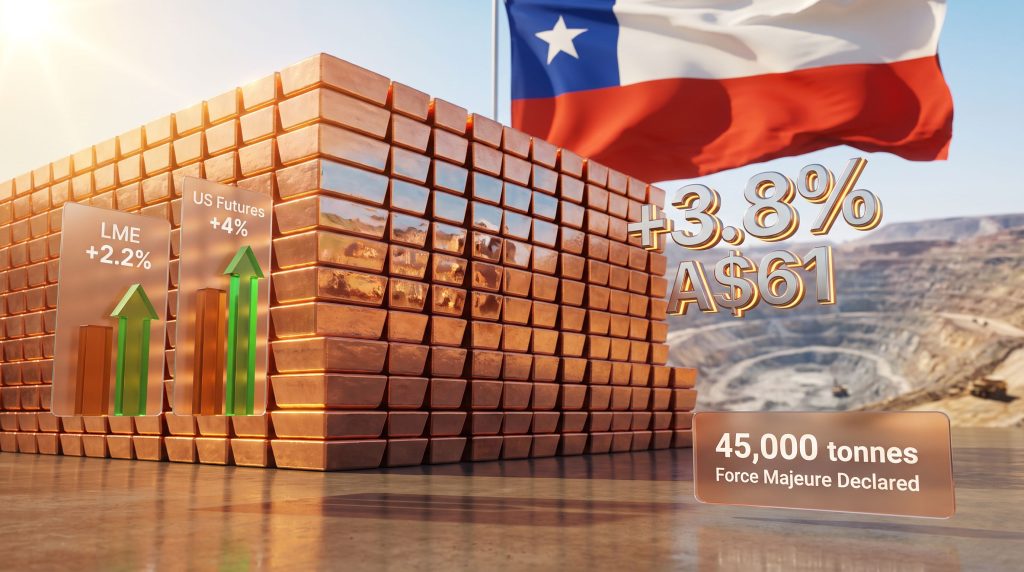
BHP's 3.8% single-session gain, pushing the stock back above A$61/share and toward its all-time high near A$65, was not driven by company-specific news. No earnings revision, no acquisition, no exploration breakthrough. Instead, the catalyst was the simultaneous arrival of two globally significant events that, in isolation, would each have been mildly supportive for mining equities. Together, they created a compounding effect that dragged the ASX market performance itself higher, lifting the benchmark index to 8,830.6 points, up 22.1 points on the session.
BHP's ~A$298.2 billion market capitalisation as Australia's largest listed company means its index weighting alone creates a reflexive dynamic: when BHP rises sharply, the ASX 200 rises with it, which then attracts incremental capital into the broader materials sector, which in turn provides secondary support for BHP's own momentum. This feedback loop is one reason single-session moves of this magnitude matter beyond the immediate share price figure.
The U.S. Inflation Catalyst: What the CPI Data Actually Said
Core CPI vs Core PCE: Why the Distinction Matters for Miners
Overnight U.S. inflation data delivered a positive surprise to markets, with headline consumer price index (CPI) figures cooling in part due to falling energy prices. A portion of this decline was linked to energy market dynamics associated with the Iran War period, meaning the market had partially anticipated the softness. Despite this, the data still exceeded the optimistic end of investor expectations.
Critically, U.S. core CPI cooled to 2.6%, a figure that markets interpreted as meaningful progress on the disinflation path. For commodity investors, lower core inflation carries a specific implication: it reduces the probability that the U.S. Federal Reserve will deliver a near-term interest rate hike, which matters because copper and other base metals are priced in U.S. dollars. When the dollar softens on reduced rate hike expectations, dollar-denominated commodities become relatively cheaper for foreign buyers, typically supporting demand and price.
However, a critical distinction is frequently overlooked by retail investors monitoring these developments. The Federal Reserve, under Chair Kevin Warsh, does not set monetary policy based on CPI. Its preferred benchmark is Core Personal Consumption Expenditures (Core PCE) inflation, a broader measure that captures a wider range of consumer spending and adjusts more dynamically for substitution effects. As of the July 15 session, Core PCE remained at 3.4%, well above the Fed's 2% target.
Warsh's public commentary reinforced that the disinflation process remains incomplete. Despite the positive CPI print, the Fed's internal framework continues to signal caution, maintaining a higher-for-longer undercurrent even as bond markets reduced their bets on an imminent rate hike.
This nuance is significant for investors building positions in BHP or other copper-exposed miners. The CPI-driven rally reflects improved near-term sentiment, not a fundamental shift in Fed policy. If Core PCE fails to converge toward the 2% target in coming months, rate hike risk remains live, which could strengthen the U.S. dollar and compress the commodity price gains that drove July 15's session.
How Wall Street Sentiment Transmits to ASX Mining Stocks
The mechanism by which U.S. overnight data influences the Australian equity market open is well established but worth understanding in structural terms:
-
Price discovery across dual-listed securities: BHP maintains listings on both the ASX and the London Stock Exchange (LSE). Overnight trading in London and via U.S. ADRs allows global investors to reprice BHP shares in real time, establishing a directional signal before the ASX opens each morning.
-
Futures market positioning: ASX SPI futures trade overnight and incorporate offshore macro developments, meaning professional traders have already priced in a significant portion of the macro news before retail investors can act on the open.
-
Risk appetite contagion: Positive U.S. data that reduces rate hike fears generally improves global risk appetite, encouraging rotation into cyclical assets including mining equities across all major exchanges.
-
U.S. earnings season amplification: With U.S. earnings season underway simultaneously, improved macro sentiment creates a more favourable backdrop for corporate earnings beats, further reinforcing the positive feedback loop into equities broadly.
Chile's Copper Supply Crisis: The Escondida Effect
Why Chile's Position in Global Copper Cannot Be Overstated
Chile is the world's largest copper-producing nation, and within Chile, the Escondida mine holds the distinction of being the single largest copper mine by annual output volume anywhere on earth. This geographic concentration of critical mineral supply is both a structural feature of the global copper market and an ongoing source of supply-side vulnerability. The Chile copper outlook remains a key variable for global commodity investors tracking potential price disruptions.
| Metric | Detail |
|---|---|
| Chile's global copper role | World's largest copper-producing nation |
| Escondida status | World's largest copper mine by output volume |
| BHP's Chilean investment program | A$10.8 billion to A$14.7 billion committed |
| Current Escondida ore grade | Approximately 0.93% copper |
| Projected global copper deficit by 2035 | Estimated 10 million tonnes |
The ore grade figure deserves particular attention. At 0.93% copper, Escondida is operating at grades that would have been considered uneconomic by historical standards. Ore grade decline is a universal characteristic of maturing porphyry copper deposits, the geological formation type that dominates Chilean production. Porphyry copper systems form from hydrothermal fluids associated with magmatic intrusions, creating large, low-grade but bulk-mineable orebodies.
As the higher-grade cores of these systems are mined out over decades, operators are progressively processing lower-grade material, requiring more energy, more water, and more processing infrastructure per tonne of copper produced. Furthermore, BHP's multi-billion-dollar investment commitment in Chile is a direct response to this geological reality, designed to maintain production volumes even as ore quality declines. This also means the investment creates a fixed cost base that amplifies the financial impact of any operational disruption, whether from labour disputes or extreme weather.
The Escondida Strike: Anatomy of a Supply Shock
A labour dispute involving approximately 2,500 workers at Escondida entered its third consecutive day without resolution on July 15. At the centre of the dispute is a recurring tension in Chilean copper labour relations: the appropriate distribution of mine profits between the operating company and its workforce. This is not a new dynamic. Escondida has a documented history of periodic strikes, including a prolonged 44-day stoppage in 2017 that removed an estimated 200,000 tonnes of copper from global supply. According to BHP's broader Chilean copper strategy, the company has committed up to $14 billion to sustain and grow output in the region, making any disruption to this infrastructure particularly consequential.
The current dispute prompted BHP to declare force majeure, a formal legal mechanism that releases a company from contractual delivery obligations when extraordinary circumstances beyond its control prevent normal operations. For copper traders and end-users holding offtake agreements with BHP, a force majeure declaration is a material event: it signals not just a temporary slowdown but a formal acknowledgement that shipment commitments cannot be met.
Analyst estimates placed the potential supply impact at approximately 45,000 tonnes of copper removed from global availability for every one to two weeks the dispute persists. To contextualise this figure, global copper consumption runs at roughly 25 million to 26 million tonnes annually, meaning a two-week Escondida stoppage represents a removal of supply equivalent to several days of global demand, in a market that analysts already consider structurally undersupplied. Indeed, the copper supply crunch narrative has been building for some time, making events like this strike all the more significant for long-term investors.
How the Strike Translated into Copper Price Momentum
The market response to the combined strike and force majeure news was immediate and significant:
| Market | Price Movement |
|---|---|
| London Metal Exchange copper | Surged more than 2.2% |
| U.S. copper futures | Jumped more than 4%, to approximately US$2.77/lb |
| Local copper futures (Wednesday lunch) | Trading at approximately US$6.32/lb |
| Copper year-to-date performance | Up approximately 10%, near multi-year highs |
The divergence between LME and U.S. futures price levels reflects different contract specifications and market structures, but the directional momentum was consistent across both benchmarks. Year-to-date copper performance of approximately 10% suggests the market was already pricing in tightening supply conditions before the Escondida dispute, meaning the strike added an acute premium on top of a structurally elevated base.
Winter Storm Risk: An Independent Second Layer of Disruption
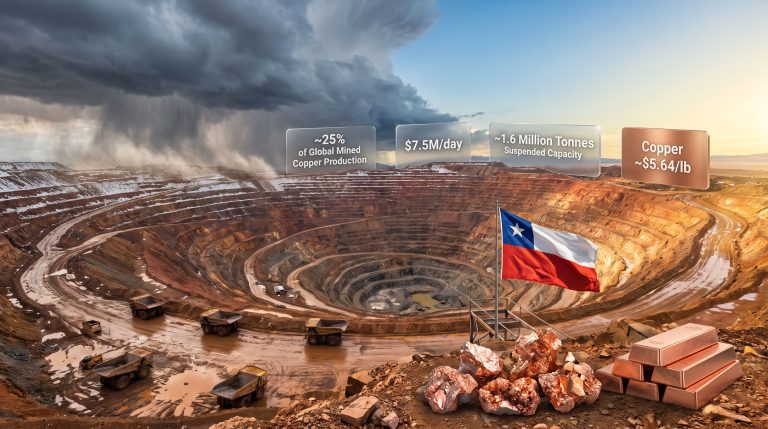
Separate from the labour dispute, a significant winter storm system was tracking toward Chile's key mining and port infrastructure. Emergency consultations were convened between major copper producers including Codelco and Teck, along with Chilean government officials, to develop contingency logistics plans, according to reports from Bloomberg.
What makes this weather event analytically distinct from a typical short-term disruption is the concern, raised in meteorological assessments, that conditions could persist across multiple storm events rather than clearing rapidly. Chile's copper export infrastructure is heavily dependent on road networks and port facilities that are vulnerable to severe Andean weather systems. A sustained disruption to port clearance would compound the production losses from the Escondida strike, creating two simultaneous and independent supply constraints operating in the same geography.
This overlap of labour disruption and extreme weather in the world's dominant copper-producing region is precisely the type of low-probability, high-impact scenario that commodity risk models struggle to price in advance. When it materialises, the market typically overreacts to the upside before recalibrating.
Modelling the Supply Disruption Across Time Horizons
| Time Horizon | Scenario | Copper Market Implication |
|---|---|---|
| Short-term (1 to 2 weeks) | Strike resolved; storm passes without major infrastructure damage | Temporary price spike normalises; supply premium fades |
| Medium-term (1 to 3 months) | Strike extends; weather delays port clearance for extended period | Sustained supply deficit; copper prices hold elevated; BHP earnings guidance under review |
| Long-term (2030 to 2035) | Structural underinvestment compounds declining ore grades | 10-million-tonne global deficit; conditions consistent with a copper supercycle |
The long-term scenario is not speculative in isolation. It reflects a convergence of trends that have been extensively modelled by mining analysts and independent research bodies. Three structural copper demand drivers are reshaping copper consumption in ways that are fundamentally different from previous commodity cycles:
-
Artificial intelligence infrastructure buildout: Data centres supporting large-scale AI computation require substantial copper wiring in power distribution, cooling systems, and network connectivity. The accelerating pace of AI infrastructure investment globally is driving copper demand that was not present in previous technology cycles.
-
Electric vehicle adoption: Each battery-electric vehicle contains approximately three to four times the copper of a conventional internal combustion engine vehicle, across motors, wiring, charging systems, and battery management infrastructure.
-
Renewable energy grid expansion: Solar panels, wind turbines, and the transmission infrastructure required to connect them to population centres are all copper-intensive. Grid-scale battery storage systems add further demand.
These three forces share a critical characteristic: they are secular demand trends, not cyclical ones. Unlike previous commodity cycles driven by construction booms in emerging markets that eventually plateau, the energy transition and digital infrastructure build-out represent a multi-decade structural shift in how copper is consumed. As BHP itself has noted, copper demand is set to surge 72% by 2050, underscoring just how transformative these trends are expected to be.
BHP's Strategic Position Within the Copper Market
Copper as a Cornerstone BHP Commodity
Within BHP's diversified portfolio, copper sits alongside iron ore and potash as one of the company's highest-conviction long-term commodity positions. The Escondida mine is the operational centrepiece of this copper strategy, which creates a strategic paradox: BHP's most important copper asset is also the asset whose disruption most directly threatens the earnings trajectory that supports the stock's premium valuation.
The ASX 200 index weighting dynamics amplify this further. When BHP surges on Chile copper issues — as it did on July 15 — it does not simply represent returns for BHP shareholders. It pulls the entire materials sub-sector higher, attracts momentum-driven capital into the index, and creates positive sentiment feedback that benefits smaller miners and explorers across the ASX. On July 15, BHP's move contributed meaningfully to the ASX 200's advance to 8,830.6 points, demonstrating the outsized influence a single company can exert on an entire national benchmark. For further context on how these production dynamics play out globally, the largest copper mines continue to exert disproportionate influence on price discovery.
The next major ASX story will hit our subscribers first
Key Risk Variables Investors Should Track
Upside Risks That Could Extend BHP's Momentum
-
A prolonged Escondida strike extending well beyond two weeks, deepening the physical supply deficit and sustaining the price premium in copper futures
-
Continued U.S. disinflation progress bringing Core PCE materially closer to the Fed's 2% target, reducing rate hike risk and supporting risk assets including mining equities
-
Accelerating EV adoption and AI infrastructure investment pulling forward copper consumption timelines beyond current consensus forecasts
-
Additional Chilean weather events compounding port and logistics disruptions beyond the initial storm window
Downside Risks That Could Reverse the Rally
-
Rapid resolution of the Escondida labour dispute through negotiation or arbitration, removing the acute supply premium from copper prices
-
Core PCE remaining sticky at 3.4% or above, prompting the Fed to signal a rate hike and strengthening the U.S. dollar, which would apply downward pressure on dollar-denominated commodity prices
-
A broader risk-off event emerging from U.S. earnings season if corporate results disappoint elevated expectations
-
Chilean government intervention mandating binding arbitration, shortcutting the strike and restoring production on a faster-than-expected timeline
Risk Callout: Core PCE at 3.4% remains well above the Fed's 2% target. Investors should be careful not to conflate a positive CPI print with a fundamental shift in Fed policy. If rate hike expectations re-emerge in coming weeks, U.S. dollar strength could cap copper's upside and moderate BHP's share price momentum, even if supply disruptions from Chile persist.
FAQ: BHP, Copper, and the Chile Supply Crisis
Why Did BHP Shares Surge on July 15, 2026?
BHP's share price climbed approximately 3.8% to above A$61, driven by two simultaneous catalysts: cooling U.S. CPI data that reduced Federal Reserve rate hike expectations, and a labour strike at the Escondida copper mine in Chile, the world's largest, which triggered a force majeure declaration and drove copper prices sharply higher.
What Is Force Majeure and Why Did BHP Declare It?
Force majeure is a formal legal mechanism through which a company notifies counterparties that it cannot fulfil contractual delivery obligations due to circumstances beyond its control. BHP's declaration at Escondida signalled that the ongoing worker strike had rendered normal production and shipment operations impossible.
How Much Copper Supply Could Be Disrupted by the Escondida Strike?
Analyst estimates placed the potential supply impact at approximately 45,000 tonnes for every one to two weeks the dispute continued, a meaningful volume in a market already characterised by structural supply tightness.
Why Does Ore Grade Decline Matter for Escondida's Long-Term Output?
As porphyry copper deposits mature, the higher-grade core zones are progressively exhausted, forcing operators to process lower-grade material. At an ore grade of approximately 0.93% copper, Escondida requires proportionally more energy, water, and processing capacity per unit of copper produced, increasing unit costs and the financial exposure to any operational interruption.
What Is the Long-Term Copper Demand Outlook?
Structural demand from electric vehicles, AI data centre infrastructure, and renewable energy grid expansion is projected to drive a global copper deficit of approximately 10 million tonnes by 2035, underpinning a long-term constructive case for copper producers.
How Does Chilean Weather Affect Copper Exports?
Chile's mining export infrastructure is dependent on road and port networks that are vulnerable to severe Andean winter storms. The meteorological risk on July 15 prompted emergency planning meetings between major producers including Codelco and Teck and Chilean government officials, raising concerns about sustained logistics disruptions extending beyond a single weather event.
Key Takeaways: What BHP's Session Tells Us About Copper in 2026
-
The simultaneous convergence of U.S. disinflation data and Chilean copper supply disruptions created an unusually powerful single-session catalyst, illustrating how macro and supply-side forces can compound each other's market impact when they arrive together.
-
Copper's structural demand story, anchored in energy transition and digital infrastructure investment, means supply disruptions now carry greater market weight than in previous commodity cycles where demand was more cyclical in nature.
-
BHP's proximity to its all-time high near A$65 suggests the market is increasingly pricing in a sustained period of copper price strength rather than simply an event-driven premium.
-
The Fed's Core PCE metric at 3.4% remains the most important variable to monitor for investors in mining equities. Until this figure converges meaningfully toward 2%, rate hike risk remains a credible tail risk capable of reversing commodity market gains.
-
Investors tracking BHP's near-term trajectory should monitor three primary variables in parallel: Core PCE data releases, the Escondida strike resolution timeline, and Chilean meteorological developments.
This article is for informational purposes only and does not constitute financial advice. Past performance is not indicative of future results. Readers should conduct their own research and consult a qualified financial adviser before making any investment decisions.
Want to Identify the Next Major ASX Mineral Discovery Before the Broader Market?
Discovery Alert's proprietary Discovery IQ model scans ASX announcements in real time, instantly transforming complex commodity data into actionable investment insights across copper and more than 30 other commodities — the same kind of supply-demand dynamics explored in this article. Explore historic discoveries and their extraordinary returns, then begin your 14-day free trial at Discovery Alert to position yourself ahead of the market.