July 15, 2026
The Hidden Value Sitting on the Surface of Peru's Copper Mines
Long before a single tonne of new ore is blasted from underground, many copper mines are sitting on a quietly overlooked opportunity: the millions of tonnes of low-grade material that have accumulated on surface over decades of operation. These stockpiles, often dismissed as uneconomic at prevailing grades, represent a category of stranded value that is increasingly attracting the attention of process engineers and mine operators across Latin America, and Rio2 copper grade technology at its Peru mine is emerging as a compelling example of how this challenge can be addressed.
The economics driving this renewed interest are straightforward. Average mined copper grades globally have fallen from roughly 1.0% Cu in the early 2000s to below 0.6% Cu across many producing jurisdictions today. As ore bodies mature and higher-grade zones are depleted, the cost of producing a pound of copper from primary ore alone continues to climb.
Against this backdrop, the ability to extract additional copper value from previously marginalised material, without sinking capital into new mines or large-scale plant expansions, has become a genuine competitive differentiator. Consequently, understanding broader copper market trends helps contextualise exactly why operations like Condestable are drawing such close attention.
Peru sits at the epicentre of this challenge. As one of the world's two largest copper-producing nations, the country hosts a diverse range of operations, from large-scale porphyry systems to smaller, high-grade skarn and vein deposits. It is within this context that Rio2's approach to its Condestable copper mine deserves close examination, particularly the company's deployment of ore sorting technology to rehabilitate low-grade stockpile material into economically viable mill feed.
When big ASX news breaks, our subscribers know first
Understanding Ore Sorting: The Pre-Concentration Principle
To appreciate why Rio2 copper grade technology at its Peru mine matters, it helps to understand what ore sorting actually does and why it is technically different from conventional beneficiation.
Traditional mineral processing involves crushing, grinding, and flotation, all of which require substantial water, reagents, and energy input. Ore sorting intervenes much earlier in the processing chain. Before material ever reaches the mill, individual rocks or ore streams pass through a sensor array that analyses each unit's mineral content in real time.
The most widely adopted sensor types in copper applications include:
- X-ray transmission (XRT): Detects density contrasts associated with sulphide mineralisation, making it particularly effective for copper-bearing sulphide ores. Furthermore, XRT ore sorting has demonstrated consistent performance improvements across multiple copper operations globally
- Electromagnetic sensors: Respond to conductive minerals including chalcopyrite and other copper sulphides
- Optical and near-infrared sensors: Identify surface mineralogy and alteration patterns, useful as a complementary sorting signal
Once the sensor system classifies each rock or ore parcel, high-speed air jets or mechanical deflectors physically separate the material into two streams: a higher-grade fraction directed toward the mill, and a rejected fraction diverted to waste or tailings storage. The entire process operates without water or chemical addition, which carries meaningful environmental advantages in water-sensitive regions like coastal and semi-arid Peru.
The critical insight for mine operators is this: by removing barren or low-grade material before it consumes grinding energy, flotation reagents, and water, ore sorting effectively compresses the cost base per unit of copper recovered while simultaneously upgrading the average grade of mill feed.
Condestable's Resource Position and the Stockpile Opportunity
What Does the Resource Inventory Reveal?
Condestable is a producing copper operation processing ore through an 8,400 tonne-per-day plant. The mine's resource and reserve inventory is substantial, as detailed in Rio2's official resource update:
| Resource Category | Tonnage | Copper Grade | Notes |
|---|---|---|---|
| Measured & Indicated Resources | 82.1 Mt | 0.69% Cu | Primary ore inventory |
| Inferred Resources | 22.2 Mt | 0.76% Cu | Additional upside potential |
| Proved & Probable Reserves | 36.5 Mt | 0.73% Cu | Economic extraction basis |
| Life-of-Mine Mill Feed Grade | All reserves | 0.73% Cu | With 0.15 g/t Au, 4.28 g/t Ag credits |
What this table does not capture is the approximately 10 million tonnes of low-grade mineralised stockpiles and historical waste material accumulated on site over the mine's long operational history. This material was generated during periods when selective mining practices prioritised higher-grade ore, with sub-economic rock set aside rather than processed. The result is a substantial surface inventory that carries real copper content but at grades that historically sat below the plant's economic processing threshold.
"Ore sorting functions as a grade bridge, elevating material that would otherwise remain stranded on surface to a quality level that the existing processing infrastructure can handle economically. This is value creation without new mining activity."
This is precisely the opportunity that Rio2 is targeting. Rather than requiring additional drilling, permitting for new ore sources, or capital-intensive plant upgrades, the ore sorting approach works with material that already exists on the mine footprint. In addition, understanding cut-off grade economics is essential to appreciating how much value may be recoverable from this surface inventory.
Laboratory Results: What the Test Work Demonstrated
How Strong Were the Early Findings?
Rio2 completed laboratory-scale ore sorting test work at Condestable during March and April 2026. The results provided the technical foundation for advancing to a full pilot programme.
The key performance metrics from that laboratory phase were as follows:
| Performance Metric | Measured Outcome |
|---|---|
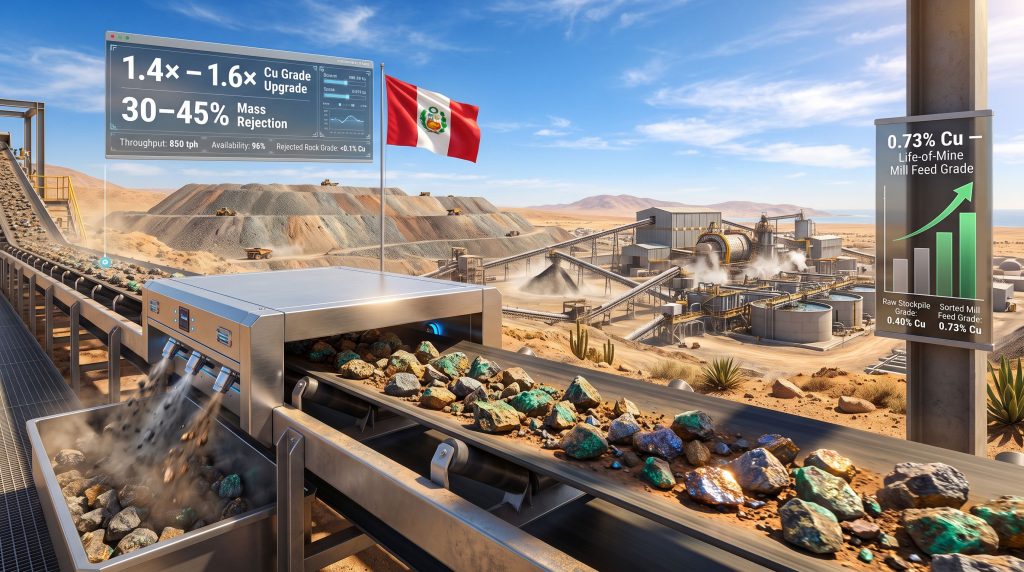
| Copper grade upgrade factor | 1.4x to 1.6x improvement |
| Mass rejection rate | 30% to 45% of low-grade material rejected |
| Target material | Low-grade stockpiles and historical waste (~10 Mt) |
| Management characterisation of results | Strongly positive |
To translate these figures into practical terms: if the raw stockpile material averages 0.35% Cu before sorting, a 1.5x grade upgrade would deliver approximately 0.525% Cu to the mill after the rejection of 30 to 45% of the total mass. That improvement is the difference between material that is uneconomic to process and material that contributes positively to the operation's unit cost structure.
Importantly, the 30 to 45% mass rejection rate carries its own economic logic independent of grade uplift. Fewer tonnes through the mill means lower grinding energy consumption, reduced reagent usage, and lower water demand per unit of copper produced. These savings accumulate across every tonne of sorted feed, compressing the C1 cost per pound of copper in ways that are not immediately obvious from grade figures alone.
One aspect of ore sorting that is frequently underappreciated outside specialist circles is the relationship between ore texture and sensor response. In copper skarn and copper-sulphide systems, mineralisation often occurs in relatively discrete zones within individual rocks, meaning that rock-by-rock sorting can be highly effective. The positive results at Condestable suggest the mine's mineralisation style is well-suited to sensor-based separation at the rock scale.
The Pilot Programme: Scaling from Laboratory to Operation
What Happens After Promising Lab Results?
Laboratory results, however strong, do not guarantee commercial performance. Continuous operation introduces variables that controlled test work cannot fully replicate: feed variability across different zones of the stockpile, equipment wear rates, operator consistency, and the cumulative effect of minor grade heterogeneity over time.
Rio2 has structured a 12-month pilot programme to address precisely these questions. The pilot is planned to run at 1,000 to 1,500 tonnes per day, a scale that is commercially meaningful without requiring full infrastructure commitment.
The pilot programme is designed to generate data across several critical performance dimensions:
- Grade upgrade consistency across varying mineralisation zones within the stockpile inventory
- Mass rejection stability as ore type and liberation characteristics change through the ~10 Mt material body
- Equipment reliability under continuous operational conditions in Peru's coastal environment
- Maintenance requirements and the practical cost of keeping sorting equipment running at target throughput
- Net economic performance relative to the cost of operating the sorting circuit itself
This staged approach reflects disciplined capital management. The pilot generates the data set needed to build a credible full-scale business case before Rio2 commits to the capital expenditure associated with permanent, large-scale ore sorting infrastructure across the entire stockpile inventory.
"The decision-gate structure of a pilot-then-expand model is increasingly standard practice in technology validation across the mining sector. It separates the cost of learning from the cost of deploying, protecting project economics during the highest-uncertainty phase."
Illustrative Economic Scenario: Quantifying the Opportunity
While actual outcomes will depend entirely on pilot results, the disclosed parameters allow for an illustrative scenario that frames the scale of the opportunity.
Assumptions:
- Stockpile inventory: ~10 Mt at an average of 0.35% Cu before sorting
- Grade upgrade factor: 1.5x (midpoint of 1.4x to 1.6x range)
- Mass rejection rate: 40% (midpoint of 30% to 45% range)
Modelled outcomes:
- Sorted feed volume delivered to mill: approximately 6 Mt
- Effective copper grade of sorted feed: approximately 0.525% Cu
- Contained copper in sorted feed: approximately 31,500 tonnes Cu
- Processing cost advantage: achieved on 40% fewer tonnes through the mill versus processing unsorted stockpile material
This scenario is strictly illustrative and based on disclosed laboratory-scale parameters. Readers should not treat these figures as forecasts or production guidance. Actual outcomes are contingent on pilot programme results and management decisions.
The next major ASX story will hit our subscribers first
Ore Sorting Within the Broader Technology Upgrade at Condestable
The ore sorting initiative does not exist in isolation. Concurrent with the sorting programme, Condestable is commissioning a dry-stack tailings filtration facility designed to improve water recovery to approximately 90%. This system eliminates the need for a conventional wet tailings storage facility, reducing both environmental risk and the operational complexity associated with water management in Peru's coastal zone.
The combination of these two technology streams creates a compounding operational improvement:
- Ore sorting reduces the volume of material processed, lowering water demand per tonne of copper produced
- The tailings filtration system recovers a far greater proportion of the water that is consumed in processing
- Together, these systems move Condestable toward a significantly lower water-intensity operating model, which carries both cost and social licence advantages in a jurisdiction where water access is politically and operationally sensitive
This dual-technology approach also signals something about Rio2's operational philosophy at Condestable: the mine is being positioned as a technology-forward asset rather than a legacy operation running on historical infrastructure. Furthermore, the broader copper processing benefits emerging from modern processing innovations underscore just how significant these technology combinations can be.
How Condestable's Results Compare to Industry Benchmarks
The grade upgrade and mass rejection figures from Condestable's laboratory test work sit comfortably within the range of documented performance across the global ore sorting industry.
| Operation Type | Typical Grade Upgrade Range | Typical Mass Rejection | Sensor Technology |
|---|---|---|---|
| Condestable (Rio2, Peru) | 1.4x to 1.6x Cu | 30% to 45% | Not yet publicly specified |
| Copper sulphide operations globally | 1.2x to 2.0x | 20% to 50% | XRT, electromagnetic |
| Industry pre-concentration benchmark | Variable by ore type | 15% to 60% | Multiple sensor types |
The credibility of Condestable's results is reinforced by their alignment with this established performance envelope. Results that fell significantly outside this range in either direction would warrant additional scrutiny. The fact that the Condestable data fits the industry pattern suggests the test methodology was sound and the ore type is compatible with sensor-based sorting.
What This Means for Copper Producers Across Latin America
Rio2 copper grade technology at its Peru mine is part of a wider and accelerating trend. Across Latin America's copper sector, operators are confronting the same structural challenge: primary ore grades are declining, processing costs are rising, and greenfield capital has become increasingly difficult and expensive to deploy.
Pre-concentration technologies, of which ore sorting is the most commercially mature, offer a pathway to extract additional value from existing mine footprints without triggering the full capital cycle associated with new project development. For mid-tier producers operating in jurisdictions where social and environmental licensing is complex and time-consuming, the ability to improve economics from within the existing mine boundary is strategically significant.
If Rio2's 12-month pilot at Condestable delivers results consistent with the laboratory phase, the operation could serve as a replicable model for other Peruvian copper producers sitting on comparable inventories of low-grade stockpile material. The implications extend beyond any single company. Consequently, the future of copper mining will increasingly depend on operators demonstrating this kind of value creation from within established mine boundaries.
Key takeaways for investors and industry observers:
- Condestable's approximately 10 Mt of low-grade stockpiles represent latent copper value that primary ore reserve figures do not capture
- Laboratory test work confirmed a 1.4x to 1.6x copper grade upgrade with 30 to 45% mass rejection at the pre-processing stage
- A structured 12-month pilot at 1,000 to 1,500 tpd is the next critical validation milestone before full-scale commitment
- Ore sorting is additive to, not a replacement for, Condestable's primary ore processing operations
- The concurrent dry-stack tailings system reinforces a broader operational efficiency strategy at the mine level
- Successful pilot outcomes could materially improve Condestable's unit cost economics and annual copper output without new mining capital expenditure
Disclaimer: This article contains illustrative financial scenarios and forward-looking analysis based on disclosed laboratory results and company statements. It does not constitute financial advice. Investors should conduct independent due diligence and consult qualified financial advisers before making investment decisions. Actual mining and processing outcomes may differ materially from laboratory-scale test results.
Want to Catch the Next Major Copper Discovery Before the Market Does?
Discovery Alert's proprietary Discovery IQ model scans ASX announcements in real time, instantly identifying significant mineral discoveries across copper and more than 30 other commodities — turning complex data into actionable opportunities for investors at every level. Explore how major mineral discoveries have historically delivered substantial returns on Discovery Alert's dedicated discoveries page, and begin your 14-day free trial today to position yourself ahead of the broader market.