July 14, 2026
From Concentrate to Cathode: Why Indonesia's Copper Ambitions Are Reshaping Asia-Pacific Supply Chains
For most of its modern mining history, Indonesia has been a raw material exporter, shipping copper concentrate overseas to be refined by smelters in China, Japan, and South Korea. That model, deeply embedded in the global copper supply chain, is now being dismantled from the inside. The country's shift toward domestic processing has taken years to materialise, but the numbers emerging from one of its flagship operations in mid-2026 suggest the transformation is no longer theoretical. It is industrial, measurable, and accelerating.
Understanding what this means for global copper markets requires stepping back from the headline figures and examining the mechanics of what is actually happening on the ground in Nusa Tenggara, and why the trajectory of Amman Mineral copper cathode output over the next 18 months deserves closer attention than it is currently receiving.
When big ASX news breaks, our subscribers know first
The Ramp-Up Trajectory: A Production Timeline That Demands Attention
Few industrial commissioning curves in Southeast Asian mining history have been as steep as the one recorded at Amman Mineral's copper smelter between early 2025 and mid-2026. The contrast between where the operation started and where it stands today is striking.
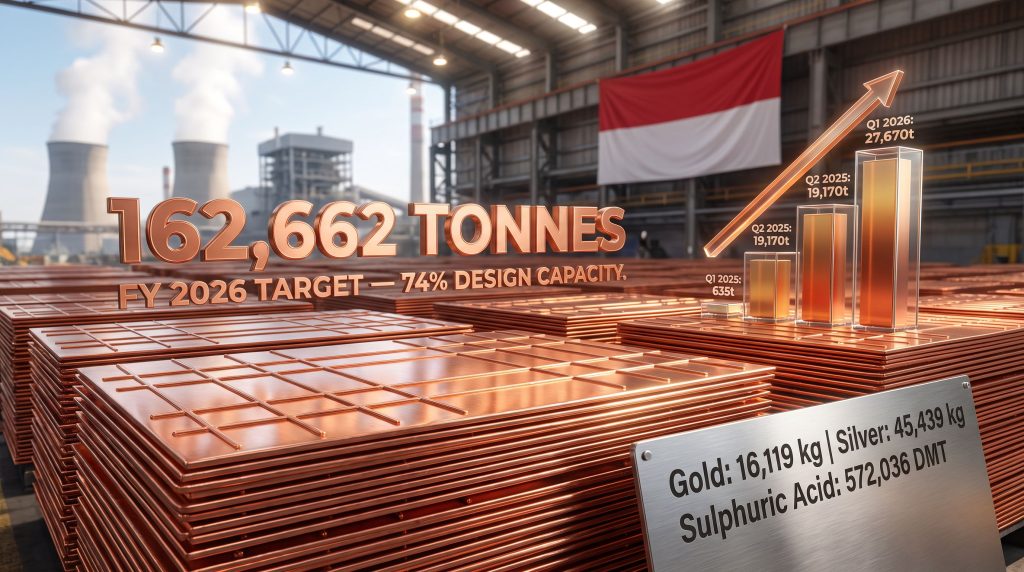
In Q1 2025, the facility produced approximately 635 tonnes of copper cathode, a figure that represented less than 1% of its design capacity. Leakage incidents during the initial commissioning phase forced management to restart the process entirely, compressing what was already an ambitious ramp-up schedule. Yet by Q2 2025, output had climbed to approximately 19,170 tonnes, reflecting roughly 35% utilisation of design capacity. By Q1 2026, quarterly output had reached 27,670 tonnes, equating to around 50% utilisation.
| Quarter | Copper Cathode Output | Estimated Smelter Utilisation |
|---|---|---|
| Q1 2025 | ~635 tonnes | <1% of design capacity |
| Q2 2025 | ~19,170 tonnes | ~35% of design capacity |
| Q1 2026 | ~27,670 tonnes | ~50% of design capacity |
| FY 2025 Total | 79,849 tonnes | Partial-year average |
| FY 2026 Target | ~162,662 tonnes | ~74% of design capacity |
| Maximum Design Capacity | 220,000 tonnes/year | 100% |
The jump from 635 tonnes in Q1 2025 to 27,670 tonnes in Q1 2026 represents a 43-fold increase in quarterly output within a single year, one of the steepest smelter ramp-up curves recorded among Southeast Asian copper operations.
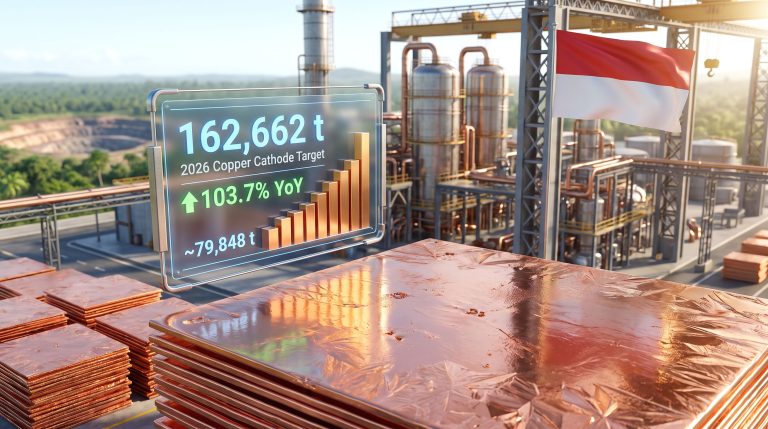
The company's chief executive disclosed to a parliamentary committee that Amman Mineral copper cathode output for the full year 2026 is targeted at 162,662 dry metric tonnes, more than double the 79,849 tonnes produced across 2025. The April 2026 commissioning completion date is the critical anchor point for this guidance, as it marked the first moment the smelter could theoretically absorb 100% of concentrate produced from the mine.
Management confirmed that as of June 2026, the facility was processing the full volume of mine output, a milestone that changes the production risk profile considerably. Prior to that point, any shortfall in smelter throughput meant copper concentrate was either stockpiling or being diverted elsewhere, both of which carry cost and logistical implications.
The Guidance Gap: Why Management and Analysts See Different Numbers
One of the more instructive tensions in Amman Mineral's 2026 production story is the divergence between executive guidance and market consensus. While the CEO has publicly committed to 162,662 tonnes, analyst consensus estimates cluster around 121,800 to 122,000 tonnes, implying a gap of approximately 40,000 tonnes between the two figures.
This gap is not necessarily a sign of overconfidence on management's part, nor scepticism on the analysts'. Rather, it reflects two legitimately different modelling assumptions:
- Management's guidance assumes the smelter operates at approximately 74% of design capacity on a sustained basis following April commissioning completion.
- Analyst consensus applies a more conservative ~65% utilisation rate and explicitly factors in the planned maintenance shutdown flagged for late December 2026 or early January 2027.
- The shutdown, described by management as a repair window, introduces a production interruption of potentially two to four weeks, which at full run-rate could cost between 8,000 and 17,000 tonnes of output depending on timing and duration.
Risk Note: Investors and analysts stress-testing full-year production forecasts should model the planned late-2026 shutdown as a discrete downside variable, not a rounding error. At current copper prices, each week of lost smelter throughput at the guided run-rate represents approximately $70 million or more in deferred revenue.
How the Smelter Actually Works: Technical Architecture and Output Quality
The Amman Mineral smelter is designed around flash smelting technology, one of the most energy-efficient and widely adopted pyrometallurgical methods in large-scale copper production. Flash smelting suspends finely ground copper concentrate in an oxygen-enriched air stream, which ignites the sulphide minerals and generates the heat required for smelting without the need for substantial external fuel inputs. The process is cleaner, faster, and more controllable than older reverberatory furnace methods, which is why it has become the dominant technology among greenfield copper smelter builds globally since the 1990s.
The facility is configured to produce LME Grade A copper cathode at 99.99% purity, the benchmark specification required for trading on the London Metal Exchange and the standard demanded by wire rod mills, cable manufacturers, and electrical component producers worldwide. This purity threshold is not merely a marketing distinction. It determines whether the product is directly tradeable on global commodity markets without further processing. Furthermore, copper smelting expansion of this calibre signals a broader regional shift in refining capability.
By-Product Value: More Than Just Copper
A less widely understood aspect of integrated copper smelting is the substantial revenue contribution from co-products and by-products. At Amman Mineral's facility, three streams sit alongside copper cathode in the 2026 production plan:
| By-Product | 2026 Planned Output |
|---|---|
| Gold | 16,119 kg |
| Silver | 45,439 kg |
| Sulphuric Acid | 572,036 dry metric tonnes |
| Copper Cathode | 162,662 dry metric tonnes |
The sulphuric acid figure warrants particular attention. At 572,036 dry metric tonnes, this volume is not a marginal by-product stream. Sulphuric acid is generated when sulphur dioxide gases from the smelting furnace are captured and converted through a contact acid plant, a standard configuration in flash smelting operations. In Indonesia's domestic industrial context, this volume represents a meaningful input source for the fertiliser and chemical manufacturing sectors, creating downstream integration value that extends well beyond the copper supply chain.
Gold and silver are recovered through the electrorefining stage of cathode production, where anode slimes containing precious metals are separated and processed. The 16,119 kg of planned gold output and 45,439 kg of silver contribute to total revenue diversification at commodity prices that, particularly for gold in mid-2026, represent significant unit value.
Smelter Commissioning Failures: Why First-Generation Pyrometallurgical Facilities Carry Elevated Execution Risk
The leakage incidents that plagued Amman Mineral's smelter during its initial 2024–2025 commissioning phase are worth examining in their own right, not because they are unique to this project, but because they are far more common across the global smelting industry than public reporting typically reflects.
First-generation pyrometallurgical smelters — facilities being commissioned for the first time without an existing operational template at the same site — face a category of risk that is distinct from ongoing mine operations. The refractory linings, off-gas handling systems, and acid plant configurations all require calibration under live thermal and chemical conditions that cannot be fully replicated in pre-commissioning testing. Refractory brick degradation, cooling water circuit failures, and converter vessel leakages are among the most common causes of unplanned shutdowns in this environment.
What distinguishes Amman Mineral's situation is that the company restarted the commissioning process after the leakage incidents rather than attempting to operate through them — a decision that compressed the early-2025 output profile but arguably produced a more stable operational foundation for the ramp-up that followed. The Q2 2025 leap from near-zero to 19,170 tonnes is consistent with a recommissioned facility that had resolved its primary mechanical vulnerabilities.
The flagged December 2026 / January 2027 shutdown suggests management is aware that at least some residual mechanical issues warrant attention before the facility attempts to push toward higher utilisation rates in 2027. This is proactive engineering practice, though it introduces a near-term output interruption that conservative production models should account for explicitly.
Global Benchmarking: Where Amman Mineral Sits in the World Copper Landscape
At its 2026 target of 162,662 tonnes and a design ceiling of 220,000 tonnes per year, Amman Mineral occupies the lower tier of what the industry classifies as large-scale copper smelting. The global production hierarchy provides useful context:
| Production Tier | Annual Output Range | Global Examples |
|---|---|---|
| Mega-scale smelters | 300,000–500,000+ tonnes | Codelco (Chile), Jiangxi Copper (China) |
| Large-scale smelters | 150,000–300,000 tonnes | Amman Mineral (Indonesia, at target) |
| Mid-scale smelters | 50,000–150,000 tonnes | Various Southeast Asian operations |
| Emerging/ramp-up | <50,000 tonnes | Early-stage commissioning facilities |
What makes the Amman Mineral story strategically significant is less about its absolute scale and more about its trajectory and geographic position. Southeast Asia's refined copper production base has historically been dwarfed by Chinese smelting capacity. A new, fully integrated, mine-to-cathode operation producing LME Grade A copper in the region represents a structural addition to Asia-Pacific supply that reduces, at least marginally, the region's dependence on Chinese refining infrastructure. In addition, understanding the broader copper price growth drivers helps contextualise why this facility's ramp-up is attracting sustained market attention.
At the copper price prevailing at the time of the announcement, approximately $5.64 per pound, each incremental 10,000 tonnes of cathode output adds roughly $124 million in gross revenue to the production ledger. The difference between management guidance and analyst consensus, approximately 40,000 tonnes, therefore represents a potential $496 million revenue swing depending on which scenario materialises.
If the facility reaches its 220,000-tonne annual design capacity in subsequent years, it would rank among the larger single-facility copper cathode producers in the Asia-Pacific region outside of China — a distinction that carries both commercial and strategic weight for Indonesia's longer-term resource industrialisation agenda.
Indonesia's Hilirisasi Policy: The Regulatory Architecture Behind the Smelter Build
The construction of Amman Mineral's copper smelter did not emerge from a purely commercial calculation. It was substantially shaped by Indonesia's hilirisasi (downstreaming) policy framework, which progressively restricted exports of unprocessed mineral concentrates and ores in favour of compelling domestic value addition.
The trajectory of this policy is instructive:
- Indonesia introduced its first significant mineral export restrictions in 2014, targeting nickel and bauxite ores in their unprocessed form.
- After a period of partial enforcement and exemptions, the government progressively tightened restrictions through the 2020–2023 period, narrowing the conditions under which copper concentrate could be legally exported.
- Mining operators with significant concentrate output faced a clear regulatory signal: build domestic smelting capacity or face increasingly constrained export access.
- This framework created the investment incentive structure within which Amman Mineral's smelter project was developed.
The hilirisasi approach is not unique to Indonesia. Similar resource nationalism strategies have been deployed in the Democratic Republic of Congo for cobalt and copper, in Chile through state ownership structures at Codelco — currently recognised as the world's top copper producer — and in several African jurisdictions through beneficiation requirements. What distinguishes Indonesia's version is its sequential application across multiple commodity chains, nickel first, then bauxite, then copper, which has forced repeated capital allocation decisions by mining companies operating within its borders.
Other Indonesian miners are now navigating the same policy environment, meaning Amman Mineral's smelter is likely to be one of several new domestic processing facilities coming online over the next five to seven years, further reshaping the country's position in global copper and base metals supply chains.
The next major ASX story will hit our subscribers first
Supply Implications: What an Additional 83,000 Tonnes Means for Copper Markets in 2026
The year-over-year increment from Amman Mineral's guidance — approximately 83,000 additional tonnes relative to 2025 output — enters the global copper market at a moment of particular price sensitivity. Copper was trading at approximately $5.64 per pound at the time of the company's parliamentary disclosure, a level that makes maximising throughput at integrated operations economically compelling.
At current prices, the economics of running a mine-to-cathode operation at higher utilisation rates are strongly positive. Treatment charges — the fees smelters earn for processing third-party concentrate — have been under pressure globally as Chinese smelting overcapacity competes for available feed. An integrated operation like Amman Mineral's, which processes its own mine's concentrate rather than relying on spot market feed, is insulated from this dynamic and benefits directly from cathode premiums rather than concentrate benchmark pricing.
This structural advantage becomes more pronounced as the smelter approaches full utilisation. The marginal cost of additional cathode production at an already-commissioned facility is substantially lower than the average total cost of bringing a new smelter online, which means the revenue contribution from each incremental tonne produced above breakeven carries disproportionate margin impact.
Whether the approximately 83,000 additional tonnes from Amman Mineral is sufficient to offset disruptions elsewhere in global copper supply remains a separate analytical question. Consequently, the broader copper supply crunch affecting multiple regions means that even incremental additions from Southeast Asia carry outsized market significance. Chile, which accounts for roughly 25–27% of global copper mine production, has faced persistent operational challenges at several major operations in recent years. Indonesia's contribution, while material, represents a modest addition to a global refined copper market estimated at approximately 25–26 million tonnes annually.
However, for investors evaluating exposure to this theme, copper investment strategies that account for emerging Asian refining capacity may offer a more nuanced risk-return profile than those focused solely on traditional producing regions.
Frequently Asked Questions: Amman Mineral Copper Cathode Output
What Is Amman Mineral's Copper Cathode Production Target for 2026?
The company's chief executive disclosed a target of 162,662 dry metric tonnes of copper cathode for full year 2026, more than double the 79,849 tonnes produced in 2025. This target assumes the smelter operates at approximately 74% of its 220,000-tonne annual design capacity following commissioning completion in April 2026.
Why Is There a Gap Between CEO Guidance and Analyst Forecasts?
Analyst consensus estimates for 2026 output range between 121,800 and 122,000 tonnes, reflecting more conservative assumptions around smelter utilisation of approximately 65% and explicitly accounting for the planned maintenance shutdown expected in late 2026 or early 2027. The executive guidance of 162,662 tonnes assumes a higher sustained run-rate that may not fully incorporate the downtime impact.
What Grade of Copper Cathode Does the Smelter Produce?
The facility produces LME Grade A copper cathode at 99.99% purity, the global benchmark specification accepted on the London Metal Exchange and required by downstream wire rod, cable, and electrical component manufacturers worldwide.
What Caused the Early Commissioning Delays?
The smelter experienced a series of leakage incidents during its initial commissioning phase in 2024 and early 2025, which required management to restart the commissioning process. These setbacks explain the extremely low Q1 2025 output of approximately 635 tonnes. The ramp-up accelerated significantly through 2025, and commissioning was declared complete in April 2026. For further context on the broader operational landscape, Amman Mineral's official disclosures provide additional detail on export quotas and concentrate volumes that shaped these decisions.
Does the Smelter Produce Anything Beyond Copper Cathode?
Yes. The 2026 production plan includes 16,119 kg of gold and 45,439 kg of silver recovered as precious metal by-products through the electrorefining process, alongside 572,036 dry metric tonnes of sulphuric acid as an industrial co-product from off-gas capture systems. Furthermore, first copper cathode production milestones from earlier in the year confirm the technical readiness of these by-product recovery circuits.
What Is the Long-Term Production Ceiling for This Facility?
The smelter's maximum annual design capacity is 220,000 tonnes of LME Grade A copper cathode. Reaching full utilisation would require sustained operational stability and resolution of any remaining mechanical vulnerabilities identified during commissioning.
Key Takeaways
- Output doubling target: 162,662 tonnes in 2026 versus 79,849 tonnes in 2025, representing a ~104% year-over-year increase if achieved.
- Conservative analyst view: approximately 122,000 tonnes at 65% utilisation, implying a ~40,000-tonne gap between management guidance and market consensus.
- Commissioning milestone: April 2026 marked the first point at which the smelter could absorb 100% of mine concentrate output, a fundamental change in the production risk profile.
- Planned shutdown risk: A late 2026 or early 2027 maintenance window introduces a near-term production interruption that stress-tested forecasting models must address explicitly.
- Full capacity potential: 220,000 tonnes annually, a level that would position this as one of the larger single-facility copper cathode operations in the Asia-Pacific region outside China.
- By-product revenue diversification: Gold, silver, and sulphuric acid co-production adds material revenue streams that partially de-risk the operation against copper price volatility.
- Policy context: Indonesia's hilirisasi downstreaming framework created the regulatory conditions that made domestic smelter investment a strategic necessity rather than a purely elective capital decision.
This article contains forward-looking production targets and market analysis. Actual output may differ materially from guidance or consensus estimates due to mechanical, operational, regulatory, or commodity price factors. This content is intended for informational purposes only and does not constitute investment advice.
Want to Catch the Next Major Copper Discovery Before the Market Does?
Indonesia's copper transformation highlights how rapidly supply chains — and investment opportunities — can shift; Discovery Alert's proprietary Discovery IQ model delivers real-time ASX alerts the moment significant mineral discoveries are announced, turning complex commodity data into actionable insights for investors at every level. Explore Discovery Alert's discoveries page to see how historic ASX mineral finds have generated substantial returns, then begin your 14-day free trial to position yourself ahead of the next major move.