
July 14, 2026
The Hidden Mechanics Behind a Copper Smelter's Journey From Cold Iron to Full Throughput
Most industrial narratives about mining output focus on capacity announcements, ribbon-cutting ceremonies, and headline tonnage targets. What they rarely illuminate is the far messier, technically demanding process of transforming a newly commissioned smelter from a functioning structure into a genuinely productive industrial asset. Smelter ramp-ups are not binary events. They unfold over months and sometimes years, constrained by metallurgical complexity, equipment calibration, feedstock logistics, and the brutal reality that even world-class engineering teams encounter unexpected structural failures.
It is within this operational reality that the story of Amman Mineral copper cathode output doubling becomes genuinely instructive, not just as a corporate milestone, but as a window into how Southeast Asia is restructuring its position within global copper supply chains.
When big ASX news breaks, our subscribers know first
Utilization Rate Versus Installed Capacity: A Distinction That Changes Everything
When headlines describe a doubling of copper cathode output at PT Amman Mineral Nusa Tenggara, the main operating subsidiary of Jakarta-listed PT Amman Mineral Internasional, the instinctive assumption is that new capacity has been built. This interpretation is incorrect and materially important for anyone modelling future production or assessing supply chain implications.
The smelter's design capacity has remained fixed at approximately 220,000 to 222,000 tonnes of copper cathode per year. What is actually doubling is the volume being produced within that existing capacity envelope, driven entirely by improvements in operational utilization rates.
The distinction matters enormously in practice:
- Capacity expansion implies new capital expenditure, new infrastructure, and a longer timeline before incremental output arrives.
- Utilization-driven growth reflects the operational maturation of existing assets, which carries different cost dynamics, risk profiles, and production forecasting requirements.
Understanding this distinction reframes the entire story. Amman Mineral is not building more smelting infrastructure. It is completing the commissioning journey of the smelter it already built, a process that took longer than anticipated due to structural setbacks in 2025. Furthermore, the copper smelting expansion occurring across Southeast Asia provides important regional context for these developments.
| Growth Driver | From | To | Nature of Change |
|---|---|---|---|
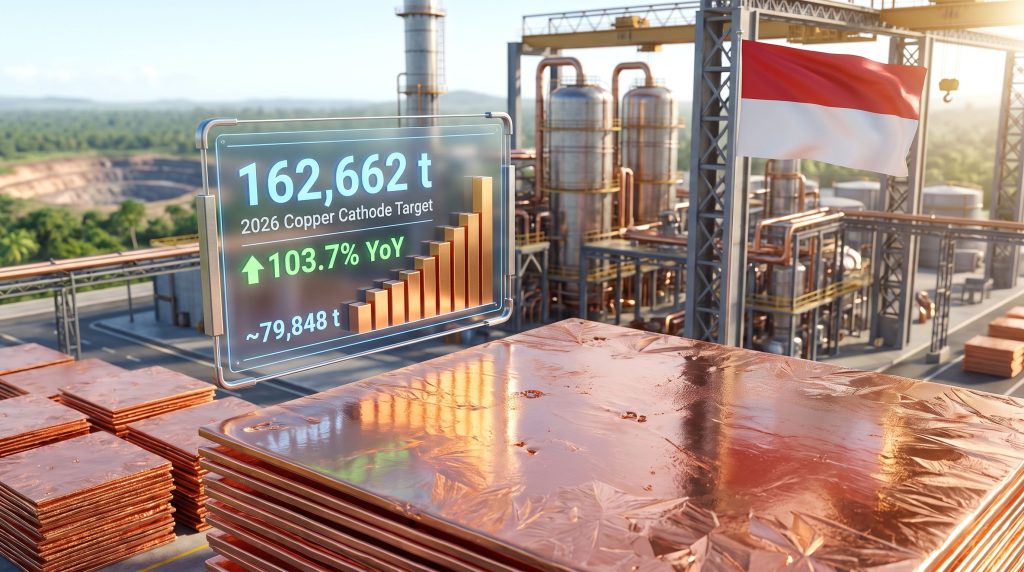
| Copper cathode production volume | ~79,848 t (2025 actual) | ~162,662 t (2026 target) | +103.7% year-on-year output increase |
| Mine ore processing throughput | 40 Mtpa | 85-90 Mtpa | Underlying capacity expansion |
| Smelter utilization rate | ~35% (Q2 2025) | ~93% (projected 2026 peak) | Operational ramp-up |
A Commissioning Timeline Defined by Setbacks and Recovery
Greenfield copper smelters are among the most technically demanding industrial assets to commission. Pyrometallurgical processing of copper concentrate involves sustained operating temperatures exceeding 1,200 degrees Celsius, corrosive sulphur dioxide gas streams, and complex electrorefining circuits. Even facilities built to exacting engineering standards routinely encounter unforeseen challenges during their initial operational phases.
Amman Mineral's commissioning journey illustrates this dynamic precisely:
- March 2025 saw first copper cathode produced, marking the formal commencement of the commissioning phase.
- Q1 2025 output reached just 635 tonnes, reflecting the controlled, low-throughput nature of early operations as operators calibrate process chemistry and equipment behaviour.
- Q2 2025 saw a meaningful acceleration to approximately 19,170 tonnes, placing the facility at roughly 35% of design capacity, a significant jump but still well below commercial operational norms.
- Late 2025 brought a significant reversal when leakage incidents forced a full smelter restart, resetting the commissioning timeline and pushing full ramp-up into 2026.
- April 2026 marked the official completion of ramp-up following recommissioning, with the facility progressively absorbing increasing volumes of copper concentrate.
- June 2026 confirmed that the smelter had achieved full concentrate absorption, meaning that every tonne of copper concentrate produced at the mine was now being processed domestically rather than exported as raw material.
- Q1 2026 recorded cathode output of approximately 27,670 tonnes at around 50% utilization, providing the baseline from which the full-year 2026 target of 162,662 tonnes would be achieved.
The leakage incidents deserve particular attention from investors and industry observers. They are not anomalies in the broader context of greenfield smelter commissioning. Refractory lining failures, flange joint leaks, and unexpected thermal expansion stresses are documented challenges across numerous copper smelter startups globally. What they reveal is the irreducible complexity of first-of-kind industrial operations in any geography, including facilities backed by experienced technical teams. Amman's double flash smelting technology offers further insight into the sophisticated processes underpinning these operations.
Beyond Copper: A Multi-Metal Output Profile That Strengthens the Economics
One aspect of Amman Mineral's 2026 production profile that receives insufficient attention in copper-focused coverage is the breadth of commodity output that the integrated mine-and-smelter system generates. The economic case for Amman Mineral's downstream investment extends well beyond copper cathode pricing.
| Commodity | 2026 Production Target |
|---|---|
| Copper cathode | 162,662 tonnes |
| Gold | 16,119 kilograms |
| Silver | 45,439 kilograms |
| Sulphuric acid (by-product) | 572,036 tonnes |
The sulphuric acid figure warrants specific commentary. At 572,036 tonnes of planned production, the acid by-product stream represents a substantial industrial output in its own right. Sulphuric acid is a critical input for fertilizer production, particularly phosphate-based products, and carries meaningful demand across Indonesia's agricultural and industrial sectors.
At sufficient scale, sulphuric acid by-product revenues can materially offset smelter operating costs, effectively subsidizing copper cathode production economics. This dynamic is well understood within the copper smelting industry but rarely factored into public-facing production narratives. Consequently, understanding the broader commodity price impact on mining company performance adds another valuable layer of analysis here.
"The economics of copper smelting are never purely about copper. At large-scale facilities, by-product acid revenues and precious metal credits from gold and silver co-production can collectively account for a meaningful share of total revenue, improving unit economics and providing natural hedges against copper price cycles."
The 16,119 kilograms of gold and 45,439 kilograms of silver planned for 2026 also provide important commodity diversification. Both metals are recovered during the copper refining process and represent genuine co-production value rather than incidental recovery. In periods of copper price weakness, gold and silver credits provide a partial buffer to overall revenue performance.
Mine Throughput Expansion: The Variable That Determines Long-Run Output
While the smelter's commissioning journey dominates the near-term narrative, the more consequential long-run development is the expansion of the underlying mine's ore processing capacity. The mine is advancing from 40 million tonnes per annum (Mtpa) to a target range of 85 to 90 Mtpa, effectively more than doubling the volume of ore being fed through the concentrator and eventually into the smelter.
This throughput expansion is the foundational variable driving copper cathode output growth beyond 2026. The smelter's design capacity of approximately 220,000 tonnes per year sets the near-term ceiling. However, whether Amman Mineral can sustain and grow output through the late 2020s and into the 2030s depends almost entirely on whether the mine's ore processing expansion delivers as planned.
Projected production trajectory based on current guidance:
- 2025 actual: approximately 79,848 tonnes (partial-year commissioning impact)
- 2026 target: 162,662 tonnes (ramp-up completion and full year contribution)
- FY2030 forecast: approximately 189,000 tonnes (reflecting mine throughput expansion trajectory)
The gap between the 2026 target and the FY2030 forecast, despite mine throughput roughly doubling, suggests that the smelter's design capacity will become the binding constraint rather than ore supply as the mine expansion matures. This dynamic points toward a future capital allocation question: whether a second smelting train or supplementary refining capacity becomes economically justified as the mine reaches its expanded throughput potential.
Operational Risks That Could Interrupt the Growth Trajectory
Investors and supply chain planners should be aware of several known risk factors that could interrupt the otherwise positive production trajectory. In addition, understanding the copper price drivers that influence market conditions provides a useful complement to the operational picture below.
Planned maintenance shutdown: Management has confirmed a scheduled smelter outage in either December 2026 or January 2027 to conduct additional structural repairs. This is a known production gap that will temporarily reduce cathode output. The timing, duration, and scope of this shutdown have not been fully detailed in public disclosures to date.
Structural vulnerabilities from commissioning history: The 2025 leakage incidents demonstrated that the smelter's structural integrity required more remediation than originally anticipated. The December/January shutdown suggests that further repair work remains necessary, raising questions about the long-term maintenance rhythm required to sustain near-design-capacity utilization rates.
Concentrate supply chain dependency: The smelter's output is directly constrained by the mine's concentrate production. If ore grades underperform, if mill throughput falls short of targets, or if geological complexity in deeper mining zones reduces recoveries, the smelter's feedstock availability could become limiting even before design capacity is fully utilized.
Indonesia's resource policy environment: Indonesian resource nationalism has been a structural feature of the country's mining policy landscape for over a decade, with the government periodically adjusting export regulations, royalty structures, and domestic processing requirements. While Amman Mineral's integrated model aligns well with the government's downstream processing objectives, regulatory shifts remain a background risk that sophisticated investors should incorporate into their scenario analysis.
The next major ASX story will hit our subscribers first
How 162,662 Tonnes Fits Within the Global Copper Cathode Hierarchy
To contextualise the scale of Amman Mineral's 2026 copper cathode target, consider that global refined copper production typically runs at approximately 25 to 26 million tonnes annually according to the International Copper Study Group. A single facility targeting roughly 162,000 tonnes represents less than 1% of global output on its own. However, incremental supply additions of this magnitude matter significantly at the margin in a market where supply-demand balances can swing on volumes of 50,000 to 100,000 tonnes.
| Smelter Commissioning Stage | Typical Utilization Range | Amman Mineral Position |
|---|---|---|
| Initial commissioning | 10-30% | Completed (Q1-Q2 2025) |
| Early ramp-up | 30-55% | Completed (Q3 2025-Q1 2026) |
| Full operational ramp | 55-85% | Current trajectory (2026) |
| Steady-state operations | 85-95%+ | Projected peak (2026) |
A target utilization rate of approximately 93% in 2026 would place Amman Mineral's smelter at the upper end of steady-state operational benchmarks globally. Sustaining that level requires consistent feedstock quality, disciplined maintenance scheduling, and the absence of further structural incidents. It is an ambitious target, though not an unrealistic one given that ramp-up has been formally confirmed as complete.
Indonesia's Downstream Copper Processing Ambitions in Regional Context
Amman Mineral's trajectory is best understood not as an isolated corporate story but as one expression of a broader structural shift in Southeast Asia's role within global copper supply chains. Indonesia has historically been a significant exporter of copper concentrate, with processing value captured primarily by smelters in China, Japan, and South Korea.
The build-out of domestic smelting capacity changes this value capture dynamic fundamentally. When Amman Mineral confirms that as of June 2026 it can process all copper concentrate produced by its mine domestically, as reported by Reuters on 14 July 2026, that operational milestone represents a concrete transfer of refining value from external processors back to Indonesia's industrial economy.
For the global copper market, the emergence of meaningful Southeast Asian refined copper supply adds geographic diversification to a production landscape that has historically been concentrated in Chile, Peru, China, and the Democratic Republic of Congo. The copper supply crunch that analysts have flagged for 2025 and beyond makes this regional diversification all the more significant. Whether Indonesian copper cathode flows primarily into regional Asian markets or competes more broadly in global spot markets will influence trade flow patterns and regional price dynamics through the remainder of the decade.
Frequently Asked Questions: Amman Mineral Copper Cathode Output Doubling
Is Amman Mineral building a second smelter to double output?
No. The doubling of copper cathode production in 2026 reflects the operational ramp-up of the existing smelter toward its design capacity of approximately 220,000 to 222,000 tonnes per year, not the construction of additional smelting infrastructure.
What caused the smelter delays in 2025 and how were they resolved?
Leakage incidents during the commissioning phase forced a full smelter restart in late 2025, resetting the ramp-up schedule. Recommissioning was completed by April 2026, following which production acceleration resumed. A further planned shutdown in December 2026 or January 2027 will address additional structural repairs.
How much copper cathode can the smelter produce at full design capacity?
The smelter is designed to produce approximately 220,000 to 222,000 tonnes of copper cathode per year at full utilization. The 2026 target of 162,662 tonnes implies operation at roughly 74% of full design capacity on an annual average basis, with quarterly utilization approaching 93% by peak periods.
What is the relationship between the mine's ore throughput expansion and future cathode production?
The mine's expansion from 40 Mtpa to 85 to 90 Mtpa of ore processing capacity is the primary driver of long-run cathode output growth. The smelter's design capacity will eventually become the binding constraint as mine throughput expands, potentially raising the question of whether additional downstream capacity will be required beyond 2030.
Three Structural Themes Worth Tracking Into 2027 and Beyond
The Amman Mineral copper cathode output doubling story resolves into three broader analytical themes that carry implications well beyond a single company's production guidance. Furthermore, exploring tailored copper investment strategies can help investors position themselves advantageously as these themes unfold.
-
Utilization-driven growth requires a different analytical lens than capacity-driven growth. Investors accustomed to valuing mining companies on installed capacity metrics need to apply utilization trajectory analysis when assessing facilities in active commissioning phases. The difference between 35% and 93% utilization of the same installed base represents a nearly threefold output variation.
-
Mine throughput expansion is the true long-run variable. The 85 to 90 Mtpa ore processing upgrade underpins whether the FY2030 forecast of approximately 189,000 tonnes of cathode is achievable. Delays or underperformance in the mine's expansion programme would flow directly into smelter feedstock availability and cathode output projections.
-
Indonesia's downstream refining model is proving viable at commercial scale. Amman Mineral's ramp-up, despite its commissioning setbacks, demonstrates that integrated mine-to-cathode production at significant scale is achievable within Indonesia's regulatory and infrastructure environment. This has implications for how other Indonesian copper and base metal operations may approach downstream processing investment decisions in coming years.
The December 2026 or January 2027 maintenance shutdown represents the most immediate near-term variable to monitor. Its duration and the extent of structural repairs required will signal whether the smelter is on a trajectory toward genuinely stable long-run operations or whether further episodic interruptions remain likely.
This article contains forward-looking production forecasts and operational targets sourced from company disclosures as reported by Reuters on 14 July 2026. Actual results may differ materially from projections due to operational, geological, regulatory, and market factors. This content is intended for informational purposes only and does not constitute financial or investment advice. Readers seeking further coverage of Amman Mineral Internasional and broader Southeast Asian mining sector developments may find ongoing reporting at Mining Weekly.
Want to Track the Next Major Copper Discovery Before the Market Does?
Discovery Alert's proprietary Discovery IQ model scans ASX announcements in real time, translating complex mineral data across 30+ commodities into clear, actionable insights — so subscribers can identify significant copper and base metal discoveries the moment they are announced. Explore historic mineral discovery returns on Discovery Alert's discoveries page and begin a 14-day free trial to position ahead of the broader market.