August 14, 2026
Why the Mining World Is Watching Copper More Closely Than Ever
The global mining industry is undergoing a quiet but profound reallocation of capital. After decades of iron ore, coal, and diversified commodity portfolios defining the major miners, copper has begun its ascent to centre stage. BHP copper growth and dividend results have become one of the clearest signals of this shift — not driven by a single policy announcement or price spike, but by years of deliberate portfolio construction and the growing consensus that copper sits at the intersection of electrification, renewable energy infrastructure, and industrial modernisation.
For investors tracking the sector, understanding how copper's structural role translates into corporate financial performance has never been more important. BHP's FY2026 results offer one of the clearest case studies available: a company that has spent four years repositioning its earnings base now stands at a historical inflection point, with copper crossing 50% of group earnings for the first time in its history.
When big ASX news breaks, our subscribers know first
BHP Copper Growth and Dividend Results: What the FY2026 Numbers Reveal
A Financial Profile That Has Fundamentally Changed
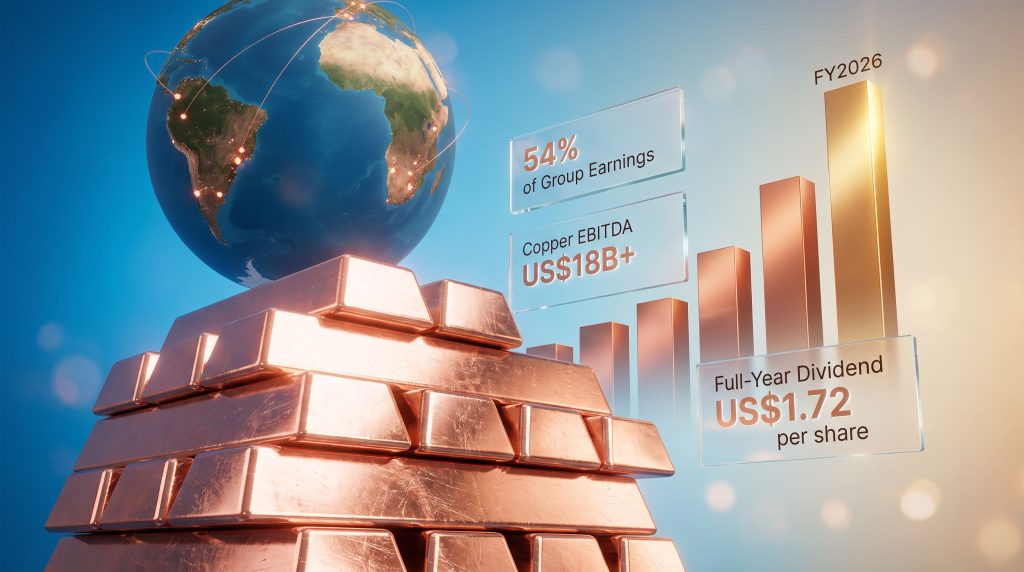
The headline figures from BHP's FY2026 results tell a story that would have been difficult to predict even five years ago. Copper now contributes 54% of group earnings, generating more than US$18 billion in EBITDA and surpassing iron ore as the company's primary earnings engine. Underlying profit climbed approximately 30% year-on-year to US$13.2 billion, while group EBITDA grew roughly 27% to approximately US$33 billion.
Furthermore, BHP's full-year profit rise on soaring copper prices has drawn considerable attention from analysts, underscoring the degree to which the metal now defines the company's financial trajectory. The table below captures the key metrics investors need to understand from this reporting period:
| Metric | FY2026 Result | Context |
|---|---|---|
| Copper share of group earnings | 54% | First time exceeding 50% in BHP's history |
| Copper EBITDA | US$18 billion+ | Now exceeds iron ore contribution |
| Underlying profit growth | ~30% YoY | Reached US$13.2 billion |
| Group EBITDA growth | ~27% YoY | Approximately US$33 billion |
| Full-year dividend | US$1.72 per share | Highest in four years |
| Final dividend (H2) | US$0.99 per share | Above analyst consensus |
| Net debt | US$8.7 billion | Below US$10-20 billion target range |
| Copper price movement | +35% | Key tailwind for earnings uplift |
| Iron ore price movement | +3% | Modest but stable contribution |
The Convergence That Made FY2026 a Standout Year
BHP's FY2026 outperformance was not driven by a single factor. The result emerged from the convergence of three separate forces hitting simultaneously: a 35% rise in copper prices, record production volumes across key copper assets, and disciplined cost management across the company's tier-one operations.
The Western Australian iron ore business also contributed meaningfully, achieving record shipments and record production for the year while maintaining its position as the world's lowest-cost iron ore producer for the seventh consecutive year. That cost leadership track record reflects the systematic operational methodology BHP refers to internally as the BHP Operating System — a continuous improvement framework applied across production, logistics, and cost management.
An additional US$6 billion in capital was unlocked from existing assets and capital structures during the year, supplementing operating cash flows and directly supporting the above-minimum dividend payout.
How BHP's Dividend Policy Actually Works
The Capital Allocation Framework in Detail
BHP operates a structured, six-monthly capital allocation process directly linked to cash generation and market outlook rather than a fixed nominal target. The framework guarantees a minimum 50% payout ratio from underlying earnings, with any additional returns determined by a combination of factors:
- Free cash flow generated during the reporting period
- Current balance sheet position and net debt levels
- Forward-looking commodity price expectations
- Capital requirements across the growth project pipeline
- Asset monetisation and capital recycling opportunities
Why FY2026 Delivered 66%, Not 50%
The FY2026 full-year dividend of US$1.72 per share represented a 66% payout ratio, landing above analyst consensus expectations of approximately 63%. This premium above the minimum threshold reflects the exceptional cash generation from the copper business combined with the US$6 billion capital unlock referenced in the results. Notably, BHP paid its highest dividend in four years as FY26 profits soared 30%, reinforcing the strength of this outcome.
BHP's CFO confirmed that the company's strong balance sheet and cash flow generation capacity provides confidence to sustain attractive shareholder returns alongside continued investment in high-quality growth assets.
The final dividend for the second half of US$0.99 per share also surprised to the upside, underlining the degree to which operational performance in the second half exceeded expectations.
Four-Year Dividend Trajectory
While BHP has not disclosed exact prior-year payout ratios in a single comparable table, the FY2026 figure of US$1.72 per share represents the highest annual dividend in four years — a meaningful signal of improved earnings quality and cash generation capacity:
| Financial Year | Full-Year Dividend (USD/share) | Payout Ratio |
|---|---|---|
| FY2023 | Below FY2026 level | ~50% range |
| FY2024 | Below FY2026 level | ~50% range |
| FY2025 | Below FY2026 level | ~50% range |
| FY2026 | US$1.72 | 66% |
The Four-Asset Copper Growth Architecture
A 50% Production Increase Anchored Across Three Continents
BHP's copper expansion strategy is built around four geographically distinct operations at varying stages of development maturity. Together, they form a credible pathway to a 50% increase in copper production by the mid-2030s, following the 30% growth already delivered over the preceding four years. The copper price drivers underpinning this expansion are well understood by analysts monitoring global electrification trends.
1. Copper South Australia (Olympic Dam)
Olympic Dam produced approximately 320,000 tonnes of copper in FY2026, its highest output in 20 years. The phased expansion roadmap is as follows:
- Phase 1 target: More than 500,000 tonnes per annum
- Phase 2 potential: Up to 650,000 tonnes per annum
- Smelter and refinery investment decision: Expected within 18 months
What makes this asset particularly significant is its integrated nature. Olympic Dam contains smelting and refinery infrastructure, meaning production increases flow through to refined copper output rather than concentrate, capturing additional value in the processing chain.
2. Escondida, Chile
The world's largest copper mine continues to evolve. BHP has already submitted environmental permit applications, finalised the scope of a new concentrator, and commenced pre-commitment works ahead of a final investment decision expected in the next calendar year. The scale and maturity of this project means it carries significantly lower development risk than a greenfield discovery.
3. Vicuña, Argentina
Vicuña may be the most strategically significant emerging copper asset in BHP's portfolio. Once fully operational, it is positioned to rank among the world's top four to five copper-producing assets and simultaneously among the top five global gold producers. Critically:
- Environmental permits have already been secured
- Argentina's RIGI large investment incentive framework has been formally awarded to the project
- A final investment decision could arrive as early as the end of calendar year 2025
The dual copper-gold profile of Vicuña is a key differentiator. In an environment where gold prices have also appreciated sharply, the by-product credit from gold production meaningfully reduces the effective cost of copper production, improving project economics compared to pure-play copper mines.
4. Long-Dated Portfolio Optionality
Beyond the three primary growth assets, BHP retains a suite of exploration and early-stage development options that extend the copper growth narrative well beyond the mid-2030s. These represent the optionality layer of the portfolio, providing leverage to copper demand scenarios beyond current investment frameworks.
Assessing BHP's 5% Annual Copper Growth Target
Why Industry-Wide Growth Has Stalled
Across the global copper sector, production growth has been persistently disrupted by a combination of factors that are difficult to resolve quickly. The copper supply crunch facing the industry reflects several compounding pressures:
- Permitting timelines stretching 10 to 20 years for new greenfield discoveries
- Geopolitical risk in copper-rich jurisdictions including parts of South America and Central Africa
- Ore grade decline at established operations, requiring processing of larger volumes to maintain output
- Capital allocation hesitancy from major miners burned by cost overruns in the previous decade
Against this backdrop, BHP's claim of five consecutive years of meeting or exceeding its copper production guidance is a genuine structural differentiator. Most copper producers cannot make the same statement.
Project Maturity as a Risk-Reduction Signal
One of the less-discussed aspects of BHP's copper growth story is how advanced each of the four key projects actually is. These are not exploration promises or early-stage concepts. Consider the status of each:
- Vicuña has environmental permits and RIGI approval secured, with a final investment decision potentially months away
- Escondida has completed its environmental permit submission and commenced pre-commitment works
- Olympic Dam's smelter and refinery expansion is less than 18 months from an investment decision
- All projects have been subject to years of engineering, feasibility, and optimisation work
This level of project maturity is unusual in the mining industry and provides a much higher probability of delivery than typical project pipelines that include conceptual-stage assets in headline production targets.
Extending the BHP Operating System Into Projects
BHP's CFO has indicated that the same operational methodology responsible for years of consistent production outperformance at existing operations is now being deliberately embedded into the project delivery pipeline. If the BHP Operating System's track record in running mines can translate into disciplined project construction and ramp-up, it would address one of the most persistent risks in mining: the gap between feasibility economics and actual delivered outcomes.
Balance Sheet Strength as a Strategic Differentiator
What US$8.7 Billion Net Debt Actually Means
BHP ended FY2026 with net debt of US$8.7 billion, sitting below the lower bound of its stated target range of US$10-20 billion. In practical terms, this means the company has more financial flexibility than its own framework requires. This position also supports the kinds of copper development partnerships that larger miners are increasingly pursuing to accelerate their project pipelines.
The significance of being below the target range is often underappreciated. It provides a buffer that enables BHP to:
- Absorb commodity price volatility without cutting the capital expenditure programme
- Accelerate investment decisions if project economics improve
- Sustain dividend payments through periods of lower earnings
- Pursue opportunistic acquisition or partnership activity without immediate balance sheet stress
The Three-Way Capital Allocation Equation
BHP's CFO has been explicit that the company's current financial position enables simultaneous execution across three priorities rather than requiring difficult trade-offs:
- Self-funded copper growth — the entire expansion pipeline can be financed entirely from copper's own operating cash flows, without requiring debt drawdowns or equity issuance
- Balance sheet resilience — capacity to absorb commodity price downturns without compromising long-term plans
- Sustained shareholder returns — attractive dividend capacity maintained across commodity price scenarios
The US$35 Billion Free Cash Flow Projection
Even at consensus commodity price assumptions that sit below current spot levels, BHP's modelling points to approximately US$35 billion in attributable free cash flow over the next five years, after fully funding the copper growth programme.
This figure is particularly instructive because it implies the three priorities above are not in competition. The growth programme, the balance sheet, and the dividend are all fundable simultaneously from the business's own cash generation. That combination is rare in the mining sector and represents a meaningful competitive advantage over peers who must choose between growth investment and shareholder returns.
The next major ASX story will hit our subscribers first
Copper's Place in the Long-Term Demand Structure
Supply Gaps Are Structural, Not Cyclical
The copper supply challenge facing the industry is not simply a function of insufficient investment in recent years. It reflects the structural reality that new copper discoveries of scale are becoming rarer, existing deposits are experiencing grade decline over time, and the lead time from discovery to production now routinely exceeds 15 years.
Meanwhile, demand drivers from electric vehicles, grid infrastructure, data centres, and industrial electrification are adding incremental copper demand that analysts broadly agree will outpace new supply capacity in the years ahead. Investors considering copper investment strategies should consequently factor in this long-term structural imbalance as a core element of their thesis.
Low Capital Intensity as a Portfolio Advantage
One factor that is frequently overlooked in commentary on BHP's copper growth is the low capital intensity of its expansion programme. Because BHP is expanding existing tier-one assets with established infrastructure rather than building greenfield operations from scratch, the cost per tonne of new copper capacity is significantly lower than industry averages.
This means that as new production comes online, the incremental cash generation per dollar invested is considerably higher than a greenfield comparison would suggest, improving returns on invested capital and compressing the payback period for each investment decision.
Key Risks That Investors Should Monitor
Commodity Price Sensitivity
The 35% rise in copper prices was a significant contributor to BHP's FY2026 earnings uplift. However, short-term copper price volatility driven by macroeconomic conditions, Chinese demand cycles, or USD movements can materially affect quarterly cash generation and dividend capacity, even where the structural demand outlook remains broadly supportive.
Multi-Jurisdictional Regulatory Exposure
BHP's copper growth pipeline spans three distinct regulatory jurisdictions: Australia, Chile, and Argentina. Each carries its own permitting, taxation, and political risk profile. Argentina in particular, despite the RIGI framework providing investment protections, remains a jurisdiction where policy continuity is a genuine consideration for long-term project economics.
Capital Cost Escalation
Mining project capital costs have been under pressure across the industry from labour shortages, equipment availability, and general construction cost inflation. BHP's low capital intensity advantage provides some protection, but cost escalation risk remains a factor that can compress project returns relative to feasibility estimates.
Project Execution Risk at Scale
Delivering multiple major expansion projects concurrently across three continents is an execution challenge of significant complexity. Embedding the BHP Operating System into project delivery is a credible strategy; however, translating operational excellence from running steady-state mines into managing complex construction programmes involves a different set of skills and risks.
Frequently Asked Questions: BHP Copper Growth and Dividend Results
What dividend did BHP declare for FY2026?
BHP declared a full-year dividend of US$1.72 per share, including a final dividend of US$0.99 per share. This is the highest annual dividend in four years and reflects a 66% payout ratio, above the company's 50% minimum threshold and above analyst consensus of 63%.
How much of BHP's earnings now come from copper?
Copper contributed approximately 54% of BHP's group earnings in FY2026. This is the first time in the company's history that copper has exceeded half of total earnings, surpassing iron ore as the primary earnings driver.
What is BHP's copper production growth target?
BHP is targeting 5% annual copper production growth through to the mid-2030s, representing a cumulative increase of approximately 50% from current levels. This follows 30% production growth already delivered over the preceding four years. In the context of top copper producer rankings, BHP's trajectory is closely watched by industry observers.
Can BHP self-fund its copper growth pipeline?
Yes. BHP has confirmed that the entire copper expansion programme spanning Australia, Chile, and Argentina can be fully funded from copper's own operating cash flows, without requiring additional debt or equity issuance.
When will BHP make final investment decisions on its copper projects?
Vicuña in Argentina could receive a final investment decision as early as late 2025. Escondida's expansion in Chile is expected to reach a decision in the next calendar year. Copper South Australia's smelter and refinery investment decision is less than 18 months away.
What is BHP's net debt position?
BHP ended FY2026 with net debt of US$8.7 billion, below its stated target range of US$10-20 billion, providing significant financial flexibility across growth, resilience, and shareholder return objectives.
What FY2026 Signals for the Road Ahead
The BHP copper growth and dividend results from FY2026 are not simply a strong annual report. They represent the visible output of a multi-year strategic repositioning that has fundamentally altered the company's earnings profile and growth trajectory. Several conclusions stand out:
- Copper's ascent to majority earnings contributor reflects deliberate portfolio construction, not commodity price luck alone
- The dividend uplift to US$1.72 per share signals earnings quality and cash generation confidence, not just a one-year windfall
- A projected US$35 billion in attributable free cash flow over five years implies the growth programme and shareholder returns are complementary, not competing priorities
- Four mature, de-risked projects with near-term investment decisions underpin the credibility of the 50% production growth target
- The BHP Operating System, applied consistently across operations, now represents an institutional competitive advantage being transferred into the project delivery phase
This article is intended for informational purposes only and does not constitute financial advice. Forecasts, projections, and production targets mentioned are based on company guidance and industry analysis and are subject to change. Investors should conduct their own research and consult a licensed financial adviser before making investment decisions. Past performance is not indicative of future results.
Want to Be First When the Next Major Copper Discovery Hits the ASX?
Discovery Alert's proprietary Discovery IQ model delivers real-time alerts the moment significant mineral discoveries — including copper — are announced on the ASX, turning complex data across 30+ commodities into clear, actionable insights for investors at every level. Explore why historic mineral discoveries have generated exceptional returns and start your 14-day free trial today to position yourself ahead of the broader market.