August 14, 2026
The Structural Economics of Large-Tonnage, Low-Grade Copper Systems
The global copper industry operates on a fundamental tension that rarely makes headlines: the world's highest-grade copper deposits are depleting faster than they are being replaced. Average copper ore grades at producing mines have declined by roughly 25% over the past two decades, according to data tracked by the International Copper Study Group. This is not a short-term anomaly. It reflects a structural shift in how the industry must think about resource development.
Furthermore, this shift is one where sheer scale and operational efficiency increasingly compensate for lower intrinsic grade. Understanding the copper supply crunch helps contextualise why large-tonnage systems have regained strategic relevance. Projects once dismissed as marginal during an era of high-grade abundance are now being evaluated through an entirely different economic lens.
This reappraisal is particularly pronounced as copper demand drivers from grid infrastructure, electric vehicles, and renewable energy generation accelerate into the late 2020s and beyond. It is within this macro framework that the Caravel Copper Project definitive feasibility study takes on significance that extends well beyond a single ASX-listed developer's milestone schedule.
When big ASX news breaks, our subscribers know first
Situating Caravel Within Australia's Copper Development Landscape
Western Australia's Wheatbelt region is not traditionally associated with copper production. The state's mining identity is anchored in iron ore and gold, with copper development historically concentrated further north and east. The absence of an established mid-tier copper development pipeline in the Wheatbelt creates both a competitive gap and an infrastructure challenge that Caravel Minerals has spent years systematically working to close.
Located approximately 150 kilometres north-east of Perth, the Caravel Copper Project sits within reasonable reach of established transport, energy, and water corridor networks. This geographic advantage meaningfully differentiates it from more remote Australian copper development candidates. Proximity to infrastructure is not merely a convenience; it is a capital cost variable that carries material weight in feasibility economics.
Reserve Scale: Why 1.42 Million Tonnes of Contained Copper Matters
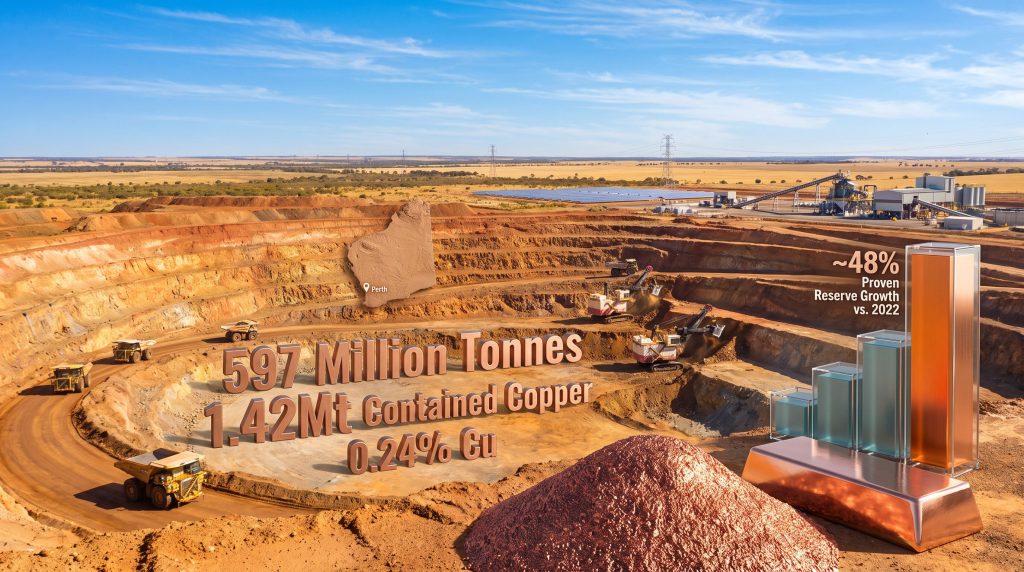
The updated ore reserve underpinning the Caravel Copper Project definitive feasibility study represents one of the more substantial copper reserve bases currently held by an ASX-listed developer outside of the major mining companies.
Caravel Copper Project: Key Reserve Parameters
| Reserve Parameter | Figure |
|---|---|
| Total Ore Reserve | 597 million tonnes |
| Copper Grade | 0.24% Cu |
| Contained Copper | 1.42 million tonnes |
| Proven Reserve | 156 million tonnes |
| Proven Reserve Growth vs. 2022 Maiden Estimate | ~48% increase |
The growth in the proven reserve category is arguably more analytically significant than the total resource number. Proven reserves, classified under the JORC Code, represent the highest confidence category of ore estimation, requiring the tightest geological knowledge and sampling density. A 48% uplift in proven tonnes relative to the 2022 maiden estimate signals two things simultaneously: stronger geological definition in the early mine years, and a more defensible mine scheduling model for the first years of operation.
This is precisely the period that lenders and offtake counterparties scrutinise most carefully. For context, most ASX-listed mid-tier copper developers carry contained copper inventories in the range of 0.1 to 0.5 million tonnes. Caravel's 1.42 million tonne contained copper figure places it in a distinctly different peer cohort — one that warrants a different capital structure, a different offtake conversation, and a different regulatory engagement framework.
How the DFS Mining Study Defines the Operational Architecture
Open-Pit Sequencing: Bindi First, Then Dasher
The mining study component of the Caravel Copper Project definitive feasibility study was completed by Mining Plus in July 2026, confirming a conventional open-pit, truck-and-shovel operation. The mine development sequence prioritises the Bindi deposit ahead of Dasher, a deliberate design choice with significant capital efficiency implications.
Sequencing Bindi first concentrates initial capital expenditure on a single deposit, avoiding the parallel infrastructure costs that would arise from activating multiple deposits simultaneously. It also allows operational teams to establish processing routines before incorporating the geological variability of a second deposit. In open-pit copper mining, early-year operational stability directly influences unit cost performance during the ramp-up phase, when cost overruns are most damaging to project economics.
Understanding cut-off grade economics is equally important when evaluating the sequencing logic, as the economic cut-off applied to each deposit influences which material enters the mine schedule in each period.
Equipment Fleet and Autonomous Haulage Readiness
The selected fleet configuration centres on 300-tonne-class haul trucks and shovels rated above 600 tonnes, placing Caravel firmly in the ultra-class equipment category. This fleet sizing is consistent with a 30-million-tonne-per-annum processing operation and reflects an expectation of large bench heights and wide pit geometries suited to bulk extraction at low strip ratios.
A less-discussed but strategically important design provision involves the infrastructure being sized and laid out to accommodate a future transition to autonomous haulage systems. This is not a near-term operational commitment; it is an engineering decision that preserves optionality. Autonomous haulage at scale has demonstrated operating cost reductions of 15 to 20% in comparable open-pit operations, primarily through reduced labour costs and improved equipment utilisation rates. Building that transition pathway into the initial infrastructure design avoids costly retrofitting at a later stage.
The project team is also evaluating the relative merits of contractor versus owner-mining models for the pre-strip and initial production phases, a standard feasibility exercise that carries meaningful implications for upfront capital commitments and operational flexibility.
Infrastructure Workstreams: Water, Power, and Processing
Water: From 18GL to 12GL Through Process Optimisation
One of the more technically significant outcomes within the Caravel Copper Project definitive feasibility study process is the one-third reduction in annual water demand, from an earlier estimate of 18 gigalitres to 12 gigalitres per year. This reduction was not achieved through water recycling alone. It was driven primarily by process design optimisation, meaning the flowsheet itself was restructured to consume less water per tonne of ore processed.
This distinction matters for regulatory purposes. A lower water demand figure changes the footprint of the groundwater licence application and potentially reduces competition with existing water users in the region. Investigations at the Gillingarra borefield are ongoing, with groundwater modelling being advanced in coordination with the Department of Water and Environmental Regulation. Securing a water licence remains a pre-final investment decision (FID) requirement and represents the primary schedule risk variable on the critical path to construction approval.
Power: Hybrid Grid Architecture With Behind-the-Meter Renewables
The power strategy combines a Western Power grid connection as the baseload foundation with behind-the-meter solar generation, battery storage, and firming capacity. A preliminary grid access offer has been secured, and a commercial proposal for renewable generation on land adjacent to the project has been received.
This hybrid architecture serves multiple purposes simultaneously:
- Grid connection provides reliability and capacity certainty during periods of low solar generation
- Behind-the-meter renewables reduce exposure to grid energy pricing during peak tariff periods
- On-site battery storage smooths dispatch and supports firming requirements
- The combined structure reduces grid dependency and strengthens the project's carbon intensity profile
From an ESG standpoint, the renewable integration component is increasingly important for concentrate offtake negotiations with smelters in jurisdictions applying carbon-adjusted pricing frameworks to incoming concentrate.
Processing Flowsheet: Multi-Product Concentrate Strategy at 30Mtpa
Processing Output Summary
| Product Stream | Description |
|---|---|
| Primary Concentrate | High-quality copper concentrate with gold and silver credits |
| Secondary Concentrate | Separate molybdenum concentrate |
| Annual Processing Rate | 30 million tonnes per annum |
The decision to incorporate a dedicated molybdenum circuit alongside the primary copper flotation flowsheet deserves closer attention than it typically receives in development-stage coverage. Molybdenum is produced as a by-product at a number of large porphyry copper systems globally, including at operations such as Freeport-McMoRan's Bingham Canyon and Codelco's El Teniente.
The metal commands its own independent market, with applications in high-strength steel alloys and industrial catalysts, and its price trajectory is not correlated with copper in the short term. Incorporating a molybdenum circuit adds capital and complexity to the processing plant, but it also adds a revenue stream that operates independently of copper price movements. At a large-scale, low-grade copper project where operating margins are sensitive to commodity price fluctuations, that diversification has genuine economic value.
Environmental Approvals: Where the Regulatory Timeline Sits
The updated Environmental Review Document is described as substantially complete, with submission to the Western Australian Environmental Protection Authority targeted for the fourth quarter of 2026. This timing places the EPA submission approximately one quarter after the DFS release target of September 2026, creating a logical sequencing where the technical study informs and supports the environmental submission.
Key environmental workstreams that are substantially complete include flora and fauna surveys, hydrological impact assessments, and baseline noise and dust characterisation. The water licence process through the Department of Water and Environmental Regulation runs on a parallel but interconnected timeline. In Western Australia, groundwater licence determinations and EPA approvals are separate regulatory instruments, meaning both must be resolved before a final investment decision can be made.
Commercial and Financing Architecture
Offtake: Life-of-Mine Coverage With a Single Counterparty
A non-binding agreement with Kutch Copper, a subsidiary of Adani Enterprises, covers potential investment in the project and life-of-mine offtake for up to 100% of Caravel's copper concentrate production. Securing a single counterparty for full-volume offtake at the DFS stage is an unusual commercial achievement for a project that has not yet taken a final investment decision.
The India copper offtake strategy reflects a broader pattern emerging across the Indo-Pacific region, where major smelters seek long-term concentrate supply well in advance of project commissioning. India's domestic copper smelting capacity has grown significantly, while its domestic mining base remains limited, creating a structural demand for imported concentrate that projects like Caravel are positioned to address.
Capital Stack: Equity, Debt, and the Role of Export Credit Agencies
Capital Commitment Tracker
| Financing Component | Amount | Structure |
|---|---|---|
| Equity Placement (Regal Funds Management) | A$30 million | Secured |
| Export Credit-Backed Senior Debt Interest | Up to US$220 million | Non-binding |
| DFS Funding Status | Fully funded | Confirmed |
The A$30 million placement to Regal Funds Management fully funds the DFS completion phase, removing the near-term equity dilution risk that frequently weighs on development-stage share prices. More structurally significant is the non-binding interest from export credit agencies for up to US$220 million in senior debt.
Export credit agencies typically engage with projects that meet sovereign strategic interests, including supply chain security for the financing nation's industrial base. Non-binding ECA interest at this scale, at the pre-DFS-release stage, is a credible signal that the project has passed an initial risk screening process. However, investors should note that non-binding interest carries no guarantee of final debt commitment, and progression from indicative interest to executed debt facilities involves extensive due diligence and project de-risking milestones.
Key investor consideration: The sequencing of financing commitments relative to DFS release is critical. The DFS document serves as the primary technical input for lender due diligence. Until that document is public, financing commitments beyond the DFS funding itself are necessarily conditional and indicative.
The next major ASX story will hit our subscribers first
DFS-to-FID: The Critical Path Analysis
The definitive feasibility study is targeted for release in September 2026, with the process plant engineering approximately 90% complete at the time of the July 2026 mining study completion announcement. The post-DFS workplan follows a structured sequence of milestones, each with its own risk profile.
DFS-to-FID Milestone Sequence
- DFS completion and public release (target: September 2026)
- Environmental Review Document submission to the WA EPA (target: Q4 2026)
- Water licence determination (pre-FID requirement)
- Binding offtake and senior debt finalisation
- Front-end engineering design (FEED) commencement
- Final Investment Decision
Of these milestones, the water licence determination carries the highest schedule uncertainty. Unlike EPA processes, which follow defined legislative timeframes, groundwater licence determinations can be extended by additional modelling requirements, third-party objections, or regulatory workload constraints. Projects in the WA Wheatbelt region have historically encountered groundwater licensing timelines of 12 to 24 months from application submission, though this varies materially based on the complexity of the groundwater system involved.
Comparative Positioning Against Peer Australian Copper Developers
Development Metrics: Caravel vs. Peer Benchmarks
| Metric | Caravel Copper Project | Typical ASX Mid-Tier Copper Developer |
|---|---|---|
| Ore Reserve | 597Mt | 50 to 200Mt |
| Copper Grade | 0.24% Cu | 0.3 to 0.8% Cu |
| Contained Copper | 1.42Mt | 0.1 to 0.5Mt |
| Processing Rate | 30Mtpa | 5 to 15Mtpa |
| Mining Method | Open-pit, truck-and-shovel | Varies |
| Power Strategy | Hybrid grid plus renewables | Primarily grid-dependent |
| By-products | Gold, silver, molybdenum | Limited or none |
The comparison above illustrates a fundamental point: Caravel does not compete on grade. At 0.24% copper, it sits well below the grades typically associated with higher-margin development projects. Its competitive argument rests on three pillars instead:
- Reserve tonnage that supports a multi-decade mine life at high throughput
- By-product revenue diversification across copper, gold, silver, and molybdenum
- Infrastructure proximity that reduces capital intensity relative to remote peers
This is the classic bulk-mining value proposition — one that requires a different capital efficiency framework and a different investor base than high-grade, smaller-scale development assets.
Strategic Outlook: What the September 2026 DFS Release Will Reveal
The global copper supply deficit anticipated for the late 2020s is not a speculative forecast. It is the output of a relatively straightforward calculation: committed mine supply, known project pipelines, and demand trajectories from electrification investment programmes across North America, Europe, and Asia. Multiple independent analyses, including those published by the International Energy Agency and Wood Mackenzie, point to a structural shortfall in refined copper supply beginning to materialise between 2027 and 2030.
Australia's opportunity within that supply gap is real but time-sensitive. Projects that complete definitive feasibility studies and secure financing in the 2026 to 2027 window are positioned to reach production in the early 2030s, precisely when the demand-supply imbalance is most acute. Furthermore, the ore reserve update released alongside the mining study announcement underscores the confidence that the project team has in the resource quality underpinning the schedule.
Risk factors investors should weigh carefully:
- Water licence timing remains the primary schedule risk variable
- Commodity price sensitivity at 0.24% Cu grades requires robust by-product credit assumptions
- The gap between non-binding financing interest and executed debt facilities is significant
- ECA debt finalisation depends on project-specific due diligence outcomes that are not yet public
The Caravel Copper Project definitive feasibility study, targeted for September 2026 release, will be the document that either consolidates or tests the market confidence that has accumulated around this project over the past several years. It will disclose capital cost estimates, operating cost projections, mine life assumptions, and infrastructure investment requirements that are not yet in the public domain. Consequently, that disclosure event is the pivotal analytical moment for anyone seeking to evaluate this project's path from feasibility to construction.
Readers seeking ongoing coverage of the Caravel Copper Project and broader Australian copper sector developments can find related reporting at australianmining.com.au, which tracks project milestones across Australia's mining industry. Additionally, the full 2022 pre-feasibility study provides useful context for understanding how the project's economics have evolved through to the current DFS stage. This article is intended for informational purposes only and does not constitute financial advice. Forecasts, timelines, and financing outcomes discussed herein are subject to material uncertainty and may differ from actual results.
Want to Be First When the Next Major Copper Discovery Hits the ASX?
Discovery Alert's proprietary Discovery IQ model scans ASX announcements in real time, delivering instant alerts on significant mineral discoveries — including copper — so subscribers can identify actionable opportunities well ahead of the broader market. Explore how historic discoveries have generated substantial returns on Discovery Alert's dedicated discoveries page, and begin your 14-day free trial today to position yourself at the forefront of Australia's next major find.