July 17, 2026
The Commodity Most Exposed to the Future of Everything
Few industrial materials occupy as peculiar a position in modern economics as copper. It is ancient in application yet utterly indispensable to the technologies that define the twenty-first century. Every electric vehicle requires roughly four times more copper than its internal combustion equivalent. Every offshore wind turbine demands tonnes of it. Every data centre row humming with AI workloads is threaded through with copper wiring. For a commodity so deeply embedded in the energy transition, the production decisions of the world's largest miner carry consequences that ripple well beyond quarterly earnings reports.
BHP copper guidance has therefore become one of the most closely watched data points in global commodities analysis, offering a real-time read on supply trajectory at a moment when demand forecasts remain structurally bullish but operationally fragile. Understanding the copper supply crunch helps contextualise why BHP's production signals carry such outsized importance in current markets.
When big ASX news breaks, our subscribers know first
BHP's Copper Division: Now the Dominant Earnings Engine
For most of BHP's modern history, iron ore was the undisputed centre of gravity. The Pilbara operations in Western Australia generated the cash flows that sustained dividends, funded acquisitions, and weathered commodity downturns. That structural reality has been quietly reordered.
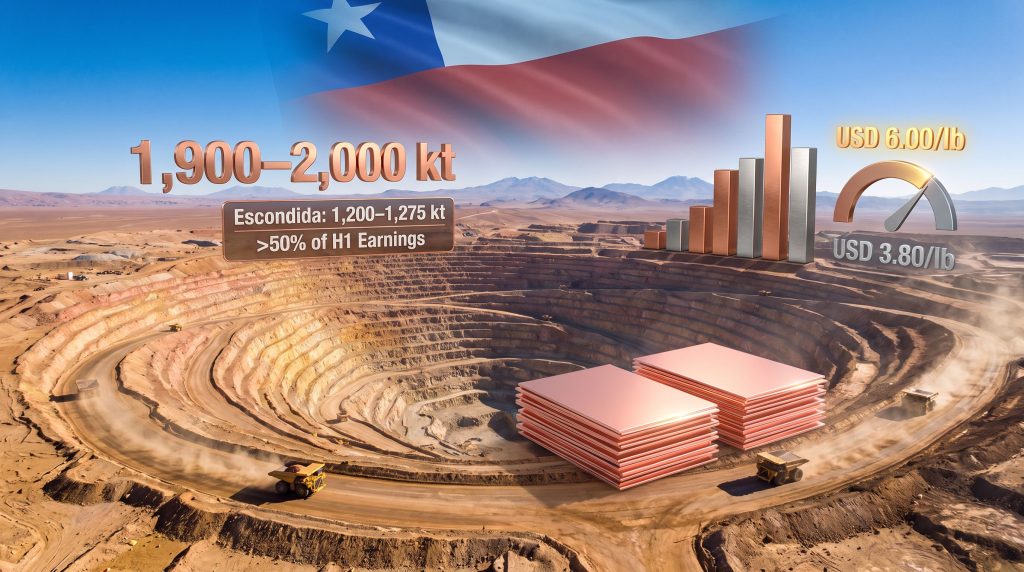
By the first half of FY2026, copper had surpassed iron ore to contribute more than 50% of BHP's underlying earnings, a milestone that signals a genuine inflection point in how the company should be analysed and valued. This is not simply a product of copper price appreciation, though elevated spot prices above USD 6 per pound have amplified the shift.
It reflects deliberate portfolio construction: the acquisition of OZ Minerals in FY2023, the purchase of a 50% joint venture stake in the Vicuña copper project in Argentina during FY2025, and the ongoing expansion of the Escondida complex in Chile. The copper price drivers underlying this shift are structural rather than cyclical.
BHP's Copper Asset Portfolio: Snapshot
| Asset | Location | FY2026 Guidance (kt) | Status |
|---|---|---|---|
| Escondida | Chile | 1,200–1,275 kt | Raised; record throughput |
| Antamina | Peru | 150–160 kt | Raised; grade improvements |
| Copper SA | South Australia | Under review | Impacted by mechanical failure |
| Spence | Chile | Brownfield expansion | Part of mid-2030s plan |
| Vicuña | Argentina | Greenfield | 50% JV; acquired FY2025 |
| Resolution Copper | USA | Greenfield | Long-term development pipeline |
What the FY2026 BHP Copper Guidance Actually Reveals
BHP raised its FY2026 group copper production guidance to 1,900–2,000 kt, lifting the lower bound by 100 kt from the prior range of 1,800–2,000 kt. Management signalled that production is expected to land in the upper half of the guidance range, a statement that conveys meaningful operational confidence at its flagship assets.
However, full-year volumes present a more nuanced picture. FY2026 copper sales came in at approximately 1.38 million metric tons, representing a 7% year-on-year decline, with the fourth quarter alone recording 350,000 metric tons, itself down 8% on the prior corresponding period. According to BHP's operational review for the nine months ended 31 March 2026, these figures reflect the complex operational realities of managing a diversified copper portfolio across multiple jurisdictions.
The headline guidance upgrade and the underlying volume decline are not contradictory. They reflect a portfolio divided between strong operational momentum in Chile and Peru, and disruption in South Australia that weighed on aggregate output.
Escondida: Where the Upgrade Was Earned
The primary driver of the guidance revision was record concentrator throughput at Escondida, the world's largest copper mine by production volume. Escondida's guidance was raised to 1,200–1,275 kt, up from the prior range of 1,150–1,250 kt, contributing an additional 50 kt to group output expectations.
This matters beyond the headline number. Escondida's concentrator throughput performance is a function of both ore grade management and processing efficiency. Achieving record throughput suggests BHP's operational teams are successfully navigating the grade variability that characterises large porphyry copper deposits as they age into lower-grade zones, a challenge that confronts virtually every legacy copper mine globally.
Antamina's Contribution
Antamina guidance was lifted to 150–160 kt, up from 140–150 kt previously, supported by higher throughput and improved head grades. BHP holds a 33.75% attributable interest in Antamina, a polymetallic mine in Peru that also produces zinc, lead, and silver as significant by-products.
The grade improvement at Antamina reflects the mine's orebody complexity, where copper and zinc zones alternate in ways that require careful mine sequencing to optimise the copper-to-zinc output ratio. Furthermore, the Chile copper outlook suggests that South American operations will remain central to global supply dynamics throughout the decade.
South Australia: Mechanical Failure and the FY2027 Downgrade
The disruption at Copper SA is the single most consequential operational development in BHP's near-term copper outlook. A mechanical failure at the South Australian operations reduced volumes materially, and as a direct consequence, analyst estimates for FY2027 copper production have been revised down by approximately 6% to 1.29 million metric tons.
Scenario Analysis: FY2027 Production Trajectories
| Scenario | FY2027 Volume Estimate | Key Assumption |
|---|---|---|
| Base Case | ~1.29 million mt | Mechanical issue resolved; partial recovery |
| Downside Case | Below 1.25 million mt | Extended repair timeline; further disruption |
| Upside Case | ~1.35 million mt | Faster remediation plus Escondida outperformance |
The critical distinction investors need to make is whether this represents an event-driven, temporary disruption or an indicator of deeper structural underperformance at the South Australian assets. BHP's acquisition of OZ Minerals brought Olympic Dam-adjacent copper processing infrastructure into the portfolio, however the South Australian copper system is operationally complex, involving both underground and surface processing components that require careful integration.
BHP has confirmed it will provide FY2027 cost guidance at its upcoming FY2026 full-year results. This disclosure will be critical for understanding the financial impact of the South Australian disruption and modelling the recovery trajectory.
The Long-Term Copper Growth Thesis: Credible or Overclaimed?
BHP's ambition to reach approximately 2 million tonnes of attributable copper per annum by the mid-2030s, with a longer pathway toward ~2.5 million tonnes of copper equivalent (CuEq) including by-product streams, represents roughly a 40% increase from current production levels. The pathway combines brownfield expansions at Escondida and Spence with greenfield developments at Vicuña and Resolution Copper.
The Demand Case: What the Market Actually Needs
Global copper demand analysis suggests the market will require an estimated 10 million tonnes of additional new supply by 2035 to balance projected consumption. The demand drivers can be categorised across several distinct pillars:
- Energy transition infrastructure: Wind turbines, solar farms, and battery storage systems all require substantial copper wiring and conductors
- Electric vehicle manufacturing: Passenger EVs use approximately 60–80 kg of copper each, versus 20–25 kg in a conventional vehicle
- Data centre and AI infrastructure: A hyperscale data centre can require tens of thousands of kilometres of copper cabling, and AI-driven expansion of compute infrastructure is accelerating this demand category
- Grid modernisation: Upgrading legacy electricity transmission and distribution networks across developed markets requires significant copper investment
- Traditional demand pillars: Construction, industrial machinery, and consumer electronics continue to provide stable baseline consumption
Supply-Side Constraints: The Structural Tailwind BHP Is Betting On
The supply response to elevated copper prices faces structural impediments that are unlike those of most other commodities. Consequently, the copper market outlook for the remainder of this decade remains tilted toward supply deficit conditions:
- Declining ore grades: Global average copper ore grades have fallen from approximately 1.5% in the 1990s to below 0.7% today at many established operations, meaning more rock must be processed to produce the same amount of metal
- Extended development timelines: The average time from copper discovery to first production now exceeds 16 years, creating an inelastic supply response even at high prices
- Rising capital intensity: New copper mine development costs have escalated significantly, with large greenfield projects now routinely exceeding USD 10,000 per tonne of annual capacity
- Permitting and regulatory complexity: Environmental approvals, indigenous land rights processes, and water use restrictions are lengthening pre-development timelines across major copper jurisdictions including Chile, Peru, and the United States
Valuation: Is BHP's Premium Justifiable?
Morningstar equity analyst Jon Mills, CFA, maintains a no-moat rating and a fair value estimate of $44 per share for BHP Group Ltd (ASX: BHP). At a recent trading price of approximately $57.55, BHP shares are trading at a ~34% premium to this assessed fair value.
The valuation methodology underpinning this assessment centres on a midcycle copper price assumption of USD 3.80 per pound from 2030, based on estimated marginal cost of production. With copper currently trading above USD 6 per pound, the gap between spot price optimism and long-run fundamental pricing is the central driver of what Morningstar characterises as an overvalued position.
The Bull and Bear Cases at a Glance
Bull arguments:
- Structural copper demand from the energy transition and AI infrastructure buildout will keep prices elevated beyond what traditional cycle analysis would predict
- Supply constraints are more durable than historical episodes of tight markets, given grade decline and permitting complexity
- BHP's low-cost asset base ensures outsized margin capture in a sustained high-price environment
Bear arguments:
- China accounts for approximately 50% of global copper demand, and its economy is undergoing a structural transition away from fixed-asset investment toward consumption-led growth, which is materially less copper-intensive
- BHP's earnings concentration in copper and iron ore leaves it highly exposed to simultaneous softening in both commodities
- Sovereign risk is rising as fiscally pressured governments consider increased resource taxation
BHP Valuation Summary
| Metric | Detail |
|---|---|
| Morningstar Fair Value | $44.00 per share |
| Recent Trading Price | ~$57.55 per share |
| Premium to Fair Value | ~34% |
| Moat Rating | No Moat |
| Midcycle Copper Price Assumption | USD 3.80/lb (from 2030) |
| Current Copper Spot Price | Above USD 6.00/lb |
| China Share of Global Copper Demand | ~50% |
The China dimension deserves deeper scrutiny than it typically receives in bullish copper narratives. China's property sector, which historically drove enormous quantities of copper through wiring, plumbing, and electrical fittings in new construction, has undergone a prolonged contraction. While EV manufacturing and renewable energy infrastructure within China are growing rapidly, the question of whether these new demand sources can fully offset the structural decline in property-related consumption is genuinely unresolved.
The next major ASX story will hit our subscribers first
Iron Ore: Stability Without a Growth Story
BHP's Western Australian Iron Ore operations recorded Q4 sales of 66 million metric tons, down 2% year-on-year, though full-year volumes were flat at 254 million metric tons. The result was broadly in line with analyst estimates, producing no material surprise.
BHP is pursuing modest expansion of WAIO above 290 million metric tons per year (100% basis), but this is incremental capacity addition rather than transformational growth. The strategic narrative here is cost discipline and operational efficiency, not volume expansion.
Divisional Comparison: Copper vs. Iron Ore
| Division | FY2026 Performance | Strategic Trajectory |
|---|---|---|
| Copper | 1.38 million mt (-7% YoY) | Growth priority; >50% of H1 earnings |
| Iron Ore (WAIO) | 254 million mt (flat YoY) | Stable; modest incremental expansion |
| Metallurgical Coal | Smaller contributor | Retained; no major expansion signalled |
| Nickel | Care and maintenance (since 2024) | Suspended due to structurally low prices |
| Potash (Jansen) | Development stage | Long-term diversification; Canada |
Portfolio Strategy and Capital Allocation
BHP's corporate transformation over the past decade reflects a deliberate pivot toward commodities with stronger long-term demand profiles. The merger of its oil and gas assets with Woodside Energy in June 2022 eliminated exposure to a sector facing structural headwinds from the energy transition. The OZ Minerals acquisition in FY2023 deepened the South Australian copper footprint, while the Vicuña joint venture in FY2025 added a large-scale greenfield option in a prolific copper-gold district straddling the Chile-Argentina border.
Placing the nickel operations on care and maintenance in 2024 demonstrated a willingness to make disciplined production decisions in the face of structurally depressed pricing, rather than continuing to mine at a loss to preserve volume metrics. In addition, copper investment strategies that account for BHP's portfolio evolution can provide useful frameworks for evaluating the company's long-term value proposition.
BHP's balance sheet management philosophy, maintaining financial capacity as a buffer through commodity cycles, reflects lessons absorbed from the overinvestment period of the China boom. Aggressive capital expenditure on iron ore and US shale gas during that era diluted long-term returns significantly.
Key Takeaways for Investors Monitoring BHP Copper Guidance
- The FY2026 guidance upgrade is operationally genuine, driven by Escondida's record throughput and Antamina's grade improvements, not accounting adjustments
- The South Australian mechanical failure is characterised as an event-driven disruption, but investors should monitor remediation progress closely before assuming a clean recovery
- The FY2027 volume downgrade of approximately 6% is material but not catastrophic if confined to one operating season
- BHP's long-term copper growth targets are ambitious and plausible in outline, but greenfield execution risk at Vicuña and Resolution Copper is real and should not be discounted
- At current prices, the market is effectively pricing in a scenario where copper remains well above long-run marginal cost indefinitely, a scenario that warrants careful scrutiny given China's evolving demand structure
- The no-moat designation reflects a fundamental truth about commodity producers: exceptional assets do not confer pricing power in markets where price is set globally
Investors seeking deeper analysis of BHP Group Ltd (ASX: BHP) equity research and broader ASX resources sector coverage can explore Morningstar Australia's research available at morningstar.com.au.
This article contains forward-looking statements, analyst estimates, and valuation assessments that involve assumptions and uncertainties. It is intended for informational purposes only and does not constitute financial advice. Past performance and stated valuations are not reliable indicators of future outcomes. Investors should conduct their own research or consult a qualified financial adviser before making investment decisions.
Want to Catch the Next Major Copper Discovery Before the Market Does?
Discovery Alert's proprietary Discovery IQ model scans ASX announcements in real time, instantly alerting subscribers to significant copper and mineral discoveries — the kind of early-stage opportunities that have historically generated substantial returns, as showcased on Discovery Alert's dedicated discoveries page. Begin your 14-day free trial at Discovery Alert and position yourself ahead of the broader market.