July 17, 2026
The Hidden Energy Crisis Undermining Africa's Critical Mineral Future
Africa's most valuable mining corridor sits atop a paradox. The Democratic Republic of Congo and Zambia collectively hold some of the planet's richest concentrations of copper and cobalt, two metals that are foundational to electric vehicle battery manufacturing and the broader energy transition. Yet the industrial zones extracting these resources operate in a state of chronic electricity deprivation, forcing mine operators to burn diesel at scale simply to keep production running. The Trafigura Angola-DRC-Zambia power line project withdrawal has brought this structural contradiction into sharp relief, revealing just how fragile the link between African mineral wealth and global clean energy ambitions truly is.
When big ASX news breaks, our subscribers know first
The Power Architecture of a Critical Mineral Bottleneck
Angola's Surplus Meets the Copperbelt's Deficit
To understand why the Trafigura Angola-DRC-Zambia power line project withdrawal matters, it helps to first grasp the underlying geography of energy imbalance across Central and Southern Africa. Angola has developed significant hydropower capacity from its northern river systems, generating electricity that currently exceeds domestic demand. Directly to the east, the DRC's Katanga region and Zambia's Copperbelt host mining operations that are starved of reliable grid power despite sitting above mineral deposits worth hundreds of billions of dollars.
The estimated power shortfall across the Katanga and Copperbelt zone sits between 1,500 and 2,000 megawatts, a gap so large that no single project could resolve it overnight. Mines operating in this deficit environment rely heavily on diesel generators, which carry fuel costs that can be two to three times higher per kilowatt-hour than grid electricity. This cost burden directly erodes project economics, compresses margins, and in some cases pushes marginal deposits below the threshold of commercial viability.
Furthermore, high-voltage direct current (HVDC) interconnectors represent the most technically efficient solution for bridging this kind of geographic and grid mismatch. Unlike alternating current (AC) transmission, HVDC systems lose significantly less energy over long distances, making them the preferred technology for cross-border energy trade corridors where generation and consumption centres are separated by hundreds of kilometres. The Angola-DRC-Zambia corridor was conceived precisely as this kind of solution, with the added ambition of integrating into the Southern African Power Pool (SAPP), the regional grid coordination framework that links more than a dozen national electricity systems.
What the Project Was Built to Achieve
In July 2024, Trafigura, engineering firm ProMarks, and the Angolan government signed a non-binding memorandum of understanding to conduct technical and economic feasibility studies for a 2,000 MW transmission line. The proposed route would carry surplus hydropower from Angola's northern dam network to mining zones in the DRC and Zambia, with electricity to be sold directly to copper and cobalt producers whose grid access is severely constrained.
The project was still in pre-feasibility and technical-economic study phase when Trafigura exited. No construction had commenced, no financing had been secured, and no binding offtake agreements with mining companies had been formalised. This context matters significantly: the infrastructure gap the project was designed to address remains entirely unresolved.
Three Compounding Forces Behind the Withdrawal
A Criminal Conviction That Changed the Governance Calculus
In January 2025, Switzerland's Federal Criminal Court delivered a conviction against Trafigura for corruption offences connected to Angolan oil contracts executed between 2009 and 2011. The court found that bribe payments totalling approximately $5 million were directed to a senior official at Angola's state oil company, Sonangol, through a layered network of intermediaries. This arrangement enabled Trafigura to secure a near-monopoly position in Angolan petroleum product trading during that period.
The financial penalties were substantial. The company received a fine of approximately 3 million Swiss francs (roughly $3.3 million USD) and was ordered to pay approximately $145 million in a compensation claim. Former Chief Operating Officer Mike Wainwright received a 32-month prison sentence, with 12 months to be served in custody. Both Trafigura and Wainwright have lodged appeals against the verdict.
The collision between this conviction and an infrastructure project requiring deep cooperation with the Angolan government created a governance conflict that was effectively impossible to manage. Continuing to pursue a project in the same sovereign market where the company had just been convicted of paying bribes to government-linked entities would have exposed both parties to reputational and legal risk that no commercially rational actor could accept.
Financing Access Narrows When Reputational Risk Rises
Large-scale cross-border transmission infrastructure in sub-Saharan Africa rarely advances without multilateral development bank participation, export credit agency backing, or blended finance structures that reduce the cost of capital to commercially viable levels. These financing channels carry their own governance requirements, and lender appetite for association with entities facing active criminal convictions is predictably low.
Civil society organisations intensified this pressure by advocating for the suspension of approximately $400 million in loan disbursements to Trafigura from the US Export-Import Bank. Whether or not these efforts directly affected Trafigura's financing access for the Angola project, they illustrate the mechanism through which reputational damage translates into capital market constraints, particularly for infrastructure projects in politically sensitive markets. Consequently, energy security risks of this nature are increasingly scrutinised by multilateral lenders before committing capital.
Structural Risks Indigenous to the DRC-Zambia Corridor
Beyond the company-specific issues, the corridor itself presents a formidable stack of project risks that would challenge any developer. The table below maps the key structural challenges:
| Risk Category | Specific Challenge |
|---|---|
| Transmission Efficiency | Grid losses of 20-25% across DRC infrastructure |
| Political Complexity | Multi-sovereign agreements required across Angola, DRC, and Zambia |
| Offtake Creditworthiness | Limited bankable power purchase agreement counterparties |
| Regulatory Fragility | Inconsistent energy sector governance across three jurisdictions |
| Currency and Revenue Risk | USD-denominated project costs versus local currency revenue exposure |
The DRC's internal grid losses alone are a critical and underappreciated challenge. When 20 to 25 cents of every dollar of electricity generated is lost before reaching the industrial consumer, the economics of power trade deteriorate significantly. For a project already dependent on mining company offtake agreements, this efficiency deficit creates a direct pricing problem: either the power delivered becomes too expensive for the mining buyer, or the project revenue falls short of what is needed to service project debt.
Who Fills the Void? Competing Developers in the Same Corridor
Meridia Energy's Dual-Line Strategy
Trafigura's departure does not represent capital abandoning this corridor. It represents a specific consortium configuration failing. Meridia Energy, a joint venture between Dubai-based Averi Finance and Moroccan construction group Somagec, is advancing two separate transmission lines targeting overlapping portions of the same regional opportunity.
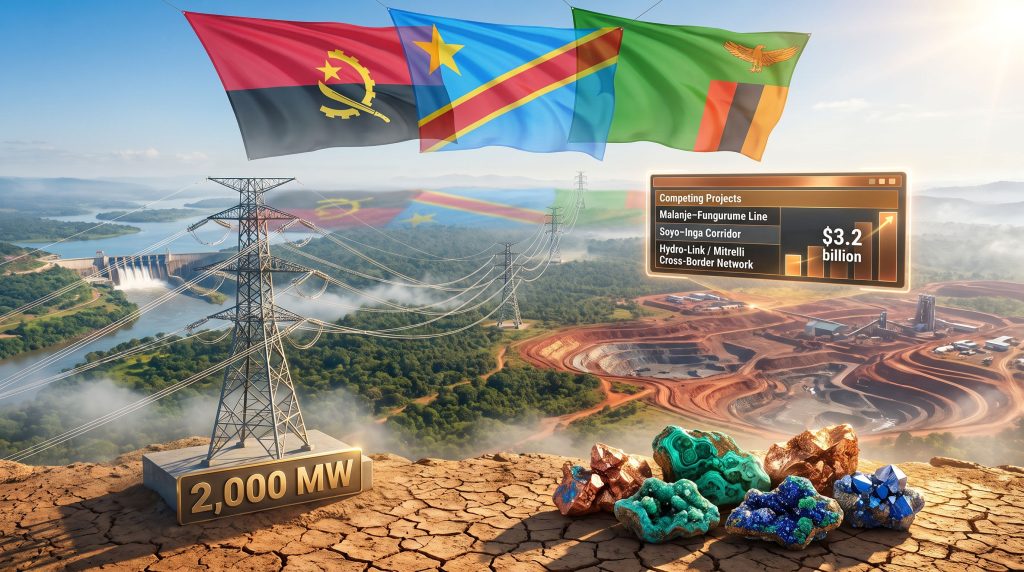
The first line would connect Malanje in Angola to Fungurume in the DRC's Lualaba Province, placing it directly adjacent to one of the world's most concentrated copper and cobalt mining zones. The second line would run from Soyo in northern Angola to the Inga Dam site in western DRC, delivering 2,000 MW to Congolese domestic consumers rather than purely to mining sector buyers. This dual-consumer strategy is potentially significant: a project serving both industrial mining demand and domestic Congolese electricity consumers may be able to construct a more diversified and therefore more bankable revenue base than a purely mining-focused offtake structure.
In addition, the DRC cobalt supply risks associated with unreliable power infrastructure continue to weigh heavily on global battery supply chain planning, making the case for alternative developers even more compelling.
The Competitive Landscape Mapped
| Project | Developer | Capacity | Target Market | Status |
|---|---|---|---|---|
| Malanje to Fungurume Line | Meridia Energy (Averi Finance / Somagec) | Not publicly disclosed | DRC Copperbelt mines | In development |
| Soyo to Inga Corridor | Meridia Energy | 2,000 MW | DRC domestic consumers | In development |
| Hydro-Link / Mitrelli Network | Hydro-Link and Mitrelli Group | Not disclosed | Regional grid integration | Target: approximately 2029 |
| Original Trafigura-ProMarks Line | Trafigura / ProMarks (withdrawn) | 2,000 MW | DRC and Zambia mining sector | Consortium in revision |
"With over $3.2 billion in competing transmission projects remaining in active development across this corridor, the withdrawal of one consortium has not diminished private capital interest in the opportunity. It has simply reshuffled the field of participants."
The Mining Sector's Hidden Vulnerability
Why Energy Dependency Is a Critical Mineral Supply Chain Risk
The energy crisis affecting the DRC and Zambia is not simply an infrastructure problem. It is an embedded vulnerability within the global critical minerals demand supply chain that receives far less attention than it deserves. Copper and cobalt from the Katanga and Copperbelt regions flow into battery cathode manufacturing processes that underpin EV production across Europe, North America, and Asia. When mines are forced to curtail production, idle equipment, or operate below capacity because grid power is unavailable, the downstream effect propagates through supply chains that have very little redundancy built in.
Diesel dependency compounds this risk in two directions simultaneously. It raises the operating cost floor for mining projects, which can make lower-grade deposits economically unviable and reduce the effective ore resource available for production. It also creates emissions-intensity problems for mining companies that are increasingly subject to ESG scrutiny from institutional investors and offtake customers seeking to document the carbon footprint of materials they purchase.
Angola's Untapped Transmission Potential
Angola's northern hydropower surplus represents one of the most commercially logical and geographically proximate energy sources available to the Copperbelt. The absence of adequate cross-border interconnection infrastructure means this surplus cannot be monetised through regional electricity trade, a situation that is economically inefficient for Angola and operationally damaging for mining companies to the east.
The Angola-DRC-Zambia corridor, in its various developer configurations, is the most direct answer to this structural mismatch. The fact that multiple independent consortia are advancing competing projects along the same route suggests that the underlying economics are attractive enough to sustain developer interest even after a high-profile withdrawal by one of the commodity trading world's largest firms. However, the broader copper supply crunch facing global markets adds further urgency to resolving this energy bottleneck before production capacity is permanently impaired.
Trafigura's Continued Angola Footprint
One detail that complicates any narrative of a clean break between Trafigura and Angola is the company's continued participation in the Lobito Corridor Railway consortium. This infrastructure project transports critical minerals extracted from the DRC through Angolan territory to Atlantic port facilities, from which they are shipped to global markets. Trafigura's ongoing involvement in the Lobito Corridor demonstrates that the company retains strategic interest in the region's mineral logistics ecosystem, even as its power infrastructure ambitions have been restructured.
This distinction matters for interpreting the withdrawal. It suggests the exit from the power line project was driven by project-specific governance and financing conflicts rather than a fundamental strategic retreat from Central Africa. Furthermore, the broader Congolese cobalt rivalry between global powers means that infrastructure decisions in this corridor carry geopolitical weight well beyond a single company's project portfolio.
The next major ASX story will hit our subscribers first
Timeline, Status, and What Comes Next
Where the Project Stands
- July 2024: Non-binding MOU signed between Trafigura, ProMarks, and the Angolan government to advance technical and economic feasibility studies for the 2,000 MW transmission corridor.
- January 2025: Switzerland's Federal Criminal Court convicts Trafigura of corruption linked to Angolan oil contracts from 2009 to 2011, imposing a fine of approximately 3 million Swiss francs and a $145 million compensation order.
- July 2025: Trafigura's withdrawal from the project confirmed by an Angolan government official, who indicated that consortium negotiations are continuing.
- Current: No formal statement issued by Trafigura or ProMarks. The Angolan Ministry of Energy and Water has not published a revised project structure. Meridia Energy continues to advance its two alternative transmission lines across the same corridor.
Medium-Term Outlook for the Copperbelt Power Deficit
The approximately 2029 commercial operation target associated with competing projects means that even if alternative developers execute efficiently, the Katanga and Copperbelt mining regions face a multi-year window during which the structural 1,500 to 2,000 MW energy deficit remains unaddressed. For mining companies operating in that environment, the pressure to rely on diesel generation will persist, maintaining cost structures that constrain project economics and limit production capacity.
"The Trafigura Angola-DRC-Zambia power line project withdrawal is ultimately a signal about project-level governance risk in politically complex markets, not a verdict on the commercial case for Central African energy infrastructure. The underlying demand fundamentals, driven by EV battery mineral supply chains, remain structurally intact and are likely to intensify as global electrification accelerates."
Frequently Asked Questions
Why Did Trafigura Exit the Angola-DRC-Zambia Power Corridor Project?
The withdrawal appears to reflect a convergence of pressures: a January 2025 Swiss criminal court conviction for corruption tied to Angolan oil contracts, civil society-driven constraints on multilateral financing access, and the inherent structural risks of cross-border transmission projects in the DRC-Zambia corridor, including high grid losses, complex multi-sovereign regulatory requirements, and limited bankable offtake agreements from mining counterparties.
Is the Angola-DRC-Zambia Transmission Corridor Project Cancelled?
No. Angolan government officials confirmed that consortium negotiations are continuing, and Meridia Energy is advancing two alternative transmission lines targeting overlapping portions of the same regional power corridor. The project concept remains alive; only the original consortium configuration has changed.
What Is the Energy Deficit in the DRC's Katanga Mining Region?
Unmet power demand in the Katanga and Copperbelt region is estimated at between 1,500 and 2,000 MW. Mining operators supplement inadequate grid supply with diesel generation, which is significantly more expensive per kilowatt-hour than grid electricity and introduces emissions-intensity challenges that are increasingly scrutinised by institutional investors and offtake buyers.
Does Trafigura Remain Active in Angola After This Withdrawal?
Yes. Trafigura continues to participate in the Lobito Corridor Railway consortium, which facilitates critical mineral exports from the DRC through Angolan Atlantic port infrastructure, demonstrating ongoing engagement with the region's mineral logistics sector.
What Makes the DRC-Zambia Corridor Particularly Difficult for Power Project Developers?
Beyond political complexity, the DRC's internal transmission network suffers grid losses of approximately 20 to 25 per cent, meaning a significant share of electricity generated is lost before reaching industrial consumers. Combined with currency mismatch risk, the difficulty of securing bankable offtake agreements, and the requirement for harmonised regulatory frameworks across three sovereign jurisdictions, the corridor presents a layered risk profile that demands sophisticated project structuring and patient capital.
Want to Track ASX Mining Opportunities Emerging From the Critical Minerals Supply Chain Disruption?
Discovery Alert's proprietary Discovery IQ model instantly scans ASX announcements to identify significant mineral discoveries — including copper and cobalt explorers positioned to benefit from the supply chain pressures highlighted in this article — delivering real-time, actionable alerts to subscribers before the broader market reacts. Explore historic discovery returns on Discovery Alert's dedicated discoveries page and begin your 14-day free trial to gain an immediate market-leading edge.