June 11, 2026
Why Copper Has Become the Lens Through Which BHP Must Now Be Read
There is a long-standing tension in commodity investing between identifying structural change and mistaking a cyclical surge for something more durable. Copper's current position in global markets sits squarely inside that tension. The metal has been the subject of bullish structural narratives for years, yet the confluence of forces now driving demand represents something qualitatively different from prior cycles. Understanding that difference is central to understanding why the BHP copper price correlation has become one of the most significant valuation dynamics on the entire ASX.
For investors accustomed to reading BHP through an iron ore framework, the analytical ground has shifted considerably beneath them. The company that once moved in near-lockstep with Chinese steel demand and iron ore spot prices is increasingly behaving like something else entirely: a large-cap proxy for global copper exposure, with all the upside leverage and downside sensitivity that entails.
When big ASX news breaks, our subscribers know first
From Iron Ore Giant to Copper Major: A Portfolio Transformation With Real Consequences
The China-led steel supercycle of the 2000s and early 2010s shaped two decades of BHP's identity on the ASX. Iron ore was the engine room. It funded dividends, underwrote balance sheet strength, and defined how institutional investors sized their positions in the stock. That era is not over, but it is no longer the dominant chapter.
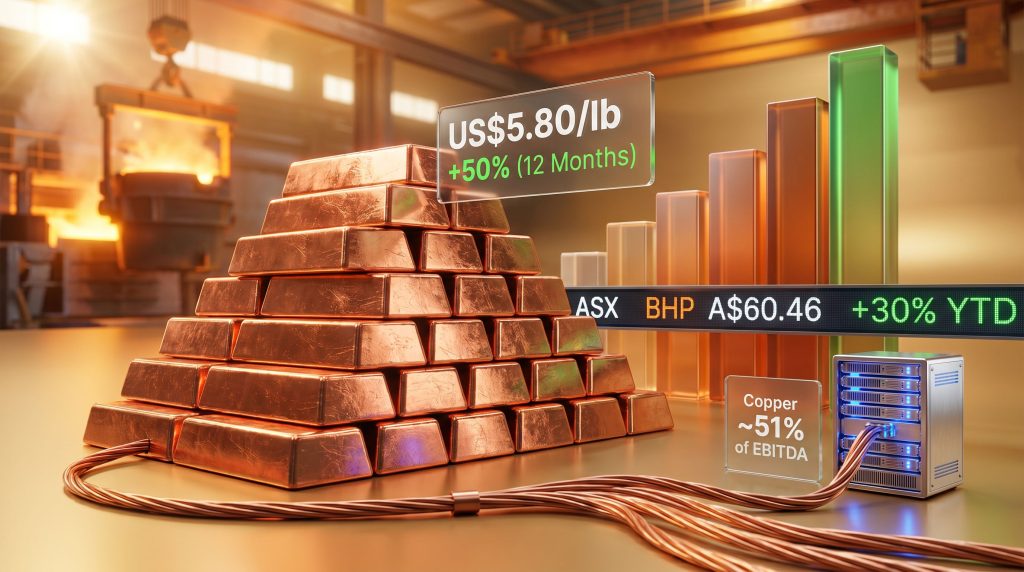
Copper now contributes approximately 51% of BHP's group EBITDA in the most recent half-year reporting period, displacing iron ore as the primary earnings driver. This is not an accident of commodity pricing alone. It reflects a deliberate, multi-year repositioning involving asset divestments, targeted acquisitions, and organic project prioritisation all tilted toward copper-intensive operations.
The practical implication is straightforward but often underappreciated: the BHP copper price correlation is no longer coincidental. It is structurally embedded in the company's earnings architecture. Investors applying an iron ore valuation lens to BHP in 2026 are working with a framework that the company itself has spent years making obsolete.
Key elements of this portfolio transformation include:
- Sustained capital allocation toward Escondida, the world's largest copper mine by production volume, located in Chile's Atacama Desert at elevations exceeding 3,000 metres above sea level
- Olympic Dam in South Australia, a uniquely complex polymetallic ore body where copper, uranium, gold, and silver occur together, requiring hydrometallurgical processing methods rather than conventional smelting in some configurations
- Organic growth projects and pre-feasibility studies across multiple copper jurisdictions aimed at reaching approximately 2.5 million tonnes per annum of copper equivalent production by FY2035
- The deliberate reduction of thermal coal exposure and other legacy assets that previously anchored BHP's commodity mix to older demand cycles
Quantifying the BHP Copper Price Correlation: What the Numbers Actually Show
With copper spot prices trading around US$5.80 per pound (approximately US$12,850 per tonne) at the time of writing, BHP's pre-market share price was sitting at approximately A$60.46 per share. That represented a weekly gain of +4.3% and a year-to-date increase exceeding +30%. On a 12-month basis, the share price has appreciated more than +50%, a trajectory that closely mirrors copper's own sustained rally over the same period.
The table below summarises the relationship across key timeframes:
| Timeframe | BHP Share Price Change | Copper Price Environment | Correlation Signal |
|---|---|---|---|
| 3 Months | Strong positive | Elevated, above US$5.50/lb | High |
| 6 Months | Positive | Upward trajectory | Moderate-High |
| 12 Months | +50%+ | Sustained rally | High |
| YTD | +30%+ | Holding above US$6.00/lb | Very High |
The psychological significance of copper holding above US$6.00 per pound should not be understated. This level functions as both a technical anchor and a sentiment threshold for institutional investors. A sustained break below it would likely prompt a reassessment of the premium currently embedded in BHP's share price. Furthermore, understanding the broader copper price drivers helps contextualise why this threshold carries such weight for BHP's valuation.
Analytical Note: Beta and earnings sensitivity are the two primary mechanisms through which copper price movements translate into BHP share price outcomes. At current EBITDA weightings, a 10% move in copper prices has a materially larger impact on BHP's earnings than an equivalent move in iron ore prices. This is a fundamentally different stock from a risk-management perspective than it was five years ago.
Three Structural Forces Reshaping Copper Demand This Cycle
Not all copper rallies are created equal. What distinguishes the current environment from prior cycles is the breadth and durability of the demand forces underpinning elevated prices.
1. AI Infrastructure and Data Centre Construction
A single hyperscale data centre can consume thousands of kilometres of copper cabling, alongside copper-intensive power distribution systems, bus bars, and liquid cooling infrastructure. As AI model training and inference workloads scale globally, the copper intensity of the digital economy is rising in ways that were not captured in demand forecasts written even five years ago. Morgan Stanley's characterisation of BHP as an AI data centre play within a 53-page research report reflects this analytical reframe. BHP does not build data centres or develop AI, but it produces the copper that makes both possible at scale. According to BHP's own research, the world will need up to 70% more copper over the next two decades to meet these emerging demands.
2. Energy Transition and Grid Electrification
The shift from internal combustion engines to electric vehicles, and from fossil fuel generation to renewable energy, is copper-intensive at every stage. EV charging networks, offshore wind cabling, grid-scale battery storage connections, and transmission line upgrades all require substantial volumes of the metal. Critically, this demand is policy-driven in multiple jurisdictions simultaneously, creating a relatively durable floor beneath long-run consumption assumptions. The copper supply crunch emerging from this dynamic is already influencing how miners like BHP are planning their long-term capital allocation.
3. Supply-Side Constraints With Long Lead Times
Copper mine development from discovery to first production typically spans 10 to 15 years. This means the supply side cannot respond quickly to price signals, even when economics are highly favourable. Grade decline at existing operations is a further complication: the average copper ore grade being mined globally has fallen significantly over the past two decades, meaning more rock must be processed to produce the same quantity of metal. Forecasts suggest demand could outpace supply later this decade, creating structural price support that is qualitatively different from a speculative pricing spike.
How Major Investment Banks Are Positioning: Institutional Consensus and Its Discontents
JP Morgan, Bank of America, and Morgan Stanley have all taken constructive positions on BHP in recent weeks. Morgan Stanley's 53-page research report provides the most detailed articulation of the copper-AI thesis, arguing that BHP's exposure to a foundational data centre material gives it a long-duration valuation support mechanism that traditional mining sector frameworks do not fully capture.
The contrast with Morningstar's stance is instructive. Morningstar's analysis indicates BHP's share price is trading well above intrinsic value estimates, with the premium driven primarily by elevated copper prices and sentiment rather than underlying asset value at normalised commodity assumptions. Investor Daily's coverage of BHP's copper pivot similarly highlights how the re-rating has been driven by sentiment as much as fundamentals.
| Analytical Lens | View on BHP | Primary Risk Factor |
|---|---|---|
| Morgan Stanley | Bullish: copper-AI structural growth thesis | Copper price correction |
| JP Morgan | Bullish: copper demand tailwinds | Supply response timing |
| Bank of America | Constructive | Macro slowdown in key demand markets |
| Morningstar | Cautious: trading above fair value | Copper price mean reversion |
When institutional capital from multiple Wall Street firms converges on a single commodity narrative, the resulting momentum can sustain elevated valuations well beyond what fundamental models would justify. It can also accelerate the unwinding when sentiment turns.
Stress-Testing the Correlation: What a Copper Correction Does to BHP Shareholders
A roughly -5% single-session decline in copper prices on the Friday preceding this analysis provided a real-world preview of how the BHP copper price correlation functions in adverse conditions. The move was driven by a combination of macroeconomic uncertainty and profit-taking, neither of which is unusual at elevated price levels.
Three scenarios frame the range of outcomes for BHP shareholders:
Scenario 1: Copper holds above US$5.50/lb (Base Case)
Institutional support remains intact, the AI infrastructure narrative continues to attract capital, and BHP's elevated valuation is broadly sustained. Long holders remain comfortable.
Scenario 2: Copper retreats to US$4.50 to US$5.00/lb (Moderate Correction)
Copper's EBITDA contribution to BHP compresses meaningfully. Iron ore's relative importance within the earnings mix increases. The share price would likely retrace toward the A$50 to A$55 range, unwinding a portion of the YTD gain.
Scenario 3: Copper returns to long-run consensus of US$3.50 to US$4.00/lb (Bear Case)
Morningstar's fair value estimate becomes the relevant pricing anchor. The AI data centre narrative loses its valuation premium. Significant de-rating risk materialises across the copper-exposed large-cap mining sector.
Risk Warning: Resource equities with elevated commodity price correlations experience amplified downside during corrections. The same sensitivity that drives outperformance in a rising commodity environment accelerates losses when prices fall. This asymmetry is particularly pronounced when a stock is trading above normalised earnings multiples.
The next major ASX story will hit our subscribers first
BHP vs. Rio Tinto: Copper Exposure Benchmarked
Both BHP and Rio Tinto have actively reduced their earnings dependence on iron ore over recent years, and both have been beneficiaries of copper's sustained rally. The structural differences between them are, however, meaningful for investors seeking the most concentrated copper exposure within the ASX large-cap mining universe.
| Metric | BHP | Rio Tinto |
|---|---|---|
| Copper as % of EBITDA (recent half) | ~51% | Growing, but lower than BHP |
| Long-term copper production target | ~2.5 Mtpa equivalent by FY2035 | Oyu Tolgoi ramp-up and other assets |
| Market capitalisation (AUD) | ~A$307 billion | Comparable large-cap |
| Primary re-rating narrative | Copper and AI infrastructure | Copper and lithium diversification |
Rio Tinto's copper expansion through Oyu Tolgoi in Mongolia represents a significant growth asset, but BHP's combination of Escondida's scale, Olympic Dam's long-duration resource base, and the explicit production target for FY2035 gives it a longer runway of copper earnings leverage than most ASX peers can match. In addition, examining the Chile copper price outlook provides further context for just how critical Escondida's jurisdiction is to BHP's long-term production forecasts.
A Practical Monitoring Framework for BHP Investors
Given how directly the BHP copper price correlation now drives share price outcomes, investors need a structured approach to tracking the signals that matter most.
Primary indicators to watch:
- LME copper spot price (US$/tonne) and COMEX copper futures (US$/lb), which are the two benchmark markets most directly feeding into BHP's realised pricing
- Whether copper is holding above or breaking below the US$6.00/lb psychological threshold
Secondary demand and supply indicators:
- Chinese manufacturing PMI, which functions as a leading indicator for industrial copper consumption
- LME warehouse inventory levels, which signal near-term physical market tightness or oversupply
- The US dollar index (DXY), since copper prices historically move inversely to USD strength due to the metal's global pricing in US dollars
Earnings-level indicators:
- Copper's share of group EBITDA each half-year reporting period
- All-in sustaining costs (AISC) per pound of copper produced, which determines the margin sensitivity at various price levels
- Production guidance versus actual output at Escondida and Olympic Dam
Step-by-step valuation check for BHP at current copper prices:
- Identify the current copper spot price and compare it against long-run consensus forecasts, typically US$3.50 to US$4.50/lb
- Estimate BHP's copper EBITDA at spot versus at consensus to quantify the copper premium embedded in the share price
- Apply a sector-appropriate earnings multiple to the normalised EBITDA figure
- Compare the resulting implied share price to the current market price to assess the premium or discount to intrinsic value
- Overlay qualitative factors including growth pipeline execution risk, balance sheet strength, dividend sustainability, and the durability of institutional sentiment
For investors seeking a broader framework, exploring copper investment strategies can help contextualise BHP's position within a diversified commodity portfolio approach.
Frequently Asked Questions: BHP and the Copper Price
Why has the BHP copper price correlation strengthened so significantly?
Copper now contributes approximately 51% of BHP's group EBITDA, surpassing iron ore's share. As the earnings mix has shifted through deliberate strategic action, so has the primary commodity driver of the share price. The correlation is now structural, not coincidental.
Is the AI data centre framing genuine or just marketing language?
BHP does not develop AI technology or operate data centres. However, copper is a foundational material in data centre construction, covering power delivery systems, cabling infrastructure, and cooling. The framing reflects a real structural demand tailwind from AI infrastructure investment rather than any direct technology exposure on BHP's part.
What is the critical copper price level for BHP's current valuation?
US$6.00/lb functions as both a psychological and technical reference point. A sustained break below this level would likely trigger a meaningful reassessment of the premium currently priced into BHP shares.
How does BHP compare to pure-play copper miners in terms of price sensitivity?
BHP remains a diversified miner, meaning its copper correlation is moderated by iron ore, potash, and other commodity exposures. Pure-play copper producers will exhibit higher percentage sensitivity to copper price movements, but BHP offers scale, balance sheet strength, and dividend capacity that smaller pure-plays cannot match.
Could iron ore reclaim its position as BHP's primary earnings driver?
If copper prices correct sharply or iron ore prices surge simultaneously, the earnings mix could shift temporarily. However, BHP's capital allocation strategy and production growth targets make continued copper dominance the structural direction of travel over the medium to long term.
The Durability Question: Structural Demand or Cyclical Enthusiasm?
The most important question for BHP shareholders is not whether copper prices will fluctuate in the near term. They will. The question is whether the forces underpinning elevated copper prices are durable enough to sustain BHP's re-rating through the inevitable periods of macro-driven volatility.
The case for durability rests on supply-side constraints that cannot be resolved quickly, electrification demand that is embedded in policy frameworks across multiple major economies, and AI infrastructure investment that shows no near-term sign of deceleration. The case for caution rests on the premium already embedded in current valuations, China's uncertain growth trajectory, and the historical tendency of commodity markets to overshoot in both directions.
BHP's balance sheet and diversified earnings base provide meaningful downside protection relative to smaller copper-focused peers, but they do not insulate shareholders from a significant copper price correction if one materialises.
The BHP copper price correlation has been architecturally embedded in the company's earnings model through deliberate strategic repositioning. Investors evaluating BHP in 2026 and beyond must treat copper as the primary commodity lens, while maintaining clear-eyed awareness of the valuation premium that elevated copper prices and institutional sentiment have created.
This article is for informational purposes only and does not constitute financial advice. Readers should conduct their own research and consult a licensed financial adviser before making any investment decisions. Past performance of commodities and equities is not indicative of future results. Forecasts and scenario analysis presented here involve inherent uncertainty and should not be treated as predictions.
Want to Stay Ahead of the Next Major Copper Discovery on the ASX?
Discovery Alert's proprietary Discovery IQ model scans ASX announcements in real time, instantly identifying significant mineral discoveries — including copper — and delivering actionable insights before the broader market can react. Explore Discovery Alert's discoveries page to see how historic mineral discoveries have generated substantial returns, and begin your 14-day free trial today to position yourself ahead of the next major find.