June 11, 2026
The Copper Metal That Powers the Energy Transition Has a Geography Problem
Every electric vehicle rolling off a production line today contains somewhere between 50 and 80 kilograms of copper, roughly two and a half times the amount found in a comparable internal combustion engine vehicle, according to International Copper Association estimates. Offshore wind installations require approximately eight times more copper per megawatt than gas-fired power plants. Grid infrastructure supporting the renewable buildout demands conductor materials at a scale the world has rarely needed to source before. When those demand trajectories are mapped against the geography of known copper reserves, the opportunity presented by copper projects in Mexico despite regulatory challenges becomes increasingly difficult to overlook.
Not because Mexico dominates global copper supply. It does not. Chile produces roughly 5.3 to 5.6 million tonnes annually, Peru around 2.2 to 2.4 million tonnes, and Mexico comes in at a more modest 0.79 to 0.83 million tonnes per year, according to the United States Geological Survey (USGS) Mineral Commodity Summaries. The significance is different. Mexico holds identified copper reserves estimated at approximately 53 million tonnes by the USGS, a resource base that remains materially underexploited relative to its geological potential.
Combined with its proximity to the United States and its position within North American supply chain networks, that untapped endowment has attracted more than US$5.1 billion in aggregate capital commitments across eight advancing copper projects, even as the country's regulatory environment has shifted significantly since 2023. Understanding why that capital is still moving, and which scenarios determine whether it produces returns or writedowns, requires a more structured analytical framework than simple optimism or pessimism about Mexico's mining sector.
When big ASX news breaks, our subscribers know first
Why the Demand Runway Justifies Long-Cycle Risk
The IEA's The Role of Critical Minerals in Clean Energy Transitions projects that clean energy applications' share of total copper demand could rise from approximately 24% in 2020 to more than 40% by 2040 under its Sustainable Development Scenario. Overall copper demand in decarbonisation-aligned pathways is expected to grow by 40 to 50% by 2040 relative to 2020 levels, depending on the speed of the energy transition. These are not marginal adjustments to demand curves. They represent a structural reorientation of what the global economy requires from copper-producing nations.
Global EV sales reached more than 14 million units in 2023, up from approximately 3 million in 2020, according to the IEA's Global EV Outlook 2024. Announced policy scenarios project between 240 and 270 million electric cars on the road by 2030, creating an exponential demand signal from the automotive sector alone. Layered on top of that is grid expansion: the IEA estimates global power networks may need to extend by 2 to 2.5 million circuit-kilometres per year on average through 2040 to support electrification and renewables integration.
Furthermore, the role of critical minerals in energy transition planning cannot be overstated. Perhaps the most consequential data point for investors evaluating Mexico's copper pipeline comes from S&P Global's 2022 study The Future of Copper, which projected global refined copper demand could approach 50 million tonnes per year by 2035 under a rapid decarbonisation pathway. That study identified a potential cumulative supply shortfall of several million tonnes annually if new mines are not sanctioned in the 2020s to be operational by the early 2030s.
Projects with 10 to 15 year development horizons, such as large-scale open-pit copper developments in Mexico, must be committed to now to avoid missing that demand window entirely. This context is essential when assessing the future of copper mining and what it means for jurisdictions like Mexico that hold substantial untapped reserves.
"The most underappreciated dynamic in copper project evaluation is the asymmetry between development lead times and market timing. A project sanctioned today will not produce meaningful output for a decade. The demand gap it is designed to fill does not fully materialise until the mid-2030s. This makes current regulatory friction a solvable variable within the project's economic lifetime, not a terminal one."
What the 2023 Mining Law Reforms Actually Changed
Mexico's 2023 amendments to its mining legislation introduced several structural changes that collectively redefined the investment environment for copper developers. Understanding each element precisely matters because the reforms are often discussed as a single event when they are, in practice, a layered set of distinct provisions with different implications for different project types.
The Five Core Regulatory Shifts
-
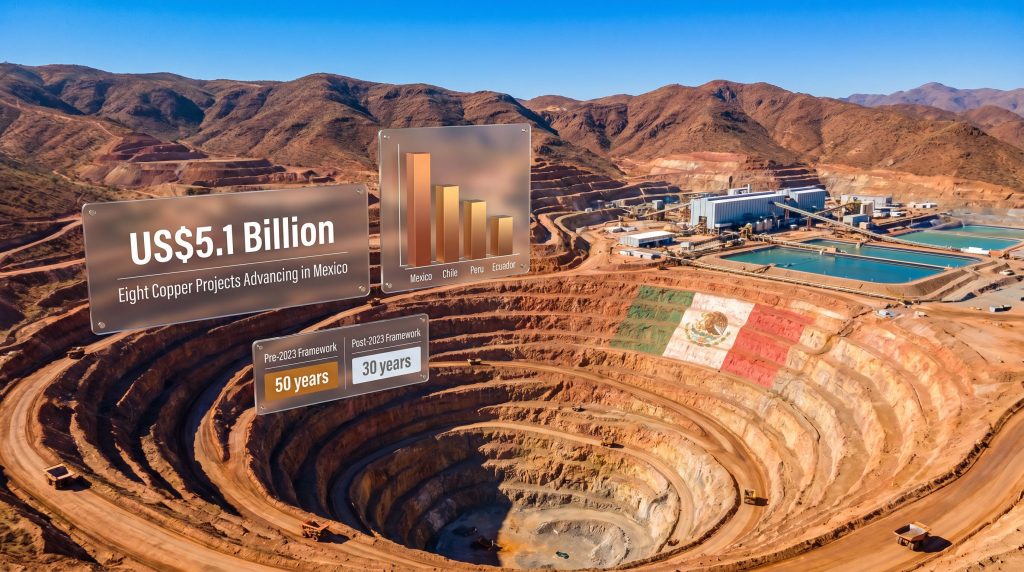
Concession tenure reduction: Maximum concession terms were reduced from 50 years to 30 years, materially compressing the economic planning horizon for long-cycle projects that require sustained production periods to generate acceptable returns on capital.
-
Restrictions on concession transfers: New limitations on the assignment and transfer of concessions introduced additional approval requirements into merger, acquisition, and joint venture structures, creating friction in deal processes where mining rights previously moved with greater flexibility.
-
Elevated water-use conditions: Water availability assessments were elevated from a standard component of Environmental Impact Assessment (EIA) processes to what effectively functions as a standalone primary approval threshold, particularly consequential in Mexico's arid northern mining regions.
-
Expanded environmental layering: Additional environmental review conditions were introduced on top of existing permitting requirements, lengthening approval timelines for operations already navigating multi-stage regulatory processes.
-
Effective freeze on new concession grants: Perhaps the most operationally significant outcome of the reform cycle has been the de facto suspension of new mining concession issuance. This is not an explicitly stated policy but a functional reality that has persisted since the reforms were enacted.
The following table summarises how these changes altered the permitting pathway for a typical large-scale copper project:
| Approval Stage | Pre-2023 Framework | Post-2023 Framework |
|---|---|---|
| Concession Duration | 50 years | 30 years |
| New Concessions Granted | Active issuance | Effectively frozen |
| Water Use Conditions | Standard EIA process | Elevated standalone threshold |
| Transfer/Assignment Rules | Relatively flexible | Tightened; additional approvals required |
| Environmental Review | Integrated permitting | Additional layered conditions |
| Legal Certainty | High | Reduced; implementing regulations pending |
The Implementing Regulations Problem
What often receives less attention in coverage of the 2023 reforms is that the implementing regulations required to give the new framework operational clarity have not been fully released. This is not a minor administrative detail. In mining project finance, lenders and equity partners require bankable regulatory certainty before committing capital at scale. A framework that is structurally defined but procedurally incomplete creates a specific category of risk that is often more damaging to project timelines than the substantive provisions themselves.
According to analysis from BNAmericas on Mexico's copper project pipeline, mining companies operating in Mexico have responded by pursuing legal challenges to contest elements of the reforms. The argument being advanced is that the new framework creates operational and financial uncertainty that is structurally incompatible with the long-term capital commitments that large-scale copper development requires. The resolution of those challenges, and the release of implementing regulations, represents the single most consequential variable for how much of Mexico's copper pipeline reaches construction within the next five years.
Water Rights and Open-Pit Mining: The Operational Bottlenecks
Of all the variables introduced or amplified by the 2023 reforms, water availability has emerged as the defining constraint for copper project advancement. Mexico's primary copper-producing regions are concentrated in arid and semi-arid zones where water access is already competitive between agricultural, municipal, and industrial users. The elevation of water-use conditions to a primary approval threshold means that projects must now satisfy a separate and more demanding evidentiary standard before other permitting stages can proceed.
Open-pit copper operations are particularly exposed to this constraint because their water consumption profiles are substantially higher than underground equivalents. The spatial footprint of open-pit mining also triggers broader environmental review requirements, including surface disturbance assessments and biodiversity impact evaluations, that have become more complex to navigate under the post-2023 framework.
For project developers, this creates a practical design question: whether operations originally conceived as open-pit can be reconfigured as underground or hybrid developments to reduce their regulatory exposure. This kind of design flexibility is increasingly being treated not merely as a technical option but as a risk mitigation instrument, particularly for projects that are still in the engineering phase and have not committed to a final extraction methodology.
Three Scenarios for Mexico's Copper Pipeline
Given the variables in play, the trajectory of copper projects in Mexico despite regulatory challenges is best understood through a scenario framework rather than a single forecast.
Scenario A: Regulatory Stabilisation
Implementing regulations are released with sufficient clarity to restore bankable certainty to the permitting process. Legal challenges are resolved in ways that either uphold the reforms with procedural clarity or modify the most operationally disruptive provisions. Project approvals resume at a measured but functional pace, and the concession freeze begins to ease selectively for priority developments.
Scenario B: Prolonged Ambiguity
Legal resolution is delayed, implementing regulations remain incomplete, and the concession freeze extends beyond the current political cycle. Capital allocation decisions shift incrementally toward lower-risk jurisdictions. Projects with legacy concession advantages continue advancing, but exploration-stage assets face structural stagnation. This scenario increases the probability that Mexico misses its window to contribute meaningfully to the mid-2030s supply response.
Scenario C: Policy Recalibration
Economic pressure, driven by fiscal needs, employment considerations, or external trade dynamics, prompts targeted adjustments to the reform framework. Selected projects of scale or strategic positioning are unlocked through administrative or legislative mechanisms without a full repeal of the 2023 changes. This scenario creates differentiated outcomes across the project pipeline depending on which assets qualify for priority treatment.
"The distinction between these scenarios is not primarily geological or economic. It is administrative. Mexico's copper resource base does not change between Scenario A and Scenario B. What changes is whether the institutional machinery exists to translate that resource base into permitted, financed, and constructed operations within the relevant demand window."
What a US$5.1 Billion Pipeline Reveals About Investor Behaviour
The aggregate capital commitment across Mexico's eight advancing copper projects is an important behavioural signal. Sophisticated institutional investors and major mining companies do not commit capital of this magnitude to jurisdictions they have abandoned. What the pipeline reflects instead is a bifurcated investment posture: continued conviction in Mexico's geological fundamentals combined with careful project-level triage to identify which assets carry manageable regulatory exposure.
However, the broader copper supply crunch playing out globally means that investors cannot simply pivot away from Mexico without accepting materially reduced exposure to one of the world's most prospective copper endowments. Consequently, the majority of capital remains committed, albeit with revised timelines and phased deployment strategies.
Project Types and Their Regulatory Exposure
Not all copper projects in Mexico face equivalent headwinds. Their vulnerability to the 2023 framework depends heavily on their development stage and technical configuration:
-
Large-scale open-pit developments carry the highest capital intensity and the greatest exposure to water availability thresholds and expanded environmental review requirements.
-
Underground copper projects present a lower surface footprint and may navigate the current regulatory environment more effectively, though they typically involve higher per-unit operating costs.
-
Copper cathode-focused operations targeting processing-stage value capture may carry a differentiated regulatory profile. Processing infrastructure can sometimes be advanced on existing permitted land without triggering the full suite of new concession requirements, giving these projects a structural advantage in the current environment.
-
Exploration-stage assets are most exposed to the concession freeze. Their advancement is fundamentally dependent on policy resolution rather than technical or financial factors.
The next major ASX story will hit our subscribers first
How Mexico Compares to Its Regional Peers
Investors evaluating copper projects in Mexico despite regulatory challenges are necessarily doing so within a comparative regional framework. In addition, Chile's copper supply gap illustrates precisely how even dominant copper-producing nations can face structural constraints that elevate the strategic importance of adjacent jurisdictions. The following table maps the key risk dimensions across Latin America's principal copper jurisdictions:
| Factor | Mexico | Chile | Peru | Ecuador |
|---|---|---|---|---|
| Geological Prospectivity | High | Very High | Very High | High |
| Regulatory Stability (Post-2023) | Moderate-Low | High | Moderate | Low-Moderate |
| New Concession Availability | Effectively Frozen | Active | Active | Selective |
| Water Risk | High (arid regions) | High | Moderate-High | Low-Moderate |
| Political Risk | Moderate | Low-Moderate | Moderate-High | High |
| Infrastructure Maturity | Moderate | High | Moderate | Low |
| Investment Sentiment | Cautious but Active | Strong | Recovering | Speculative |
Chile's dominance in the regional comparison reflects decades of institutional investment in regulatory predictability, not superior geology alone. Peru's recovery trajectory acknowledges that political volatility has been partially offset by ongoing project advancement. Ecuador's low infrastructure maturity and high political risk create a speculative profile despite genuine geological prospectivity. Mexico sits in a distinct position: better infrastructure and institutional history than Ecuador, but currently constrained by self-imposed regulatory uncertainty that peer jurisdictions have not replicated.
The Risk Matrix Every Investor Should Understand
Five primary risk vectors define the current exposure profile for copper projects in Mexico:
-
Regulatory risk: Incomplete implementing regulations, the functional concession freeze, and uncertain legal challenge timelines.
-
Permitting risk: Water availability thresholds operating as a standalone gating mechanism, plus expanded environmental evaluation requirements for open-pit configurations.
-
Political risk: Policy continuity uncertainty across administrative cycles and the potential for further reform iterations before the current framework stabilises.
-
Financial risk: Extended development timelines increase project carrying costs and compress internal rate of return calculations for capital already deployed.
-
Operational risk: Community opposition and water access disputes that can stall projects independently of the formal regulatory framework.
Experienced operators are responding to these vectors through phased development strategies that limit upfront capital exposure while preserving optionality, proactive regulatory engagement to position projects favourably before implementing regulations are finalised, and deliberate effort to qualify under existing pre-2023 concession frameworks wherever technically feasible. For those developing copper investment strategies with a regional focus, these distinctions between project types and risk profiles are essential to understand before committing capital.
Milestones That Will Define the Next Five Years
For investors tracking Mexico's copper development pipeline, the following indicators will determine which scenario materialises. As noted by Crux Investor in their analysis of Mexico's mining industry under reform, the resolution of legal and regulatory uncertainties will be the defining factor for capital allocation decisions across the sector:
- Release of detailed implementing regulations for the 2023 mining law amendments
- Judicial or administrative resolution of pending legal challenges from mining companies
- Any resumption of new concession grants as a signal of policy recalibration
- Water use framework clarifications establishing clear approval thresholds for large-scale operations
- Federal budget allocations to mining sector regulatory agencies as a proxy for institutional processing capacity
None of these milestones require Mexico to abandon its 2023 reforms entirely. What they require is procedural completion: the translation of structurally defined policy into operationally navigable process. That distinction matters for investors because it frames the current environment as one of regulatory incompleteness rather than regulatory hostility. The geological case for Mexico's copper endowment remains intact. The institutional machinery for translating that endowment into production is what needs attention.
This article contains forward-looking analysis, scenario modelling, and projections drawn from third-party research sources including the IEA, USGS, S&P Global, and the International Copper Association. All projections involve inherent uncertainty and should not be construed as financial advice. Investors should conduct independent due diligence before making capital allocation decisions related to mining assets in any jurisdiction.
Want to Track the Next Major Copper Discovery Before the Broader Market Does?
Discovery Alert's proprietary Discovery IQ model delivers real-time alerts on significant ASX mineral discoveries — instantly translating complex data across 30+ commodities into actionable insights for both short-term traders and long-term investors. Explore how historic mineral discoveries have generated substantial returns on Discovery Alert's dedicated discoveries page, and begin your 14-day free trial today to position yourself ahead of the market.