June 10, 2026
The Economics of Polymetallic Discovery: Why Commodity Mix Defines Development Value
In copper exploration, the difference between a good project and a great one rarely comes down to grade alone. The most economically resilient deposits in the world share a structural characteristic that single-commodity projects fundamentally lack: diversified revenue streams that cushion operating costs across metal price cycles. When a copper mine also produces meaningful quantities of gold and silver, those by-product credits effectively reduce the net cost of producing each pound of copper, compressing the all-in sustaining cost curve and expanding the margin window available to project developers.
This dynamic sits at the core of why the Ero Copper Furnas project in Brazil has attracted sustained institutional attention since its preliminary economic assessment was published in February 2026. Furnas is not simply a copper deposit. It is a polymetallic system embedded within one of the planet's most mineralogically endowed geological corridors, advancing through a structured joint venture framework at a pace that has surprised even close observers of the project.
When big ASX news breaks, our subscribers know first
Geological Architecture: Why the Carajás Province Matters
Brazil's Pará state in the northern Amazon basin hosts the Carajás Mineral Province, a geological feature so prolific in base and precious metal endowment that it has shaped the global copper and iron ore supply landscape for decades. Vale's Salobo copper-gold operation, located approximately 70 kilometres northwest of Furnas, is one of the largest copper-gold mines on Earth by contained metal. The geological processes responsible for Salobo's formation — specifically the IOCG mineralising systems active across this Archean craton — are the same forces that shaped the Furnas deposit.
This is not coincidental proximity. IOCG systems in the Carajás tend to cluster along regional structural corridors, and Furnas sits within that same mineralising architecture. For exploration geologists, this context is significant: the Carajás is not a jurisdiction where you find isolated anomalies. Deposits in this belt have a demonstrated tendency toward scale.
The Furnas tenement covers approximately 2,400 hectares and remains open both at depth and along strike, a technical descriptor that carries considerable weight in resource estimation. When a deposit is described as open in these directions, it means that drilling has not yet encountered the boundaries of the mineralised system. The resource disclosed in the February 2026 PEA likely reflects the current state of geological knowledge rather than the ultimate extent of the system.
The Earn-In Framework: Structured Ownership With Accelerated Execution
Understanding how Ero Copper is acquiring its interest in Furnas is essential context for evaluating the project's trajectory. The formal earn-in agreement, executed in July 2024 with Salobo Metais, a subsidiary of Vale Base Metals, gives Ero the right to acquire a 60% controlling interest in Furnas by satisfying a defined set of exploration, engineering, and development obligations over a five-year window.
Critically, a binding term sheet had been in place since October 2023, meaning the commercial relationship predates the formal agreement by approximately nine months. This sequencing reflects how major mining joint ventures are typically structured: heads of agreement are signed first to lock in commercial intent, with definitive documentation following after due diligence and legal formalisation.
What has distinguished Ero's execution is the pace of delivery against these milestones. Drilling programs at Furnas are on track to be completed by year-end 2026, placing Ero approximately two years ahead of its contractual obligations. National Bank Financial analyst Shane Nagle noted in a June 2026 research note that the required earn-in spending under the Vale Base Metals agreement is expected to be satisfied by year-end, reinforcing that milestone completion is genuinely imminent rather than aspirational.
Structural Insight: In earn-in agreements, accelerated milestone completion is not merely operationally impressive. It compresses the timeline to majority ownership, which in turn unlocks the company's ability to progress the project toward bankable feasibility studies and project financing discussions on its own terms.
Decoding the Latest Drill Results: What the Intercepts Actually Mean
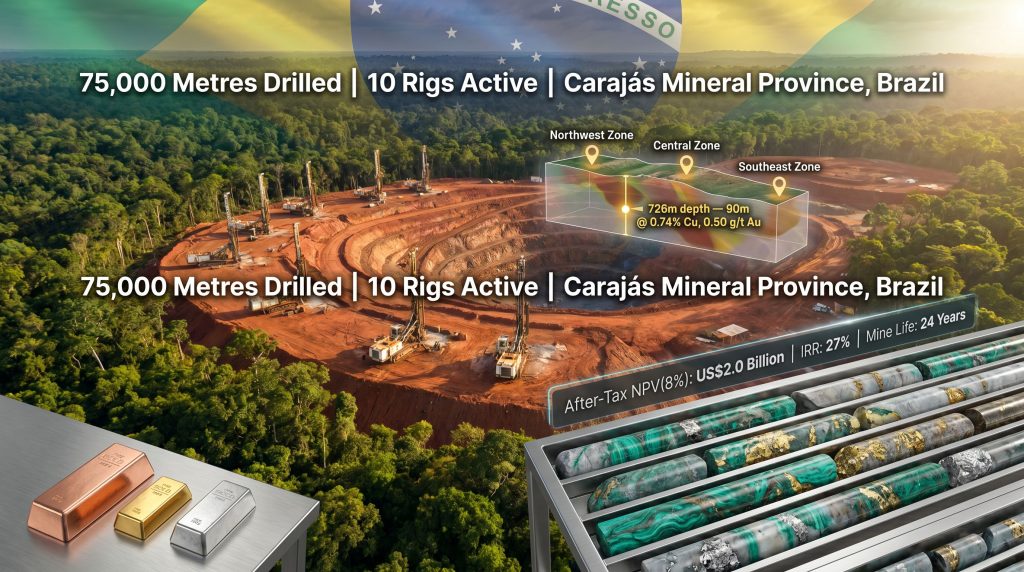
As of late May 2026, Ero had completed more than 75,000 metres of drilling at Furnas, with laboratory assay results returned for approximately 52,000 metres. Ten drill rigs were operating simultaneously at the project, a fleet deployment that signals a serious and well-resourced exploration program rather than a pace-limited effort. Furthermore, interpreting these drill results correctly is essential for understanding the true scale of what is emerging at Furnas.
The latest batch of results covers approximately 24,000 metres of new drilling and reveals mineralisation extending beyond the boundaries of the existing resource model in two distinct areas.
Southeast Zone: Depth and Strike Extensions Confirmed
The Southeast zone is the most mature part of the Furnas deposit, and the latest step-out results confirm it remains considerably larger than the current inferred resource captures.
Hole FURN-DD-00357 intersected a composite interval of 90 metres grading 0.74% copper, 0.50 g/t gold, and 3.18 g/t silver from a depth of 726 metres. Within that broader interval, a higher-grade core of 32 metres graded 1.17% copper, 0.68 g/t gold, and 5.40 g/t silver. The spatial position of this intercept extends known Southeast zone mineralisation approximately 115 metres down dip beyond the existing resource envelope.
Hole FURN-DD-00354 added a shallower extension, intersecting 45 metres grading 0.98% copper, 0.36 g/t gold, and 1.72 g/t silver from 459 metres depth, including a high-grade sub-interval of 20 metres at 1.78% copper, 0.25 g/t gold, and 3.12 g/t silver. This intercept sits approximately 80 metres beyond the current inferred resource boundary, confirming along-strike continuity.
The 1.78% copper grade in the high-grade sub-interval of FURN-DD-00354 represents the strongest copper grade reported in this batch of results. For context, copper deposits with average grades above 1.0% are considered high-grade in the current global development pipeline, where the median grade of new copper projects has declined meaningfully over the past two decades as the highest-grade deposits have been progressively developed.
The Central Zone: A Strategic Discovery Near Planned Infrastructure
The more strategically intriguing result in the latest drill package comes from the Central zone, an area located between the established Northwest and Southeast mineralised corridors.
Hole FURN-DD-00368 returned 41 metres grading 0.94% copper, 0.44 g/t gold, and 1.58 g/t silver from 380 metres depth. The hole was drilled approximately 220 metres below the current inferred resource and more than 1.1 kilometres west of the Southeast zone resource boundary.
What makes this result particularly notable is its spatial relationship to planned project infrastructure. In mine development economics, the cost of accessing mineralisation is directly related to its distance from processing facilities and haulage corridors. Mineralisation discovered adjacent to planned infrastructure can be incorporated into a mine plan at substantially lower incremental capital cost than equivalent tonnes discovered in remote step-out locations. Consequently, the Central zone's position near planned infrastructure means that any resource growth in this area carries an inherent capital efficiency advantage.
Drill Result Summary
| Hole ID | Zone | Depth (m) | Interval (m) | Cu (%) | Au (g/t) | Ag (g/t) | Key Significance |
|---|---|---|---|---|---|---|---|
| FURN-DD-00357 | Southeast | 726 | 90 | 0.74 | 0.50 | 3.18 | 115m down-dip extension |
| FURN-DD-00357 (HG sub-interval) | Southeast | 726 | 32 | 1.17 | 0.68 | 5.40 | High-grade core within broad zone |
| FURN-DD-00354 | Southeast | 459 | 45 | 0.98 | 0.36 | 1.72 | 80m beyond resource boundary |
| FURN-DD-00354 (HG sub-interval) | Southeast | 459 | 20 | 1.78 | 0.25 | 3.12 | Highest copper grade in batch |
| FURN-DD-00368 | Central | 380 | 41 | 0.94 | 0.44 | 1.58 | New zone near planned infrastructure |
PEA Economics: Placing Furnas in the Global Copper Development Context
The February 2026 preliminary economic assessment provides a comprehensive snapshot of Furnas' development potential at current resource dimensions. The numbers are significant in both absolute and relative terms.
Key PEA parameters at a glance:
- Mine life: 24 years
- Average annual copper production: 52,000 tonnes
- Average annual gold production: 84,000 ounces
- Average annual silver production: 374,000 ounces
- Copper-equivalent production rate over the first 15 years: approximately 108,000 tonnes per year
- After-tax NPV at an 8% discount rate: approximately US$2.0 billion
- Internal rate of return: 27%
- Estimated initial capital expenditure: approximately US$1.3 billion
A 27% IRR at an 8% discount rate positions Furnas in the upper tier of pre-feasibility copper projects globally. To provide investor context: most copper development projects in the Americas that have successfully reached construction decisions in the past decade have done so with IRRs in the 15% to 22% range. Furnas' 27% figure reflects the combined benefit of polymetallic by-product credits, a long mine life, and the infrastructure advantages of the Carajás region.
The capital efficiency ratio is equally compelling. At a US$1.3 billion initial capital requirement against a US$2.0 billion after-tax NPV, every dollar of upfront capital is projected to generate approximately US$1.54 of net present value. This metric, sometimes called the NPV-to-capex ratio, is a primary screening tool for institutional investors evaluating development-stage copper assets.
Investor Perspective: With Ero's market capitalisation sitting at approximately C$3.8 billion (US$2.7 billion) at the time of the June 2026 drill results, the Furnas PEA NPV of US$2.0 billion represents a substantial proportion of the company's entire enterprise value, even before accounting for the producing Tucumã mine. This relative valuation dynamic is precisely what makes development-stage assets of this scale compelling to resource-focused portfolio managers.
Commodity Profile: How By-Product Credits Work in Practice
The polymetallic nature of Furnas is not merely a geological curiosity. It has direct implications for the project's cost structure and commercial resilience. In addition, broader copper market dynamics in 2025 and beyond underscore why cost-competitive polymetallic projects like Furnas are increasingly valued by institutional investors.
In copper mining economics, by-product credits are revenues generated from metals other than the primary commodity, which are then subtracted from gross operating costs to calculate a net or by-product AISC (all-in sustaining cost). When gold and silver production is meaningful relative to copper output, this credit can reduce the reported copper AISC by several hundred dollars per tonne.
| Commodity | Role at Furnas | Economic Function |
|---|---|---|
| Copper | Primary metal | Core revenue driver across the mine life |
| Gold | By-product | Significant cost credit reducing net copper AISC |
| Silver | By-product | Additional margin support, particularly at elevated silver prices |
At Furnas' projected annual gold production of 84,000 ounces, even at conservative gold price assumptions, the annual by-product credit runs into the tens of millions of dollars. This structural cost advantage means Furnas' copper break-even price is materially lower than its headline operating cost figure would suggest in isolation.
The next major ASX story will hit our subscribers first
Regional Infrastructure: The Capital Cost Advantage That Rarely Gets Priced In
One factor that is systematically underappreciated in early-stage copper project valuations is the cost of infrastructure. Greenfield copper mines built in remote jurisdictions without existing roads, power, or logistics networks routinely spend 30% to 50% of their total capital budget on infrastructure construction before a single tonne of ore is processed.
Furnas benefits from an unusually strong pre-existing infrastructure base for a development-stage project:
- Paved road access within the regional corridor
- An existing power substation with connectivity potential
- Rail access within the broader Carajás transport network
- Proximity to Vale's established Salobo operations approximately 70 kilometres to the northwest
- Ero's own Tucumã mine approximately 190 kilometres to the northeast
This infrastructure density is a direct consequence of Carajás' multi-decade development history as a major mining district. Vale's investment in regional logistics infrastructure over the past 40 years has created a development environment where new projects can leverage existing assets rather than building from scratch.
From PEA to Prefeasibility: The 2027 Engineering Roadmap
The transition from a preliminary economic assessment to a prefeasibility study (PFS) is one of the most capital-intensive and technically demanding phases of mine development. It requires moving from conceptual engineering to defined engineering, and from inferred resources to predominantly indicated resources. For those unfamiliar with this process, understanding what a definitive feasibility study entails provides useful context for the milestones ahead.
The distinction between inferred and indicated resource categories is critical and often misunderstood outside the mining industry. Under the JORC Code and NI 43-101 standards:
- Inferred resources are estimated with limited geological confidence and cannot be used in mine planning or bankable feasibility studies
- Indicated resources carry sufficient geological confidence to support mine planning, economic modelling, and project financing discussions
- Measured resources represent the highest confidence category, underpinning detailed mine design
Ero's current drilling program is explicitly designed to convert inferred resources to indicated classification, which directly improves the quality of inputs available for the 2027 PFS. Higher resource confidence typically translates to more favourable project financing terms, narrower risk premiums demanded by lenders, and stronger institutional investor participation in project equity raises.
Key technical workstreams between now and PFS completion include metallurgical test work to confirm processing recoveries, geotechnical studies to inform mine design, environmental baseline programs, and continued step-out drilling to define the full extent of the Southeast, Northwest, and Central zones.
Risk Framework: What Investors Should Monitor
No development-stage mining project is without material risks, and a balanced assessment of Furnas requires honest engagement with the challenges ahead.
| Risk Category | Specific Risk | Mitigation Factor |
|---|---|---|
| Geological | Deeper mineralisation proves discontinuous | Multiple zones confirmed; open at depth and strike |
| Technical | Metallurgical recoveries differ from PEA assumptions | Test work ongoing ahead of PFS |
| Capital | US$1.3B capex in Brazilian construction environment | Regional infrastructure reduces greenfield exposure |
| JV Governance | Partner alignment within Vale earn-in structure | Clearly defined milestone obligations in definitive agreement |
| Resource Conversion | Step-out results require infill drilling for indicated classification | Active 10-rig program targeting conversion |
| Permitting | Environmental approvals in Pará state | Established jurisdiction with operating mine precedents |
Three exploration upside vectors deserve particular attention:
- Down-dip extensions in the Southeast zone, confirmed by FURN-DD-00357 at 726 metres, suggest the mineralised system continues well below current resource limits
- Along-strike extensions in the Northwest zone, where the deposit remains open, could add meaningful tonnes at shallow to moderate depths
- Central zone expansion, currently at an early but strategically positioned stage, has the potential to become a third major mineralised corridor within the mine plan
Furnas and Tucumã: Building a Brazilian Copper Platform
Ero Copper's strategic logic in Brazil is increasingly coherent. The company operates the Tucumã copper mine in Pará state, providing an established operational platform, local workforce expertise, and regulatory relationships within the same jurisdiction as Furnas. However, it is the Ero Copper Furnas project in Brazil that is drawing the most significant investor attention given its polymetallic scale and proximity to world-class existing operations.
| Parameter | Tucumã | Furnas |
|---|---|---|
| Development Stage | Operating mine | PEA complete; PFS targeted 2027 |
| Location | Pará state, Brazil | Pará state, Brazil (~190km from Tucumã) |
| Commodity Mix | Copper | Copper-gold-silver (polymetallic) |
| Projected Mine Life | Operating | 24 years (PEA) |
| Annual Copper Production | Operating | ~52,000t average (PEA) |
| Ownership Structure | 100% Ero | 60% earn-in via Vale Base Metals JV |
The concentration of assets within a single high-endowment mineral province is a deliberate strategic choice. Operators with multiple assets in the same region benefit from shared infrastructure, shared regulatory relationships, and the ability to allocate skilled personnel across projects without the friction and cost of geographic diversification. Furthermore, those exploring copper investment opportunities will find that this kind of provincial consolidation represents one of the more compelling structural advantages available in the current development pipeline.
Ero's CEO Makko DeFilippo has noted publicly that the continuity of high-grade intervals within both the Southeast and Northwest zones, combined with the emerging Central zone opportunity near planned infrastructure, reinforces and builds upon what was already a compelling economic foundation established in the February 2026 PEA.
Frequently Asked Questions: Ero Copper Furnas Project
What is the Furnas project and where is it located?
Furnas is an advanced-stage polymetallic copper-gold-silver development project in Brazil's Pará state, within the Carajás Mineral Province. The project covers approximately 2,400 hectares and sits roughly 70 kilometres from Vale's Salobo copper-gold mine.
What are the headline economics from the Furnas PEA?
The February 2026 PEA outlines a 24-year mine life, average annual production of 52,000 tonnes of copper, 84,000 ounces of gold, and 374,000 ounces of silver, with an after-tax NPV(8%) of approximately US$2.0 billion, a 27% IRR, and estimated initial capital of approximately US$1.3 billion.
Why does the Central zone discovery matter?
The Central zone sits between the established Northwest and Southeast corridors, approximately 220 metres below the current inferred resource and more than 1.1 kilometres west of the Southeast zone. Its proximity to planned project infrastructure means resource growth in this area could be incorporated into the mine plan at lower incremental capital cost than equivalent remote discoveries.
When is the prefeasibility study expected?
Ero Copper is targeting PFS completion in 2027, building on the February 2026 PEA and ongoing resource conversion drilling programs.
This article contains forward-looking statements and references to preliminary economic assessments that are subject to material assumptions, risks, and uncertainties. PEA-level economics are preliminary in nature and should not be relied upon as a definitive representation of future project performance. Readers should conduct their own due diligence and seek independent financial advice before making investment decisions.
Want to Identify the Next Major Polymetallic Discovery Before the Market Does?
Discovery Alert's proprietary Discovery IQ model delivers real-time alerts on significant ASX mineral discoveries, instantly transforming complex drill results and resource data into actionable investment insights — explore Discovery Alert's discoveries page to see how historic polymetallic finds have generated exceptional returns, and begin a 14-day free trial to position yourself ahead of the broader market.