June 11, 2026
The Hidden Price Split Reshaping the Global Copper Market
Global commodity markets have always been shaped by the tension between physical supply constraints and financial pricing mechanisms. For most of the past century, copper traded within a broadly unified international pricing framework, with the London Metal Exchange benchmark serving as the central reference point for producers, smelters, and fabricators from Santiago to Shanghai. That uniformity is now fracturing, and US copper tariffs and domestic price premium dynamics are at the centre of this structural shift.
A structural wedge is forming between the price of copper inside the United States and the price of copper everywhere else, and the financial consequences of that divergence are only beginning to be understood by investors. Understanding how this mechanism works, how large the gap has already grown, and which producers stand to benefit requires looking well beyond the headline tariff rates. Furthermore, the copper supply crunch playing out globally adds another layer of complexity to this already intricate pricing environment.
When big ASX news breaks, our subscribers know first
How the Tariff Structure Is Splitting Copper Into Two Pricing Regimes
The Implementation Timeline and Its Market Consequences
The US copper tariff schedule calls for a 15% import levy beginning January 2027, escalating to 30% in 2028. A formal determination on the precise scope of the tariff is expected during the second half of 2026, and this scope decision carries more pricing significance than the headline rates themselves.
A critical and widely misunderstood distinction: the tariff applies to semi-finished copper products and copper-intensive derivative products, not to refined copper cathodes. This granular scoping detail fundamentally changes the size of the effective premium, because refined copper cathodes have historically represented a large share of US copper imports.
When the US clarified that the 50% levy under consideration applied only to semi-finished and derivative forms, analysts projected that a previously observed 28% COMEX premium over LME would narrow materially, since the dominant import category fell outside the tariff's reach. Consequently, the US copper tariff impact on specific product categories has become one of the most closely watched variables in the market.
Tariff scope, not the headline rate, is the dominant variable governing the real-world size of the domestic price premium. Investors who focus only on the percentage rate risk significantly misjudging the actual pricing impact.
Quantifying the Domestic Premium: The Numbers Behind the Divergence
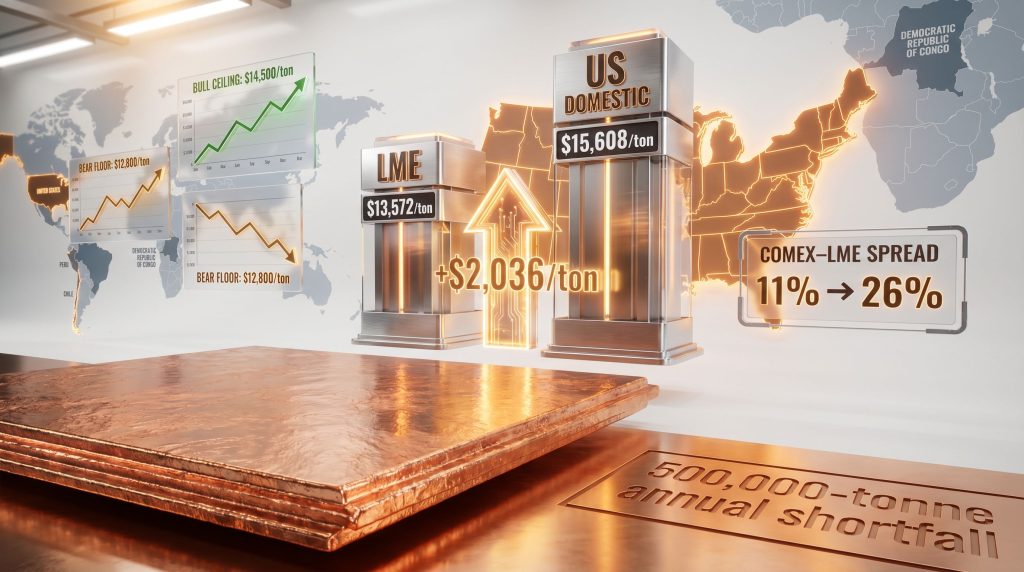
At the LME copper benchmark of $13,572 per tonne recorded on June 10, 2026, the arithmetic of the tariff structure produces the following implied pricing outcomes:
| Benchmark | Price (June 2026) | Tariff Applied | Implied US Domestic Price | Domestic Premium |
|---|---|---|---|---|
| LME Copper | $13,572/t | None | $13,572/t | Baseline |
| US at 15% Tariff | $13,572/t | 15% | ~$15,608/t | +$2,036/t |
| US at 30% Tariff | $13,572/t | 30% | ~$17,644/t | +$4,072/t |
| Peak COMEX Premium (observed mid-2026) | N/A | N/A | N/A | ~$2,596/t |
The COMEX-LME spread expanded from roughly 11% before tariff announcements to above 26% at its mid-2026 peak, briefly producing a premium of approximately $2,596 per tonne. For context, the average US domestic copper premium throughout 2024 sat near just $150 per tonne, meaning the tariff-driven pricing environment represents an order-of-magnitude shift in the competitive landscape for US-exposed producers.
The mechanism driving the initial spike was classic arbitrage front-running: traders and importers accelerated shipments of copper into the US ahead of implementation, creating acute demand pressure on domestic supply while LME prices remained comparatively anchored to global industrial demand fundamentals. This kind of pre-tariff inventory accumulation is a well-documented behaviour in commodities markets and typically precedes a partial premium reversal once the front-running cycle exhausts itself. Indeed, the copper tariff fears that initially drove this behaviour remain a persistent undercurrent in market sentiment.
The Supply Gap That Tariffs Cannot Solve Quickly
America's Structural Copper Deficit
US copper tariffs and domestic price premium signals are powerful economic forces, but price signals alone cannot conjure new mines into production on short timescales. The arithmetic of the US copper supply position illustrates the challenge clearly:
- Annual US copper consumption: approximately 1.6 million tonnes
- Domestic mine production capacity: approximately 1.1 million tonnes
- Structural annual import shortfall: approximately 500,000 tonnes
- Time required to meaningfully close this gap: industry estimates point to at least a decade, with material new supply unlikely before the early-to-mid 2030s
The 500,000-tonne deficit cannot be resolved through tariff policy alone. Closing it requires new mine development, expanded smelting capacity, increased refining infrastructure, and scaled secondary copper recycling. Each of these pathways involves its own timeline constraint.
Why Mine Development Timelines Undermine Near-Term Self-Sufficiency
The permitting and development cycle for a new copper mine in the United States typically spans 7 to 15 years from initial discovery to first production. Even a project that received environmental approval today would be unlikely to contribute meaningfully to domestic supply before the early 2030s at the earliest. Smelting and refining capacity expansions carry similarly long lead times given the infrastructure investment required.
Secondary copper recycling, often cited as a near-term offset, can partially reduce the import deficit but cannot substitute for primary mine production at the volumes required. Recycled copper currently accounts for roughly 30 to 35% of US copper supply, and while elevated domestic prices create stronger economic incentives for secondary recovery, the feedstock availability and processing capacity constraints limit how rapidly this share can grow.
The US will remain a structural net importer of copper for at least the next decade, regardless of how aggressively tariff policy is implemented. The tariff premium improves domestic producer economics but does not resolve the underlying supply gap within the policy's near-term window.
Macro Forces Suppressing LME Copper While US Premiums Build
The Federal Reserve, Dollar Strength, and Industrial Metal Pricing
While the structural tariff premium builds on a forward basis, near-term LME copper pricing faces a distinct set of headwinds rooted in monetary policy dynamics. US payroll data for May 2026 came in at 172,000 new jobs, exceeding consensus expectations and pushing the US dollar index to 99.87. Markets shifted rapidly toward pricing a Fed rate hike by December 2026, creating the classic inverse relationship between a strengthening dollar and industrial metal prices denominated in that currency.
LME copper fell 0.32% to $13,572 per tonne on June 10, 2026 as this dynamic played out. Simultaneously, Shanghai Futures Exchange copper fell 0.29% to 104,110 yuan per tonne, reflecting the coordinated pressure of dollar strength across both primary copper trading venues.
Saxo analyst Charu Chanana articulated the policy dilemma facing the Fed in commentary published by Reuters on June 10: the central bank cannot dismiss rising inflation expectations simply because the underlying cause is an oil supply shock rather than demand-driven price pressure. This observation carries important implications for copper. If the Fed responds to energy-driven inflation by maintaining elevated rates and a stronger dollar, LME copper will face sustained downward pressure even as the forward tariff premium for US-exposed producers continues to build. According to analysis from Coface, this monetary tightening dynamic represents one of the most underappreciated risks to copper's near-term pricing trajectory.
The Geopolitical Energy Overlay and China's Rising Input Costs
Energy costs represent 20 to 30% of cash operating costs at open-pit copper mining operations. Two simultaneous developments were compressing this dimension of the copper market in mid-2026.
First, conflict in the Middle East, specifically the disruption of Strait of Hormuz shipping routes, was elevating energy input costs across industrial supply chains globally. Brent crude settled at $91.66 per barrel and WTI at $88.46 per barrel on June 10. For copper producers outside the US tariff umbrella, particularly those in central Africa and parts of South America reliant on imported diesel, this represented a direct cost compression without any offsetting premium benefit.
Second, China's Producer Price Index rose for a third consecutive month in May 2026, reaching its highest level since 2022. As the world's largest copper-consuming economy, rising Chinese manufacturing input costs carry material implications for downstream copper demand. The European Central Bank was simultaneously expected to raise rates by 25 basis points in June 2026, with additional tightening projected later in the year, adding monetary pressure across another major copper demand region.
Scenario Analysis: Where LME Copper Goes From Here
| Scenario | Key Driver | Fed Posture | Dollar Index | LME Copper Range |
|---|---|---|---|---|
| Base Case | CPI prints ~4.2% (consensus) | One December hike | ~99 to 100 | $13,400 to $13,800/t |
| Bear Case | CPI above 4.4% | September hike priced in | Above 101 | ~$12,800/t |
| Bull Case | CPI at 0.3% or below / ceasefire | Pause signalled | Weakens | Above $14,500/t |
A geopolitical de-escalation scenario involving a US-Iran ceasefire and a halt to Israeli operations against Hezbollah would simultaneously lower energy costs, weaken the dollar, and remove a key demand-side headwind. Copper above $14,500 per tonne on the LME becomes plausible under those conditions. However, Israel's public rejection of ceasefire terms as of June 2026 makes this scenario a lower-probability path in the near term.
Who Captures the Premium and Who Bears the Compression
The Producer Divide: A Tale of Two Copper Markets
The emergence of a sustained US copper domestic price premium creates a stark bifurcation across the global producer landscape:
| Producer Category | Tariff Exposure | Pricing Benchmark | Estimated 2027 Advantage |
|---|---|---|---|
| US producers with domestic refining (e.g., Freeport-McMoRan) | Direct beneficiary | US domestic price | +$2,036/t vs. LME baseline |
| Chilean and Peruvian producers | None | LME benchmark | No tariff premium |
| DRC and central African producers | None | LME benchmark | No tariff premium; higher fuel costs |
| Producers with partial US sales | Mixed exposure | Blended benchmark | Proportional benefit |
Freeport tariff concerns have been widely discussed in industry circles, yet the company remains the clearest direct beneficiary of the tariff framework given its position as the largest US copper producer with significant domestic refining capacity. Producers operating entirely within LME-benchmarked markets face the opposite dynamic: no access to the domestic premium while absorbing higher energy costs and, in some cases, facing the additional headwind of monetary tightening in their key demand markets.
The Investor Positioning Challenge Before Formal Tariff Confirmation
A critical discipline for investors navigating the current copper market environment is the distinction between projected and realised premiums. Until the formal H2 2026 tariff scope decision is announced, the $2,036 per tonne domestic premium is an implied figure, not a confirmed one. Several important investment positioning considerations follow from this:
- Analyst earnings revisions for US-exposed copper producers are expected to begin incorporating the domestic premium into 2027 forecasts only after formal tariff confirmation, meaning current valuations may not yet fully reflect the forward premium.
- Tariff scope remains the critical swing variable. A decision to exclude refined copper cathodes from the levy's reach would significantly compress the real-world premium relative to the headline rate calculation.
- Hedge position analysis and tariff scope scenario modelling are more analytically rigorous tools than assuming full premium realisation in current equity valuations.
- Investors should explicitly separate tariff-exposed equity positions from LME-linked producer exposure when constructing copper sector portfolios. In addition, copper investment strategies that account for this bifurcation are increasingly essential for portfolio construction in the current environment.
Key Catalysts That Will Define Copper's Trajectory Through 2027
Near-Term Price Triggers to Monitor
- US May CPI print (June 10, 2026): A core reading above 0.4% likely keeps LME copper capped below $13,800 per tonne. A reading at 0.3% or below provides the basis for a meaningful recovery.
- Fed communication: Any shift in language toward a longer pause would weaken the dollar and provide immediate relief for LME copper pricing.
- Middle East geopolitical developments: A verifiable move toward ceasefire would lower Brent crude, ease supply chain energy costs, and remove a significant demand-side headwind for copper.
Medium and Longer-Term Structural Drivers
- Formal US tariff scope decision (H2 2026): The single most consequential event for copper equity valuations. Scope determination will directly govern the size of the domestic premium and catalyse analyst forecast revision cycles across the sector.
- Energy transition demand growth: Copper's role in electric vehicle powertrains, grid infrastructure expansion, and renewable energy systems continues to build structural long-run demand, independent of near-term monetary and geopolitical noise.
- China manufacturing demand trajectory: As PPI inflation filters through Chinese production costs, the downstream impact on copper fabrication demand will become clearer through Q3 2026 data.
- US refining and smelting capacity expansion: The economic incentive created by the domestic premium will drive investment decisions, but given 7 to 15 year development cycles, material supply-side response from new US capacity remains a 2030s story. Furthermore, detailed analysis from Fastmarkets highlights how these long development timescales fundamentally limit the tariff's ability to drive domestic self-sufficiency within its implementation window.
The next major ASX story will hit our subscribers first
Frequently Asked Questions: Understanding US Copper Tariffs and the Domestic Price Premium
What is driving the current US domestic copper price premium?
The premium reflects the market's forward pricing of scheduled US import tariffs. At the 15% tariff rate effective January 2027, applied to the June 2026 LME benchmark of $13,572 per tonne, the implied US copper price reaches approximately $15,608 per tonne, a premium of $2,036 per tonne. Pre-tariff arbitrage activity pushed the observed COMEX-LME spread to a peak of approximately $2,596 per tonne in mid-2026.
Why does tariff scope matter more than the tariff rate?
Because the tariff applies to semi-finished products and copper-intensive derivatives, not refined copper cathodes. Refined cathodes historically represent the dominant share of US copper imports. When the scope of a proposed 50% levy was clarified to exclude cathodes, analysts projected the premium would collapse from its peak levels. The headline rate determines the mathematical upper bound; the product scope determines how much of actual import volume falls within that bound.
Can US domestic production replace copper imports under the tariff framework?
Not within the tariff's implementation window. The 500,000-tonne annual shortfall between US consumption (approximately 1.6 million tonnes) and domestic production (approximately 1.1 million tonnes) cannot be closed within the near-to-medium term. New mine permitting and development in the US typically requires 7 to 15 years, placing meaningful new domestic supply response in the early-to-mid 2030s at the earliest. US copper tariffs and domestic price premium signals, however powerful, cannot compress these geological and regulatory timelines.
Which producers stand to gain most from the tariff premium?
US producers with domestic smelting and refining capacity are positioned to capture the tariff-supported domestic price rather than the lower LME benchmark. Internationally benchmarked producers in Chile, Peru, and the DRC remain LME price-takers with no access to the domestic premium, and those in energy-import-dependent regions face the additional burden of elevated operating costs without any offsetting premium benefit.
This article contains forward-looking statements and scenario analysis based on publicly available market data and scheduled policy timelines as of June 2026. Commodity prices, tariff implementations, and geopolitical conditions are subject to change. Nothing in this article constitutes financial advice. Investors should conduct their own due diligence and consult qualified financial advisers before making investment decisions.
Want To Stay Ahead of Major ASX Mineral Discoveries Before the Broader Market Reacts?
The bifurcation reshaping global copper markets underscores just how rapidly commodity dynamics can shift — and how critical timing is for investors. Discovery Alert's proprietary Discovery IQ model delivers real-time alerts on significant ASX mineral discoveries, instantly translating complex mineral data into actionable insights for both traders and long-term investors — explore historic discovery returns on Discovery Alert's discoveries page and begin your 14-day free trial to position yourself ahead of the next major market move.