June 11, 2026
The Income Investor's Dilemma: When a Rising Share Price Becomes the Enemy of Yield
There is a quiet tension that sits at the heart of dividend investing in cyclical industries. When a mining giant's share price surges to record highs, income-focused investors face a counterintuitive problem: the very price appreciation that makes headlines actually dilutes the BHP dividend yield percentage that drew them to the stock in the first place. This dynamic is playing out in real time with BHP Group Ltd (ASX: BHP) in 2026, and understanding it is essential before making any income-based investment decision around Australia's largest listed company.
When big ASX news breaks, our subscribers know first
Why Income Investors Gravitate Toward BHP in the First Place
Not every investor buying BHP shares is chasing the next price breakout. A significant cohort of ASX shareholders, particularly retirees, self-managed superannuation fund (SMSF) trustees, and passive income seekers, hold BHP primarily for its dividend stream rather than capital appreciation.
The appeal is understandable. BHP is one of the most recognised names on the S&P/ASX 200 Index, carries a large and liquid market capitalisation, and has a long track record of paying fully franked dividends. For Australian resident taxpayers, fully franked dividends carry an attached franking credit that can be used to offset income tax liability, or in some cases, received as a cash refund. This mechanism fundamentally changes the effective return calculation.
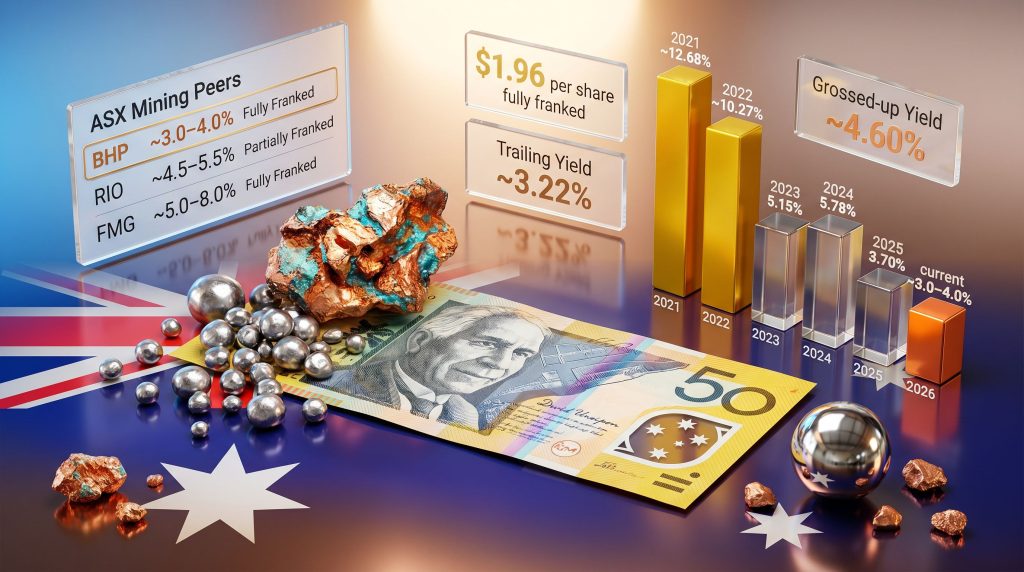
Consider the practical difference: a grossed-up yield for a taxpayer in the 30% bracket effectively transforms a face yield of approximately 3.22% into something closer to 4.60% on an after-tax equivalent basis. For SMSF members in pension phase, where the effective tax rate is zero, franking credits can be refunded entirely in cash, making the headline yield figure meaningfully understated compared to the actual income received.
This franking advantage is frequently overlooked when investors compare BHP's nominal yield against unfranked alternatives such as term deposits or certain real estate investment trusts. Our franking benefits guide explains how a fair comparison must account for the tax-adjusted return, not just the face percentage.
What Dividend Yield Actually Measures
Dividend yield is calculated by dividing the annual dividend per share by the current share price, expressed as a percentage. As a simple example: if BHP pays $1.96 per share across a trailing 12-month period and trades at $60.71, the trailing yield works out to approximately 3.22%.
The critical distinction for cyclical stocks like BHP is between trailing yield (what has already been paid) and forward yield (what the market anticipates will be paid). For a mining company whose distributions are directly tied to commodity revenues, these two figures can diverge significantly. An investor anchoring to a trailing yield calculated during a commodity boom may be disappointed by the forward reality when prices normalise.
BHP's Current Dividend Yield in 2026: The Numbers in Detail
As of mid-May 2026, BHP carries a trailing 12-month dividend of $1.96 per share, fully franked, comprised of two separate payments:
- The interim dividend paid in March 2026: $1.04 per share
- The final dividend paid in September 2025: $0.92 per share
Against a share price of $60.71 at the time of writing, this produces a trailing BHP dividend yield of approximately 3.22% (Motley Fool Australia, May 15, 2026).
It is worth noting that BHP shares reached a new all-time record high of $61.62 on May 13, 2026, after surging more than 4.7% over a single week, before retreating approximately 2.14% intraday. During this period, BHP reclaimed its position as the largest stock by market capitalisation on the S&P/ASX 200 Index, surpassing Commonwealth Bank of Australia (ASX: CBA) after CBA experienced a significant single-day decline.
Different data platforms report slightly varied yield figures depending on methodology, currency denomination, and share class reference:
| Data Source | Reported Yield | Basis |
|---|---|---|
| Motley Fool Australia | ~3.22% | $1.96 trailing / $60.71 share price |
| StockAnalysis | ~2.96% | Annual dividend of $2.63/share |
| GuruFocus | ~3.00% | As of May 9, 2026 |
| Simply Wall St | ~3.99–4.00% | Including franking gross-up |
These variations stem from several technical factors: some platforms calculate using USD-denominated dividends relevant to the NYSE ADR share class rather than the AUD-denominated ASX listing; others incorporate the franking credit gross-up into their yield figure; and trailing versus forward calculation methods can produce meaningfully different outputs for a company with a variable payout policy.
Investors should treat any single yield figure as an approximation and verify against BHP's official dividend disclosures before making decisions based on yield comparisons.
A Decade of Dividend Volatility: Understanding the Commodity Cycle Effect
The BHP dividend yield is not a stable or predictable number. It moves in direct response to the global commodity cycle, and ignoring this dynamic leads to some of the most common mistakes income investors make when evaluating mining stocks.
The scale of BHP's dividend swings over recent years is striking:
| Year | Approximate Dividend Per Share (AUD) | Approximate TTM Yield |
|---|---|---|
| 2021 | Record high (supercycle peak) | ~12.68% |
| 2022 | ~$4.63 | ~10.27–11.33% |
| 2023 | Declining cycle | ~5.15–5.35% |
| 2024 | Continued moderation | ~5.78–6.10% |
| 2025 | ~$1.71 | ~3.70% |
| 2026 (current trailing) | ~$1.96 | ~3.0–4.0% |
Sources: Motley Fool Australia (May 15, 2026); GuruFocus; StockAnalysis. Past dividends are not indicative of future payments.
The drop from $4.63 per share in 2022 to just $1.71 in 2025 represents a reduction of more than 60% in absolute dollar terms. However, the interim dividend paid in March 2026 of $1.04 per share was a meaningful improvement over the $0.79 per share paid in the equivalent period of 2025, a year-on-year increase of approximately 31.6%, suggesting that the trough may be passing.
Key insight for income investors: GuruFocus data indicates BHP's current yield sits below its 10-year median of approximately 5.52%. This signals one of three possible outcomes: dividends will grow as commodity conditions improve, the share price will retreat from record highs, or the income thesis simply requires recalibration to a structurally lower payout era. None of these scenarios is inherently bearish, but each demands a different strategic response.
The Two-Forces Compression Problem
Two distinct forces are simultaneously compressing BHP's yield percentage in 2026:
-
Dividend normalisation: Payouts have retreated from the extraordinary peak levels seen during the 2021-2022 commodity supercycle, when iron ore and energy prices reached historic highs in the aftermath of pandemic-era supply disruptions.
-
Share price appreciation: With BHP recently printing an all-time record high of $61.62, the mechanical relationship between price and yield works against income investors entering at current levels. The same $1.96 annual dividend divided by a price of $61.62 yields a lower percentage than it would at $50.00. Record prices and record yields simply cannot coexist.
What Actually Drives the Size of BHP's Dividend
BHP operates a variable dividend policy, targeting a minimum payout of 50% of underlying attributable profit, with the board retaining discretion to distribute more during periods of elevated commodity revenues. This is a floor, not a ceiling, and understanding the distinction matters enormously for income modelling.
The practical implication is that BHP's dividend is a direct function of its earnings, which are themselves a direct function of commodity prices. Two commodities sit at the centre of this equation:
Iron ore remains BHP's largest revenue contributor. The iron ore demand outlook is central to dividend forecasting, as sustained pricing above benchmark thresholds has historically supported stronger dividend cycles. When iron ore weakens materially, dividend cuts follow with relatively short lag times.
Copper is playing an increasingly significant role. The copper price drivers are closely tied to BHP's exposure, anchored by its interest in the Escondida mine in Chile, one of the world's largest copper operations. This positions the company as a structural beneficiary of global electrification trends and energy transition demand. Commentary as of May 2026 noted copper near recent record highs as a partial driver of BHP's strong share price performance.
The commodity sensitivity of BHP's payout can be modelled in broad scenario terms:
| Commodity Scenario | Likely Dividend Direction | Investor Implication |
|---|---|---|
| Iron ore sustains above US$100/tonne | Dividend growth probable | Yield expansion potential |
| Copper holds near record highs | Supplementary dividend possible | Upside surprise scenario |
| Iron ore falls below US$80/tonne | Dividend reduction risk elevated | Yield compression risk |
| Both commodities weaken simultaneously | Significant payout reduction likely | Capital preservation priority |
Commodity price thresholds are illustrative only and do not constitute financial advice or guaranteed outcomes.
BHP does not guarantee a fixed dividend. Its variable payout policy means that income investors must monitor commodity market conditions as a primary variable, not merely the company's historical payment record.
Furthermore, the BHP strategic pivot towards copper and potash introduces longer-term structural considerations for dividend capacity. BHP's capital expenditure pipeline also competes with distributions for available cash. The Jansen potash project in Canada represents a multibillion-dollar development commitment that will absorb meaningful free cash flow over coming years, separate from near-term commodity pricing.
BHP Dividend Yield vs. ASX Mining Peers
Evaluating BHP's dividend yield in isolation tells only part of the income story. Placing it alongside comparable ASX-listed miners provides useful context for relative value assessment:
| Company | Approximate Current Yield | Franking Status | Payout Policy |
|---|---|---|---|
| BHP Group (ASX: BHP) | ~3.0–4.0% | Fully franked | Min. 50% of underlying profit |
| Rio Tinto (ASX: RIO) | ~4.5–5.5%* | Partially franked | 40–60% of underlying earnings |
| Fortescue (ASX: FMG) | ~5.0–8.0%* | Fully franked | Variable, iron ore-linked |
Approximate figures based on publicly available trailing data as of mid-2026. Verify current yields before making investment decisions.
Rio Tinto's nominally higher yield requires adjustment for its partial franking status. Once franking credits are stripped out of the comparison, BHP's fully franked income stream narrows the effective gap considerably for Australian resident taxpayers.
Fortescue's higher headline yield reflects its concentrated exposure to iron ore, which amplifies both the upside during commodity booms and the downside when prices retreat. BHP's diversification across iron ore, copper, potash, and metallurgical coal provides greater earnings stability than a single-commodity producer, which may justify a lower nominal yield in exchange for more consistent income delivery across commodity cycles.
The next major ASX story will hit our subscribers first
Is BHP's Dividend Sustainable? Metrics That Actually Matter
Dividend sustainability in the mining sector is evaluated through a different lens than in defensive sectors like utilities or infrastructure. The following indicators are the most relevant for assessing whether BHP's current payout level can be maintained or grown:
- Payout ratio: The 60% payout ratio applied to the 2026 interim dividend suggests the board is not stretching to maintain distributions, leaving room for both reinvestment and shareholder returns simultaneously.
- Balance sheet quality: BHP has historically maintained investment-grade credit ratings, providing the financial flexibility to sustain dividends through commodity downturns without resorting to asset sales or equity raisings.
- Free cash flow conversion: The proportion of earnings that converts to actual distributable cash is the most direct measure of dividend reliability. Investors should monitor this figure in BHP's half-year and full-year results releases.
- Commodity price trajectory: Given the variable payout policy, no balance sheet metric is more important for forecasting distributions than the prevailing iron ore and copper price environment.
Warning Signs Worth Watching
- A sustained decline in iron ore pricing toward or below US$80 per tonne
- A reversal in copper's recent price strength from elevated levels
- A significant unplanned acquisition that stretches net debt beyond comfortable leverage ratios
- Deterioration in free cash flow margins due to rising operational costs or declining ore grades at key mines
What Income Investors Should Realistically Expect in 2026
Important disclaimer: No future dividend can be confirmed until formally announced by BHP's board. The scenario analysis below represents analytical modelling only and does not constitute financial advice. Past dividends are not a reliable indicator of future payments.
With the March 2026 interim dividend of $1.04 per share already confirmed and paid, the key variable for the full-year 2026 BHP dividend yield is the September final dividend. Three broad scenarios emerge:
- Base case (commodity prices hold steady): The full-year 2026 dividend approaches or matches the trailing $1.96 per share figure, sustaining a yield of approximately 3.2–4.0% depending on where the share price settles.
- Bull case (iron ore and copper both strengthen): A stronger commodity environment could push the full-year dividend toward the $2.50 range, implying a yield of approximately 4.0–5.0% at current share price levels, or higher if the price retreats from record highs.
- Bear case (commodity softening): A weaker second half for iron ore or copper could see the final dividend fall short of the $0.92 paid in September 2025, pulling the full-year total below the 2025 payout of $1.71 and compressing the yield below 3.0%.
The Entry Price Problem for Yield Seekers
Investors entering BHP at or near record share price levels face a structural yield disadvantage compared to those who accumulated shares during periods of price weakness. A share purchased at $45.00 collecting the same $1.96 annual dividend earns a yield on cost of approximately 4.36%, materially higher than the 3.22% available to a buyer at $60.71.
Dollar-cost averaging over time, rather than deploying capital in a single transaction near price highs, is a disciplined approach to managing entry-price yield risk across volatile commodity cycles. Consequently, investors can also review historical dividend yield data to better contextualise entry points relative to long-term averages.
Frequently Asked Questions: BHP Dividend Yield
What is BHP's current dividend yield?
BHP's trailing dividend yield currently sits at approximately 3.0% to 4.0%, depending on the data source and methodology. On a straightforward cash basis using ASX-listed shares, the trailing yield is approximately 3.22%, calculated from $1.96 per share in total dividends over the past 12 months against a share price of $60.71 (Motley Fool Australia, May 15, 2026).
Does BHP pay fully franked dividends?
Yes. BHP's ASX-listed dividends are paid fully franked, meaning eligible Australian shareholders receive attached franking credits that can offset income tax obligations or, in some cases, be refunded in cash. This makes the effective after-tax return materially higher than the face yield for most Australian resident investors.
How often does BHP pay dividends?
BHP pays dividends twice per year: an interim dividend typically paid in March following half-year results, and a final dividend typically paid in September following full-year results.
Why is BHP's yield lower than in 2021-2022?
Two factors explain the compression. Absolute dividend payments have moderated significantly from the peaks of the commodity supercycle, when BHP paid approximately $4.63 per share in 2022 alone. Simultaneously, BHP's share price reaching record highs near $61.62 in May 2026 mathematically reduces the yield percentage even when the dollar dividend remains respectable in isolation.
Is BHP a good dividend stock for retirees?
BHP offers several characteristics that appeal to retirees: fully franked dividends, a large and liquid market capitalisation, and a lengthy history of income payments. However, the cyclical nature of mining distributions means income is variable rather than stable year to year. This is a meaningful distinction from genuinely defensive income sources such as infrastructure or utility companies, and retirees dependent on predictable income flows should factor this volatility into their allocation decisions.
How does BHP's yield compare to Rio Tinto?
Rio Tinto's nominal yield of approximately 4.5–5.5% appears higher on the surface, but Rio Tinto's ASX-listed dividends carry only partial franking. Once the franking credit adjustment is applied for Australian resident taxpayers, the after-tax income gap between the two companies narrows considerably.
Key Takeaways for Income Investors Evaluating BHP
- The BHP dividend yield of approximately 3.0–4.0% is real, meaningful, and fully franked, but it reflects a normalised post-boom level rather than a continuation of the extraordinary distributions seen during the 2021-2022 commodity supercycle.
- The grossed-up yield for Australian resident taxpayers is materially higher than the face yield, making direct comparisons with unfranked income assets structurally misleading without adjustment.
- BHP's variable payout policy means commodity market conditions, particularly iron ore and copper pricing, are the single most important variables when forecasting future income, not historical averages.
- Investors entering near record share price levels should model conservative yield scenarios and resist anchoring to the peak distributions of prior commodity cycles.
- The March 2026 interim dividend of $1.04 per share, a 31.6% improvement over the equivalent 2025 payment, represents a tangible early signal that the distribution cycle may be recovering from its 2025 trough.
- Copper's growing importance within BHP's earnings mix provides a structural growth pathway that could support dividend recovery independently of iron ore's trajectory over the medium term.
This article contains general information only and does not constitute personal financial advice. Dividend yields and commodity prices referenced are based on publicly available data as of mid-May 2026 and are subject to change. Investors should consider their own circumstances and consult a licensed financial adviser before making investment decisions. Past dividends are not a reliable indicator of future payments.
Want to Catch the Next Major ASX Mineral Discovery Before the Market Does?
While BHP offers a compelling fully franked income stream, the real wealth-building opportunities often emerge earlier in the cycle — at the moment of discovery. Discovery Alert's proprietary Discovery IQ model instantly identifies significant ASX mineral discoveries in real time, translating complex data across 30-plus commodities into clear, actionable insights, much like the transformative early-stage opportunities seen with De Grey Mining and WA1 Resources. Explore historic discovery returns on Discovery Alert's dedicated discoveries page and begin your 14-day free trial today to position yourself ahead of the broader market.