May 15, 2026
When a Recovery Rally Meets an Insider Sale: The Psychology Investors Must Understand
Few market events are as psychologically disorienting for retail investors as watching a stock that has surged nearly 150% in twelve months suddenly reverse sharply on a single day. The instinct is to search for a catastrophic trigger, some hidden sign that the entire recovery thesis has been invalidated. But the reality of markets is almost always more nuanced than a single-day price move suggests, and the Mineral Resources share price fall after Chris Ellison's stake sale is a textbook example of that complexity.
Understanding what actually happened on May 15, 2026, and what it may or may not mean for the company's long-term trajectory, requires investors to separate three distinct forces that converged simultaneously: insider selling mechanics, sector-wide lithium price weakness, and unresolved governance questions. Each force is meaningful on its own. Together, they created the conditions for a sharp sell-off in a stock that had already accumulated significant unrealised gains across a broad investor base.
When big ASX news breaks, our subscribers know first
The Transaction Itself: What the Numbers Actually Reveal
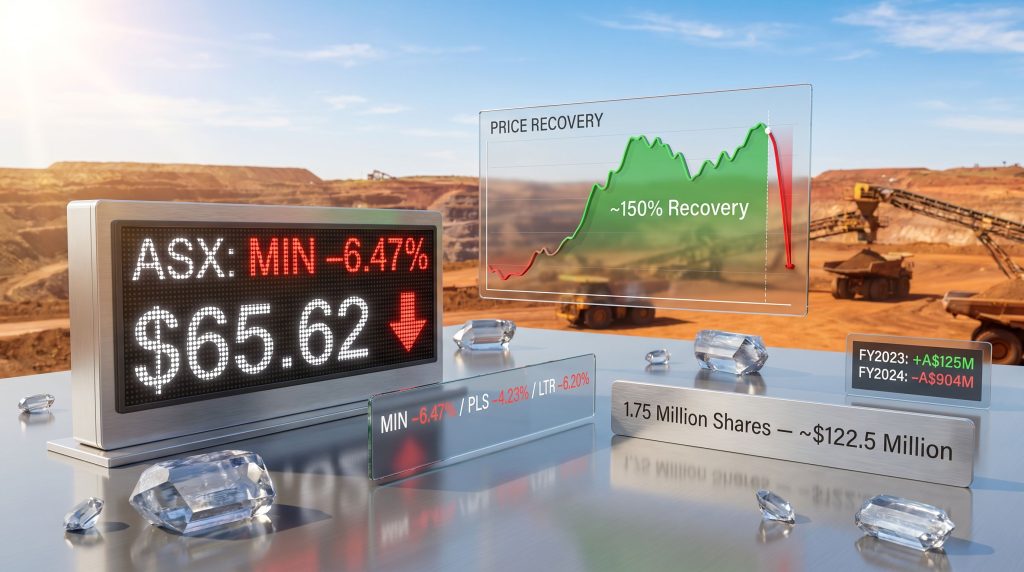
Between May 11 and May 14, 2026, Mineral Resources managing director Chris Ellison sold 1.75 million shares on-market across multiple trading sessions. The total proceeds reached approximately $122.5 million, executed at a weighted average price of $69.98 per share. The company disclosed the transaction via an ASX Appendix 3Y notification on May 15, which is the standard regulatory mechanism through which Australian listed companies notify the exchange of changes in director interests.
The weighted average sale price of $69.98 is particularly instructive. It sits above the stock's price at the time the sell-off was being reported (approximately $65.62), which means Ellison's execution across those four trading days captured prices materially higher than where the stock was trading once the market absorbed the news. Whether this reflects sophisticated execution strategy or simply the natural consequence of spreading a large block sale across multiple sessions without triggering an immediate price response is difficult to determine from public disclosure alone.
Key Transaction Details at a Glance
| Detail | Figure |
|---|---|
| Shares sold | 1.75 million |
| Gross proceeds | ~$122.5 million |
| Weighted average sale price | $69.98 per share |
| Sale period | May 11 to May 14, 2026 |
| Stated rationale | Personal financial planning, including family office establishment |
| Compliance status | Executed under company securities trading policy |
| Remaining shareholding | 20.8 million shares (~10.54% of issued capital) |
| Last prior on-market sale | December 2017 |
The eight-year gap since Ellison's previous on-market sale is arguably the most underappreciated data point in this entire episode. Founders and managing directors of major resource companies rarely go eight-plus years without a single on-market disposal, particularly through the kind of multi-year commodity cycle volatility that Mineral Resources has navigated since 2017. That extended period of holding suggests the current sale is not part of a pattern of progressive disengagement.
The Dual Interpretation Problem in ASX Director Selling
When a managing director of an ASX 200 company sells a block of shares worth over $120 million, markets are immediately confronted with what might be called the dual interpretation problem. The same transaction can simultaneously represent entirely rational personal wealth management and be read by other market participants as a directional signal about business confidence. These two interpretations are not mutually exclusive, and the market typically prices in some probability weighting of each.
The challenge for investors is that markets rarely take the time to distinguish between these two readings in real time. The reflexive response to a large insider sale is selling pressure, regardless of the stated rationale.
Family office formation is a well-established wealth structuring mechanism for high-net-worth individuals. These entities typically require substantial initial capitalisation to justify their operational costs, which include dedicated investment management, legal and tax advisory, estate planning functions, and sometimes philanthropic administration. A $122.5 million liquidity event is entirely proportionate as a catalyst for establishing such a structure, particularly for a founder-level executive managing a multi-billion dollar net worth position.
Furthermore, what investors must weigh carefully is whether the underlying investment thesis for Mineral Resources has changed. Ellison retaining 20.8 million shares representing 10.54% of issued capital means he remains the company's single largest shareholder. A person who has genuinely lost conviction in a company's future does not typically retain a ten-percent-plus stake after a partial sale. That continued exposure is a meaningful counterfactual to the bearish interpretation.
Mineral Resources Share Price Context: Setting the Scene
To properly assess the significance of a 6.47% single-day decline, it is essential to understand the price trajectory that preceded it. Mineral Resources shares had climbed approximately 20% in 2026 alone and had recovered roughly 150% over the preceding twelve months from what had been multi-year lows. The market capitalisation sat at approximately $7.3 billion at the time of reporting.
| Metric | Data Point |
|---|---|
| Intraday decline (May 15, 2026) | ~6.47% |
| Share price at time of reporting | ~$65.62 |
| Year-to-date gain (2026) | ~20%+ |
| 12-month recovery | ~150% |
| Market capitalisation | ~A$7.3 billion |
| Recovery from multi-year low | ~160% |
A stock that has returned 150% in twelve months carries an unusual characteristic: almost every investor who participated in the recovery is sitting on a profit. That creates a structurally fragile holder base. When a negative catalyst arrives, even a modest one, the path of least resistance for short-term holders is to lock in gains. The Ellison sale provided exactly that kind of catalyst, not because it is necessarily bearish on fundamentals, but because it gave investors a psychological permission slip to take profits after an extended rally.
This dynamic is common in recovered resource stocks. The same behavioural mechanism that drives momentum on the way up — fear of missing out, trend-following — operates in reverse when a credible reason to sell presents itself. The Mineral Resources share price fall is therefore as much a story about accumulated profit-taking pressure in a heavily recovered stock as it is about any specific change in business fundamentals.
Lithium Market Weakness: Compounding the Selling Pressure
The Ellison sale did not occur in a vacuum. On the same trading day, broader weakness across the lithium sector was adding independent pressure to Mineral Resources shares and amplifying the sell-off through correlated positioning. The ongoing lithium market downturn has made the entire sector particularly sensitive to negative catalysts.
| Company / Asset | Intraday Move |
|---|---|
| Mineral Resources (ASX: MIN) | -6.47% |
| Pilbara Minerals (ASX: PLS) | -4.23% |
| Liontown Resources (ASX: LTR) | -6.20% |
| Lithium carbonate (China, CNY/t) | -2.7% (~CNY 195,000/t) |
Lithium carbonate pricing in China, which serves as a widely referenced benchmark for the global battery materials market, fell approximately 2.7% to around CNY 195,000 per tonne on the day. This is significant because Mineral Resources derives a material portion of its business exposure from lithium operations, and pricing movements in the Chinese spot market have an outsized influence on sentiment toward ASX-listed lithium producers even when those companies' actual realisations are governed by contract structures and foreign exchange dynamics.
The correlation between lithium carbonate spot price moves and ASX lithium equity price moves is often stronger in the short term than fundamentals would strictly justify. This is partly because retail and institutional investors use lithium carbonate price as a real-time proxy for sector health, and partly because algorithmic trading systems are programmed to respond to commodity price signals. The result is that a 2.7% spot price decline can translate into a 4% to 7% equity move on any given day, particularly in stocks that have experienced strong recent appreciation.
Separating company-specific risk from sector-wide commodity risk is a discipline that long-term investors in resources must apply rigorously. For instance, Liontown share performance demonstrates how lithium-exposed stocks can move sharply on broader sector sentiment rather than company-specific news alone. On May 15, both forces were working simultaneously against Mineral Resources, and that combination, rather than any single factor, explains the magnitude of the decline.
Governance Uncertainty: The Underappreciated Overhang
Beyond the share sale and commodity price dynamics, Mineral Resources carries ongoing governance-related uncertainty that institutional investors in particular are monitoring closely. The Mineral Resources governance issues have become an additional layer of complexity for investors trying to assess the company's long-term trajectory. Leadership transition timelines and succession clarity are priced into resource sector valuations more than many retail investors appreciate.
Analyst opinion on Mineral Resources reflects this uncertainty in stark terms. The divergence between institutional ratings is unusually wide for a company of this size and recovery trajectory.
| Institution | Rating | Price Target |
|---|---|---|
| Citigroup | Sell | A$35 |
| RBC Capital Markets | Outperform | A$64 |
The Citigroup sell rating with a $35 target represents a significant implied downside from current levels and suggests a materially different set of assumptions about lithium price recovery, debt management, and business fundamentals. RBC's outperform rating at $64 is roughly in line with current trading levels, implying limited near-term upside but a positive directional view. This kind of analyst divergence typically reflects genuine disagreement about the fundamental outlook rather than minor methodological differences, and it is a signal that investors should examine assumptions rather than rely on consensus.
The next major ASX story will hit our subscribers first
The Financial Backdrop: From Profit to Loss and Back
No assessment of the Mineral Resources situation is complete without examining what happened to the company's financials during the period that produced this recovery. The contrast between FY2023 and FY2024 is dramatic and reflects the brutal impact of the lithium price collapse on integrated miners with significant spodumene exposure.
| Period | Net Result |
|---|---|
| FY2023 | +A$125 million (profit) |
| FY2024 | -A$904 million (loss) |
The swing from a $125 million profit to a $904 million loss was driven by a combination of lithium price collapse, asset writedowns, and cost pressures. This financial context matters because it explains both the depth of the multi-year low and the magnitude of the subsequent recovery. Investors who bought during the trough were pricing in a scenario where lithium markets would eventually recover and where Mineral Resources' iron ore operations would provide a stabilising earnings base while that recovery plays out.
The Onslow Iron expansion is a particularly important variable in the bull case for Mineral Resources. Iron ore provides a more predictable cash flow profile than lithium, and any progress in Onslow's production ramp-up has the potential to improve the company's debt servicing capacity and reduce financial risk at the group level. Investors tracking the Mineral Resources thesis should consequently watch Onslow's operational milestones as closely as lithium price movements.
How to Think About a 6% Drop After a 150% Rally
For investors holding Mineral Resources shares, the key question is whether the May 15 sell-off represents an opportunity, a warning, or simply market noise within a broader recovery trend. The answer depends almost entirely on the answers to a set of more fundamental questions that the single-day price move cannot resolve on its own.
Investors should be working through the following framework before making any reactive decisions:
- Has the core investment thesis changed, specifically the view that lithium markets will recover and Onslow will deliver improving iron ore cash flows?
- Does the Ellison sale reflect a change in his conviction about the company's future, or is it a personal financial management event disconnected from his view of business fundamentals?
- Is the current lithium carbonate price weakness a cyclical soft patch or evidence of a more structural demand/supply imbalance that would extend the recovery timeline?
- Has the governance uncertainty around leadership succession been adequately reflected in the current share price, or does it represent an unpriced risk?
- What is the realistic timeframe for the catalysts that the bull case depends on, and does the current valuation appropriately discount that timeline?
None of these questions has a definitive answer today, which is precisely why the analyst community is so divided on MIN's valuation. The wide gap between the Citigroup target of $35 and the RBC target of $64 is an honest reflection of the genuine uncertainty around these inputs.
What Investors Should Watch From Here
For shareholders and prospective investors monitoring the Mineral Resources situation, there are several specific data points and announcements that should anchor any forward-looking assessment.
- CEO succession announcement: Clarity on leadership continuity is likely to remove a governance discount from the share price if handled well, and amplify selling pressure if managed poorly.
- Lithium carbonate price direction: The CNY benchmark price should be tracked weekly. A sustained move above CNY 200,000 per tonne would improve the economics of Mineral Resources' lithium operations materially.
- Onslow Iron project milestones: Production ramp-up progress and any quarterly output guidance revisions will be critical indicators of the non-lithium earnings base.
- Institutional ownership changes: Post-sale shifts in substantial shareholder positions, disclosed through ASX Section 671B notifications, will signal whether large funds are adding or reducing exposure at current levels.
- Quarterly cash flow statements: Debt management and operating cash flow trajectory remain the most important near-term financial metrics given the FY2024 loss magnitude.
This article contains general analysis only and does not constitute personal financial advice. Mineral Resources shares involve significant risk, including commodity price volatility, governance uncertainty, and debt-related considerations. Past performance is not indicative of future results. Investors should consider their personal circumstances and consult a licensed financial adviser before making investment decisions. Analyst price targets referenced represent institutional views as at the time of writing and are subject to change.
Want to Stay Ahead of Significant ASX Mineral Discoveries Before the Broader Market?
Discovery Alert's proprietary Discovery IQ model delivers real-time alerts on major ASX mineral discoveries, cutting through complex data to surface actionable opportunities for both short-term traders and long-term investors — explore the historic returns major discoveries have generated and begin your 14-day free trial today to secure a genuine market-leading edge.