June 6, 2026
The Hidden Skill Set Separating Profitable Mining Investors From the Rest
Learning how to read ASX mining announcements is one of the most overlooked advantages in junior resource investing. Most people who lose money in mining stocks do not fail because they chose the wrong commodity or jurisdiction. Instead, they fail because they misread the document sitting right in front of them.
The gap between what an announcement says and what it actually means is where capital is won and lost. Therefore, understanding how to close that gap systematically, the way a trained geologist does, turns research from guesswork into a repeatable and evidence-based discipline.
Why ASX Mining Announcements Are Structurally Biased Toward Good News
Junior mining companies occupy a peculiar corner of capital markets. Unlike mature businesses with recurring cash flow, explorers are usually pre-revenue entities whose value depends heavily on investor belief in future discovery potential.
As a result, management teams have a strong incentive to present each update in the most favourable light possible. Furthermore, this bias is not always misconduct. In many cases, it reflects rational behaviour in a market where many small-cap explorers are competing for the same investment dollars.
Most ASX mining announcements contain overwhelmingly positive framing. However, failed holes, weak assumptions, and what did not work are rarely emphasised voluntarily. Consequently, investors need to read every filing with healthy scepticism.
The ability to read ASX mining announcements critically is not primarily about access to information. It is about knowing which information actually matters, what has been omitted, and why.
Trained geologists spend years separating signal from noise. For that reason, the difference between a genuine discovery and a polished press release often comes down to context the announcement barely explains.
What ASX Mining Announcements Actually Are: Types, Compliance, and Disclosure Requirements
The Regulatory Architecture Governing Every Filing
Every ASX-listed mining company operates within a continuous disclosure framework. This framework includes the ASX Listing Rules, the JORC Code (2012 Edition), the Corporations Act 2001 (Cth), and ASIC guidance on disclosure and market conduct.
For investors, this means there is a baseline level of rigour. In addition, tools like the ASX’s own market announcements platform help track official releases efficiently.
However, compliance does not remove interpretive ambiguity. Geology remains uncertain, and companies still have latitude in how they frame the same facts.
A Map of the Key Announcement Categories
Knowing the document type tells you how seriously to treat it. For instance:
- Exploration results: drill intercepts, assays, geological commentary
- Resource or reserve updates: tonnage, grade, classification
- Quarterly reports: cash, burn rate, progress
- Feasibility studies: economics, capex, production assumptions
- Corporate actions: raises, board changes, M&A
- Routine regulatory filings: licences and compliance updates
Among these, resource updates and feasibility work often matter most for valuation. In particular, investors should understand how definitive feasibility studies reduce project risk and reshape market expectations.
Why the Price-Sensitive Tag Changes Everything
The price-sensitive label signals that the ASX expects the information to move the share price materially. Therefore, these filings deserve more than a quick scan.
Timing also matters. A pre-market release gives the market a full session to absorb the news. By contrast, a late-session filing can create sharp volatility that says more about order flow than project quality.
The Three-Tier Reading System for Processing ASX Announcements Efficiently
Because daily release volumes are high, investors need a practical filter. That is why a tiered reading system works so well.
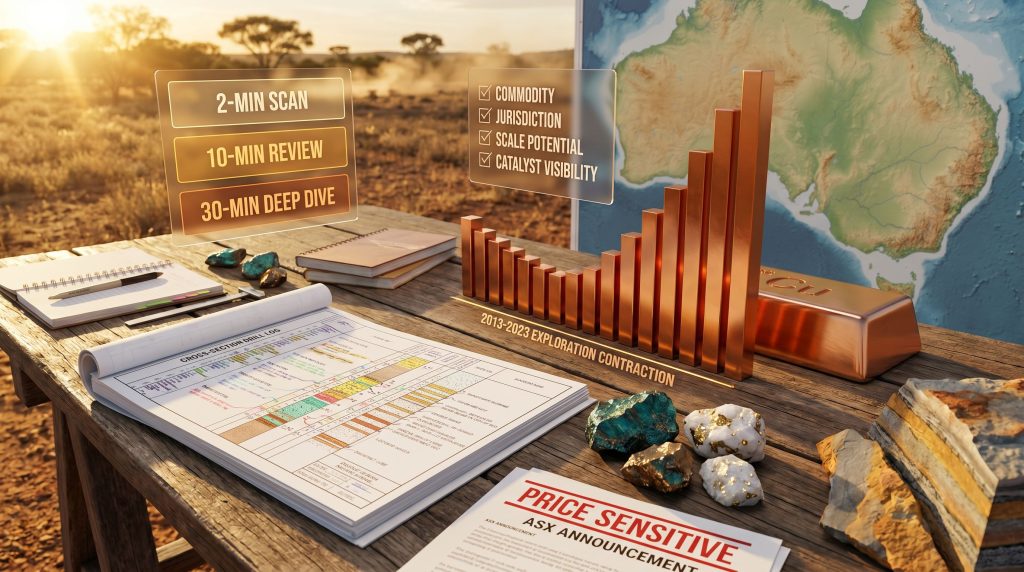
Tier 1: The Two-Minute Rapid Scan
Start with every announcement:
- Identify the company and type of filing
- Check whether it is price-sensitive
- Read the bolded highlights
- Scan for trigger words such as guidance revision, debt restructure, or management departure
- Decide whether to move on or escalate
Tier 2: The Ten-Minute Material Review
Use this for important filings:
- Read management commentary carefully
- Pull out key numbers such as cash, burn rate, production, or guidance
- Compare with the prior period
- Watch for softer language in outlook statements
- Decide whether the thesis has changed
Tier 3: The Thirty-Minute Deep Dive
Use this only for core holdings or major catalysts:
- Review appendices and technical notes
- Check footnotes and related-party transactions
- Compare the release against previous announcements
- Assess whether it strengthens or weakens the investment case
After enough repetition, pattern recognition improves quickly. In fact, becoming proficient in how to read ASX mining announcements often depends more on disciplined repetition than raw intelligence.
Applying a Geological Lens to Exploration Announcements
The Three Pre-Screening Criteria That Come Before the Geology
Before analysing any intercept, start with three filters:
- Commodity: is there real supply tightness or structural demand growth?
- Jurisdiction: is it in a credible mining region?
- Scale potential: can this become a district-scale story?
Projects with multi-deposit potential generally attract stronger institutional interest. Conversely, small isolated deposits can spark temporary excitement without supporting a durable re-rating.
Reading Drill Results: What a Geologist Sees Beyond the Headline Grade
Retail investors often stop at the headline intercept. However, a geologist will usually look at several variables together:
- Grade
- Depth
- Strike length
- Host rock
- Structural controls
- Geophysical signatures
- Multi-element geochemistry
For example, strong assays matter far more when they sit within the right geological setting. Accordingly, investors should improve their skill in interpreting drill results rather than reacting to grade alone.
Likewise, proper drilling result interpretation means asking whether the intercept is shallow, continuous, and scalable, not merely impressive in isolation.
A single positive geological indicator, such as alteration or anomalous geochemistry in isolation, carries very limited predictive value for a genuine mineral discovery.
This convergence principle is crucial. When host rock, structure, and geochemistry align, discovery probability rises substantially. However, when only one variable looks good, caution is warranted.
The JORC Code: What Resource Classification Actually Means
The JORC Code establishes three key confidence levels:
- Inferred Resource
- Indicated Resource
- Measured Resource
These categories matter because they reflect geological confidence. Furthermore, investors should always ask what assumptions support the estimate, especially the cut-off grade significance used to define the resource boundary.
Three useful questions are:
- Is this a formal JORC resource or just an exploration target?
- What proportion is Inferred versus Indicated or Measured?
- What cut-off grade and economic assumptions were applied?
Evaluating the People, Capital Structure, and Catalysts
Management Quality: The Most Underrated Variable in Junior Mining
In junior mining, people often matter as much as geology. A strong team can raise capital, adjust strategy, and move a discovery through development. A weak team can destroy value even with promising rocks.
Track record matters most. Has management previously discovered, financed, developed, or sold a project? In addition, investors should be alert to subtle management red flags that may not appear obvious in headline announcements.
The talent shortage created during the 2013 to 2019 downturn still matters today. Many experienced geologists left the sector permanently, and that loss of knowledge continues to affect project execution.
Decoding the Capital Structure
A junior miner’s capital structure often reveals more than the announcement itself. Focus on:
- Cash runway greater than 12 months
- Cash runway under two quarters
- High share count and prior dilution
- Strategic investors on the register
When funding is tight, announcements may become more promotional. Therefore, cash position and dilution risk should always sit alongside the geological story.
Identifying Catalysts: Why Mining Stocks Move When They Do
Mining stocks are catalyst-driven. The main triggers include:
- Drill results
- Resource upgrades
- Feasibility completions
- Commodity price breakouts
- M&A or farm-in activity
If no clear catalyst is visible, the opportunity cost of holding can be significant. That is especially true in a market with hundreds of listed miners competing for attention.
The Macro Supply Context: Why Geological Scarcity Is the Dominant Investment Theme
The Compounding Consequences of a Decade-Long Exploration Drought
The period from 2013 to 2019 saw a severe contraction in exploration investment. Capital dried up, geologists exited the industry, and university geology programmes shrank. Yet commodity demand did not vanish.
This matters because the average time from discovery to production is around 10 to 15 years. Consequently, discoveries not made during that period are now missing from the supply pipeline.
Copper as the Leading Indicator
Copper’s move beyond its 2011 highs is technically meaningful. It suggests structural change, not merely a cyclical bounce. Demand is being supported by electrification, grid expansion, and urbanisation.
Against that backdrop, mastering how to read ASX mining announcements allows investors to recognise early-stage supply stories before the broader market fully prices them in.
A Repeatable Seven-Point Decision Framework for Any ASX Mining Announcement
When assessing a company, apply these filters:
- Commodity — is demand growing and supply tight?
- Jurisdiction — is the location investable?
- Scale potential — can the project expand materially?
- Geological quality — do multiple indicators converge?
- Management track record — has this team delivered before?
- Capital structure — is the company funded?
- Catalyst visibility — what could re-rate the stock next?
If a company fails two or more, move on. In addition, investors can sharpen their framework by reviewing ASX announcement guidance for beginners, especially when building an efficient screening process.
Frequently Asked Questions About Reading ASX Mining Announcements
What does a price-sensitive designation on an ASX announcement mean?
It means the ASX considers the information likely to have a material effect on price. Therefore, it deserves immediate and careful review.
What is the JORC Code and why does it matter?
It is Australia’s mandatory standard for public reporting of mineral resources and ore reserves. As a result, it creates a common framework for comparing projects and judging confidence levels.
How can I tell whether a drill result is genuinely significant?
Look at grade, width, depth, continuity, and setting together. A flashy number alone is rarely enough.
What is the most common red flag in exploration announcements?
A single positive indicator presented without supporting context. For example, one anomalous hole or one geochemical result is not the same as a coherent mineralised system.
Which quarterly report metrics matter most for junior miners?
Focus on:
- Cash at quarter end
- Quarterly burn rate
- Work completed versus plan
- Timeline changes
Ultimately, how to read ASX mining announcements is about judging what matters, what has been omitted, and whether the investment case is genuinely improving.
This article contains general educational information about how to approach and interpret ASX mining announcements. It does not constitute financial advice, investment recommendations, or a solicitation to buy or sell any security. Mineral exploration involves substantial risk, and past geological results are not indicative of future discovery outcomes. Readers should seek independent financial and geological advice before making any investment decisions.
Want to Spot the Next Major ASX Mineral Discovery Before the Market Does?
Discovery Alert's proprietary Discovery IQ model scans ASX announcements in real time, instantly translating complex mineral data into actionable insights for both short-term traders and long-term investors — visit the Discovery Alert discoveries page to see how historic finds like De Grey Mining and WA1 Resources delivered exceptional returns, then begin your 14-day free trial to position yourself ahead of the market.