July 28, 2026
The Global Race for Stable Crude: Why Western Hemisphere Oil Is Attracting Unprecedented Attention
Every significant disruption to Middle Eastern energy flows throughout modern history has triggered the same investor response: a renewed push to identify oil-producing regions insulated from geopolitical volatility. The Persian Gulf has supplied energy markets with recurring anxiety for decades, and each cycle of tension accelerates capital migration toward alternatives. Today, that pattern is playing out with unusual urgency, and one formation in South America's Patagonian steppe is emerging as the most credible large-scale beneficiary.
The Argentina Vaca Muerta shale bid round, launched through Neuquén's provincial energy authority Gas y Petróleo del Neuquén (GyP), represents the most expansive licensing exercise the formation has seen in a decade. Understanding what makes this moment different from previous licensing cycles requires examining the intersection of supply chain vulnerability, unconventional geology, and evolving commercial infrastructure that has transformed Vaca Muerta from a regional opportunity into a globally significant energy story.
When big ASX news breaks, our subscribers know first
What Is Vaca Muerta and Why Has Its Commercial Moment Finally Arrived?
Formation Profile and Strategic Classification
Vaca Muerta occupies the Neuquén Basin in Argentina's Patagonia region, and its geological characteristics have been recognised for years as exceptional. According to Rystad Energy, the formation holds the distinction of being the largest commercial shale play open to international oil and gas companies outside North America, a classification that carries enormous weight for energy companies seeking to diversify their unconventional resource portfolios beyond U.S. shale basins.
The formation contains organic-rich shale of Jurassic age, a geological age known globally for producing prolific hydrocarbon source rocks. Its lateral extent is vast, and reservoir quality across the productive fairway is considered consistent by industry standards. This consistency is a critical commercial factor because it allows operators to apply predictive well performance models with greater confidence than exploration-stage plays typically permit.
What has historically limited Vaca Muerta's development pace was not resource quality but infrastructure. Pipeline takeaway capacity, export terminal access, and the availability of oilfield services were all constraints that suppressed development economics. That infrastructure picture has been changing materially, and the timing of the current licensing round reflects a deliberate effort to align acreage access with improved logistics economics.
Production Trajectory: From Aspiration to Credible Forecast
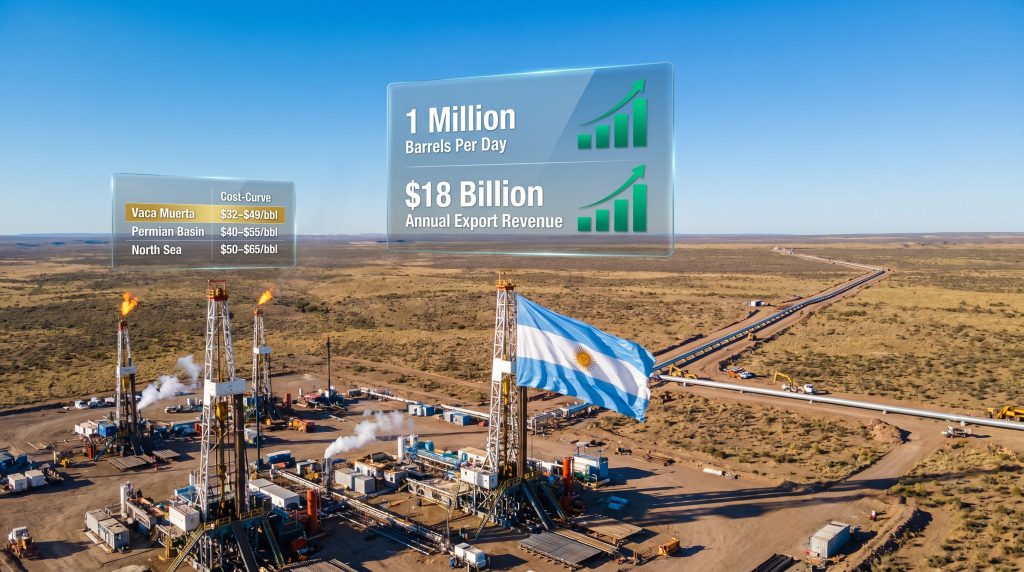
Rystad Energy's projection that the formation could produce more than 1 million barrels per day of crude by the end of the decade shifts Vaca Muerta from a regional growth story into a globally relevant supply variable. For context, production at that scale would position Argentina among the significant non-OPEC oil producers globally, altering the country's energy trade position fundamentally.
The distance between current production levels and the million-barrel-per-day threshold is substantial, but the trajectory is supported by a combination of demonstrated well productivity, improving service sector capability, and the licensing activity now underway. Reaching that threshold requires sustained capital deployment across multiple operators over several years, which is precisely why the current bid round's scale matters. For a broader crude oil market overview, the formation's trajectory is increasingly difficult to ignore.
Breaking Down the 2026 Argentina Vaca Muerta Shale Bid Round
The GyP Licensing Structure: Scale and Mechanics
The current Argentina Vaca Muerta shale bid round is operated by Gas y Petróleo del Neuquén, the provincial energy authority for Neuquén province. The round offers 15 exploration blocks, a figure that immediately distinguishes it from prior exercises: it is more than double the six blocks offered in the most recent previous provincial auction, according to Rystad Energy's reporting cited by Reuters.
The blocks are distributed across the geographic breadth of the Neuquén Basin:
- Northwest acreage: Condensate-rich zones where liquids-weighted gas production dominates the commercial case
- Northeast acreage: Oil-focused reservoir areas oriented toward crude production growth
- Southern frontier zones: Earlier-stage exploration acreage with longer-dated development timelines and higher geological upside potential
This geographic diversity gives the round strategic flexibility. Operators with different risk preferences and commodity exposure strategies can find blocks that align with their portfolio objectives, broadening the potential bidder universe beyond pure crude-focused producers.
Competitive Bidding Parameters
The bid structure is deliberately multi-dimensional, which has important implications for who wins and what the competitive dynamics look like. According to Reuters, bidders compete across four variables:
- Carried working interest awarded to GyP, the provincial energy authority
- Royalty rates above the statutory 15% minimum threshold
- Defined work program commitments, specifying drilling and development obligations
- Access bonuses with a stated floor of $500,000 per block
This multi-variable structure favours operators who can offer robust work programmes backed by strong balance sheets. Unlike single-variable royalty auctions where the highest bidder simply pays more per barrel, this structure rewards operators who demonstrate genuine development intent. For the province, it optimises for resource development rather than pure fiscal rent extraction, which aligns with the broader goal of accelerating production growth.
Why Most Previous Vaca Muerta Deals Bypassed Licensing Rounds Entirely
One of the less widely understood dynamics of Vaca Muerta's commercial history is that the majority of acreage access by international firms has occurred through corporate acquisitions and farm-in agreements rather than through government-issued licences. Rystad Energy's analysis confirms this pattern, noting that the current round represents one of the best opportunities in years for international firms to secure fresh acreage directly through the licensing process.
This matters for several reasons. Entering via acquisition or farm-in typically requires paying a corporate control premium or negotiating with an existing operator who has already captured much of the upfront value. Direct licensing gives new entrants the ability to secure acreage at economics set by competition rather than by bilateral negotiation with incumbent operators.
"Industry Insight: The shift from farm-in dominated entry to direct licensing rounds signals a maturation of Argentina's upstream regulatory confidence. When infrastructure matures and political risk perceptions improve, governments can capture more competitive tension through licensing rather than watching value transfer in private corporate transactions."
The Economics That Make Vaca Muerta Globally Competitive
Breakeven Analysis: The $32 to $49 Per Barrel Threshold
Rystad Energy estimates that breakeven prices across the most commercially attractive Vaca Muerta blocks range from $32 to $49 per barrel. This range positions the formation as genuinely competitive with established global unconventional plays, not merely aspirationally comparable. Furthermore, as the oil geopolitics analysis for 2025 demonstrates, cost-competitive non-OPEC sources are increasingly attractive to global buyers.
To appreciate the significance of this range, it is worth benchmarking against other major production regions:
| Production Region | Estimated Breakeven Range (USD/bbl) | Development Stage |
|---|---|---|
| Vaca Muerta (top blocks) | $32 to $49 | Active development |
| U.S. Permian Basin | ~$40 to $55 | Mature |
| Eagle Ford Shale (U.S.) | ~$38 to $52 | Active |
| North Sea | ~$50 to $65 | Mature / declining |
Note: Permian Basin, Eagle Ford, and North Sea breakeven ranges are general industry estimates widely cited in energy research. They are provided for contextual comparison and may vary by operator, vintage, and prevailing service costs. Readers should verify against current published data from energy consultancies.
The lower end of Vaca Muerta's breakeven range at $32 per barrel is particularly significant. At that level, development economics remain viable across a wide range of oil price environments, reducing the return sensitivity that makes some frontier plays commercially fragile when prices soften.
Infrastructure as the Commercial Multiplier
Breakeven economics do not exist in isolation from logistics. According to Reuters, growing interest in the formation has been directly linked to expansion of pipeline and export infrastructure in the region. This is a frequently underappreciated factor in unconventional development economics: the per-barrel cost of getting oil from wellhead to market can materially erode or enhance headline breakeven figures.
The practical implication is that blocks with superior pipeline access can commercialise at lower effective oil prices than geologically comparable blocks in areas with constrained takeaway capacity. For bidders evaluating the current GyP round, proximity to existing or planned infrastructure corridors is a first-order factor in block valuation, not a secondary consideration. Global crude shipments data further underscores how logistics capability is increasingly shaping which formations attract capital.
International Capital Flowing Into Vaca Muerta: Who Is Committing and Why
Continental Resources: The U.S. Shale Template Applied to Argentina
Among international operators, Continental Resources has made the most visible recent commitment to Vaca Muerta. The U.S. producer acquired a 90% operating stake in the Los Toldos II Oeste block and subsequently farmed into assets held by Pan American Energy, according to Reuters. This sequential approach — first securing an operating position and then expanding through a farm-in — reflects a deliberate strategy to build operational scale and learning curve advantages in the formation.
Continental's significance extends beyond its own acreage position. As one of the firms most associated with the industrialisation of U.S. shale development, its presence in Vaca Muerta carries a validation signal for other international operators evaluating the basin. When experienced unconventional operators with proven operational capability commit capital to a new formation, it reduces perceived execution risk for subsequent entrants. Rystad Energy's analysis highlights precisely how this dynamic has accelerated the formation's commercial momentum.
The Competitive Landscape: Domestic and International Operators
The Vaca Muerta investment landscape encompasses a range of operator types with different commercial strategies:
- International majors and independents seeking to diversify unconventional portfolios beyond North American basins
- Regional operators with existing Argentine operations who are expanding their footprint within the formation
- State-linked entities including Argentina's YPF, which participates both as an independent operator and as a joint venture partner with international firms
This diversity of operator types creates a competitive dynamic in the bidding process that tends to produce well-structured work programmes. Companies with operational experience in the basin can bid aggressively on development commitments, while new entrants may compete on financial terms to offset their learning curve disadvantage.
The Geopolitical Driver: Middle East Risk and the Logic of Supply Diversification
Strait of Hormuz Vulnerability and Its Capital Allocation Consequences
The current heightened focus on Vaca Muerta is explicitly connected to elevated concern about crude supply disruption through the Strait of Hormuz, the narrow waterway through which a substantial portion of global seaborne oil transits. Reuters reports directly that the GyP licensing round has attracted intensified attention from energy companies and importing nations seeking more reliable crude supply amid Middle East tensions. Indeed, the trade war impact on oil markets has compounded this diversification urgency considerably.
The commercial logic operates through several mechanisms simultaneously:
- Supply chain diversification: Energy importers seek to reduce dependence on any single shipping chokepoint by developing relationships with geographically diverse suppliers
- Price risk management: Non-OPEC production growth from politically stable regions structurally moderates the risk premium embedded in oil prices during Middle East instability
- Long-duration capital deployment: International operators with multi-decade investment horizons prefer to allocate exploration capital to jurisdictions where supply disruption risk is geopolitically uncorrelated with Middle Eastern tensions
Why Argentina's Current Policy Trajectory Matters for Investor Confidence
Energy investment decisions in Argentina have historically been complicated by policy volatility, including episodes of price controls, export restrictions, and nationalisations that damaged investor confidence. The current environment, characterised by efforts to attract foreign upstream capital and provide competitive fiscal frameworks for large-scale investment, represents a meaningful shift in that historical pattern. Consequently, Argentina has expanded its incentive frameworks specifically to accelerate Vaca Muerta shale oil investment.
It is important to note that this represents a general policy direction rather than any specific commitment to individual project operators. Investors must weigh the positive trajectory against Argentina's historical policy cycle risks, which remain a legitimate consideration for any long-duration capital commitment. The formation's geological quality is not in question; the variable that requires ongoing monitoring is whether the current policy environment proves durable across political cycles.
The next major ASX story will hit our subscribers first
Market Implications: What 1 Million Barrels Per Day Means for Global Supply
Non-OPEC Supply Growth and Price Structure
Rystad Energy's projection of Vaca Muerta reaching more than 1 million barrels per day by the end of the decade is significant in a global supply context. At that production scale, Argentina would be contributing a meaningful increment of non-OPEC production to global markets, a development with structural price implications. However, understanding OPEC's market influence remains equally essential when assessing how this new supply interacts with existing production strategies.
The breakeven economics of the most competitive blocks at $32 per barrel effectively define a price level below which development activity would slow materially. This creates a de facto production cost floor that informs the medium-term price outlook for producers globally. Supply additions that are commercially viable at $32 to $49 per barrel place ceiling pressure on prices above that range by incentivising accelerated investment when margins widen.
Competitive Context: Vaca Muerta Among Global Non-OPEC Growth Stories
Vaca Muerta's development trajectory places it in direct comparison with other large-scale non-OPEC production growth stories currently competing for international capital:
- Guyana's offshore Stabroek block has attracted substantial international investment as a low-cost deepwater play
- Brazil's pre-salt basins continue to deliver production growth through Petrobras-operated offshore developments
- U.S. Permian Basin remains the dominant unconventional production hub globally, though with maturing acreage economics in core areas
Vaca Muerta's competitive positioning against these alternatives rests on its combination of accessible breakeven costs, large prospective acreage open to international licensing, and improving infrastructure economics. It does not displace these competing investment destinations, but it competes meaningfully for the allocation of international upstream capital seeking non-OPEC diversification.
Disclaimer: All production forecasts, breakeven estimates, and market projections cited in this article are drawn from third-party analysis by Rystad Energy as reported by Reuters and Kitco News. These forward-looking statements involve assumptions and uncertainties. They should not be treated as guarantees of future production, revenue, or price outcomes. Readers making investment decisions should conduct independent due diligence and consult qualified financial and energy advisors.
Frequently Asked Questions: Argentina Vaca Muerta Shale Bid Round
What is the Argentina Vaca Muerta shale bid round currently underway?
The current round is a licensing exercise run by Gas y Petróleo del Neuquén (GyP), the provincial energy authority for Neuquén province. It offers 15 exploration blocks across the Neuquén Basin to domestic and international operators, representing more than double the scale of the previous provincial auction.
What are the breakeven costs for Vaca Muerta's most competitive blocks?
Rystad Energy estimates that breakeven prices for the most commercially prospective blocks range from $32 to $49 per barrel, positioning the formation as competitive with established shale plays in North America.
Why is Vaca Muerta attracting increased international attention in 2026?
Heightened concern about potential disruption to crude flows through the Strait of Hormuz has intensified the interest of energy companies and importing nations in securing supply from geographically stable, Western Hemisphere sources. Vaca Muerta's scale, improving infrastructure, and competitive breakeven economics align with that diversification objective.
What makes the current bid round different from previous Vaca Muerta auctions?
The round is the largest in a decade, offering 15 blocks compared to six in the prior provincial auction. It also comes at a point where most recent acreage access has been through acquisitions and farm-ins rather than government-issued licences, making it one of the strongest opportunities in years for international firms to enter directly through the licensing process.
How does the bidding process work?
Bidders compete across four variables: carried working interest for GyP, royalty rates above the 15% statutory minimum, work programme commitments, and access bonuses starting at $500,000 per block. This multi-variable structure rewards operators with genuine development intent and strong balance sheets.
What is Vaca Muerta's production potential?
Rystad Energy projects that the formation could produce more than 1 million barrels of crude per day by the end of the decade, which would rank it among the most significant non-OPEC producing assets globally.
Want To Stay Ahead Of The Next Major Resource Discovery?
While Vaca Muerta's shale bid round illustrates how transformative large-scale resource discoveries can be, Discovery Alert's proprietary Discovery IQ model delivers real-time alerts on significant ASX mineral discoveries — instantly converting complex geological data into actionable investment insights for both short-term traders and long-term investors. Explore Discovery Alert's dedicated discoveries page to understand how historic ASX discoveries have generated substantial returns, and begin your 14-day free trial today to position yourself ahead of the broader market.