
June 15, 2026
Understanding the Architecture Behind Argentina's Mining Investment Surge
Sovereign investment frameworks rarely emerge in isolation. They are typically forged in response to macroeconomic necessity, commodity cycle timing, and the intensifying global competition for capital that can transform resource endowments into productive infrastructure. Argentina's Régimen de Incentivo para Grandes Inversiones, universally known by its acronym RIGI, represents precisely this kind of calculated sovereign repositioning. Enacted in 2024 and carrying an enrollment window that closes in July 2026, the regime has quickly become one of the most consequential policy instruments operating across Latin American mining today.
The framework targets capital at scale. Rather than incrementally adjusting tax settings or offering project-by-project concessions, RIGI establishes a structural architecture designed to attract transformational investment across mining, energy, and hydrocarbon sectors simultaneously. Understanding what it offers, how its approval pipeline is performing, and where its risks lie is essential context for anyone tracking large-scale mining capital flows into South America.
When big ASX news breaks, our subscribers know first
What Is RIGI and How Does It Differ From Argentina's Previous Mining Frameworks?
Argentina's relationship with foreign mining capital has a complicated history. Law No. 24,196, introduced in 1993, was designed to open the sector to international investment by providing royalty caps, import duty exemptions, and fiscal stability guarantees. For several decades it served as the primary legal foundation for foreign-backed mining development. However, critics consistently argued that its long-term fiscal concessions extracted excessive cost from the public treasury relative to the royalty revenue captured.
RIGI does not simply modify its predecessor. It introduces a fresh structural layer built around minimum investment thresholds, a 20% mandatory local supplier participation requirement, and a formally bounded enrollment period rather than an open-ended invitation. The regime spans multiple sectors simultaneously, which distinguishes it architecturally from the single-sector focus of earlier frameworks.
Key structural features of RIGI include:
- Tax stability guarantees protecting approved projects from regulatory changes during the investment lifecycle
- Mandatory local content participation set at a minimum of 20% of total procurement value
- Eligibility across mining, energy, and hydrocarbon sectors within a single legislative instrument
- A fixed two-year enrollment window, with new applications closing in July 2026
- Formal approval and rejection mechanics with documented regulatory determination outcomes
The time-bounded enrollment design is arguably the most strategically distinctive feature. By creating urgency, RIGI pressures capital allocation decisions in ways that open-ended investment laws cannot. Projects that fail to secure RIGI certification before the deadline lose access to the framework's fiscal protections entirely.
How Does Argentina's RIGI Compare to Peer Latin American Mining Regimes?
Situating RIGI within the regional competitive landscape helps clarify why it has attracted significant attention from international project developers.
| Feature | Argentina RIGI | Chile Royalty Framework | Peru Stability Agreements |
|---|---|---|---|
| Tax stability guarantee | Yes | Partial | Yes |
| Local content requirement | 20% minimum | Variable | Variable |
| Eligible sectors | Mining, energy, hydrocarbons | Mining | Mining, hydrocarbons |
| Enrollment deadline | July 2026 | Ongoing | Ongoing |
| Total pipeline value | US$33.876 billion | Not publicly consolidated | Not publicly consolidated |
Chile's evolving royalty regime has introduced incremental uncertainty for large-scale copper developers, particularly those assessing decade-long capital commitments. Peru's stability agreements remain project-specific and administratively complex. RIGI's combination of multi-sector coverage, a consolidated approval pipeline, and a firm deadline has enabled Argentina to position itself as the most structurally legible investment destination among the three in the current cycle.
This competitive repositioning has real consequences. Capital that may have previously defaulted to Chilean copper development is now being actively directed toward Argentine projects, particularly within the emerging copper belt centred on San Juan Province. Furthermore, the broader Argentina copper system emerging across the Andean corridor is drawing increased scrutiny from globally diversified mining funds.
The Scale of Argentina's RIGI Mining Pipeline
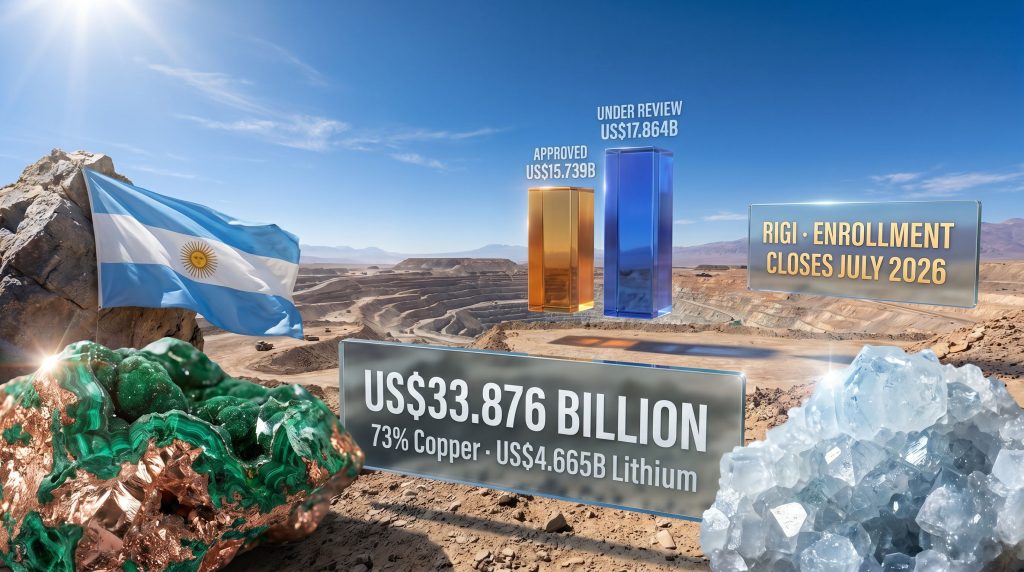
The headline figures are substantial. The total proposed investment across RIGI-registered mining and energy projects reaches US$33.876 billion. Of this, US$15.739 billion, representing approximately 46.5% of submitted capital, has received formal approval as of early 2026.
The remaining US$17.864 billion is still awaiting regulatory determination, with the mining sub-sector carrying a particularly concentrated backlog.
Breaking down the pipeline further:
- 8 projects have received full RIGI approval, all satisfying the 20% local supplier threshold
- 12 projects are currently under active regulatory review, representing approximately US$17 to US$18 billion in potential capital deployment
- 1 project valued at US$273 million has been formally rejected, establishing the first recorded RIGI rejection since the regime's inception
- Approximately 13 mining projects valued at a combined US$42 billion are progressing through the broader RIGI pipeline
Structural Observation: The fact that 73% of mining-specific investment requests remain pending approval reveals a meaningful administrative bottleneck. For investors assessing timeline risk on RIGI-adjacent assets, the pace of regulatory determinations carries direct implications for development schedules and capital deployment windows.
The first formal rejection under RIGI is itself analytically significant. It confirms that the framework is operating as a genuine screening mechanism rather than a rubber-stamp approval process, which arguably increases its credibility with sophisticated capital allocators who require regulatory rigour as a precondition for commitment.
Which Commodities Are Driving Investment Volumes?
Copper dominates the RIGI mining pipeline by a considerable margin. Projects tied to copper development account for approximately 73% of total mining investment submitted under the framework, with key assets including Vicuña, MARA, and El Pachón advancing through the approval queue. The geographic concentration of these assets within San Juan Province has effectively established a new Andean copper development corridor. However, the broader copper supply crunch anticipated through the 2030s is providing additional urgency for investors to secure exposure early.
Lithium represents the second major commodity pillar, with approximately US$4.665 billion in RIGI-linked investment concentrated across Catamarca, Salta, and Jujuy provinces. These three provinces form Argentina's internationally recognised lithium triangle, a region containing some of the world's most cost-effective brine-based lithium resources. In addition, Argentina lithium brines are increasingly regarded as amongst the most commercially viable globally. The lithium investment committed under RIGI encompasses both lithium carbonate and lithium hydroxide processing capacity, reflecting the downstream integration ambitions embedded in several approved projects.
| Commodity | Share of Mining Investment | Key Provinces | Primary Output |
|---|---|---|---|
| Copper | ~73% | San Juan | Copper cathodes |
| Lithium | ~US$4.665 billion committed | Catamarca, Salta, Jujuy | Lithium carbonate, hydroxide |
| Other minerals | Remainder | Various | Mixed |
The copper-lithium combination positions Argentina's RIGI pipeline directly within the critical minerals energy transition supply chains that Western industrial economies are actively seeking to diversify and secure. Copper underpins electrification infrastructure broadly, while lithium feeds battery manufacturing for electric vehicles and grid storage applications. Both commodities face structural supply deficits that are expected to intensify through the 2030s, making early-stage RIGI approvals particularly valuable from a long-horizon capital deployment perspective.
Argentina Adds Two Mining Projects to the RIGI: Los Azules and Fénix
The most recent additions to the RIGI framework illustrate the breadth of assets now entering the pipeline. Argentina adds two mining projects to the RIGI in the form of the Los Azules copper operation and the Fénix lithium expansion, bringing a combined US$3.202 billion in committed capital into the approved portfolio. According to reporting by BNamericas, these approvals represent a pivotal moment in the regime's evolving track record.
Los Azules: A Copper Development of Continental Significance
Los Azules, operated by McEwen Copper through its Argentine vehicle Andes Corporación Minera, represents a US$2.672 billion capital commitment in San Juan Province. The project's technical approach centres on heap leach processing, a methodology that recovers copper from oxide ores through a percolation process rather than the energy and water-intensive concentrator routes that characterise most large-scale porphyry copper developments.
This distinction matters for several reasons beyond operational efficiency:
- Heap leach operations typically carry a lower water consumption footprint, a critical advantage in the arid Andean environment where water access represents a significant permitting and community relations challenge
- The technology enables phased capital deployment, reducing the upfront capital intensity compared to conventional concentrator-based models
- Lower water use strengthens the project's environmental credentials, which played a documented role in satisfying RIGI's approval criteria
Los Azules is considered one of the largest undeveloped copper resources in South America, and its RIGI approval signals a meaningful step toward production. For context, the Andean copper belt spanning Chile and Argentina contains the majority of the world's identified copper reserves, and Los Azules adds a significant Argentine asset to this geologically exceptional corridor.
Fénix: Brownfield Lithium Expansion at US$530 Million
The Fénix lithium project represents a brownfield expansion of an existing lithium operation, with a capital commitment of US$530 million now formally approved under RIGI. Brownfield expansions carry different risk profiles compared to greenfield developments. Existing infrastructure, established lithium brine extraction systems, and demonstrated processing performance reduce geological and operational uncertainty substantially.
Fénix's RIGI approval is being interpreted within the industry as a benchmark for how the framework accommodates expansion-stage lithium assets alongside the greenfield copper developments that have dominated RIGI headlines. Its inclusion signals that the regime's capital threshold and local supplier requirements are accessible to a broader range of project types than initially assumed.
| Attribute | Los Azules | Fénix Expansion |
|---|---|---|
| Commodity | Copper | Lithium |
| Investment value | US$2.672 billion | US$530 million |
| Project type | Greenfield development | Brownfield expansion |
| Province | San Juan | Lithium triangle region |
| Key technology | Heap leaching | Brine processing |
| Environmental focus | Low water consumption | Brine management systems |
The next major ASX story will hit our subscribers first
How the RIGI Approval Process Works
For investors and project developers assessing the framework's mechanics, the RIGI approval pathway operates through three clearly defined stages.
Stage 1: Application Submission
- Applicants must demonstrate that their proposed investment meets the minimum capital threshold qualifying for the regime
- Documentation of local supplier participation commitments must confirm at least 20% of procurement value directed toward Argentine suppliers
- Sector eligibility must be formally confirmed within the application package
Stage 2: Regulatory Review
- The relevant Argentine federal authority conducts a multi-dimensional assessment covering financial viability, capital commitment authenticity, and environmental compliance obligations
- Environmental review has emerged as a substantive component of the process, not a procedural formality, as evidenced by the Los Azules assessment of its water management credentials
- Financial verification confirms that committed capital is genuinely accessible and not contingent on speculative financing arrangements
Stage 3: Formal Determination
- Approved projects receive RIGI certification, which activates the framework's tax stability protections and fiscal benefit structure
- Rejected applications receive formal notification, and the rejection becomes part of the public record
- Approved projects carry ongoing compliance monitoring obligations throughout the investment lifecycle
Deadline Alert: The RIGI enrollment window closes in July 2026. Projects that have not submitted complete applications before this date cannot access the current framework's incentive structure, regardless of their investment scale or commodity credentials.
RIGI's Extension to Upstream Hydrocarbons
An often-overlooked dimension of Argentina's evolving RIGI architecture is its deliberate extension to cover upstream hydrocarbon activities, including well drilling operations. This expansion was designed to protect the competitive positioning of Vaca Muerta, Argentina's world-class unconventional oil and gas formation in the Neuquén Basin, during a period of elevated global crude price volatility.
The hydrocarbons extension significantly broadens the total addressable investment pool under RIGI and introduces a new category of large-scale international operators into the framework's approval pipeline. For U.S. and European energy companies with existing or prospective Vaca Muerta positions, RIGI's fiscal stability provisions offer meaningful downside protection for long-dated capital commitments in an environment where commodity price cycles can compress project economics unpredictably.
Risk Factors and Critical Perspectives on RIGI
No investment framework of this scale operates without tension, and RIGI has attracted substantive criticism from multiple analytical directions.
Fiscal Cost and Historical Precedent
Civil society organisations and fiscal policy analysts have drawn explicit parallels between RIGI and Argentina's 1993 Mining Investment Law, arguing that long-term tax stability guarantees create permanent fiscal concessions that transfer public resource value to private capital at below-market rates. The historical record of predecessor frameworks in Argentina shows that resource revenue capture has often underperformed initial projections, generating sustained public debate about the appropriate distribution of mining windfalls.
Environmental Oversight Capacity
There is a documented gap between project-level environmental commitments and the systemic regulatory oversight capacity of Argentine environmental bodies. Projects like Los Azules can credibly claim green mining credentials based on their technical design, but the enforceability of those commitments over a multi-decade operational timeline depends on institutional capacity that critics argue remains underdeveloped relative to the scale of investment now entering the pipeline.
Investor-Side Timeline and Approval Risk
The 73% pending approval rate across mining-specific RIGI applications represents a material bottleneck for developers whose project timelines depend on regulatory certainty. Combined with the approaching July 2026 enrollment deadline and Argentina's well-documented history of macroeconomic instability, investors assessing long-dated capital commitments must carefully model currency risk, regulatory approval timing risk, and the possibility that the framework's incentive structure could evolve under future administrations.
What Argentina's RIGI Pipeline Signals for Regional Critical Mineral Strategy
The scale and commodity composition of Argentina's RIGI pipeline reflects something larger than a single country's investment attraction strategy. With copper representing nearly three quarters of committed mining capital and lithium contributing several billion dollars in approved and pending investment, the framework has positioned Argentina as a direct contributor to the Western world's efforts to build more resilient critical mineral supply chains.
Heap leach copper production from San Juan, combined with brine-based lithium carbonate and hydroxide output from the lithium triangle provinces, creates a complementary output profile that aligns closely with the input requirements of battery manufacturing and electrification infrastructure investment. The July 2026 deadline introduces a defined window within which this strategic alignment can be locked in under predictable fiscal terms, a consideration that has not been lost on sophisticated capital allocators monitoring the Argentine investment environment.
Whether the framework ultimately delivers on its promise will depend on the pace of regulatory determinations for the US$17.864 billion still awaiting approval, the institutional capacity to enforce compliance obligations across a growing portfolio of approved projects, and the macroeconomic stability of the Argentine economy over the multi-year development horizons involved. Consequently, as mining.com has noted, Argentina adds two mining projects to the RIGI as part of a broader pattern of progressive approvals, each of which carries genuine uncertainty that investors should approach with appropriate due diligence. Each of these factors must be carefully weighed before assuming that framework approval translates directly into project execution certainty.
This article contains forward-looking assessments based on publicly available information and should not be construed as financial or investment advice. Project timelines, investment figures, and regulatory outcomes are subject to change. Readers should conduct independent due diligence before making investment decisions related to any projects or jurisdictions discussed.
Want to Track the Next Major Mineral Discovery Before the Broader Market Does?
Discovery Alert's proprietary Discovery IQ model delivers real-time alerts on significant ASX mineral discoveries across critical commodities including copper and lithium, translating complex geological and market data into actionable investment insights for both short-term traders and long-horizon investors. Explore Discovery Alert's discoveries page to understand how historic mineral discoveries have generated substantial returns, and begin your 14-day free trial today to position yourself ahead of the market.