May 15, 2026
When Geology Meets Policy: Why Mining Capital Is Concentrating in Ontario
The global mining industry has long operated on a fundamental tension: the world's most resource-rich geological formations rarely sit inside the world's most investor-friendly regulatory environments. For decades, mining capital chased grade and tonnage regardless of jurisdictional complexity, absorbing permitting delays, political risk, and social licence uncertainty as unavoidable costs of doing business. That calculus is shifting. The Ontario government and Agnico Eagle to invest in mining at a combined scale of C$14 billion is a concrete expression of this shift, demonstrating how jurisdictions that combine genuine geological endowment with smart policy frameworks are winning the competition for large-scale capital.
Consequently, understanding what makes this deal structurally significant requires looking beyond the headline figures to the geological, regulatory, and strategic logic underneath them.
When big ASX news breaks, our subscribers know first
What the C$14 Billion Commitment Actually Covers
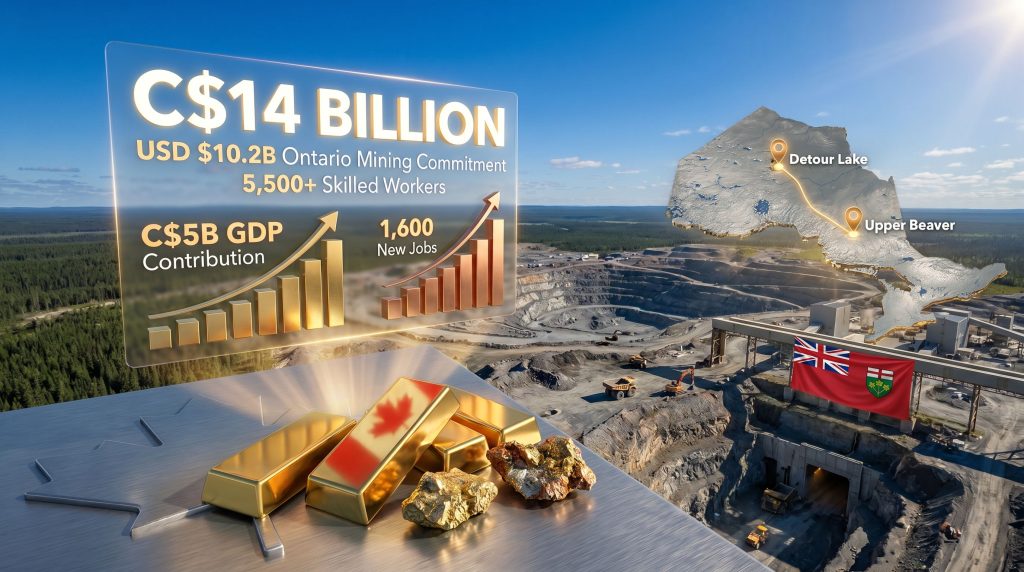
The total investment figure encompasses three distinct categories of capital deployment rather than a single project announcement. Agnico Eagle, identified as Canada's largest mining company and the world's second-largest gold producer, has committed approximately C$12 billion (USD $8.7 billion) across its existing operating assets, development projects, and exploration programmes within Ontario through 2030.
A further C$2 billion (USD $1.46 billion) is specifically allocated to two flagship development projects: the Detour Lake Underground project and the Upper Beaver gold-copper project (Engineering & Mining Journal, May 14, 2026).
These two projects alone are projected to contribute nearly C$5 billion (USD $3.65 billion) to Ontario's GDP and generate up to 1,600 new direct jobs, with Agnico Eagle's total Ontario workforce expected to surpass 5,500 skilled workers following full expansion. According to Reuters, this commitment reinforces Ontario's position as a premier destination for global mining capital.
| Investment Component | CAD Value | USD Equivalent |
|---|---|---|
| Total combined Ontario commitment | C$14 billion | ~USD $10.2 billion |
| Agnico Eagle operational, development and exploration spend | C$12 billion | ~USD $8.7 billion |
| Detour Lake Underground and Upper Beaver allocation | C$2 billion | ~USD $1.46 billion |
| Projected GDP contribution from flagship projects | C$5 billion | ~USD $3.65 billion |
| New direct jobs created | Up to 1,600 | — |
| Post-expansion total Ontario workforce | 5,500+ | — |
Detour Lake Underground: From Open Pit to the Deep
The Detour Lake operation, located northeast of Cochrane in northern Ontario, represents one of Canada's largest gold mines by resource base. The planned transition from open-pit to underground mining is a technically significant milestone. Open-pit mining accesses near-surface mineralisation at relatively low extraction costs but becomes uneconomical as the pit deepens and the strip ratio climbs.
Transitioning underground extends a mine's productive life by accessing deeper, often higher-grade ore bodies that open-pit methods cannot reach economically. This type of transition is capital intensive and operationally complex, requiring parallel infrastructure development, shaft sinking or decline construction, ventilation systems, and underground materials handling equipment, all while maintaining surface operations.
The C$2 billion combined allocation signals Agnico Eagle's confidence in the underlying resource quality at depth — confidence built on years of drilling data and geological modelling rather than speculative projection.
Upper Beaver: A Multi-Metal Opportunity East of Kirkland Lake
The Upper Beaver project sits within Ontario's historically prolific Kirkland Lake mining district, a region that has produced tens of millions of ounces of gold over more than a century of continuous mining activity. Furthermore, Upper Beaver distinguishes itself as a gold-copper system, meaning it carries economic value from two separate commodity streams simultaneously.
This dual-metal character can improve project economics significantly, as copper by-product credits offset gold production costs. The broader significance of gold-copper exploration in such established districts is that proximity to existing infrastructure — roads, power lines, processing facilities, and skilled labour — reduces greenfield capital requirements considerably.
Ontario's Geological Foundation: The Abitibi Greenstone Belt
Any serious analysis of why this investment is concentrated in Ontario must begin with the Abitibi Greenstone Belt. Stretching across northeastern Ontario and northwestern Quebec, the Abitibi is one of the largest and most productive Archean greenstone belts on Earth, formed approximately 2.7 billion years ago through a sequence of volcanic, sedimentary, and intrusive geological events.
The belt has been continuously mined since the early twentieth century, producing well over 200 million ounces of gold cumulatively across dozens of camps and districts. However, what makes it strategically unique is that ongoing exploration and technological advances in deep drilling and geophysical imaging continue to reveal new mineralised zones, suggesting the belt remains underexplored relative to its full endowment.
Geological endowment creates the opportunity, but it is policy certainty and operational infrastructure that convert geological opportunity into investable capital.
Ontario currently hosts 37 active mining operations, 19 of which are gold mines, confirming its position as Canada's leading mineral-producing province. Agnico Eagle's existing Ontario operations alone contributed approximately C$5.3 billion (USD $3.86 billion) to the provincial economy in 2025 (Engineering & Mining Journal, May 14, 2026).
How Ontario's Regulatory Reform Is Unlocking Private Capital
Geological quality is a necessary condition for attracting mining capital but rarely a sufficient one. The regulatory environment surrounding project approval has become an increasingly decisive variable, particularly as permitting timelines in many jurisdictions have extended well beyond a decade for large-scale projects.
Ontario's response to this challenge is the "One Project, One Process" (1P1P) framework, introduced in late 2024. Its foundational design logic consolidates multi-agency approval processes into a single coordinated pathway, establishing a targeted maximum timeline of two years for advanced exploration and mine development applications. In this respect, Ontario's approach reflects broader trends in mining permit reform that are reshaping how governments compete for private investment.
The four structural pillars of the 1P1P framework operate as follows:
-
Centralised coordination reduces duplication between provincial ministries and federal agencies, eliminating sequential approval processes that previously required applicants to satisfy multiple regulators independently.
-
Hard timeline caps create investment certainty by defining the maximum period between application submission and approval decision, allowing capital allocation decisions to be modelled with predictable regulatory risk parameters.
-
Environmental standard maintenance preserves the regulatory rigour that underpins Ontario's social licence to mine, preventing the framework from becoming a mechanism for lowering assessment quality rather than improving process efficiency.
-
Formalised Indigenous consultation embeds First Nations engagement as a structured, time-bound component of the accelerated process. This mirrors emerging Indigenous consultation frameworks being developed across Canada, rather than treating consultation as an open-ended obligation that extends timelines indefinitely.
The Ontario government has additionally indicated its intention to introduce further red tape reduction targeting early-stage exploration approvals, dedicated fast-track pathways for mine expansions, and elimination of overlapping federal-provincial approval requirements where legally permissible (Engineering & Mining Journal, May 14, 2026).
The Economics of Permitting Speed
Mining project finance is acutely sensitive to the time value of money. A major development project requiring C$1 billion in capital expenditure and carrying a five-year permitting timeline accumulates substantial holding costs — including carrying costs on committed land tenements, exploration drilling programs maintained to preserve tenure, and opportunity costs on capital that cannot be deployed into production-generating assets.
Every month of permitting delay that can be systematically eliminated through framework reform translates directly into improved project economics. For a commitment of the scale the Ontario government and Agnico Eagle to invest in mining represents, even incremental improvements in permitting efficiency compound into substantial capital efficiency gains across the portfolio.
Strategic Concentration vs. Global Diversification
A less commonly examined dimension of this announcement is what it reveals about Agnico Eagle's broader capital allocation philosophy. The mining industry default position has historically favoured geographic diversification as a risk management tool. However, Agnico Eagle's decision to concentrate a disproportionate share of its 2026 to 2030 capital programme within a single Canadian province represents a deliberate departure from this orthodoxy.
The strategic logic reflects several compounding advantages:
-
Operational synergies from shared infrastructure, centralised logistics networks, and cross-asset workforce deployment reduce per-unit production costs across the Ontario portfolio.
-
Knowledge concentration in a single geological setting allows technical teams to develop deep, transferable expertise in the Abitibi's specific mineralisation styles and processing characteristics.
-
Procurement leverage from aggregating supply chain requirements across multiple Ontario operations enables volume-based pricing advantages that distributed global operations cannot achieve.
-
Reduced sovereign risk in a stable, rule-of-law jurisdiction with transparent regulatory processes and enforceable contract rights insulates the capital programme from political volatility.
-
Relationship capital built over decades with Ontario First Nations communities, provincial regulators, and local governments represents a non-replicable competitive advantage that cannot simply be purchased or transferred.
Understanding this within the broader mining investment landscape helps explain why institutional capital is increasingly favouring jurisdictional quality over pure geographic diversification.
Indigenous Partnerships as Structural Investment Infrastructure
One of the most consequential and least discussed aspects of large-scale mining investment in northern Ontario is the role of First Nations partnerships as a foundational element of project viability. Agnico Eagle's Ontario operations are underpinned by formal agreements with multiple First Nation communities, covering employment targets, environmental monitoring participation, revenue sharing arrangements, and cultural heritage protection protocols (Engineering & Mining Journal, May 14, 2026).
Ammar Al-Joundi, Agnico Eagle's president and CEO, characterised the company's outlook as being built on responsible development, employment generation, Indigenous reconciliation, skills development, and long-term growth as interconnected rather than competing objectives.
The First Nations partnership frameworks Agnico Eagle has developed in Ontario are not merely ethical commitments. They are investment-grade risk management infrastructure that reduces project-level uncertainty in measurable ways.
Companies that invest in genuine long-term partnerships rather than transactional engagement structures reduce social licence risk in ways that improve project economics and create replicable models that attract further investment to the region.
The next major ASX story will hit our subscribers first
What This Signals for Ontario's Competitive Position
The Ontario government's stated ambition, as articulated by Energy and Mines Minister Stephen Lecce, is for the province to establish itself as the mining and critical minerals capital of the G7 (Engineering & Mining Journal, May 14, 2026). As Mining Weekly reports, this framing positions Ontario as an active competitor in a global race for mining capital that includes established jurisdictions in Western Australia, Nevada, and Scandinavia.
| Competitive Factor | Ontario's Position | Key Differentiator |
|---|---|---|
| Geological endowment | Abitibi Greenstone Belt | World-class, multi-century production history |
| Regulatory efficiency | 1P1P framework, 2-year target | Structured reform with hard timeline commitments |
| Workforce depth | 5,500+ Agnico Eagle workers alone | Established skilled labour pool in northern Ontario |
| Indigenous partnerships | Formal agreements, multiple communities | Long-term relationship capital, not transactional |
| Infrastructure maturity | Multiple operating mines in proximity | Shared infrastructure enables portfolio synergies |
| Sovereign stability | Federal and provincial rule-of-law | Transparent, enforceable regulatory environment |
Economic Multipliers and Northern Community Impact
The direct employment and GDP figures represent only the first layer of economic impact. Mining investments of this scale in remote northern communities generate substantial indirect and induced economic activity through supply chain procurement, infrastructure co-investment, and the spending patterns of a growing workforce.
Economic research on remote community mining typically estimates that each direct mining position supports two to four additional jobs in adjacent service, supply, and logistics sectors. For northern Ontario communities where mining has historically been the primary economic driver, the concentration of Agnico Eagle's expanded workforce creates compounding economic effects that extend well beyond the mine sites themselves.
The advancement of definitive feasibility studies for projects like Detour Lake Underground and Upper Beaver will further clarify these economic projections as development timelines solidify.
Disclaimer: Forward-looking statements regarding employment, GDP contribution, and economic multiplier effects are based on projections and estimates at the time of announcement. Actual outcomes may vary depending on commodity prices, project timelines, regulatory processes, and operational factors. This article is intended for informational purposes only and does not constitute financial or investment advice.
Key Takeaways for Industry Observers and Investors
The Ontario government and Agnico Eagle to invest in mining at this scale carries implications that extend well beyond a single company's capital programme:
-
Regulatory reform generates measurable capital responses. The 1P1P framework demonstrates that targeted, well-designed permitting efficiency, when combined with maintained environmental standards, can unlock private sector commitments that transform provincial economic trajectories.
-
Geological endowment requires policy infrastructure to attract capital. Ontario's success reflects resource quality, regulatory predictability, and partnership frameworks working in concert — not geological advantage operating in isolation.
-
Concentration strategies can outperform diversification in stable jurisdictions. When jurisdictional quality is sufficiently high, concentrating capital to capture operational synergies and relationship advantages can generate superior risk-adjusted returns.
-
Indigenous partnership frameworks are financially material. Established First Nations agreements reduce social licence risk in ways that directly improve project economics and create durable competitive advantages for operators who invest in them genuinely.
-
Ontario is competing deliberately for G7 mining capital. This announcement positions the province as an active rival to established mining jurisdictions globally, with a policy and partnership framework designed to attract further investment beyond this single commitment.
Want To Position Yourself Ahead Of The Next Major ASX Mineral Discovery?
Discovery Alert's proprietary Discovery IQ model delivers real-time alerts on significant ASX mineral discoveries, transforming complex geological and commodity data into actionable insights for both short-term traders and long-term investors — explore Discovery Alert's discoveries page to understand how historic finds have generated substantial returns, and begin your 14-day free trial today to secure a market-leading edge.