
August 6, 2026
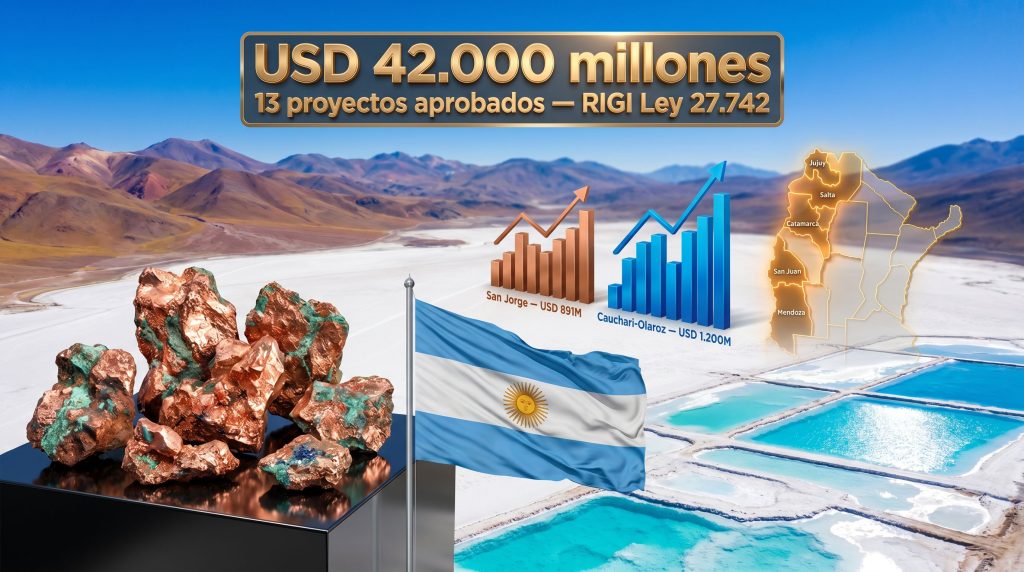
Argentina Aprueba Proyectos Mineros Bajo Régimen RIGI: El Nuevo Polo de Inversión en Minerales Críticos
Global demand for critical minerals rarely shifts along predictable lines. The energy transition has created a structural scramble for copper, lithium, and silver that no single country anticipated fully, yet the nations with the most agile regulatory frameworks are now capturing disproportionate shares of capital. Against this backdrop, Argentina aprueba proyectos mineros bajo régimen RIGI as one of the most consequential investment regimes in Latin American mining history, and its results are becoming impossible to ignore.
When big ASX news breaks, our subscribers know first
What Is the RIGI and Why Does It Matter for Mining?
The Régimen de Incentivo para Grandes Inversiones, known as RIGI, is a long-term investment stabilisation framework established through Argentina's Ley 27.742 in 2024. Its core proposition is straightforward but structurally significant: projects meeting the minimum USD 200 million investment threshold gain access to a 30-year guarantee of fiscal, customs, and foreign exchange stability. This means that regardless of future changes in tax codes, import duties, or currency controls, approved projects operate under the terms locked in at entry.
Projects must be structured through a dedicated legal vehicle called a Vehículo de Proyecto Único, essentially a ring-fenced special purpose vehicle that separates project liabilities and benefits from broader corporate structures. This design provides both the investor and the regulator with clean accountability boundaries, which is particularly important for multi-decade mining operations where corporate ownership can change multiple times.
The regime remains open to new applications until July 8, 2027, with a possible one-year extension under the terms of the enabling legislation. Provinces including San Juan, Salta, Catamarca, Jujuy, and Mendoza have formally adhered to the regime, creating a geographically diverse map of eligible project zones that covers some of South America's most mineralogically endowed territories.
The 30-year stability horizon is not merely a marketing proposition. For copper or lithium projects with construction timelines of four to six years followed by multi-decade production lives, regulatory certainty at entry fundamentally changes the risk-adjusted return calculation for institutional capital.
The Scale of Capital Accumulation Under RIGI
By May 2026, Argentina had approved 13 mining projects under the RIGI framework, with total committed investment in the mining sector surpassing USD 42 billion. A pipeline of approximately 40 additional projects is in various stages of evaluation, with up to 20 further approvals potentially materialising before the 2027 application deadline.
Furthermore, what makes this acceleration particularly notable is that mining has emerged as the dominant sector within RIGI, outpacing even hydrocarbon commitments in total capital deployed. This reflects the intersection of Argentina's exceptional geological endowment with the global energy transition's appetite for battery metals and electrification materials.
| Metric | Figure |
|---|---|
| Mining projects approved (May 2026) | 13 |
| Total committed mining investment | Over USD 42 billion |
| Projects currently in evaluation pipeline | ~40 |
| Additional approvals possible before 2027 deadline | Up to 20 |
| RIGI application window closes | July 8, 2027 |
The velocity of approvals from February through May 2026 signals that both the government and project developers have established sufficient procedural familiarity with the RIGI framework to accelerate deal flow significantly.
San Jorge and Cauchari-Olaroz: The May 2026 Approvals Examined
On May 14, 2026, Argentina's Economy Minister Luis Caputo announced the formal RIGI approval of two projects representing a combined investment of USD 2.1 billion. These additions underscore the breadth of Argentina's critical mineral ambitions, spanning both copper and lithium within a single announcement.
San Jorge: Mendoza's Copper Comeback
The San Jorge copper project, situated in Mendoza Province, carries an approved investment commitment of USD 891 million. Copper projects of this scale are significant for several reasons beyond raw capital figures.
Mendoza has historically been less prominent in Argentina's mining narrative compared to San Juan or Jujuy, making San Jorge's approval a meaningful geographic expansion of the country's productive mining footprint. The project will contribute to Argentina's broader Argentina copper systems pipeline, which also includes the Los Azules project in San Juan operated by McEwen Copper Corp, carrying an investment commitment of approximately USD 2.672 billion, making it the single largest copper project in the RIGI portfolio.
From a geological standpoint, copper porphyry deposits in the Andean region, which characterise projects like San Jorge, typically exhibit large tonnage at moderate grades. These deposits require significant upfront capital for infrastructure and processing facilities but deliver long mine lives, often exceeding 25 years, which aligns well with the RIGI's 30-year stability horizon. Investors should note that production timelines for projects of this size typically involve three to five years from approval to first metal, meaning near-term production contributions should not be assumed.
Cauchari-Olaroz: Consolidating Jujuy's Lithium Position
The expansion of the Cauchari-Olaroz lithium operation in Jujuy Province represents an investment of USD 1.2 billion, the larger of the two May approvals. Crucially, this is an expansion of an existing brine operation rather than a greenfield development, which carries meaningfully different risk characteristics.
Lithium brine production in the Puna region of Jujuy operates through solar evaporation of lithium-rich saltwater extracted from beneath high-altitude salt flats. The process is chemically distinct from hard-rock lithium mining, generally carries lower operating costs, but requires multi-year evaporation pond cycling, meaning production ramp-up timelines are measured in years rather than months. The primary output is lithium carbonate, a key feedstock for lithium-ion battery cathode manufacturing.
Jujuy's geological position within the Lithium Triangle — the tri-border convergence of Argentina, Chile, and Bolivia containing more than half of the world's known lithium resources — gives its projects structural supply chain significance. The International Energy Agency has documented that lithium demand could increase by a factor of six or more by 2040 under accelerated energy transition scenarios, creating sustained pressure on brine supply that Argentine projects are positioned to partially address (IEA, The Role of Critical Minerals in Clean Energy Transitions, 2021).
In addition, technologies such as direct lithium extraction are increasingly being explored alongside traditional brine methods to improve recovery rates and reduce environmental impact across the region.
Expanding an operational brine asset is fundamentally different from approving a greenfield project. Existing infrastructure, established processing chemistry, and on-the-ground workforce reduce execution risk substantially, though brine pond expansion still requires multi-year lead times before incremental production flows.
Economic Impact: Employment, Exports, and Provincial Revenue
The combined economic impact of the San Jorge and Cauchari-Olaroz approvals encompasses more than 8,000 direct and indirect jobs across construction and operational phases. This figure reflects employment generated across both project lifecycles, with construction employment typically front-loaded and operational employment sustained over the mine's full life.
| Project | Province | Mineral | Investment (USD) | Combined Jobs |
|---|---|---|---|---|
| San Jorge | Mendoza | Copper | 891 million | Part of 8,000+ |
| Cauchari-Olaroz (expansion) | Jujuy | Lithium | 1.2 billion | Part of 8,000+ |
| Los Azules | San Juan | Copper | 2.672 billion | Separate impact |
| Gualcamayo | San Juan | Gold | 665 million | ~1,700 |
| Diablillos | Salta/Catamarca | Gold/Silver | 760–764 million | Reported separately |
| Fénix (expansion) | Jujuy | Lithium | 530 million | Not disclosed |
| Veladero (expansion) | San Juan | Gold/Silver | 380 million | Part of 2,300+ |
Beyond direct employment, mining projects of this scale generate significant foreign exchange earnings through export revenues. For a country that has historically struggled with chronic current account pressures, the prospect of multiple multi-billion-dollar mineral export streams coming online during the late 2020s and early 2030s carries macroeconomic significance that extends well beyond the mining sector itself.
Notably, the Diablillos project approval under the RIGI regime represents one of the more prominent gold and silver developments in the pipeline, further diversifying Argentina's critical minerals portfolio beyond lithium and copper.
Argentina's Competitive Position Against Regional Peers
The Regulatory Differentiation Argument
Chile remains the world's dominant copper producer, accounting for roughly 27% of global output according to USGS data, and also holds significant lithium reserves in the Atacama. However, Chile's recent policy environment has introduced investor uncertainty, including debates over potential mining royalty increases and constitutional reform processes that, while ultimately not as disruptive as some feared, created hesitation among capital allocators during the review periods.
Bolivia's lithium resources are enormous on paper, concentrated in the Salar de Uyuni, but the country's state-led development model and historical challenges with foreign investment frameworks have prevented large-scale private sector deployment. As of early 2026, Bolivian lithium production remains a fraction of its theoretical potential.
Argentina's differentiation through RIGI is essentially a 30-year bet that regulatory predictability outcompetes raw resource supremacy as a capital attraction mechanism. For institutional investors with multi-decade return horizons, this argument carries genuine weight. Consequently, the Argentina lithium brine market is attracting increasing attention from global capital allocators seeking stable, long-duration exposure to battery metals.
Copper: A Long Game for Argentina
If the current RIGI copper pipeline — including San Jorge, Los Azules, and other advanced projects — reaches production during the late 2020s and early 2030s, Argentina could establish itself as a meaningful secondary copper supplier at the regional level. The ongoing copper supply crunch globally lends additional urgency to Argentina's efforts to bring new copper assets into production as quickly as the regulatory framework permits.
However, challenging Chile's dominance in absolute terms would require sustained project execution across a decade or more, with production figures that remain speculative until feasibility studies are finalised and construction is confirmed.
Investors should treat market share projections for Argentine copper with appropriate caution. Production timelines for large porphyry copper projects are routinely extended, and commodity price cycles can alter project economics substantially between approval and first production.
The next major ASX story will hit our subscribers first
Risk Factors Investors Should Understand
No regulatory framework, regardless of how well designed, eliminates all investment risk. Several categories of risk apply specifically to Argentina aprueba proyectos mineros bajo régimen RIGI:
- Political continuity risk: The 30-year stability guarantee is only as durable as Argentina's institutional capacity to honour it across future administrations. Argentina's history includes periods of significant policy reversal, and while the RIGI's legal architecture is designed to make unwinding difficult, investors should assess sovereign risk independently.
- Social licence challenges: Mining projects in arid and ecologically sensitive zones, including the Puna region of Jujuy and wine-growing areas of Mendoza, face ongoing community consultation requirements. Local opposition to water use in particular represents a recurring friction point for Argentine mining development.
- Commodity price exposure: Projects approved today will begin production in the late 2020s at the earliest. Both copper and lithium prices are highly cyclical. Lithium in particular experienced sharp price corrections in 2023 and 2024 after earlier peaks, demonstrating that demand growth narratives do not insulate against near-term market imbalances.
- Foreign capital dependency: The Argentine mining sector's growth trajectory is largely dependent on foreign capital, primarily from North American, Australian, and European operators. Shifts in global capital availability or risk appetite could affect project timelines independent of Argentine regulatory conditions.
Furthermore, Argentina's broader RIGI mining investment wave has drawn considerable international commentary, with analysts noting both the structural ambition of the framework and the execution challenges that remain.
Frequently Asked Questions About RIGI and Argentine Mining
What is the RIGI and how does it work for mining projects?
The RIGI is Argentina's large investment incentive regime, established through Ley 27.742 in 2024. It offers 30 years of fiscal, customs, and foreign exchange stability to projects committing a minimum of USD 200 million. Projects operate through a dedicated legal vehicle and require formal government approval. The regime is open to new applications until July 8, 2027.
How many mining projects have been approved under RIGI as of May 2026?
Thirteen mining projects have received formal RIGI approval as of May 2026, with total committed investment in the sector exceeding USD 42 billion. A pipeline of approximately 40 additional projects is under evaluation.
What is the difference between San Jorge and Cauchari-Olaroz as investment assets?
San Jorge is a copper porphyry development project in Mendoza requiring construction from a greenfield or near-greenfield stage, with an investment commitment of USD 891 million. Cauchari-Olaroz is a brine-based lithium expansion in Jujuy, building on existing operational infrastructure, with USD 1.2 billion committed. The expansion nature of Cauchari-Olaroz reduces certain execution risks relative to a pure greenfield development.
Which minerals are prioritised within the RIGI portfolio?
Lithium and copper represent the largest concentration of committed capital, reflecting global energy transition demand. Gold and silver projects also feature prominently, including Diablillos in Salta and Catamarca and the Veladero expansion in San Juan.
When does the RIGI close to new applications?
The application window closes on July 8, 2027, with a possible one-year extension as provided under the framework legislation.
Argentina's Trajectory as a Critical Minerals Producer
What Argentina aprueba proyectos mineros bajo régimen RIGI represents at a structural level is not simply a series of individual project approvals. It is the progressive construction of a critical minerals supply chain anchored by regulatory certainty in a country where geological endowment has historically exceeded its productive output.
The projects expected to reach production during the late 2020s and 2030s will determine whether this regulatory architecture translates into lasting economic transformation or whether implementation challenges, commodity cycles, or political shifts interrupt the trajectory. The pipeline of approximately 40 projects under evaluation and the potential for up to 20 additional approvals before the 2027 deadline suggest the current momentum has genuine structural foundations.
For global battery supply chains, energy companies, and institutional investors with long-duration mandates, Argentina's RIGI portfolio warrants serious analytical attention. Whether that attention translates into sustained capital deployment will depend as much on execution quality and political consistency over the coming decade as on the framework's technical design.
This article contains forward-looking statements and projections based on publicly available information and announced investment commitments. Mining project timelines, employment figures, and production estimates are subject to change based on regulatory, market, and operational developments. Nothing in this article constitutes financial advice. Investors should conduct independent due diligence before making investment decisions.
Want to Stay Ahead of the Next Major Mineral Discovery on the ASX?
While Argentina's RIGI regime is reshaping global critical minerals investment, Discovery Alert's proprietary Discovery IQ model scans ASX announcements in real time — instantly identifying significant copper, lithium, and gold discoveries and delivering actionable alerts before the broader market reacts. Explore how historic ASX mineral discoveries have generated substantial returns on Discovery Alert's dedicated discoveries page, and begin your 14-day free trial today to position yourself ahead of the next major find.