
August 14, 2026
Why Energy Systems That Depend on Imports Are Structurally Fragile
The history of modern energy policy is, in many ways, a catalogue of lessons learned too late. Nations that built their electricity grids and industrial economies around imported fossil fuels repeatedly discovered that geopolitical events beyond their control could translate almost immediately into economic pain at home. Price shocks, supply disruptions, and the weaponisation of energy exports by producing nations have all demonstrated the same underlying truth: import dependency is a form of strategic vulnerability that market mechanisms alone cannot resolve.
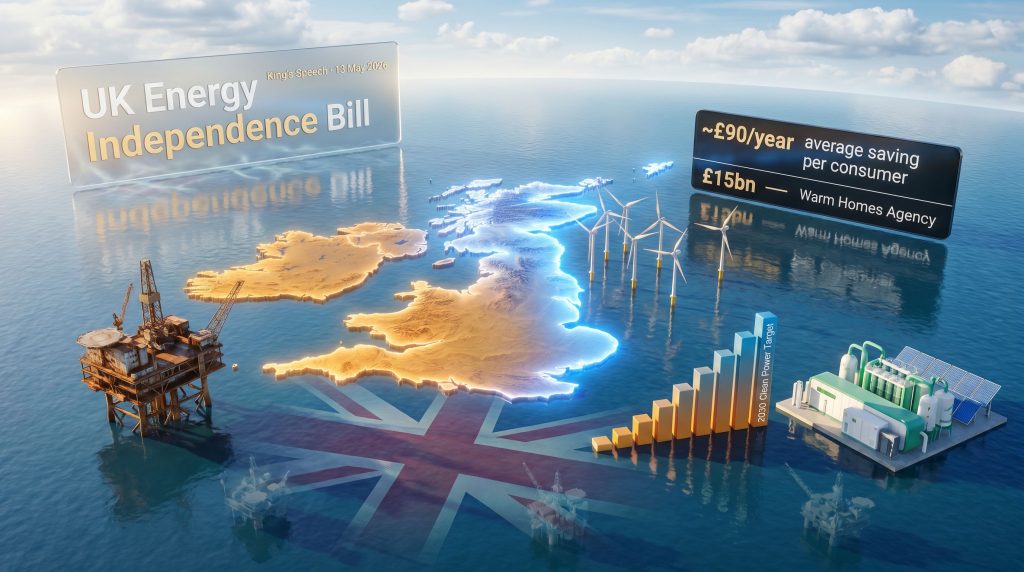
It is against this backdrop that the UK Energy Independence Bill, announced through the King's Speech on 13 May 2026, takes on its full significance. This is not a routine policy adjustment. It represents one of the most structurally ambitious attempts by any democratic government to legislate its way out of fossil fuel dependency within a defined parliamentary timeframe, building directly on the institutional foundations of the Great British Energy Act 2025.
Understanding what the Bill actually does, why it is being introduced now, and what obstacles stand between its announcement and implementation requires looking well beyond the headlines.
When big ASX news breaks, our subscribers know first
The Strategic Logic of Legislating Energy Sovereignty
There is an important distinction between energy security and energy independence, and the UK government has consciously chosen the more ambitious of the two objectives. Energy security implies having reliable access to supply, whether domestic or imported. Energy independence implies reducing the structural exposure to imported supply altogether.
The decision to pursue independence through primary legislation, rather than through market incentives or regulatory guidance, reflects a specific political calculation. A statutory prohibition is far harder for a successor government to reverse than a policy commitment. By embedding the North West Shelf extension ban and related provisions into an Act of Parliament, the current administration is attempting to make its energy direction durable beyond its own electoral lifespan.
This matters enormously for long-duration infrastructure investment. Offshore wind farms, grid interconnectors, and hydrogen infrastructure all require capital commitments measured in decades. Investors pricing policy risk into those decisions need to know that the regulatory ground beneath their projects will not shift with each change of government.
Legislative certainty functions as a form of risk capital for the clean energy sector. When the rules are written into statute, private investors can model their returns with greater confidence, reducing the cost of capital and accelerating deployment timelines.
What the UK Energy Independence Bill Actually Contains
A Statutory End to North Sea Exploration Licensing
The centrepiece of the UK Energy Independence Bill is a permanent statutory prohibition on new North Sea oil and gas exploration licences. This is a meaningful escalation from the government's earlier non-binding commitment not to issue new licences, which remained vulnerable to policy reversal through executive action alone.
It is important to understand the distinction between licence categories in the North Sea regulatory framework:
- Exploration licences: Permissions to search for undiscovered hydrocarbon reserves. These are permanently prohibited under the Bill.
- Appraisal licences: Permissions to assess discovered but not yet developed fields. The precise treatment under the Bill requires further regulatory clarification.
- Production licences: Permissions to extract from already-developed and licensed fields. These continue under existing permissions.
The fracking prohibition is also codified into statute under this Bill, converting a moratorium into a permanent legislative ban. This removes the possibility that a future government could lift the fracking restriction through executive action without parliamentary approval.
Two specific projects sit at the centre of industry opposition to these provisions: the Rosebank oil and gas field development, for which Unite union publicly demanded immediate approval, and the Shell-operated Jackdaw gas condensate project, both identified as requiring government licensing decisions under the current regulatory framework.
Transitional Energy Certificates: Managing Decline Without Chaos
One of the most technically sophisticated elements of the Bill is the introduction of Transitional Energy Certificates, a new regulatory instrument with no direct precedent in UK energy law.
What are Transitional Energy Certificates? Transitional Energy Certificates allow energy companies to maximise production from existing offshore fields, including geological zones adjacent to already-licensed blocks, without triggering the prohibition on new exploration licences. They are designed to manage the orderly decline of North Sea output while preserving the economic viability of legacy assets.
The concept of adjacent area production is central to understanding how this mechanism works in practice. Rather than requiring a new exploration licence to access formations that border an existing licensed block, operators can use these certificates to extract hydrocarbons from those zones under the existing regulatory framework.
This serves two purposes simultaneously. First, it provides investor certainty for companies with capital already deployed in North Sea infrastructure. Second, it allows the government to maintain its statutory prohibition on new exploration while avoiding the abrupt stranded-asset scenario that would otherwise trigger legal challenges and capital flight from legacy operators.
The definitional boundary between an "adjacent area" and a genuinely "new exploration area" remains a critical point of regulatory ambiguity. This distinction will almost certainly become a source of industry-regulator dispute as specific field development proposals are evaluated against the new framework.
Grid Infrastructure and Clean Energy Acceleration
Beyond the North Sea provisions, the Bill contains a suite of measures targeting the regulatory and planning bottlenecks that have historically slowed clean energy deployment in the UK. The renewable energy transition includes streamlined pathways for offshore wind connections and green hydrogen infrastructure, alongside the formal prohibition on new coal licences, which completes the legislative arc from the UK's coal phase-out commitments to a comprehensive fossil fuel licensing moratorium.
The industry organisation RenewableUK described the Bill as presenting a genuine opportunity to reduce electricity costs while strengthening energy security through lower renewable build costs. This position reflects the commercial sector's alignment between the Bill's regulatory streamlining provisions and their own investment economics.
The Warm Homes Agenda and Consumer Protection Architecture
The consumer-facing provisions of the Bill are substantial and deserve closer examination than they typically receive in coverage focused on the North Sea provisions.
Key consumer measures and their projected impacts:
| Consumer Measure | Detail | Estimated Benefit |
|---|---|---|
| Subsidy restructuring | Three-quarters of legacy renewable scheme subsidies shifted from bills to general taxation | ~£90/year average saving per household |
| Dynamic pricing | Cheaper electricity rates during peak renewable generation periods | Lower per-unit cost during solar and wind peaks |
| Export fee removal | Elimination of charges for households exporting solar electricity | Improved residential solar economics |
| Warm Homes Agency | New body backed by £15 billion for home electrification | Targeted support for low-income households |
| Landlord obligations | Mandatory investment in energy efficiency upgrades | Improved rental sector efficiency standards |
| Ofgem expansion | Regulator's remit extended to energy brokers and intermediaries | Closure of long-standing consumer protection gap |
The £15 billion Warm Homes Agency commitment represents one of the largest single residential energy investment programmes in UK legislative history. Its mandate to target low-income households explicitly acknowledges that the energy transition, if unmanaged, can impose disproportionate costs on those least able to absorb them.
The extension of Ofgem's enforcement authority to cover third-party energy brokers is a quietly significant reform. Broker misconduct, including misrepresentation of tariffs and conflicts of interest in switching recommendations, has operated outside regulatory accountability for years. Closing this gap addresses a documented pattern of consumer harm that previous regulatory frameworks failed to reach.
The subsidy restructuring deserves particular attention from a distributional standpoint. Legacy renewable energy support costs, embedded in electricity bills as mandated charges, are effectively flat-rate levies that fall proportionally harder on lower-income households. Shifting approximately three-quarters of these costs to general taxation realigns the burden toward a more progressive payment mechanism, while delivering projected average savings of around £90 per year per consumer.
How the Energy Independence Bill Relates to the Great British Energy Act 2025
Two Acts, One Strategic Direction
The Great British Energy Act 2025, which received Royal Assent on 15 May 2025, established Great British Energy (GBE) as a publicly owned clean energy company with a mandate spanning production, distribution, emissions reduction, and energy security across all four UK nations.
The clean energy transition announced almost exactly one year later functions as the regulatory and market-structure layer that surrounds GBE's operational mandate. The relationship between the two pieces of legislation can be understood as follows:
- The 2025 Act created the institutional vehicle for the UK's clean energy transition.
- The 2026 Bill reshapes the market rules within which every energy sector participant, including GBE, must now operate.
Without the 2025 Act, the 2026 Bill would lack the institutional infrastructure to deliver on its ambitions. Without the 2026 Bill, the 2025 Act would operate within a market framework that still permitted new fossil fuel exploration, creating a structural contradiction at the heart of UK energy policy.
Together, they send a coordinated signal to private capital: clean energy investment is being de-risked through institutional and regulatory certainty, while new fossil fuel development is being constrained through statutory prohibition.
The Political Risks That Could Derail the Bill
Labour's Internal Fault Lines
The UK Energy Independence Bill entered a deeply unstable political environment. At the time of the King's Speech on 13 May 2026, four government ministers had resigned in quick succession, creating conditions for a potential Labour leadership contest that could significantly alter the Bill's parliamentary trajectory.
The significance of a leadership change extends beyond personal politics. Different candidates for the Labour leadership represent meaningfully different energy policy orientations:
- Wes Streeting (right-leaning, pro-growth orientation): His resignation statement on 13 May 2026 explicitly framed the moment as requiring a contest that would be a broad battle of ideas. Analysts have noted his positioning could make him open to revisiting North Sea licensing restrictions in the interest of economic activity.
- Angela Rayner and Andy Burnham (soft-left): Both have publicly indicated support for maintaining the North Sea exploration ban, suggesting the Bill's core provisions would be more likely to survive under either candidate.
A leadership change could delay the Bill's passage, narrow its scope through amendment, or in a more pro-growth leadership scenario, introduce provisions that partially restore new North Sea licensing under specific conditions.
Union Opposition: The Jobs and Security Argument
The political pressure on the North Sea provisions does not come exclusively from within the parliamentary Labour Party. Two of Labour's most significant traditional union allies have adopted positions explicitly opposed to the exploration ban.
Unite General Secretary Sharon Graham argued publicly that the government's stance on oil and gas was endangering both employment and national security, framing the exploration ban not as an environmental victory but as an economic and strategic error.
The GMB union's Scottish branch warned in April 2026 that a fast-tracked reduction in oil and gas production carried serious risks of employment catastrophe in regions where the sector provides a significant concentration of skilled, high-wage jobs. This regional dimension, centred on Scotland and northeast England, adds geographic specificity to the political pressure and connects directly to Labour's electoral interests in those constituencies.
The Transitional Energy Certificates mechanism can be understood partly as the government's attempt to absorb this pressure. By guaranteeing continued production from existing licensed assets while maintaining the exploration ban, it offers the industry an economic lifeline without formally conceding on the statutory prohibition.
Global Comparisons: The UK's Approach in International Context
How Other Nations Are Navigating the Same Tension
The fundamental tension the UK is attempting to resolve legislatively, between the economic value of domestic fossil fuel production and the strategic imperative of a green transition, is playing out in different ways across multiple jurisdictions.
| Country or Region | Policy Direction | Key Mechanism or Development |
|---|---|---|
| United Kingdom | Permanent ban on new fossil fuel licences; clean energy acceleration | Energy Independence Bill 2026 |
| European Union | Transition acceleration alongside pragmatic domestic gas use | Methane regulation; domestic gas production strategy |
| New Zealand | Reversed previous exploration ban; pivoting to LNG imports | Regasification facility planned at Port Taranaki |
| South Australia | Lifting fracking moratorium two years ahead of scheduled expiry | Energy Resources (Regulated Activities) Amendment Bill |
New Zealand provides perhaps the most instructive cautionary case. The country's official proved and probable gas reserves fell by 23% year-on-year to just 731 PJ as of January 2025, a decline of 217 PJ in twelve months driven by both production drawdown and significant downward reserve revisions. The Pohokura field alone recorded a 129 PJ reduction, partly attributed to well underperformance. New Zealand's centre-right government reversed its predecessor's exploration ban but has failed to attract meaningful new investment, forcing a pivot to LNG imports including a planned regasification facility at Port Taranaki. The lesson is not straightforward in either direction: it demonstrates that an abrupt ban can create supply crises, while also showing that simply reversing the ban does not automatically attract replacement investment.
Spain illustrates the potential end-state of a high-renewables grid. Natural gas was setting electricity prices only 10% of the time in 2026, compared with 75% in 2018. This dramatic compression in gas price-setting frequency shows how a sustained build-out of renewable capacity can structurally reduce the influence of fossil fuel pricing on consumer electricity costs.
Within the European Union, the debate remains unresolved. EU Energy Commissioner Dan Jorgensen argued at a May 2026 informal ministerial meeting that the EU must accelerate its transition away from fossil fuels and stay the course on its methane regulation, even while acknowledging the need for pragmatic implementation. By contrast, Cyprus and Romania pushed for expanded domestic gas production as a security measure, while Romania's representative suggested that natural gas could remain relevant beyond 2050 if carbon capture and storage technologies mature sufficiently. This internal EU tension mirrors, at a continental scale, precisely the same debate playing out within the UK Labour Party.
South Australia's decision to lift its fracking moratorium two years ahead of schedule illustrates how governments under energy supply pressure can reverse course. The state's argument that over 1,300 wells have been fracked in the Cooper basin since 1969 without aquifer impacts provides a technical basis for the reversal, while the political complexity of passing the legislation through an upper chamber where Labor lacks a majority reflects how even pro-production decisions encounter institutional resistance.
The next major ASX story will hit our subscribers first
What the Bill Means for the UK's 2030 Clean Power Target
Removing the Regulatory Friction From Clean Energy Build
The UK government has committed to a clean power grid by 2030, an ambition that requires the construction of significant additional offshore wind capacity and grid infrastructure on a timeline that has historically been obstructed by planning delays and grid connection queues.
The UK Energy Independence Bill's provisions targeting these bottlenecks are, in some respects, as important as the North Sea licensing provisions for determining whether the 2030 target is achievable. A statutory ban on fossil fuel exploration does not itself generate a single additional megawatt of renewable capacity. What accelerates deployment is the removal of the regulatory friction that has caused approved projects to sit in limbo for years awaiting grid connections and planning approvals.
The dynamic pricing provisions work in parallel with supply-side measures. By creating financial incentives for households and businesses to shift consumption toward periods of high renewable generation, the system improves the economics of renewable assets and reduces the grid integration challenges associated with variable generation. The elimination of export fees for residential solar generators similarly improves the investment case for rooftop solar, which contributes to distributed generation capacity.
The Remaining Execution Risks
Statutory ambition and operational delivery are different things. Furthermore, the critical minerals demand required for clean energy infrastructure adds further complexity. Several execution risks remain that the Bill's provisions alone cannot resolve:
- Grid connection timelines: The UK's grid connection queue has contained projects waiting years for approval. Regulatory streamlining provisions will need to translate into measurable acceleration in processing times.
- Supply chain constraints: Offshore wind turbine manufacturing, subsea cable production, and specialist installation vessels are all subject to global supply and demand dynamics that UK legislation cannot directly influence.
- Political stability: As detailed above, a Labour leadership change could delay the Bill itself, independent of any downstream execution challenges.
- Consumer savings realisation: The projected £90 per year saving from subsidy restructuring depends on implementation mechanisms functioning as designed, with actual savings flowing to household bills rather than being absorbed elsewhere in the supply chain.
Frequently Asked Questions: UK Energy Independence Bill
What is the UK Energy Independence Bill?
The UK Energy Independence Bill is legislation announced in the King's Speech on 13 May 2026 that permanently bans new North Sea oil and gas exploration licences, introduces Transitional Energy Certificates for existing licensed fields, accelerates clean energy deployment through planning and regulatory reform, and introduces a broad package of consumer protection and energy affordability measures including the creation of a Warm Homes Agency.
Will the North Sea ban affect existing oil and gas production?
No. The prohibition applies specifically to new exploration licences. Existing licensed fields continue to operate under their current permissions. The Transitional Energy Certificates mechanism is explicitly designed to maximise output from those fields, including from geological zones adjacent to already-licensed blocks.
How much could the Bill save consumers annually?
The subsidy restructuring provisions are projected to deliver average household savings of approximately £90 per year by shifting roughly three-quarters of legacy renewable energy support scheme costs from household electricity bills to general taxation. Additional savings are anticipated through dynamic pricing access during high renewable generation periods.
What is the Warm Homes Agency?
The Warm Homes Agency is a new body established under the Bill, backed by a £15 billion commitment, tasked with electrifying UK residential properties with targeted financial support for low-income households. It represents the Bill's primary mechanism for addressing fuel poverty and residential decarbonisation simultaneously.
How does this Bill differ from the Great British Energy Act 2025?
The Great British Energy Act 2025 established Great British Energy as a publicly owned clean energy company. The Energy Independence Bill is the complementary regulatory and market framework that bans new fossil fuel licences, reforms consumer energy markets, and creates the structural conditions within which all energy sector participants, including GBE, must now operate.
A Legislative Bet on Durable Change
Locking In the Transition Against Political Reversal
The most analytically significant feature of the UK Energy Independence Bill is not any single provision, but the deliberate choice of legislative mechanism. By embedding the exploration ban, the fracking prohibition, and the consumer protection framework into primary legislation rather than policy documents or regulatory guidance, the government is making a calculated bet that statutory durability will outlast its own electoral fortunes.
This is simultaneously the Bill's greatest strength and its most politically exposed characteristic. The strength lies in providing the long-horizon certainty that infrastructure investors require. The exposure lies in the fact that this very durability will make the Bill a central battleground in any future leadership contest or general election, concentrating opposition rather than diffusing it.
The tension at the heart of the legislation, between the pace of decarbonisation and the economic realities of managed fossil fuel decline, will not be resolved by parliamentary passage alone. It will be tested continuously through union negotiations, planning disputes, grid connection timelines, and the quarterly rhythm of household energy bills.
Disclaimer: This article contains forward-looking statements and projections based on publicly available information as of May 2026. Consumer savings estimates, deployment timelines, and political scenario assessments are subject to significant uncertainty. Nothing in this article constitutes financial or investment advice.
Want to Know Which ASX Energy and Resources Companies Could Benefit From the Global Clean Energy Shift?
Discovery Alert's proprietary Discovery IQ model delivers real-time alerts on significant ASX mineral discoveries — including critical minerals essential to the clean energy transition — instantly equipping subscribers with actionable insights ahead of the broader market. Explore historic examples of major mineral discoveries and their market returns on Discovery Alert's dedicated discoveries page, and begin your 14-day free trial today to position yourself at the forefront of the next major find.