May 14, 2026
The Hidden Bottleneck in the EV Revolution That Almost Nobody Talks About
Every conversation about electric vehicle supply chains eventually circles back to lithium. Cobalt gets its share of scrutiny. Nickel and manganese feature in cathode chemistry debates. Yet the single material present in the greatest quantity by weight inside every lithium-ion battery cell on the planet receives comparatively little mainstream attention: graphite.
Specifically, it is the processed form of graphite that sits at the centre of one of the most consequential supply chain vulnerabilities in the global energy transition. Coated, spheronized, and purified graphite, commonly abbreviated as CSPG, is the anode-active material that makes lithium-ion batteries function. Without it, there is no anode. Without an anode, there is no battery. And without batteries at scale, there is no EV transition.
The problem is not that graphite is rare. It is that the infrastructure required to transform raw graphite into battery-grade CSPG is overwhelmingly concentrated in a single country, creating a structural dependency that Western battery manufacturers, automotive OEMs, and governments are only beginning to reckon with seriously.
When big ASX news breaks, our subscribers know first
Why the Graphite Processing Bottleneck Is More Dangerous Than the Mining Gap
Understanding the graphite supply chain requires distinguishing between two very different industrial activities that are frequently conflated: mining and processing. Raw graphite can be extracted in multiple countries across Africa, Europe, and North America. The challenge lies in what happens next.
Transforming flake graphite into CSPG involves a multi-stage industrial process that includes micronization, spheronization (reshaping irregular flakes into uniform spherical particles), high-temperature purification to remove impurities, and carbon coating to optimise electrochemical performance. Each stage requires specialised equipment, precise process control, and significant energy input.
China currently controls an estimated 65% of global primary graphite output and roughly 90% of downstream processing capacity for battery-grade material, according to reporting by MiningMX citing company statements. This is not simply a mining dominance story. It is a processing dominance story, and it is the processing capacity that is genuinely difficult to replicate outside Asia in the near term.
Furthermore, the graphite shortage risks associated with this concentration are increasingly well-documented, with supply security analysts flagging anode material as one of the highest-vulnerability nodes in the entire EV value chain.
"The battery anode supply chain challenge is fundamentally a processing and logistics problem, not a mining problem. Whoever establishes credible CSPG production capacity outside Asia controls a critical node in the global EV supply chain."
What makes this concentration particularly significant from a supply security standpoint is the material's sheer volume requirement. A typical lithium-ion EV battery cell contains graphite in quantities far exceeding any other single active material by mass, making anode supply security a foundational concern rather than a peripheral one for battery manufacturers planning long-term production.
Why Western Battery Gigafactories Cannot Simply Source Locally
The pipeline of battery gigafactory capacity being built across North America and Europe presupposes a reliable supply of anode-ready CSPG. Yet outside Asia, commercially operating CSPG production facilities of any meaningful scale remain exceptionally rare. This creates a paradox: Western governments are investing heavily in battery manufacturing infrastructure while the most volumetrically significant input material remains almost entirely sourced from Chinese processors.
The commercial consequence is that any non-Asian producer capable of delivering traceable, qualified CSPG at industrial scale is entering a market with limited competition and strong structural demand. The first movers in this space carry disproportionate leverage in long-term offtake negotiations. Consequently, understanding the broader battery metals landscape is essential context for evaluating where anode supply fits within the wider critical mineral investment picture.
Understanding the NextSource Anode Battery Plant in Abu Dhabi
Against this backdrop, the decision by NextSource Materials (TSX: NEXT; OTCQB: NSRCF) to formally commit to Phase 1 of its Battery Anode Facility in Abu Dhabi represents a notable development in the global effort to build ex-China CSPG production infrastructure.
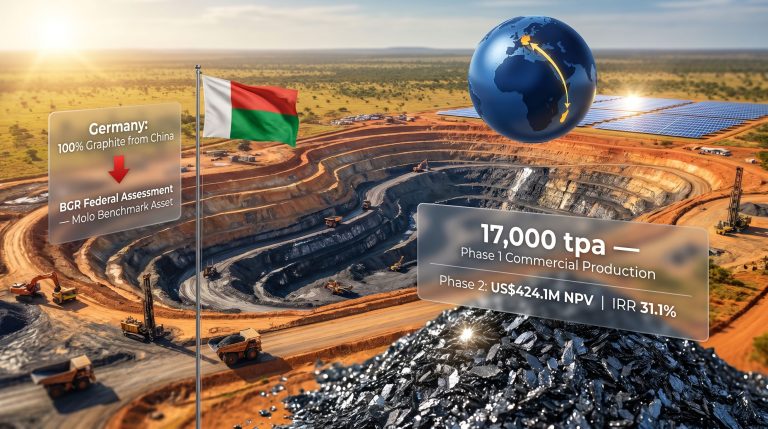
The Toronto-listed graphite developer, which operates the Molo graphite mine in Madagascar opened in 2024, announced the approval of the Final Investment Decision for Phase 1 of its Battery Anode Facility located within the Industrial City of Abu Dhabi on May 13, 2026, as reported by MiningMX. The decision followed the completion of a Front-End Engineering Design study, an engineering validation process that confirms technical design parameters, economic assumptions, and operational readiness before binding capital is committed.
The significance of an FID cannot be overstated in project development terms. It is the moment at which a project transitions from a planning exercise into a binding obligation, triggering contractor engagement, equipment procurement scheduling, and regulatory approval processes. For investors and offtake customers alike, an FID signals that development risk has materially reduced and execution has begun.
The Vertical Integration Thesis
NextSource's strategic architecture is built around vertical integration: control the mine, control the processing, and deliver a finished, battery-ready product directly to cell manufacturers and automotive customers. The NextSource anode battery plant in Abu Dhabi is the downstream processing component of this model, designed to receive raw graphite feedstock from the Molo mine and convert it into CSPG for direct delivery.
This integrated model carries several competitive advantages that a pure miner or pure processor cannot replicate individually:
- Full supply chain traceability from mine origin to finished anode material, increasingly demanded by OEMs navigating ESG reporting requirements and responsible sourcing mandates
- Margin capture across the value chain, avoiding the discount that miners face when selling unprocessed flake graphite to third-party processors
- Feedstock cost control, insulating the processing business from price volatility in spot raw material markets
- Customer qualification advantages, as battery manufacturers increasingly prefer to qualify a single integrated supplier rather than manage separate mining and processing relationships
Phase 1 Infrastructure: What the Abu Dhabi BAF Actually Looks Like
The physical structure of the NextSource anode battery plant in Abu Dhabi departs meaningfully from the conventional model for new industrial processing facilities. Rather than constructing a purpose-built processing plant on a greenfield site, the company is installing processing equipment inside an existing 60,000 square metre warehouse at ICAD.
This approach, which might be described as an installation-first development model, compresses construction timelines substantially, eliminates the civil engineering risk associated with new building construction, and reduces upfront capital exposure. In an environment where broader regional tensions have already introduced delays to certain project workstreams, building within an existing structure provides meaningful schedule resilience.
The key parameters of Phase 1 are as follows:
| Parameter | Detail |
|---|---|
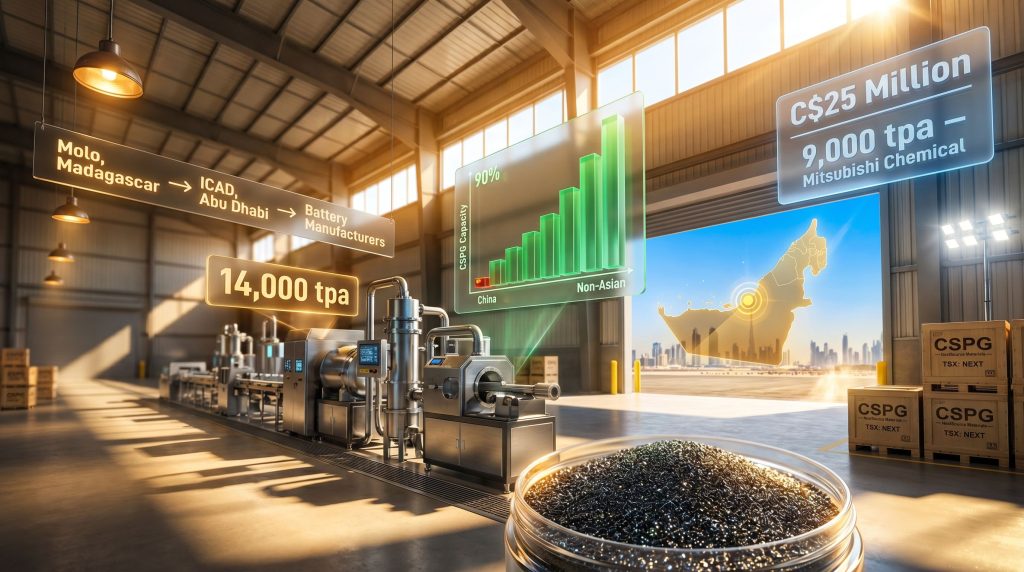
| Phase 1 Production Capacity | 14,000 tonnes per annum (tpa) of CSPG |
| Maximum Scalability (all phases) | Up to 30,000 tpa |
| Facility Location | Industrial City of Abu Dhabi (ICAD), UAE |
| Site Footprint | Existing 60,000 m² warehouse (pre-built) |
| Technical Study Author | Stantec (October 2025) |
The Stantec-authored technical and economic study confirmed both the technical viability of the Phase 1 design and the economic case for expansion toward a 30,000 tpa ceiling across multiple phases. Crucially, the modular design means each successive phase can be activated incrementally as offtake agreements are secured, rather than requiring a single large capital commitment upfront.
The Modular Expansion Logic: Capital Discipline Meets Market Optionality
The phased, modular approach reflects a capital discipline philosophy well-suited to the realities of battery minerals markets, which have historically exhibited significant price volatility and demand uncertainty. Rather than committing to a 30,000 tpa facility from the outset, NextSource is building a proven production platform at 14,000 tpa and layering on additional capacity as commercial conditions justify.
This is not simply a financial preference. It is a technically sound approach to industrial scaling: proving equipment configurations, process parameters, and product quality specifications at Phase 1 before replicating them at greater scale reduces the risk of costly retrofits in later phases. In addition, this disciplined approach aligns well with the evolving dynamics of battery raw materials supply chains, where market conditions can shift considerably between project conception and full commissioning.
The Molo-to-Abu Dhabi Supply Chain: From Mine to Anode Material
The integrated supply chain that NextSource is constructing flows from a single starting point: the Molo graphite mine in Madagascar, which commenced operations in 2024. Molo provides the raw natural flake graphite that feeds Phase 1 of the Abu Dhabi BAF, which then processes it through spheronization, purification, and coating stages before delivery to battery customers.
The flow looks like this:
- Natural flake graphite extracted at Molo mine, Madagascar
- Raw graphite transported to Abu Dhabi processing facility at ICAD
- Multi-stage CSPG processing: spheronization, purification, carbon coating
- Finished CSPG delivered to battery cell manufacturers and automotive OEMs
Graphite vs. Other Battery Materials: A Supply Security Comparison
To understand why the anode side of the supply chain warrants specific attention, it helps to compare the processing concentration across key battery materials:
| Battery Component | Material | Primary Processing Concentration |
|---|---|---|
| Anode (active material) | Natural / Synthetic Graphite | China: est. ~90% of battery-grade processing |
| Cathode (active material) | Lithium, Cobalt, Nickel, Manganese | China, South Korea, Japan (distributed) |
| Anode current collector | Copper | Global |
| Cathode current collector | Aluminium | Global |
The anode column stands out. While cathode active material processing is distributed across multiple Asian jurisdictions, graphite processing for battery-grade use remains uniquely concentrated in China. This distinction is critical: it means that supply chain diversification efforts targeting cathode materials alone will not address the graphite anode dependency.
It is also worth noting that graphite's importance in battery design is often underappreciated relative to its actual volume in a finished cell. A standard lithium-ion cell contains substantially more graphite by mass than any other single active material, making the sourcing and processing of anode material a higher-volume supply chain challenge than cathode sourcing. The push for critical minerals security is, however, beginning to drive policy responses across multiple governments that recognise this imbalance.
How NextSource Is Financing the Abu Dhabi BAF
The funding architecture for the NextSource anode battery plant in Abu Dhabi combines equity capital with strategic partnership and commercial offtake commitments.
NextSource raised C$25 million through a private placement, issuing 58.8 million shares to institutional investors. Vision Blue Resources, the company's anchor institutional investor, subscribed for approximately 47% of the total placement, effectively maintaining its proportional ownership stake rather than diluting its position.
Vision Blue was founded by Mick Davis, the former CEO of Xstrata, who also serves as Chairman of NextSource. His involvement is commercially significant: Davis built Xstrata into one of the world's largest diversified mining companies before its merger with Glencore, and his decision to maintain anchor investor status through this placement reflects institutional conviction in the project's trajectory.
The financing structure also involves a Japanese consortium, with JOGMEC (Japan Organization for Metals and Energy Security) participating in strategic financing. JOGMEC is a Japanese government-affiliated body that deploys capital into mineral supply chain projects aligned with Japan's industrial and energy security objectives. Its participation reflects recognition of the Abu Dhabi BAF's strategic relevance to Japan's battery supply chain, independent of purely commercial considerations.
On the commercial side, a multi-year offtake agreement with Mitsubishi Chemical Corporation secures 9,000 tpa of Phase 1 CSPG output for delivery to North American markets, with negotiations ongoing for the remaining 5,000 tpa of Phase 1 capacity. This mirrors patterns seen across battery supply chain growth globally, where strategic offtake agreements are increasingly secured before production facilities are commissioned.
Funding and Commercial Commitments at a Glance
| Capital or Commercial Source | Type | Value / Scope |
|---|---|---|
| Private placement (total) | Equity capital raise | C$25 million |
| Vision Blue Resources | Anchor equity subscriber | ~47% of placement |
| Mick Davis (Vision Blue founder) | Board chairman | Strategic governance |
| JOGMEC (Japan) | Strategic consortium financing | Undisclosed quantum |
| Mitsubishi Chemical Corporation | Multi-year offtake agreement | 9,000 tpa to North America |
| Remaining Phase 1 offtake | Under active negotiation | 5,000 tpa |
The Mitsubishi Chemical offtake is particularly noteworthy because it pre-sells the majority of Phase 1 production before a single tonne of CSPG has been processed. This de-risks the revenue model substantially and provides the financial underpinning that supports the FID itself.
"The combination of anchor equity from Vision Blue, strategic financing from a Japanese consortium, and pre-committed offtake from Mitsubishi Chemical creates a layered de-risking structure that is considerably more robust than a single-source financing model."
The next major ASX story will hit our subscribers first
Why Abu Dhabi: The Strategic Logic Behind the Location
The choice of Abu Dhabi as the location for this facility is not simply a matter of convenience. It reflects a deliberate set of trade-offs between geopolitical stability, logistics efficiency, industrial infrastructure availability, and jurisdictional risk.
CEO Hanré Rossouw has described the UAE as offering a stable, strategically positioned, and commercially supportive setting for advanced materials manufacturing, a characterisation that acknowledges the broader tensions affecting the Middle East region while distinguishing Abu Dhabi's position within it, as reported by MiningMX.
The regional conflict dynamics involving Iran, the US, and Israel did introduce delays to certain project workstreams during the planning phase. Despite this, NextSource proceeded with the FID, a decision that implicitly communicates the company's assessment that the UAE's structural advantages outweigh the residual geopolitical noise of the broader region.
The Industrial City of Abu Dhabi provides a specific set of locational advantages that are difficult to replicate in alternative processing jurisdictions:
- Direct access to major global shipping lanes connecting Asia, Europe, and East Africa
- An existing 60,000 m² warehouse that eliminates greenfield construction timelines entirely
- Access to Abu Dhabi's established industrial ecosystem including utilities, logistics providers, and downstream industrial customers
- A regulatory environment that has historically offered streamlined industrial permitting for advanced materials operations, contrasting with timelines of two to five or more years common in many Western markets
- Geopolitical neutrality and broad trade relationships that allow the facility to service customers across North America, Europe, and Asia without exposure to bilateral trade restrictions
Comparing Abu Dhabi Against Alternative Processing Jurisdictions
| Factor | Abu Dhabi (ICAD) | Typical Western Alternative |
|---|---|---|
| Permitting timeline | Streamlined industrial approvals | Often 2-5+ years |
| Infrastructure availability | Existing warehouse ready for equipment installation | Greenfield construction required |
| Port and logistics access | Direct access to major global shipping routes | Varies by location |
| Geopolitical trade exposure | Broad international trade relationships | Potential sanctions or trade restriction exposure |
| Proximity to Asian supply chains | Strong connectivity | Structurally more distant |
Three Commercial Scenarios for the Abu Dhabi BAF
The investment case for the NextSource anode battery plant in Abu Dhabi is best understood through a scenario framework that accounts for execution variables, market conditions, and strategic optionality.
Scenario 1: Phase 1 Executes on Schedule at 14,000 tpa
If construction, equipment installation, and commissioning proceed on timeline, Phase 1 CSPG production could reach delivery-ready status within 2026. At 14,000 tpa, the facility would represent one of the largest operating non-Asian CSPG production assets globally. First-mover status in ex-China battery anode supply carries significant long-term commercial value, particularly in qualifying with Western OEMs who are actively seeking to diversify away from Chinese anode sourcing.
Scenario 2: Phased Scale-Up to 30,000 tpa
Successful Phase 1 execution creates the technical and commercial platform for Phase 2 and Phase 3 capacity additions, scaling toward the 30,000 tpa ceiling confirmed by the Stantec technical study. This trajectory requires securing offtake agreements for the additional volume beyond the current Mitsubishi Chemical commitment, and potentially accessing project financing to fund incremental capital expenditure. At 30,000 tpa, the facility would support anode material supply for a substantial volume of EV battery production annually.
Scenario 3: Abu Dhabi as the First Node in a Global BAF Network
The Abu Dhabi facility has been described as the intended first installation in a planned global network of Battery Anode Facilities. Future nodes positioned near major EV manufacturing clusters in Europe or North America would replicate the modular warehouse installation model developed in Abu Dhabi. This scenario transforms the company from a single-project developer into a multi-jurisdictional anode supply platform, a fundamentally different and more defensible long-term investment proposition.
Disclaimer: The scenario projections outlined above involve forward-looking assumptions regarding production timelines, offtake agreements, and market conditions. These are not guaranteed outcomes. Investors should conduct their own due diligence and consult a qualified financial adviser before making investment decisions.
Frequently Asked Questions: NextSource Anode Battery Plant in Abu Dhabi
What is the NextSource Battery Anode Facility in Abu Dhabi?
The NextSource Battery Anode Facility is a graphite processing plant under development within the Industrial City of Abu Dhabi, UAE. Its purpose is to convert natural flake graphite mined at the Molo mine in Madagascar into coated, spheronized, and purified graphite for direct use as anode active material in lithium-ion batteries.
What is CSPG and why does it matter for EV batteries?
CSPG stands for coated, spheronized, and purified graphite. It is the processed form of natural graphite used as the active material on the anode side of a lithium-ion battery cell. Without CSPG, a lithium-ion battery cannot function. It differs significantly from raw flake graphite, requiring multiple industrial processing stages to achieve the particle size, purity, and surface characteristics required by battery manufacturers.
When was the Final Investment Decision for the Abu Dhabi BAF approved?
NextSource announced approval of the Final Investment Decision for Phase 1 of the Abu Dhabi Battery Anode Facility in May 2026, as reported by MiningMX on May 13, 2026. The decision followed the successful completion of a Front-End Engineering Design study conducted with engineering firm Stantec.
What is the production capacity of the Abu Dhabi BAF?
Phase 1 targets a production capacity of 14,000 tonnes per annum of CSPG. The facility has been designed with modular scalability in mind, with the Stantec technical study confirming technical viability for expansion to 30,000 tonnes per annum across multiple development phases.
Who are the key investors and commercial partners?
Vision Blue Resources serves as the anchor equity investor, subscribing for approximately 47% of the C$25 million private placement. Vision Blue was founded by Mick Davis, former CEO of Xstrata, who chairs NextSource's board. A Japanese consortium including JOGMEC has provided strategic financing support. Mitsubishi Chemical Corporation holds a multi-year offtake agreement for 9,000 tpa of Phase 1 production destined for North American customers, with negotiations continuing for the remaining 5,000 tpa.
How does the Abu Dhabi BAF address China's dominance in graphite processing?
China controls an estimated 90% of global processing capacity for battery-grade graphite. The Abu Dhabi BAF is specifically designed to produce CSPG outside the Asian processing ecosystem, providing EV manufacturers and battery producers with a traceable, non-Chinese source of anode active material. This is increasingly important as Western automotive OEMs and governments implement supply chain resilience requirements.
Why was Abu Dhabi selected over other locations?
Abu Dhabi's Industrial City offers an existing warehouse facility that eliminates greenfield construction timelines, direct access to major global shipping routes, streamlined industrial permitting, and geopolitical neutrality that allows the facility to serve customers in North America, Europe, and Asia. These structural advantages were assessed to outweigh the broader regional tensions affecting parts of the Middle East.
Want to Know Which ASX Mineral Discoveries Could Deliver the Next Major Return?
Discovery Alert's proprietary Discovery IQ model scans ASX announcements in real time, instantly identifying significant mineral discoveries — including those across battery materials critical to the EV supply chain — and translating complex data into actionable investment opportunities. Explore historic discoveries and the exceptional returns they generated to understand why positioning early matters, then begin your 14-day free trial to stay ahead of the market.