May 14, 2026
From Consultation to Co-Ownership: Why the Integra Resources Shoshone-Paiute DeLamar Partnership Rewrites the Rules of US Mining Engagement
For most of the twentieth century, the relationship between mining companies operating on US federal lands and the Indigenous nations whose ancestral territories those lands encompass followed a predictable and often inadequate script. Companies consulted, tribes commented, regulators decided, and the results were frequently contested, delayed, or litigated. That framework is showing its age. Across the western United States, the limitations of transactional engagement are becoming increasingly apparent to project developers, institutional investors, and tribal nations alike.
The Integra Resources Shoshone-Paiute DeLamar partnership, announced on May 13, 2026, introduces a fundamentally different structural logic. Rather than positioning the Shoshone-Paiute Tribes of the Duck Valley Reservation as external stakeholders to be managed through a consultation process, the agreement grants them direct equity ownership in the DeLamar Project itself. It is a structural departure with implications that extend well beyond southwestern Idaho.
When big ASX news breaks, our subscribers know first
Why Equity Ownership Changes Everything in US Federal Lands Mining
The conventional stakeholder engagement model in American mining rests on a legal baseline established by federal law: companies must consult with federally recognised tribes before disturbing lands that may carry cultural, spiritual, or economic significance. Consultation, however, is not consent. And consent is not ownership.
What distinguishes equity-based partnership frameworks from their consultation-only predecessors is the incentive architecture they create. When a tribal nation holds shares in a project, its financial interests become aligned with project success rather than project opposition. That alignment does not override sovereign rights or eliminate legitimate concerns, but it changes the nature of the relationship in a way that pure consultation cannot replicate.
This distinction matters enormously for investors evaluating junior and mid-tier precious metals developers operating on Bureau of Land Management (BLM) administered land. Projects that face organised tribal opposition at the National Environmental Policy Act (NEPA) review stage can experience multi-year delays or, in extreme cases, outright permit denials. Projects where tribal stakeholders are co-developers and equity holders carry a fundamentally different risk profile. The evolving landscape of US mining permits adds further complexity to this picture, making early stakeholder alignment even more commercially valuable.
The Structural Gap Between Benefit Agreements and Equity Participation
To understand why the Integra Resources Shoshone-Paiute DeLamar partnership is significant, it helps to compare it directly against conventional community benefit agreement (CBA) models.
| Feature | Standard Community Benefit Agreement | Integra-Shoshone-Paiute Equity Model |
|---|---|---|
| Financial Mechanism | Cash payments or in-kind contributions | Direct equity ownership in the developer |
| Alignment of Interests | Transactional and time-limited | Long-term value participation tied to project success |
| Tribal Role in Mine Planning | Advisory or consultative | Co-development of mine plans and baseline data collection |
| Monitoring Rights | Typically third-party or government-led | Tribal monitoring embedded in project framework |
| Sovereignty Recognition | Often implicit | Explicitly preserved; independent decision-making authority retained |
| Integration with Permitting | Separate from regulatory pathway | Consensus-based processes incorporated upstream of formal submission |
The distinction is not merely philosophical. Embedding a tribal nation as an equity participant rather than a contract recipient means their economic future is tied to the project's advancement, not its obstruction. That structural alignment is what makes this model qualitatively different from anything that has preceded it on federally managed lands in the Lower 48 states.
What the Integra Resources Shoshone-Paiute DeLamar Partnership Actually Involves
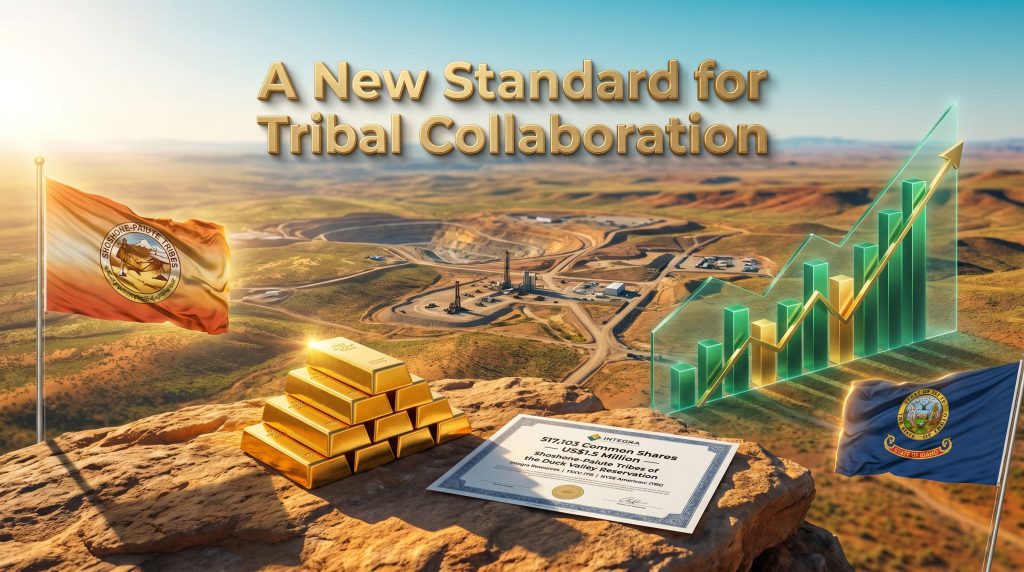
Announced on May 13, 2026, the agreement involves Integra Resources (TSXV: ITR | NYSE American: ITRG) issuing 517,103 common shares to the Shoshone-Paiute Tribes of the Duck Valley Reservation. The shares carry an aggregate value of US$1.5 million, priced at C$3.97 per share, reflecting the TSX Venture Exchange closing price immediately before execution. Completion of the grant is subject to NYSE American approval and satisfaction of customary closing conditions.
Critically, this equity grant did not emerge from a single negotiating session. It formalises the outcomes of approximately five years of collaborative work between Integra and the Shoshone-Paiute on baseline environmental data collection, tribal monitoring program design, and mine plan co-development. The equity stake is, in this sense, a recognition of contribution already made rather than an inducement for future cooperation.
Agreement Snapshot
- Shares issued: 517,103 common shares of Integra Resources
- Aggregate value: US$1.5 million
- Pricing reference: C$3.97 per share (TSXV closing price immediately prior to execution)
- Exchange approval required: NYSE American
- Announcement date: May 13, 2026
- Project location: Owyhee County, southwestern Idaho (federally managed lands)
- Tribal nation: Shoshone-Paiute Tribes of the Duck Valley Reservation
The tribal leadership's framing of this arrangement is instructive. Brian Mason, Chairman of the Shoshone-Paiute Tribes, articulated that the nation evaluates opportunities through a multi-generational lens, weighing alignment with tribal values, protection of cultural resources, and durability of economic benefit. Mason described the equity ownership as evidence of the relationship's maturity, grounded in respect and transparency, and as consistent with the tribe's long-term goals for economic independence and diversification, while explicitly preserving sovereign authority over how projects proceed.
That final point deserves emphasis. The equity structure does not subordinate tribal sovereignty to commercial interests. The Shoshone-Paiute retain independent decision-making authority as a condition of the framework itself. Participation in project economics does not mean surrender of governance rights.
The DeLamar Project: Strategic Context and Development History
The DeLamar Project sits in Owyhee County in southwestern Idaho, on federally administered land with a documented history of mineral production. Kinross Gold operated the site through the 1980s and 1990s before ceasing operations in 1998. Integra Resources acquired the asset in 2017 and has since committed approximately US$140 million to its advancement through successive study phases.
Development Timeline
- 2017 – Integra Resources acquires DeLamar Project
- 2019 – Preliminary Economic Assessment (PEA) completed
- 2022 – Pre-Feasibility Study (PFS) completed
- 2025 – Feasibility Study completed
- March 2025 – Mine Plan of Operations submitted to the Bureau of Land Management
The submission of the Mine Plan of Operations to the BLM in March 2025 initiated the formal federal permitting process, including a NEPA environmental review. That milestone carries direct significance for the tribal equity agreement: the partnership formalises a collaborative arrangement that was already informing mine plan development before the document was submitted to regulators. Furthermore, the completion of the definitive feasibility study in 2025 provided the technical foundation upon which the mine plan submission was built.
DeLamar is a heap leach gold and silver project, a processing methodology well-suited to the lower-grade but large-tonnage mineralisation characteristic of the Great Basin region. Heap leach operations apply a leaching solution to crushed ore stacked on lined pads, recovering precious metals without the energy intensity of conventional milling. The technology has a long track record in Nevada and Idaho, with comparable operations providing a meaningful baseline for cost and recovery assumptions.
Integra positions DeLamar within a broader Great Basin portfolio that includes the Florida Canyon Mine in Nevada, an operating heap leach asset, and the Nevada North Project, also in Nevada at development stage. This portfolio structure provides investors with both near-term production cash flow and development optionality. In addition, current gold and silver market trends reinforce the strategic case for advancing heap leach projects of this scale.
The US$140 million committed to DeLamar since 2017 represents one of the more substantial pre-construction investment programs among junior gold developers in the western United States, reflecting the scale of technical and environmental work required to bring a federal lands project to permit-ready status.
How Tribal Equity Restructures Permitting Risk
The BLM's permitting process for mining projects on federal lands operates under NEPA, which requires environmental impact assessment and public comment. Tribal consultation is a legally mandated component of that process, but the quality and depth of that consultation varies enormously. Projects where tribal opposition materialises during the public comment period can face document challenges, requests for supplemental environmental impact statements, and legal challenges that extend timelines by years.
The Integra Resources Shoshone-Paiute DeLamar partnership addresses this risk at the architectural level. By embedding the Shoshone-Paiute as co-developers of the mine plan itself, the collaborative work that informs the regulatory submission reflects tribal input from the outset. Concerns about sacred sites, water resources, and cultural heritage are incorporated into the project design rather than raised in opposition to it.
This upstream integration matters because the most expensive permitting delays are those that arise after substantial regulatory work has already been completed. A late-stage objection that requires redesign of a key project component, or that triggers additional environmental studies, can add years and tens of millions of dollars to project costs. An equity partner whose monitoring protocols and cultural resource protections are embedded in the mine plan is structurally disinclined to generate that kind of friction.
Tribal monitoring rights embedded throughout the project lifecycle — from baseline data collection through construction, operations, and mine reclamation — create an accountability mechanism that also reduces regulatory uncertainty. Regulators reviewing a mine plan that carries demonstrable tribal input and ongoing monitoring commitments have a stronger evidentiary foundation for approving it than one that treats tribal consultation as a procedural checkbox.
What Unprecedented Really Means in a US Legal Context
The characterisation of this agreement as unprecedented for federally managed lands in the Lower 48 reflects a genuine gap in US mining history. While Canadian mining has developed robust Impact and Benefit Agreement frameworks, and Australia has evolved Native Title agreements into increasingly sophisticated economic participation structures, the US domestic framework has historically been far more limited. The broader context of mining claims and First Nations in Canada illustrates just how far ahead other jurisdictions have progressed in formalising equity-based Indigenous partnerships.
| Jurisdiction | Common Model | Equity Participation | Sovereignty Preservation |
|---|---|---|---|
| Canada (BC, Ontario) | Impact and Benefit Agreements | Increasingly common | Varies by agreement |
| Australia | Native Title Agreements | Emerging | Recognised under Native Title Act |
| United States (Lower 48) | Government-to-Government Consultation | Historically rare | Typically limited |
| DeLamar Model (Idaho, 2026) | Relationship Agreement + Equity Grant | US$1.5M direct equity stake | Explicitly maintained |
US federal lands occupy a legally distinct category from tribal territory and traditional use areas, and the government-to-government consultation framework has rarely produced the kind of formal economic partnership that the DeLamar arrangement represents. The legal architecture permitting a tribal government to hold equity in a listed mining company operating on adjacent federal land, while retaining sovereign authority, is genuinely novel in the Lower 48 context.
For institutional investors applying ESG frameworks, this precedent creates a new benchmark. Projects that continue operating under consultation-only models may face increasing scrutiny compared to those that adopt equity participation structures, particularly as ESG screening criteria evolve to incorporate Indigenous rights as a standalone assessment dimension.
The next major ASX story will hit our subscribers first
Economic and Cultural Dimensions for the Shoshone-Paiute
The economic logic of the equity stake extends beyond the US$1.5 million face value of the share grant. As a holder of Integra common shares, the Shoshone-Paiute Tribes now carry direct exposure to DeLamar Project value creation. If the project advances through permitting and into construction and production, the value of the equity position will reflect that trajectory.
Beyond the share value itself, the framework creates pathways for:
- Workforce development and long-term employment for tribal members in skilled and semi-skilled mining roles
- Revenue participation tied to the project's operational lifecycle rather than one-time payments
- Economic diversification aligned with the tribe's stated goal of financial independence
- Co-management of environmental baseline data, building tribal institutional capacity in environmental science
The cultural dimension is equally embedded. Sacred site identification and protection are integrated into the mine plan development process, not appended as afterthoughts. Baseline environmental data is co-managed with tribal representatives, ensuring that the tribe's knowledge of the landscape informs the scientific record rather than being excluded from it. Accountability mechanisms run from construction through final reclamation, meaning the relationship does not terminate when the first gold bar is poured.
Integra Resources: Company Profile and Investment Context
Integra Resources operates across the Great Basin of the western United States with a portfolio structured to provide both current production revenue and development pipeline value. The Florida Canyon Mine in Nevada provides operational cash flow, while DeLamar in Idaho and Nevada North in Nevada represent the development stage assets.
At the time of the announcement, Integra carried a market capitalisation of approximately US$576 million, reflecting the combined value assigned to its operating and development assets by the market.
The company trades on both the TSX Venture Exchange (TSXV: ITR) and NYSE American (ITRG), providing access to both Canadian resource-focused capital markets and the broader US institutional investment community. The dual-listing also explains the regulatory requirement for NYSE American approval before the equity grant to the Shoshone-Paiute can be completed.
Is This Model Replicable Across US Mining?
The structural prerequisites for replicating the DeLamar equity partnership model are specific but not prohibitive. Projects that wish to pursue a similar approach would need to satisfy several conditions:
- Sufficient project scale to support a meaningful equity valuation that registers as economically significant to the tribal partner
- Early-stage engagement initiated well before regulatory submissions, allowing genuine co-development rather than retrospective consultation
- Technical integration of tribal monitoring and cultural resource protection into project design workflows
- Exchange compliance mechanisms capable of accommodating share issuances to sovereign tribal entities
- Alignment between tribal economic development priorities and the project's anticipated timeline
The greatest barrier to replication is likely the second condition. The Integra-Shoshone-Paiute relationship reflects approximately five years of collaborative work before the equity grant was formalised. Companies that begin exploring partnership structures only after regulatory complications emerge are structurally disadvantaged relative to those that initiate engagement at the earliest feasibility stage.
For ESG-focused institutional investors evaluating the junior and mid-tier US mining sector, the DeLamar model provides a new analytical lens. Social licence is increasingly quantifiable in terms of permitting timeline risk, litigation probability, and community opposition costs. Equity-based tribal partnerships represent one of the more robust mechanisms for reducing that risk, and the precedent established in Owyhee County will likely attract attention from project developers across Nevada, Arizona, Utah, and Montana, where BLM-administered land and tribal traditional use areas frequently overlap.
Key Takeaways: What the DeLamar Framework Signals
| Dimension | Significance |
|---|---|
| Equity Structure | Converts tribal stakeholder from external commenter to direct project participant |
| Permitting Risk | Upstream consensus reduces late-stage regulatory opposition probability |
| Social Licence | Broadens community support base across tribal, local, and political stakeholders |
| Precedent Value | Described as unprecedented for federally managed lands in the Lower 48 |
| ESG Alignment | Positions Integra within emerging best-practice frameworks for Indigenous engagement |
| Economic Impact | Long-term jobs, workforce development, and revenue participation for tribal members |
The Integra Resources Shoshone-Paiute DeLamar partnership does not resolve all the complexities inherent in mining on federal lands adjacent to tribal traditional territories. Permitting outcomes remain subject to regulatory processes, environmental review findings, and a range of factors outside any single partnership agreement's control. Nothing in this article should be construed as investment advice, and past project structures do not guarantee future permitting outcomes.
What the agreement does achieve is a structural repositioning of the relationship between a listed precious metals developer and a sovereign tribal nation — from procedural obligation to genuine economic alignment. In a sector where social licence failures have derailed projects carrying billions of dollars in sunk capital, that repositioning carries real and measurable value, both for the Shoshone-Paiute Tribes and for investors evaluating Integra Resources' risk-adjusted development timeline.
The question for the broader industry is no longer whether equity-based tribal partnerships are possible on US federal lands. The DeLamar precedent establishes that they are. The question now is how quickly other developers will recognise that the consultation-only era is ending.
Want to Track the Next Major Mineral Discovery Before the Broader Market Does?
Discovery Alert's proprietary Discovery IQ model delivers real-time alerts on significant ASX mineral discoveries, turning complex mineral data into actionable insights for investors at every experience level — explore Discovery Alert's discoveries page to understand how historic finds have generated substantial returns, and begin your 14-day free trial today to position yourself ahead of the market.