June 20, 2026
Why the Monetary System's Foundations Are Shifting Beneath Us
The global reserve architecture has not collapsed suddenly. It has eroded gradually, through accumulated decisions by sovereign actors who no longer accept the foundational premise that U.S. financial instruments represent a risk-free store of value. Understanding this shift requires setting aside the noise of daily price movements and examining the structural forces that operate across decades, not quarters.
Gold and silver as protection against de-dollarization and central bank buying are no longer fringe investment theses reserved for contrarian commentators. They have become measurable, documented phenomena backed by official data from multilateral institutions, central bank survey results, and exchange delivery records that defy historical norms by orders of magnitude.
When big ASX news breaks, our subscribers know first
Gold's Enduring Role: Structural, Not Speculative
Why Gold's Core Function Has Not Changed
Gold has survived every major monetary disruption of the modern era. Hyperinflation in Weimar Germany, two world wars, the Great Depression, and the unilateral suspension of Bretton Woods convertibility in 1971 all failed to extinguish its function as a store of value. The World Economic Forum's concept of a "polycrisis," where multiple overlapping systemic failures compound simultaneously, has only elevated the strategic case for assets that exist entirely outside the financial system.
The distinction that matters most is not between gold and other commodities. It is between assets that carry counterparty risk and assets that do not. A Treasury bond, a bank deposit, and an ETF share all represent claims on another party's promise to perform. Physical gold held in direct possession carries no such obligation. When the counterparty in question is a government experiencing fiscal stress, that distinction becomes the difference between preservation and loss.
There is also a more nuanced distinction worth understanding: gold functioning as a currency hedge versus gold functioning as a system hedge. A currency hedge protects against one currency weakening relative to others. A system hedge protects against the credibility of the entire framework of electronic accounting records and institutional promises. The evidence from central bank behaviour suggests the world's most sophisticated reserve managers are increasingly treating gold as the latter.
Dismantling the Interest Rate Myth
One of the most persistent misconceptions in financial analysis is that gold performs well only when interest rates fall. The data contradicts this narrative cleanly. From 2022 onward, the U.S. Federal Funds Rate rose by approximately 450 basis points in one of the fastest tightening cycles on record. Over that same period, gold nearly tripled in value.
The interest rate narrative functions less as analytical insight and more as a convenient framing tool — one that is selectively applied when it fits a bearish argument for gold and quietly abandoned when the evidence moves the other way. The genuine driver of gold's structural appreciation is the erosion of confidence in dollar-denominated sovereign debt instruments, a process that accelerates during periods of fiscal deterioration regardless of the prevailing rate environment. Furthermore, understanding gold in the monetary system helps clarify why these dynamics extend well beyond short-term rate cycles.
Central Banks and the Scale of a Historic Pivot
Quantifying the Accumulation
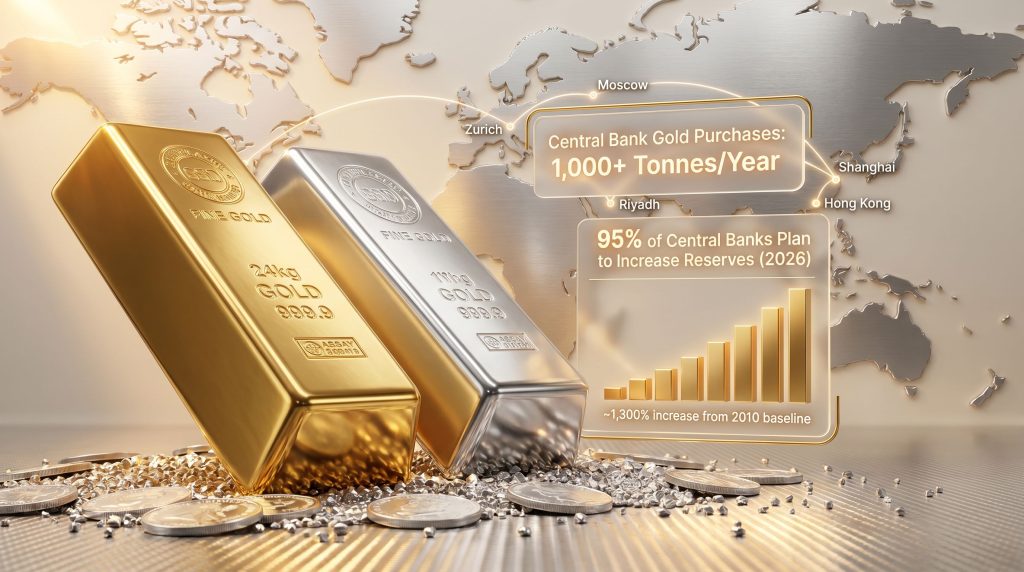
The transformation in central bank gold purchasing behaviour over the past decade is difficult to overstate. The following data illustrates the magnitude of this structural shift:
| Metric | Data Point |
|---|---|
| Annual purchases (2022–2024) | Over 1,000 tonnes per year for three consecutive years |
| Increase from 2010 baseline (77 tonnes) | Approximately 1,300% |
| 2025 annual total | Approximately 850 tonnes (third-highest on record) |
| Q1 2025 World Gold Council figure | 244 tonnes purchased despite record-high prices |
| Central bank share of total gold demand | Approximately 25% vs. 2–5% throughout the 2010s |
| Central banks planning reserve increases in 2026 | 95% (World Gold Council March 2026 survey) |
| Primary motivation cited | Geopolitical concerns (29%), followed by currency diversification |
The most revealing aspect of this data is not the volume but the price insensitivity. Central bank gold reserves are being expanded aggressively at all-time highs, a behaviour that signals motivations are structural rather than tactical. They are not attempting to buy low. They are attempting to eliminate a category of risk that they have concluded is no longer acceptable.
China's acceleration provides the most dramatic illustration. Monthly gold purchase volumes rose from baseline levels to nearly nine times the prior year's figures in early 2025, occurring precisely during periods when Western paper prices were under sustained downward pressure. This pattern — buying harder as the price is pushed lower — is the behaviour of an actor that has concluded price is a distraction from the underlying strategic objective.
De-Treasurization: A More Precise Framework
The dominant framing describes this movement as de-dollarization. A more analytically precise characterisation is de-treasurization: sovereign actors are specifically reducing exposure to U.S. Treasury instruments while the dollar itself remains operationally necessary for global trade settlement.
This distinction matters significantly for investors. The dollar is not being abandoned because global commerce still requires it for day-to-day settlement. What is being abandoned is the practice of recycling dollar-denominated trade surpluses into long-duration U.S. Treasury instruments. China has reduced its Treasury holdings by approximately half while simultaneously expanding gold reserves at a historic pace.
The performance comparison over 25 years is unambiguous: gold has delivered approximately double the return of the 10-year U.S. Treasury, while carrying zero counterparty risk. The Congressional Budget Office projects U.S. interest payments approaching $2 trillion annually within the coming years as the debt trajectory continues upward. This fiscal arithmetic presents reserve managers with a straightforward calculation: hold an instrument whose issuer's debt servicing costs are accelerating exponentially, or hold an asset with no counterparty whatsoever.
The Ferguson Law framework offers a historical lens on this dynamic. When a nation's debt servicing expenditure exceeds its military spending, the historical record suggests a gradual erosion of superpower status. The United States is approaching that threshold, and foreign reserve managers are adjusting their allocations accordingly.
The dollar's share of global foreign exchange reserves has declined from historical highs above 70% to approximately 58% currently. This is a measured, documented trend, not speculation.
The Great Repatriation: Physical Gold Returns Home
A Watershed Moment in Reserve Management Philosophy
The modern gold repatriation movement began in earnest in 2017 when Germany's Bundesbank formally demanded the return of gold held at the New York Federal Reserve after years of requests that had gone unmet. The significance of that moment extended far beyond Germany's own reserves.
Within a short period, Austria, Hungary, Turkey, Poland, the Czech National Bank, the Dutch National Bank, and India all initiated or completed similar repatriation processes. India's withdrawal of gold from the Bank of England was particularly notable given the scale and the symbolic departure from decades of custodial convention.
The motivations behind the original custodial arrangements were practical: access to COMEX and LBMA trading infrastructure, the transactional convenience of Western exchange access, and the historical reliability of Western rule of law. Central banks are now explicitly forgoing those advantages in favour of something they have concluded is more valuable: the elimination of counterparty risk through direct physical possession.
The year following the Bundesbank repatriation, 2018, saw central banks collectively purchase more gold than in the preceding six decades combined. Since that year, the accumulation has not slowed. The repatriation and the purchasing acceleration are not coincidental. They reflect the same underlying conclusion reached by an expanding group of sovereign reserve managers.
The 2022 Inflection Point
The freezing of Russian foreign exchange reserves following the 2022 conflict in Ukraine represented a geopolitical inflection point that restructured how sovereign actors evaluate the safety of assets held within the Western financial system. The weaponisation of the SWIFT system transformed gold custody from a logistical preference into a sovereignty imperative.
The Polish National Bank's leadership articulated perhaps the most candid public explanation for accelerating gold accumulation: the country is purchasing gold as a safeguard for scenarios in which the global financial system, which operates primarily on electronic accounting records, faces severe disruption. The framing is striking in its directness. It is not about inflation protection or currency diversification in the conventional sense. It is about maintaining economic stability if electronic financial infrastructure becomes unreliable or inaccessible.
The 1971 precedent remains instructive. When President Nixon unilaterally closed the gold window, nations that had trusted the U.S. commitment to convert dollar reserves into gold discovered the limits of that trust. Today's reserve managers are drawing explicit lessons from that episode.
Asia's Role in Reshaping the Global Monetary Architecture
China's Dual Strategy: Accumulation and Infrastructure
China's approach to the evolving monetary landscape operates on two simultaneous tracks. The first is aggressive accumulation of physical gold and silver. The second is the construction of alternative financial infrastructure that reduces dependency on Western settlement systems. Indeed, gold's role in the monetary shift driven by China's actions cannot be understated.
On the silver side, China's import data tells a striking story. February and March 2025 both recorded historically anomalous volumes, with March setting an all-time national import record, occurring precisely as Western silver prices were experiencing engineered downward pressure. China simultaneously transitioned from a net silver exporter to a net silver importer in 2025, a structural reversal that carries significant long-term implications for global supply.
On the infrastructure side, the Cross-Border Interbank Payment System (CIPS) now encompasses ASEAN nations representing approximately 800 million people, which constitutes China's largest trading bloc. Trade settlement agreements with Brazil and the UAE have established yuan-denominated parallel trade channels, including petroleum-for-yuan arrangements that explicitly bypass dollar settlement mechanisms.
China's resource security strategy extends well beyond precious metals. Controlling approximately 90% of global rare earth refining capacity while simultaneously securing upstream mineral assets in nickel, copper, graphite, and related materials across more than 20 Brazilian states reflects a comprehensive long-term positioning for resource sovereignty.
The Yuan-Gold Convertibility Model
A critical technical distinction shapes the understanding of China's monetary architecture: the difference between a gold-backed currency and a gold-redeemable currency. A backed currency requires proportional gold holdings for every unit of currency in circulation, constraining monetary policy significantly. A redeemable currency allows holders to convert the currency into gold seamlessly, without dollar intermediation, while preserving greater monetary policy latitude.
China has effectively implemented the latter through the Shanghai Gold Exchange. Energy exporters can sell commodities to China for yuan, then redeem that yuan for physical gold through Shanghai exchange infrastructure without ever touching the dollar system. This model provides the credibility benefits of gold convertibility while retaining the flexibility benefits of a managed currency.
The BRICS Vault Network
The Shanghai Metals Exchange vault expansion programme represents the physical infrastructure for a multipolar monetary settlement system. Reported and planned vault locations include:
- Hong Kong (operational, serving as the primary exit point for gold leaving China)
- Saudi Arabia (reported as complete and operational)
- United Arab Emirates (planned)
- Switzerland (planned)
- Singapore, Moscow, and St. Petersburg (existing or under development)
These vaults connect with CIPS and EMBRIDGE payment rails to enable cross-border settlement in local currencies, with gold functioning as the neutral balancing asset. The strategic implication is significant: gold is being positioned to replace U.S. Treasuries as the reserve collateral of choice in a multipolar trade environment.
Silver's Dual Identity: Industrial Giant and Emerging Monetary Asset
The Silver Paradox
Silver occupies a uniquely complex position in the current environment. Unlike gold, which functions primarily as a monetary and reserve asset, approximately 50% of silver demand is industrial, spanning solar energy applications, electronics manufacturing, and medical uses. This dual-demand structure creates supply dynamics that are arguably more complex than gold alone.
| Characteristic | Gold | Silver |
|---|---|---|
| Primary demand driver | Monetary and reserve | Industrial (~50%) plus monetary |
| Central bank direct purchasing | Dominant buyer category | Minimal direct purchasing |
| Market capitalisation | Over $15 trillion | Significantly smaller |
| Gold-to-silver ratio (current) | Approximately 85:1 | Reference metric |
| Historical 100-year average ratio | Approximately 60:1 | Reference metric |
| Ratio during monetary stress periods | 30–40:1 | Compression potential |
| Bank of America analyst target range | n/a | $130 to $390/oz by end of 2025 |
The gold-silver ratio at approximately 85:1 against a 100-year historical average near 60:1 represents a significant pricing anomaly. During periods of acute monetary stress, this ratio has historically compressed to the 30–40:1 range, implying substantial potential outperformance for silver relative to gold if the structural thesis plays out.
The market capitalisation differential between gold and silver creates an asymmetry that carries important practical implications. Central banks cannot meaningfully accumulate silver at scale given the market's relative size. Individual and institutional investors, however, can access this asymmetric opportunity in ways that sovereign reserve managers cannot.
A 7% single-session price move in silver, as observed in one recent trading session, is historically anomalous. Industry practitioners with decades of experience have noted that daily moves exceeding 2% were essentially absent in silver markets for extended periods. The emergence of such outsized daily moves signals a fundamental shift in market dynamics.
Supply Constraints Converging With Demand
Silver's supply dynamics involve structural constraints that are not widely understood outside specialist circles:
- Approximately 80% of global silver production is a byproduct of copper, zinc, and lead mining rather than primary silver extraction from dedicated silver mines
- Primary silver producers like First Majestic represent only about 20% of annual silver production
- This byproduct dependency means silver supply is largely controlled by the economics of base metal mining, not by silver demand or silver price
China's restrictions on sulfuric acid exports introduce a cascading supply risk that has received limited attention in Western financial media. Sulfuric acid is essential for copper mining operations. Constrained sulfuric acid availability affects copper mining economics, which in turn affects silver byproduct availability. Mosaic Company revised its guidance materially as fertiliser production costs escalated due to sulfuric acid supply constraints, serving as an early indicator of how these restrictions are propagating through related supply chains.
China also announced in November 2024 that domestic silver production would not be permitted to enter international markets, representing a supply shock that passed largely without comment in mainstream financial coverage. Combined with the transition from net exporter to net importer status in 2025, the supply picture for silver is tightening through multiple simultaneous channels.
COMEX Delivery Anomalies
The physical silver market is sending signals that the paper price mechanism is not capturing. In February 2025, approximately 26 million ounces of silver were delivered on COMEX contracts, which was not a primary delivery month. However, 39 million ounces physically left exchange warehouses during the same period, representing a 50% excess of physical removal over contract delivery.
The identity of the consistent large-scale physical buyers taking delivery at this scale remains unconfirmed. What is documented is that the practice of standing for delivery on precious metals futures contracts was historically a sub-1% occurrence across the market. The sustained, multi-month pattern of nine-figure physical removals represents an extreme statistical anomaly.
The price suppression mechanism during this period involved two converging forces. ETF rebalancing at the turn of the year created systematic selling pressure as leveraged funds adjusted positions. Simultaneously, CME Group increased margin requirements on COMEX silver contracts by approximately 300% over a six-week period from early December 2024 to mid-January 2025, moving from roughly $15,000 to approximately $54,000 per contract. The combination of forced ETF rebalancing and tripled margin requirements created cascading liquidation pressure that drove prices sharply lower.
Price, in this framework, functions as a tool of misdirection rather than a reliable signal of fundamental value. The divergence between what paper prices indicate and what physical delivery data reveals is arguably the most important signal available to precious metals investors.
The next major ASX story will hit our subscribers first
The Geopolitical Architecture of Distrust
Why Nations Are Reducing Treasury Exposure
The freezing of Russian foreign exchange reserves in 2022 established a precedent that reoriented how foreign reserve managers assess the safety of assets held within the Western financial system. Prior to that event, the risk of sovereign reserves being frozen or confiscated was largely theoretical. After 2022, it became documented historical fact.
Subsequent trade policy developments, including tariff regimes that functionally operate as economic sanctions against trading partners, have reinforced the perception among foreign reserve managers that access to U.S. financial infrastructure is conditional rather than rule-based. The distinction matters enormously for reserve management. Rule-based systems allow for reliable long-term planning. Conditional systems introduce political risk that cannot be hedged through conventional financial instruments. Only assets held in direct physical possession eliminate this risk category entirely.
The erosion of U.S. institutional credibility, assessed as a structural rather than partisan observation by foreign reserve managers, has accelerated the timeline for reserve diversification. Consequently, nations that might have undertaken a gradual multi-decade transition are now moving with greater urgency. This is broadly consistent with Warren Buffett's warnings about the long-term risks facing the U.S. dollar.
The Petrodollar Recycling Mechanism Under Pressure
Understanding why U.S. long-term interest rates matter requires understanding how the petrodollar recycling system has historically functioned:
- Energy exporters accumulate U.S. dollars through commodity sales denominated in dollars
- Excess dollar holdings are recycled into U.S. Treasury instruments, creating sustained demand
- This sustained Treasury demand suppresses long-term U.S. interest rates
- Suppressed long-term rates inflate U.S. asset prices and keep imported consumer goods inexpensive
- The cycle reinforces dollar demand and Treasury market liquidity simultaneously
When energy trade increasingly settles outside the dollar system, as is occurring through China-UAE and China-Brazil bilateral arrangements, this recycling mechanism weakens. Less dollar-denominated energy trade means less surplus dollar accumulation, which means less Treasury purchasing demand. The mathematical consequence is upward pressure on U.S. long-term interest rates, which in turn stresses every asset class that has been priced under the assumption of perpetually suppressed rates.
Key Metrics and Forward Indicators for Investors
The 10-Year Treasury Yield: The System's Gravitational Centre
If there is one indicator that encapsulates the stress building within the global financial architecture, it is the yield on the 10-year U.S. Treasury. Rising yields compress bond prices, stress bank balance sheets that hold Treasuries as tier-one capital, pressure equity valuations built on discounted cash flow models, and increase the government's own cost of servicing its expanding debt, creating a self-reinforcing feedback loop.
The Federal Reserve controls the short end of the yield curve through its policy rate decisions. The long end, specifically the 10-year Treasury yield, is determined by market forces including foreign demand, inflation expectations, and fiscal credibility assessments. The Genius Act and associated stablecoin legislation, which would require future digital payment flows to be collateralised by short-duration Treasuries, effectively anchors the front end of the curve through a new structural mechanism. However, it does not address the long end.
When the 10-year yield approached 5%, regional U.S. bank failures followed, as institutions that had loaded their balance sheets with long-duration Treasuries during the zero-rate era faced mark-to-market losses that threatened solvency. Shadow Stats alternative inflation calculations suggest that if true inflation runs materially above official CPI figures, the real yield on 10-year Treasuries is deeply negative even at current nominal yields.
Furthermore, record gold ETF inflows in recent periods underscore that institutional investors are not waiting passively for this stress to materialise. Record gold ETF inflows reflect a growing consensus among sophisticated allocators that structural diversification is no longer optional.
Scenario Pathways for Precious Metals Investors
Scenario A: Gradual Multipolar Transition (Base Case)
- Dollar reserve share continues eroding gradually over a 5–15 year horizon
- Gold and silver maintain a structurally bullish trajectory punctuated by volatility events
- Regional trade blocs increasingly settle in local currencies with gold as neutral collateral
- The dollar retains operational importance but loses the premium associated with reserve currency status
Scenario B: Accelerated Fragmentation (Stress Case)
- Triggered by major geopolitical escalation, a U.S. fiscal crisis, or a loss of confidence in Treasury market liquidity
- Disorderly reallocation of sovereign reserves occurs more rapidly than the base case anticipates
- Gold surges dramatically as the primary safe-haven destination for displaced capital
- Silver outperforms gold as the gold-to-silver ratio compresses sharply toward historical norms
Scenario C: System Stabilisation (Bull Case for Traditional Assets)
- Credible U.S. fiscal consolidation reduces the debt trajectory meaningfully
- Geopolitical tensions de-escalate, restoring confidence in Western financial architecture
- Gold and silver consolidate rather than advance materially from current levels
- Precious metals retain purchasing power but underperform risk assets in a recovering system
Frequently Asked Questions
Is de-dollarisation actually happening, or is it overstated?
The dollar's share of global foreign exchange reserves has declined from above 70% historically to approximately 58% currently. Central bank gold purchases have increased approximately 1,300% from 2010 levels. These are measurable, documented trends. The pace remains gradual rather than sudden, but the directional shift is not in dispute among serious analysts.
Why are central banks buying gold at record-high prices?
Central banks are demonstrably price-agnostic in their accumulation patterns. Their primary motivations — encompassing geopolitical risk management, counterparty risk elimination, and structural reserve diversification — operate independently of price considerations. Survey data confirms 29% of central bank respondents cite geopolitical concerns as the primary driver of purchasing decisions.
Is silver a monetary metal or an industrial metal in 2025?
Silver occupies both categories simultaneously and with roughly equal weight. Approximately 50% of demand is industrial, spanning solar energy, electronics, and medical applications. Monetary and investment demand is accelerating. This dual-demand structure creates a supply-demand dynamic arguably more compelling than gold alone, particularly given the byproduct mining dependency that means silver supply cannot easily respond to price signals.
What is the gold-to-silver ratio and why does it matter?
The ratio measures how many ounces of silver are required to purchase one ounce of gold. At approximately 85:1 currently against a 100-year average near 60:1, the ratio suggests silver is historically undervalued relative to gold. During past periods of monetary stress, the ratio has compressed to the 30–40:1 range, which would imply significant outperformance for silver if replicated.
What could cause gold and silver prices to fall despite structural tailwinds?
A credible U.S. fiscal consolidation programme, significant dollar strengthening, rising real interest rates that make Treasuries genuinely attractive to foreign holders, or a resolution of major geopolitical tensions could all moderate precious metals demand. Volatility risk remains real even within a structural bull market, as the margin-driven price dislocations of early 2025 demonstrated clearly.
Should individual investors approach gold and silver differently from each other?
Gold provides systemic protection and reserve function, serving as the foundational wealth preservation instrument. Silver offers additional upside potential through its industrial demand support and its significantly smaller market capitalisation, which means capital flows that move gold modestly can move silver dramatically. Central banks cannot access silver's asymmetric characteristics at meaningful scale, making it an opportunity available primarily to individual and institutional investors.
Navigating the Transition: Gold and Silver as Both Shield and Bridge
Preservation and Positioning Simultaneously
The strategic case for gold and silver as protection against de-dollarisation and central bank buying involves two distinct but complementary functions. The defensive function is straightforward: preserving purchasing power through periods of systemic stress, currency debasement, and institutional trust erosion. The offensive function is less commonly discussed but equally important.
Historical precedent from major monetary transitions suggests that once the stress period resolves, assets that have held value through the transition become instruments for acquiring dramatically repriced productive assets. Blue-chip equities trading at single-digit price-to-earnings ratios, real estate available at deep discounts to replacement cost, and other hard assets severely undervalued during periods of financial system stress represent generational wealth-building opportunities for investors who preserved capital through the difficult period.
The mathematical trajectory of U.S. debt accumulation, with interest payments projected to approach $2 trillion annually within the coming years while the debt principal continues expanding, makes some form of system stress a matter of arithmetic rather than ideology. The specific form, timing, and severity remain genuinely uncertain. What is less uncertain is that investors who hold assets with no counterparty risk are better positioned for multiple potential outcomes than those whose wealth is entirely concentrated within the electronic accounting record system that central banks globally are now explicitly hedging against.
Gold and silver are not merely hedges against the downside. They are bridges to the investment environment that exists on the other side of the current system's eventual recalibration, whenever and however that recalibration arrives.
The statistical data and central bank purchasing figures referenced throughout this article draw on publicly available research from the World Gold Council, IMF reserve composition data, Congressional Budget Office projections, and institutional financial analysis through 2025–2026. Forward-looking scenarios and price projections represent analytical frameworks rather than investment advice. Readers should conduct independent research and consult qualified financial advisers before making investment decisions. Precious metals markets involve substantial price volatility and past performance does not guarantee future results.
Want to Know Which ASX Miners Are Discovering the Next Monetary Metal Opportunity?
Discovery Alert's proprietary Discovery IQ model scans ASX announcements in real time, instantly identifying significant mineral discoveries — including gold and silver explorers positioned at the intersection of structural demand and monetary tailwinds — and delivers actionable alerts before the broader market reacts. Explore historic discovery returns on Discovery Alert's dedicated discoveries page to understand the scale of opportunity major finds can generate, then begin your 14-day free trial to ensure you're positioned ahead of the next significant announcement.