
June 29, 2026
When Yield Curves Speak Louder Than Headlines: Reading the Gold Market's Real Signals
There is a common misconception among retail investors that gold prices move primarily in response to geopolitical events, central bank commentary, or headline inflation readings. In practice, the stronger US dollar and higher yields pressure gold equities through a more mechanical and often less visible transmission system: the interplay between real interest rates, currency dynamics, and institutional capital allocation. When these forces align against non-yielding assets, even a backdrop of genuine geopolitical risk and structurally elevated gold demand can fail to prevent significant price pressure.
Understanding this mechanism is not just an academic exercise. For investors holding gold equities, the consequences are amplified well beyond what bullion price movements alone suggest. The current macro regime as of mid-May 2026 represents precisely the kind of environment where that amplification works against them.
When big ASX news breaks, our subscribers know first
The Dollar-Yield Squeeze and How It Transmits Into Gold Equities
The relationship between the US dollar, Treasury yields, and gold prices follows a logic that is straightforward in theory but easy to underestimate in practice. Gold is priced globally in US dollars, which means a stronger dollar mechanically raises the local-currency cost of purchasing gold for buyers in every other country. This demand suppression effect is immediate and broad-based, particularly affecting the world's two largest physical gold markets: India and China.
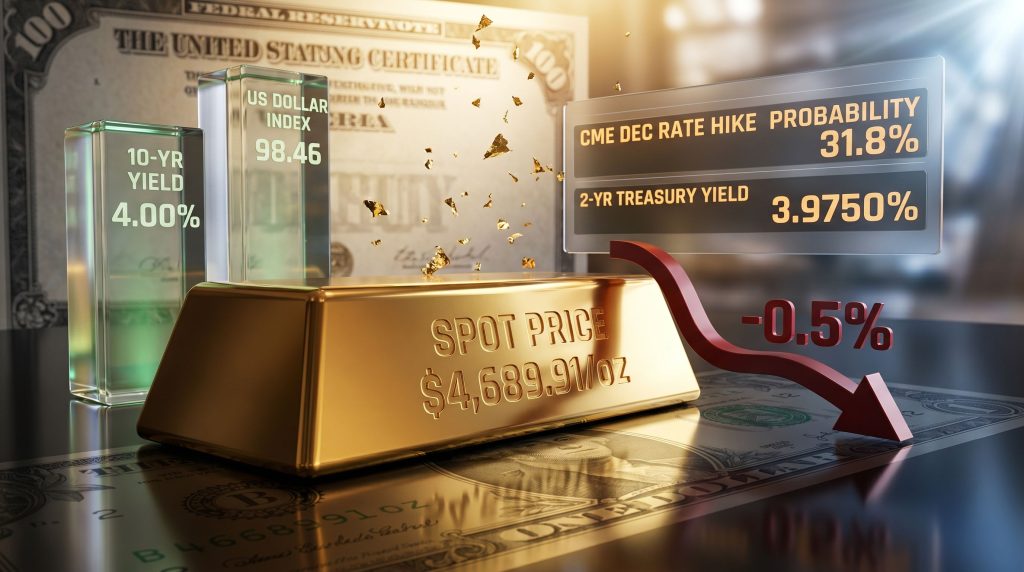
At the same time, rising Treasury yields create a competing store of value. When the 10-year Treasury yield sits at 4.00% and the 2-year yield reaches 3.9750%, short-duration US government debt offers a meaningful, risk-free nominal return. Gold, which generates no income, cannot compete on a yield basis. The 2-year yield signals a persistent inflation expectation that institutional portfolio managers running return targets of 6–8% annually cannot ignore, giving them a clear incentive to rotate capital toward instruments that contribute to that target rather than assets that require price appreciation alone.
As of May 14, 2026, this dual pressure was measurably present:
| Indicator | Level | Significance |
|---|---|---|
| US Dollar Index (DXY) | 98.46 (+0.63%) | Multi-week high; suppresses non-USD gold demand |
| 10-Year Treasury Yield | 4.00% | Raises the opportunity cost for zero-yield assets |
| 2-Year Treasury Yield | 3.9750% | Near a 1.5-month high; signals persistent inflation expectations |
| Spot Gold Price | $4,689.91/oz (-0.5%) | Immediate demand erosion from yield competition |
| CME FedWatch December Rate Hike Probability | 31.8% | Markets pricing in a prolonged tightening cycle |
For gold mining equities, the pressure is compounded further. Higher financing costs directly increase the weighted average cost of capital for development projects, compressing internal rates of return on capital expenditure programmes. A stronger US dollar simultaneously increases the real cost of servicing USD-denominated debt for miners whose revenues and cost bases are in weaker local currencies. This is what analysts refer to as the double squeeze: valuations compress from the top while financing conditions tighten from below.
Furthermore, gold equities leverage means that even modest declines in spot gold can produce outsized earnings compression for producers with fixed cost structures — a dynamic that is often underestimated until it is already priced into share prices.
When short-duration Treasuries approach 4%, the implicit yield premium over gold becomes a genuinely meaningful deterrent for institutional allocators managing duration risk and return targets simultaneously.
Inflation Data Reshaping the Federal Reserve's Policy Calculus
The inflationary backdrop driving this macro regime is not a single data point but an accumulating pattern. April 2026 producer prices recorded their largest monthly increase in four years, arriving on the heels of a consumer inflation reading that had already reached a three-year high. Back-to-back inflation surprises of this magnitude shift the Federal Reserve's reaction function in a specific and consequential direction: from neutral to restrictive.
Markets have responded accordingly. Carol Kong of Commonwealth Bank of Australia has noted that if the Fed proceeds with a rate increase in December 2026, long-dated Treasury yields could breach 5.04%, a level that would materially extend the pressure on non-yielding assets and further compress valuations for gold equity developers. The CME FedWatch tool already reflected a 31.8% probability of a December rate hike as of mid-May, a figure that commands attention because it sits well above the sub-16% levels seen earlier in the year.
Incoming Federal Reserve Chair Kevin Warsh's policy stance is being scrutinised carefully by both bond and commodity markets. Any signal of a more hawkish disposition would reinforce the trajectory already being priced into Treasury yields and the US dollar.
Why Supply-Chain Costs Are Keeping Inflation Structurally Sticky
Several structural forces are making inflation harder to dislodge than a simple rate-hike cycle would normally resolve:
- Ongoing conflict in the Middle East continues to embed a risk premium into energy and shipping costs, feeding through into producer input prices across multiple sectors.
- Risks associated with the Strait of Hormuz remain a live concern for global energy supply chains, and any escalation in this chokepoint would transmit quickly into fuel and freight costs worldwide.
- Chinese monetary authorities have been intervening to slow yuan appreciation against the US dollar, a policy posture that structurally supports dollar demand and limits the speed at which external inflationary pressures can ease.
- Energy and shipping cost normalisation historically takes months, not weeks, after geopolitical tensions reduce, meaning that even a diplomatic breakthrough would not deliver immediate inflation relief.
This structural stickiness is why market participants have begun treating inflation as a durable regime feature rather than a transitory phenomenon, and it is this conviction that is keeping Treasury yields elevated and capital rotating away from gold.
Physical Demand Destruction: What the Bullion Market Is Signalling
One of the most telling indicators of how macro headwinds are transmitting into real-world behaviour is the condition of India's physical gold market. Following increases in import duties, bullion dealers in India have been citing discounts exceeding $200 per ounce, a figure that reflects rapid and severe demand destruction at the consumer level. India, alongside China, has historically represented the largest pool of physical gold demand globally, providing a structural floor under prices that paper markets alone cannot replicate.
When this floor weakens, the consequences extend beyond price support. The feedback loop runs directly into gold equity sentiment: weaker physical demand reduces the price conviction that underpins production economics, which in turn lowers the confidence of equity investors in forward earnings estimates for gold producers.
Currency depreciation compounds the problem. When emerging market currencies weaken against the US dollar, the local-currency cost of gold rises even if the USD price remains stable, creating a dual affordability barrier for the world's largest consumer markets. This is a less-discussed dimension of how the stronger US dollar and higher yields pressure gold equities, yet its effects are both measurable and material.
Gold Equity Amplification: Why Mining Stocks Move Further Than Bullion
A critical concept for investors who are new to the sector is that gold equities do not shadow bullion prices on a one-to-one basis. Mining companies carry operating leverage, meaning their earnings are far more sensitive to changes in the gold price than the price move itself would suggest. A 10% decline in spot gold can translate into a 20–30% compression in earnings for a mid-tier producer with a fixed cost structure, and the equity market typically discounts this rapidly.
In a rising yield environment, this leverage cuts in the wrong direction:
- Fixed operational costs remain constant even as gold revenues decline.
- Debt service obligations, often fixed in USD terms, become more expensive in real terms as yields rise.
- Equity market beta amplifies both the macro risk-off sentiment and the sector-specific headwinds.
- Capital raising becomes more expensive precisely when development-stage companies need it most.
The euro's trajectory illustrated the currency dimension clearly, with the common currency tracking toward its largest weekly decline in two months, falling 0.57% against the dollar during the same period. For European gold mining portfolios, this compounds the already-challenging revenue environment. Stronger US dollar and higher yields pressure on gold equities is therefore not merely a theoretical concern — it is actively reshaping financing conditions across the sector.
Scenario Analysis: How Different Rate Paths Affect Gold Equity Valuations
| Scenario | December Rate Hike Probability | 10-Year Yield Direction | Gold Equity Outlook |
|---|---|---|---|
| Base Case (Current) | 31.8% | Holding near 4.00% | Continued pressure; selective value in low-debt producers |
| Hawkish Escalation | Above 45% | Trending toward 5%+ | Material valuation compression; financing stress for developers |
| Dovish Reversal | Below 16% | Declining toward 3.5% | Relief rally likely; re-rating opportunity for quality assets |
Geopolitical Risk Cannot Override Macro Fundamentals
A persistent blind spot for many gold investors is overweighting the safe-haven narrative. Gold does carry gold safe-haven dynamics, but in a high-yield environment, much of the institutional safe-haven demand flows toward US Treasuries rather than bullion. Government bonds satisfy the same defensive allocation need while generating a return, making them structurally superior to gold when yields are meaningfully positive.
This dynamic was evidenced in late March 2026, when spot gold fell 1.8% to $4,563.64/oz even as US military deployments in the Middle East escalated. Geopolitical escalation provided a modest bid, but the yield and dollar headwinds proved dominant. Investors who positioned around geopolitical catalysts rather than monetary policy signals found themselves on the wrong side of the trade.
Trading geopolitical timelines in a high-yield macro environment carries a structurally asymmetric risk profile. The upside if tensions ease quickly is limited; the downside if inflation remains entrenched and yields continue climbing is material.
Jim Baird, Chief Investment Officer at Plante Moran Financial Advisors, has noted that while diplomatic engagements can reduce short-term market volatility, investors should not expect such meetings to deliver rapid changes in the underlying financing conditions or energy cost environment driving institutional capital allocation decisions. Policy normalisation and supply chain adjustment operate on timescales that diplomatic announcements simply cannot compress.
The next major ASX story will hit our subscribers first
The Structural Bull Case for Gold Has Not Been Invalidated
None of the above should be read as a dismissal of gold's long-term investment thesis. The structural forces supporting gold remain substantive and are largely independent of the current yield cycle. Furthermore, understanding gold and bonds dynamics across economic cycles provides important context for why near-term headwinds do not negate the longer-term case.
- Central bank gold demand across multiple regions continues as a reserve diversification strategy, reducing concentration in US dollar assets.
- BRICS+ economies have been actively reducing exposure to US Treasuries amid what analysts have described as a broader "sell America" sentiment, redirecting reserves toward gold as a neutral reserve asset.
- The US fiscal trajectory, characterised by persistent deficits operating against a backdrop of a global debt overhang estimated in the hundreds of trillions of dollars, creates long-term currency debasement risk that structurally supports gold's monetary role.
- Gold's year-to-date performance through early 2026 had already reflected an extraordinary run, with some reporting periods capturing gains in the range of 25–40%, demonstrating that the underlying demand thesis remained compelling even as near-term headwinds accumulated.
The question is not whether the structural bull case exists but whether near-term macro headwinds will delay its realisation. The answer, based on current Treasury yield levels and CME FedWatch pricing, is yes — at least until rate expectations shift materially.
Signals That Could Reverse the Current Headwinds
Investors watching for a regime shift should monitor the following thresholds:
- A sustained decline in the 2-year Treasury yield below 3.5% would indicate markets are no longer pricing in further Fed tightening.
- CME FedWatch December rate hike probability falling well below 16% would signal a meaningful shift in inflation and yield expectations.
- A reversal in DXY below 95 would remove the primary currency headwind for non-USD gold buyers and restore physical demand conditions in key emerging markets.
Portfolio Positioning Under Dollar Strength and Yield Pressure
Investors navigating this environment require a structured approach to portfolio stress-testing rather than reactive positioning around individual data releases.
A five-step framework for gold equity portfolio management:
- Assess debt maturity profiles. Companies with near-term refinancing obligations face the highest risk in a rising rate environment. Prioritise producers with fixed long-term debt structures or substantial cash balances.
- Evaluate currency exposure. Determine what proportion of each company's cost base is denominated in weaker local currencies (AUD, CAD, ZAR) versus USD revenues. A domestic cost base in a depreciating currency is a natural hedge against USD strength.
- Review all-in sustaining cost (AISC) margins. The gap between AISC and current spot gold prices determines margin resilience. Producers with AISC well below $2,500/oz retain meaningful buffer even under price compression scenarios.
- Monitor CME FedWatch probabilities weekly. This tool provides the most real-time indicator of institutional rate expectations and is a leading signal for Treasury yield direction.
- Track the 2-year Treasury yield as a directional barometer. Sustained moves above 4.25% warrant defensive repositioning toward producers with low debt and strong free cash flow generation.
Characteristics That Define Outperformers in Dollar-Strength Cycles
Not all gold equities are equally exposed. Companies that have historically demonstrated resilience during sustained dollar-strength periods share several identifiable characteristics:
- Net debt-to-EBITDA ratios below 1.0x, reducing vulnerability to rising borrowing costs.
- Cost bases denominated in weaker currencies, particularly AUD or CAD, where local currency depreciation against the USD partially offsets lower gold revenues.
- Strong free cash flow generation at current spot prices, providing self-funding capacity without requiring capital market access during periods of tighter credit.
- Established production profiles rather than development-stage balance sheets, avoiding the dual burden of capital expenditure requirements and rising financing costs simultaneously.
For ASX-listed producers in the Top 200 by market capitalisation, the AUD/USD dynamic provides an additional layer of natural currency hedging that partially insulates margins from USD strength — a structural advantage that is often underappreciated by investors focused primarily on spot gold price movements.
Frequently Asked Questions: Dollar Strength, Higher Yields, and Gold
Does a stronger US dollar always drive gold prices lower?
Not in every circumstance, but dollar strength is one of the most consistent short-term headwinds for gold pricing. Because gold is denominated globally in USD, appreciation in the dollar raises the effective local-currency cost for international buyers, reducing demand. The exception occurs during periods of systemic financial stress, when gold and the dollar can both rise simultaneously as investors seek multiple forms of safety. In the current environment, where dollar strength is yield-driven rather than crisis-driven, the traditional inverse relationship holds.
How do Treasury yields specifically undermine gold's investment case?
When real yields — meaning nominal yields adjusted for inflation expectations — turn meaningfully positive and rise above approximately 1.5% on the 10-year, gold historically faces sustained institutional selling pressure. The mechanism is straightforward: investors who can earn a real return from risk-free government debt have diminishing incentive to hold a non-yielding asset whose return depends entirely on price appreciation.
Are gold equities more sensitive to yield increases than physical gold?
Significantly more sensitive. Gold equities carry additional layers of risk that amplify yield impacts: operational leverage, debt service obligations, equity market beta, and management execution uncertainty. A 50-basis-point rise in yields can produce a multiple of the corresponding impact on bullion, both through direct earnings compression and through the equity risk premium expansion that higher rates typically trigger across the broader market.
Can geopolitical escalation in the Middle East offset yield and dollar headwinds?
Geopolitical risk generates a safe-haven bid for gold, but this bid is frequently overwhelmed in high-yield environments because Treasuries simultaneously satisfy defensive demand while offering income. Unless geopolitical escalation triggers a broad-based flight from US dollar assets — which would require a fundamental reassessment of US fiscal or monetary credibility — the macro headwinds from yields and dollar strength are likely to remain dominant. Historical analysis of gold volatility during geopolitical crises supports this conclusion.
Key Takeaways for Gold Equity Investors
The current confluence of a US Dollar Index at 98.46, a 10-year Treasury yield at 4.00%, and a 31.8% probability of a December rate hike creates a structurally challenging environment where the stronger US dollar and higher yields pressure gold equities from multiple directions simultaneously. Several conclusions follow directly from this regime:
- Physical demand destruction, evidenced by Indian bullion dealer discounts exceeding $200/oz, confirms that macro headwinds are producing real-world demand consequences, not just paper market movements.
- Gold equities face compounded pressure from higher financing costs, currency headwinds, and equity market risk-off sentiment operating simultaneously rather than sequentially.
- Geopolitical risk cannot be relied upon as a price catalyst when yields are competing effectively for institutional safe-haven capital.
- The structural gold bull case, anchored in central bank accumulation, de-dollarisation trends, and fiscal debasement risk, remains valid but is unlikely to overcome near-term headwinds until rate expectations shift materially.
- The 2-year Treasury yield and CME FedWatch probabilities remain the most reliable real-time indicators for timing when macro conditions may become more constructive for gold equity valuations.
This article is intended for informational purposes only and does not constitute financial advice. All market data referenced reflects conditions as of May 14, 2026. Investors should conduct independent due diligence and consider seeking professional financial advice before making investment decisions. Forward-looking statements and scenario projections involve inherent uncertainty and should not be relied upon as predictions of future performance.
Want to Know When the Next Major ASX Gold Discovery Hits the Market?
While macro headwinds continue to pressure gold equities, significant mineral discoveries on the ASX can still generate outsized returns regardless of the broader yield environment — Discovery Alert's proprietary Discovery IQ model delivers real-time alerts the moment a significant discovery is announced, ensuring subscribers can act before the broader market responds. Explore historic discovery returns to understand the scale of opportunity, and begin a 14-day free trial today to position ahead of the next major find.