
May 14, 2026
The Quiet Race to Secure Graphite Before Europe's Battery Boom Peaks
For decades, natural graphite occupied a low-profile corner of industrial commodity markets. It lubricated machinery, lined furnaces, and found its way into pencils. The mineral was abundant, affordable, and — critically — overwhelmingly sourced from a single country. That comfortable arrangement is now fracturing under the weight of the energy transition, and the countries most exposed to the resulting supply risk are scrambling to rewire their procurement strategies before the pressure becomes a crisis.
Germany sits at the sharp end of this problem. As Europe's largest manufacturing economy and the continent's most significant automotive producer, Germany faces a structural mismatch that industrial planners now classify as a systemic vulnerability. A battery gigafactory pipeline growing rapidly in scale, combined with near-zero domestic graphite production and a historical dependency on Chinese imports, has placed the country in a precarious position. The German federal government's response is materialising through financial instruments, diplomatic engagement, and technical assessment missions — one of which recently brought a scientific delegation to a remote open-pit operation in southern Madagascar, making the Molo mine graphite Germany critical minerals study a development of considerable strategic significance.
When big ASX news breaks, our subscribers know first
Why Graphite Has Moved From Industrial Input to Geopolitical Priority
The reclassification of natural graphite as a Critical Raw Material under European Union frameworks represents more than a bureaucratic designation. It signals that procurement obligations, investment mandates, and bilateral diplomatic engagement now apply at the federal government level — fundamentally altering how European institutions interact with graphite producers worldwide.
Several forces converged to produce this shift. At the technical level, natural graphite constitutes approximately 15 to 25 percent of a lithium-ion battery cell by weight, making it the single largest mineral input by mass in the dominant battery chemistry used across electric vehicles, grid storage, and consumer electronics. Unlike some battery materials where substitution pathways exist, natural graphite's structural role in the anode cannot easily be replaced without significant performance and cost penalties.
Synthetic graphite offers an alternative, but carries a substantially higher energy footprint in production, with estimates suggesting synthetic graphite manufacturing consumes roughly five times more energy per tonne than processing natural graphite concentrate into battery-grade material. For European manufacturers navigating increasingly stringent carbon accounting requirements, the carbon intensity of supply chain inputs is becoming a procurement factor in its own right. Furthermore, the battery raw materials market has evolved rapidly, with procurement teams now factoring in full supply chain carbon exposure.
The geopolitical dimension crystallised sharply when China imposed export restrictions on flake graphite in late 2023, applying licensing requirements to overseas shipments of the material. The restrictions validated years of supply chain diversification advocacy and created immediate urgency for battery supply chain planners who had previously accepted Chinese dominance as a structural given. China controls an estimated 70 to 90 percent of global natural graphite processing capacity, meaning that even producers mining graphite outside China often rely on Chinese facilities to transform raw concentrate into battery-grade spherical purified graphite.
This processing chokepoint is arguably more significant than raw mining dependency, and it is one reason why European governments are now seeking not just alternative mining sources but complete supply chain architectures that operate outside Asian processing networks. Consequently, the global graphite shortage has intensified pressure on policymakers to act decisively.
Understanding Germany's Federal Institute for Geosciences and Natural Resources
The BGR is Germany's independent scientific advisory body for matters relating to raw material availability, geological risk, and supply security. Its assessments carry direct weight with federal ministries because they are conducted independently of commercial interests — the distinction between a BGR evaluation and a commercial due diligence exercise is therefore meaningful. When the BGR selects an asset for study, it is applying a government-grade scientific lens to a supply question with genuine national security dimensions.
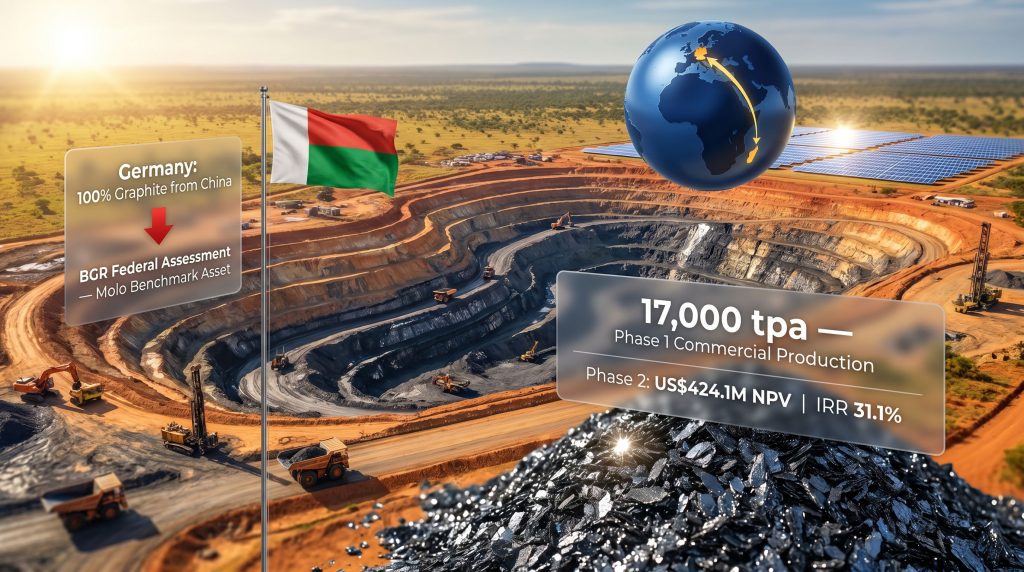
A BGR technical team conducted a site visit at the Molo graphite mine in Madagascar during the week of 12 to 14 May 2026, as part of a broader independent study on graphite production across the island nation. The study is examining Madagascar's graphite production landscape with the objective of assessing individual operations against Germany's strategic supply quality benchmarks.
Critically, the study is being conducted with the formal approval and support of Madagascar's Ministry of Mines, and findings are to be presented to Germany's Federal Ministry for Economic Cooperation and Development. This ministerial pathway ensures that study conclusions feed directly into federal-level decision-making — including potential eligibility assessments for German government investment instruments and formal bilateral supply arrangements.
The significance of BGR selecting Molo as a benchmark asset rather than simply cataloguing it as an existing producer cannot be overstated. It signals that the operation is being evaluated as a potential quality and reliability standard against which other Malagasy operations will be measured — a qualitatively different form of engagement than routine commodity cataloguing.
The Molo Graphite Mine: Technical and Operational Profile
The Molo mine graphite Germany critical minerals study centres on an operation with a compelling technical profile. Operated by TSX-listed NextSource Materials and located in southern Madagascar, the mine covers a permitted area of approximately 176 km² across more than 36 km of strike length. The deposit's geological formation through high-grade metamorphic processes has produced some of the highest-purity natural flake graphite found anywhere outside China, a characteristic that distinguishes it from many competing global sources.
The operation runs as an open-pit mine with a low waste-to-ore strip ratio of 0.53:1, an efficiency metric that directly influences operating economics by reducing the volume of material that must be excavated and moved for every tonne of ore processed. The deposit remains open to depth and along strike, which supports long-term resource growth beyond the currently defined inventory.
Mineral Resource and Reserve Summary
| Resource/Reserve Category | Tonnage (Mt) | Grade (% Cg) | Contained Graphite (kt) |
|---|---|---|---|
| Proven Reserves (High Grade) | 15.5 | 7.00 | 1,085 |
| Proven Reserves (Low Grade) | 5.8 | 4.25 | 248 |
| Measured and Indicated Resources | 100.4 | 6.3 | ~6,325 |
| Inferred Resources | 40.9 | 5.8 | ~2,372 |
Total proven and probable reserves stand at approximately 21.3 million tonnes at roughly 6.8% Cg grade, underpinning a 25-year life of mine and providing the long-term volume certainty that industrial offtake partners require when structuring supply agreements.
Phase 1 nameplate production capacity is 17,000 tonnes per annum (tpa) of SuperFlake® graphite concentrate, with the operation powered by a solar-hybrid energy plant engineered to reduce CO₂ emissions by more than 11,300 tonnes per year compared to a conventional grid-powered facility. This environmental design profile is not incidental — compliance with IFC Performance Standards and the Equator Principles represents a credentialing factor increasingly demanded by European institutional investors and offtake partners navigating their own ESG obligations.
Phase 2 Expansion Parameters
| Metric | Value |
|---|---|
| Expansion Capacity Target | 150,000 tpa |
| Capital Expenditure | US$161.7 million |
| Pre-Tax NPV (8% discount rate) | US$424.1 million |
| Internal Rate of Return | 31.1% |
| Life of Mine | 25 years |
The Phase 2 feasibility economics are particularly relevant in the context of German investment frameworks. A pre-tax NPV of US$424.1 million at an IRR of 31.1% represents a commercially robust project profile by any standard, and the capex requirement of US$161.7 million falls within the range addressable by KfW minority equity participation.
How Molo Compares to Other Non-Chinese Graphite Sources
The competitive landscape for natural flake graphite production outside China remains extremely thin. Fewer than a handful of operations are in commercial production, with most African and Canadian graphite projects still navigating development and pre-production phases. This scarcity elevates each operating mine to a position of genuine strategic significance in the global supply calculus.
Molo's most structurally important distinction is that it is already producing and already shipping — a competitive advantage that no amount of development-stage project economics can replicate. The first commercial container shipments of SuperFlake® graphite concentrate from Tulear port, Madagascar, to Germany and the United States were completed in October 2024, targeting refractory materials, graphite foils for electronics, and fire-retardant product manufacturing. These shipments represent the physical proof-of-concept for a Madagascar-to-Germany graphite supply corridor.
Competitive Positioning Matrix
| Attribute | Molo (Madagascar) | Typical Chinese Supply | African Peers (Development Stage) |
|---|---|---|---|
| Production Status | Commercial (Phase 1) | Fully operational | Pre-production |
| Grade (% Cg) | ~6.8 to 7.0% | Variable | Variable |
| ESG Compliance | IFC/Equator Principles | Limited transparency | Variable |
| Carbon Footprint | Solar-hybrid powered | Coal-heavy grid processing | Undetermined |
| Supply Chain Transparency | High | Low | Limited |
| Timeline to Supply | Immediate | Subject to export restrictions | Multi-year |
A study from the Karlsruhe Institute of Technology highlighted that diversifying Germany's metallic raw material supply from African sources requires acknowledging lead times of ten or more years from exploration to production. Molo's status as an already-operating mine effectively eliminates this timeline risk — making it structurally unique among African graphite assets currently being evaluated for European supply chains.
Germany's Critical Minerals Investment Architecture
Germany has committed substantial capital to the structural problem of raw material dependency, deploying multiple instruments that could directly intersect with Molo's Phase 2 expansion financing. In addition, growing critical minerals demand across Europe is accelerating the pace at which these investment frameworks are being activated.
The KfW Raw Materials Fund represents Germany's most direct project-level mechanism. With a total capitalisation of €1 billion, the fund provides minority equity investment of up to €150 million per qualifying project in upstream mining and processing. Eligibility criteria align closely with Molo's existing profile — supply chain transparency, ESG compliance, and strategic material designation are all prerequisites the operation can demonstrate.
Separately, Germany has joined France and Italy in a coordinated €2.5-billion critical minerals investment framework targeting battery metals, rare earths, and industrial minerals including graphite. This trilateral commitment represents the most significant multilateral European government initiative directed at ex-China mineral supply chain development, and its scope explicitly encompasses the type of operational and expansion financing that Molo's Phase 2 would require. Furthermore, Europe's critical minerals supply chain ambitions are increasingly dependent on securing partnerships with exactly the kind of operating mine that Molo represents.
Should the BGR study conclude that Molo meets Germany's supply quality benchmarks, the Phase 2 expansion's US$161.7 million capex could become eligible for KfW minority equity participation — potentially providing up to €150 million in sovereign capital that would materially de-risk the financing structure while establishing a formal bilateral Madagascar-Germany resource relationship. This outcome is speculative and dependent on study conclusions not yet publicly released.
The next major ASX story will hit our subscribers first
Madagascar's Strategic Position in Europe's Mineral Diversification
Madagascar's emergence as a tier-one graphite jurisdiction is rooted in geology. The island's graphite belt was formed through ancient high-grade metamorphic processes that produced unusually pure natural flake graphite across multiple project areas, providing a scale of potential supply that extends well beyond any single operation.
Practically, Madagascar holds several structural advantages over competing African jurisdictions. Established port infrastructure at Tulear enables direct container shipping to European destinations without requiring transhipment through third-country hubs. The country's regulatory frameworks have been progressively aligned with international mining standards, and the formal government endorsement of the BGR study signals Madagascar's deliberate intent to position itself within European critical minerals procurement networks.
The broader African context matters here. The continent hosts a significant proportion of the world's undeveloped critical mineral resources, yet has historically captured limited value from their extraction. The current European drive for supply chain diversification represents an unusual structural alignment of interests — European governments need non-Chinese sources urgently, while African jurisdictions with operating projects need the long-term offtake commitments and capital that European investment frameworks can provide. Moreover, the availability of recycled graphite supply is growing, but remains insufficient to bridge the anticipated shortfall on its own.
The Anode Material Pathway and NextSource's Vertical Integration Ambition
Understanding the Molo mine graphite Germany critical minerals study in its full context requires mapping the complete production pathway from mine output to battery cell, because the value — and the supply chain vulnerability — is not evenly distributed across each processing step.
The transformation from raw graphite to battery-grade material follows a defined sequence:
- Mining and concentration at the open-pit operation produces SuperFlake® graphite concentrate
- Micronization and spheronization reduce particle size and shape the graphite into spherical particles optimised for anode performance
- Thermal purification removes impurities to battery-grade specifications (typically above 99.95% carbon purity)
- Surface coating applies a carbon layer to optimise electrochemical performance in the battery cell
- Cell integration by battery manufacturers who combine spherical purified graphite (SPG) with binders and current collectors to form the anode
The critical vulnerability for European supply chains is that steps two through four are dominated by Chinese processing facilities. NextSource's stated objective of vertical integration into anode material production outside Asian processing chains directly targets this chokepoint. If achieved, it would position Molo not merely as a raw material source but as a node in a fully European-controlled battery anode supply chain — which is precisely the architecture that German industrial planners are attempting to construct.
Supply Chain Risk Reduction: A Quantified Framework
| Risk Factor | Current State (China-Dependent) | Post-Diversification Scenario |
|---|---|---|
| Single-source dependency | Near-total reliance on China | Materially reduced through multi-source procurement |
| Export restriction exposure | High — 2023 precedent established | Significantly lower |
| ESG supply chain auditability | Low | High under IFC-compliant framework |
| Carbon intensity of supply | Elevated (coal-grid processing) | Lower (solar-hybrid production) |
| Geopolitical disruption risk | Elevated and concentrated | Distributed across multiple jurisdictions |
| Processing chain control | Minimal | Improved through vertical integration pathway |
Long-Term Demand Drivers for Natural Graphite
| Demand Driver | Timeframe | Directional Impact |
|---|---|---|
| EV battery gigafactory buildout across Europe | 2025 to 2030 | Significant volume uplift |
| Grid-scale energy storage expansion | 2026 to 2035 | Incremental but sustained growth |
| Industrial refractory and lubricant applications | Ongoing | Stable baseline demand |
| Fuel cell component manufacturing | 2027 to 2035 | Emerging demand category |
| Anode material localisation mandates | 2026 onward | Accelerating near-term demand |
Key Takeaways for Industry Observers and Investors
Several structural themes emerge from the convergence of the BGR assessment, German investment frameworks, and Molo's operational profile:
-
Sovereign validation carries a different weight than commercial endorsement. A federal German government scientific agency conducting an independent site visit represents a qualitatively distinct form of recognition — it feeds directly into policy and procurement decision-making rather than simply signalling commercial interest.
-
Benchmark status is a meaningful distinction. Being assessed as a quality reference point against which other Malagasy operations are measured suggests the BGR is evaluating Molo as a standard-setter rather than merely documenting its existence.
-
The processing chain is the real battleground. Raw graphite production is only the first step. Europe's supply chain ambition requires controlling or accessing the full processing pathway to battery-grade material — and NextSource's vertical integration objectives align directly with this requirement.
-
Timing creates structural advantage. Development-stage graphite projects face a decade-long path to production. Operating mines with established port logistics and proven commercial shipments to European customers occupy a fundamentally different risk profile for both offtakers and investors.
-
Madagascar's government alignment matters. Formal Ministry of Mines endorsement of the BGR study signals that Madagascar's regulatory environment is actively supporting its integration into European supply chains rather than creating friction — a non-trivial distinction in the African mining context.
This article contains forward-looking analysis and speculative scenario assessments based on publicly available information and should not be construed as financial or investment advice. Readers should conduct independent due diligence and consult qualified advisors before making any investment decisions related to companies or projects discussed herein. All financial metrics cited for the Molo Phase 2 expansion are drawn from company-disclosed feasibility studies and are subject to the material assumptions and risks inherent in such assessments.
Readers seeking broader context on Germany's critical minerals strategy and European battery supply chain developments can consult Mining Weekly at miningweekly.com, which tracks ongoing developments across graphite, lithium, and battery materials sectors.
Want to Know When the Next Major Graphite or Critical Minerals Discovery Hits the ASX?
Discovery Alert's proprietary Discovery IQ model scans ASX announcements in real time, instantly identifying significant mineral discoveries — including graphite and battery materials — and delivering actionable alerts to subscribers before the broader market reacts. Explore how major mineral discoveries have historically generated exceptional returns on the Discovery Alert discoveries page, and begin your 14-day free trial today to position yourself ahead of the next critical minerals opportunity.