June 30, 2026
The Geological Calculus Behind the World's Most Expensive Copper Bet
Porphyry copper deposits are among the most paradoxical assets in the mining world. They are enormous, often containing billions of tonnes of mineralisation, yet their economic viability is perpetually under pressure from a single, relentless force: grade dilution. As mining progresses deeper and outward from the highest-concentration core, the copper percentage in each tonne of rock declines. Maintaining output therefore demands a choice between operational innovation, capital-intensive expansion, or both.
This geological reality sits at the heart of the BHP Escondida copper expansion in Chile, a programme that has now crossed a critical regulatory threshold and unlocked one of the most consequential investment programmes in global mining history. The question is not simply whether BHP can execute a multi-billion dollar construction effort in the Atacama Desert. The question is whether the copper market, the regulatory environment, and the resource itself will align in time to justify the scale of commitment being made.
When big ASX news breaks, our subscribers know first
Escondida's Position in the Global Copper Architecture
Understanding the scale of this investment requires understanding what Escondida actually represents in global copper supply terms. Located in the Atacama Desert of northern Chile at high altitude, Escondida is the single largest copper-producing operation on earth, and has held that distinction for decades.
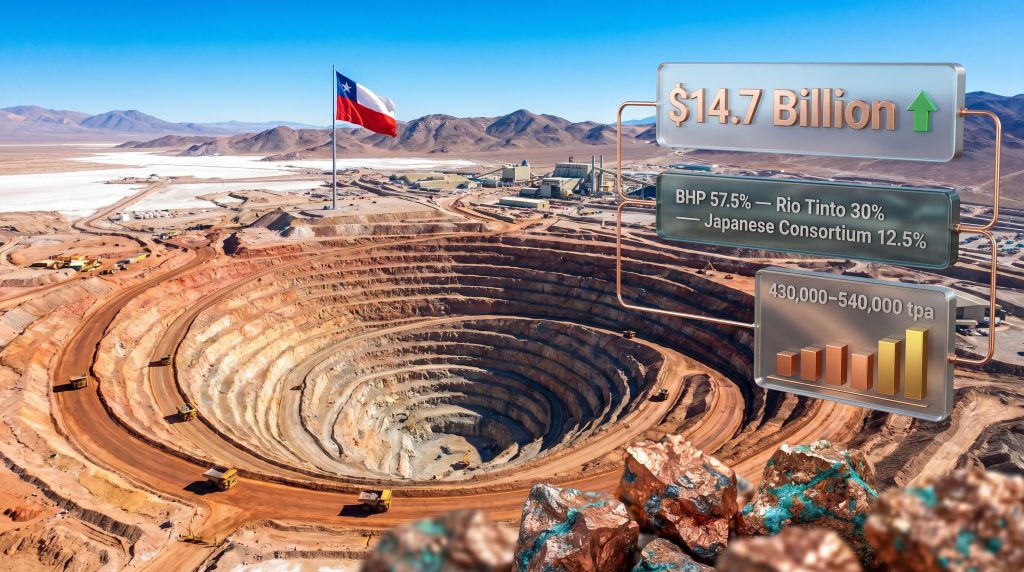
The ownership structure of the mine reflects the global strategic appetite for tier-one copper assets:
| Shareholder | Ownership Stake |
|---|---|
| BHP Group | 57.5% |
| Rio Tinto | 30.0% |
| Japanese Consortium | 12.5% |
BHP's majority position makes Escondida the centrepiece of its global copper ambitions. Taken together, BHP-operated Chilean mines account for approximately 27% of Chile's total national copper output, a figure that underscores the mine's systemic importance not just to BHP's balance sheet, but to the host nation's fiscal position.
Despite decades of continuous extraction, Escondida retains a remaining copper resource of approximately 26 billion tonnes at an average grade of 0.53%. That figure provides the geological foundation necessary to justify capital expenditure at the scale BHP is proposing, but it also signals the challenge ahead. Consequently, 0.53% average grade means processing roughly 200 tonnes of rock to recover a single tonne of copper, which demands industrial-scale throughput capacity — precisely what the expansion programme is designed to deliver.
What Chile's Regulatory Approval Actually Unlocked
In July 2026, Chile's Antofagasta Environmental Assessment Commission granted BHP the first major regulatory clearance in its multi-stage Escondida expansion programme. The approved scope covers sulphide leaching facility upgrades and electricity infrastructure improvements, carrying a capital cost of approximately $1.3 billion.
This initial approval is best understood as a regulatory gateway rather than the full programme itself. Furthermore, the broader investment architecture is substantially larger:
| Expansion Component | Capital Cost Range | Incremental Output | Target Timeline |
|---|---|---|---|
| Sulphide Leaching + Electricity (Stage 1) | ~$1.3 billion | 35,000-55,000 tpa | From 2030/32 |
| Laguna Seca Concentrator Optimisation | $2.0B-$2.6B | 50,000-70,000 tpa | From 2030/31 |
| New Concentrator (125 ktpd) | $4.4B-$5.9B | 220,000-260,000 tpa | From 2031/32 |
| Pampa Norte (Spence + Cerro Colorado) | $2.8B-$3.9B | 125,000-155,000 tpa | Phased |
| Total Programme | $10.7B-$14.7B | 430,000-540,000 tpa | Multi-decade |
The range between floor and ceiling estimates is itself informative. A spread of roughly $4 billion between low and high case reflects genuine uncertainty in final scope, contractor pricing, water infrastructure requirements, and community engagement costs. Mining megaprojects in remote, high-altitude environments carry structural cost escalation risk that even the most rigorous feasibility studies struggle to fully contain.
The Sulphide Leaching Decision: A Technical Inflection Point
One of the less-discussed aspects of the BHP Escondida copper expansion in Chile is the deliberate emphasis on sulphide leaching technology in the initial approval stage. This choice has significant technical and strategic implications worth unpacking.
Conventional copper processing at Escondida has historically relied on flotation circuits, where crushed ore is mixed with water and reagents to separate copper-bearing minerals from waste rock. Sulphide leaching, by contrast, uses acidic solutions to dissolve copper directly from sulphide ore, bypassing some of the capital-intensive grinding and flotation infrastructure.
The critical distinction is that primary sulphide ores, which dominate Escondida's deeper resource base, have traditionally been considered difficult to process via leaching. Advances in heap leaching technology and bioleaching techniques are gradually changing this assumption, however the metallurgical risk profile differs meaningfully from conventional flotation. BHP's investment in sulphide leaching at Escondida signals a strategic bet on emerging processing technology, not just conventional expansion.
"The shift toward sulphide leaching at depth is one of the most technically ambitious aspects of the Escondida programme, representing a departure from established processing norms at the site."
Laguna Seca: The Defensive Investment the Market Underestimates
Among the expansion components, the Laguna Seca concentrator optimisation deserves particular attention because its strategic rationale is partly defensive. BHP has committed an initial $2 billion to maintaining throughput capacity at this facility, but the investment is not purely about growth.
The upcoming closure of the Los Colorados processing plant creates a production gap at Escondida that Laguna Seca must absorb. Without this upgrade, the natural decline in ore grades combined with reduced processing capacity would erode output at a mine that delivered a 22% year-on-year increase in copper production during the first half of FY2025. The Laguna Seca commitment is therefore as much about protecting existing output as it is about expansion — a nuance often lost when headline capital figures are reported in isolation.
The New Concentrator: Scale Economics and the 2028 Construction Window
The single largest component of the Escondida programme is a new concentrator with a nameplate processing capacity of 125,000 tonnes per day. BHP formally applied for separate environmental approval to construct this facility in March 2026, meaning the permitting process runs in parallel with, but independently from, the July 2026 approval.
Key parameters of the new concentrator project:
- Processing capacity: 125,000 tonnes of ore per day (ktpd)
- Estimated capital cost: $4.4 billion to $5.9 billion
- Construction start target: 2028 (subject to environmental approval)
- First production contribution: 2031/32
- Incremental annual output: 220,000 to 260,000 tonnes of copper
The 2028 construction start is a critical pathway dependency. If environmental approval for the new concentrator is delayed significantly, the entire production timeline shifts, potentially creating a supply contribution gap precisely when the global copper deficit is projected to be most acute. Chile's project-by-project approval framework means each component must navigate its own regulatory process, introducing sequential risk into what BHP would prefer to be a coordinated build programme.
The next major ASX story will hit our subscribers first
BHP's Production Growth Target in Context
BHP's stated ambition to roughly double its global copper output to more than two million tonnes per annum by the mid-2030s is an extraordinary target when examined against current production levels. In addition, understanding the copper price growth drivers underpinning this commitment reveals why BHP is willing to commit capital at this scale.
| Metric | Current Position | Mid-2030s Target |
|---|---|---|
| BHP Group Copper Output | ~1 million tpa | >2 million tpa |
| Escondida H1 FY2025 Output Growth | +22% year-on-year | – |
| Total BHP H1 FY2025 Group Copper | ~987,000 tonnes | – |
| Chilean Share of BHP Copper | Majority of total | Majority of total |
Achieving this requires the Chilean expansion programme to execute largely as planned, across multiple separate regulatory approvals, through a decade of construction in one of the world's most logistically challenging environments. The Atacama Desert presents unique operational constraints: extreme water scarcity, altitude effects on equipment and personnel, and distance from industrial supply chains all add cost and execution risk relative to more accessible mining jurisdictions.
The Pampa Norte Dimension: Cerro Colorado and Spence
BHP's Chilean copper strategy extends beyond Escondida to encompass its Pampa Norte operations. In June 2026, BHP applied to restart and expand Cerro Colorado in northern Chile at a projected cost of $1.5 billion, with the operation expected to contribute between 85,000 and 100,000 additional tonnes per annum once operational.
Combined with the Spence operation, the total Pampa Norte expansion is budgeted at $2.8 billion to $3.9 billion, targeting 125,000 to 155,000 tonnes per annum in incremental output. This positions Pampa Norte as a meaningful supplementary contributor to BHP's copper growth ambitions, even as Escondida dominates the headline investment figures.
The Supply Deficit Imperative: Why This Investment Cannot Wait
What Is Driving the Copper Supply Crunch?
The projected global copper supply deficit of approximately 10 million tonnes within the next decade is not a speculative forecast confined to optimistic industry reports. The ongoing copper supply crunch reflects a convergence of structural forces that analysts across the commodity research spectrum broadly agree are real:
- EV adoption curves requiring significantly more copper per vehicle than internal combustion equivalents
- Grid infrastructure upgrades across major economies demanding sustained high-voltage cable and transformer investment
- Data centre and AI hardware proliferation driving copper-intensive power infrastructure
- Declining grades at existing operations reducing effective output from the same physical mine footprint
- 15-20 year lead times for new greenfield copper mines preventing rapid supply-side response
This combination creates what commodity strategists sometimes describe as a structural inelasticity problem: demand is accelerating across multiple vectors simultaneously, while the supply response is constrained by geological, regulatory, and capital factors that cannot be compressed regardless of price incentive.
How Does Chile Fit Into the Global Picture?
Chile's copper supply gap is particularly significant given that the country remains the world's largest copper producer. However, output from existing Chilean operations has faced persistent grade decline pressure. The Chile copper price outlook consequently remains closely tied to BHP's ability to deliver on its expansion commitments.
"The scarcity of development-ready tier-one copper assets globally means existing operations like Escondida carry a strategic premium that justifies capital intensity at a scale that would be difficult to rationalise in a more abundant supply environment."
Key Risks Every Investor Should Understand
What Are the Principal Risks for This Programme?
The BHP Escondida copper expansion in Chile is compelling from a strategic standpoint. Nevertheless, several material risks warrant careful consideration, and sound copper investment strategies must account for each of them:
- Capital cost escalation: The $4 billion gap between low and high-case estimates signals meaningful execution uncertainty, particularly for the new concentrator in a remote desert environment
- Sequential regulatory risk: Multiple separate approval processes mean any single delay cascades through the entire production timeline
- Water scarcity: The Atacama is one of the driest environments on earth, and processing expansion at scale requires substantial water infrastructure investment
- Community and indigenous stakeholder engagement: Northern Chile has a history of project timeline sensitivity related to indigenous land rights and water access disputes
- Ore grade and metallurgical uncertainty: The economic viability of lower-grade sulphide zones depends on processing efficiency outcomes that are not yet fully proven at commercial scale at this site
- Copper price trajectory: The entire investment thesis is underpinned by long-term price support; near-term volatility does not invalidate the thesis, but a sustained structural price decline would alter the economics materially
Disclaimer: This article is intended for informational purposes only and does not constitute financial advice. Forward-looking statements regarding production targets, capital costs, and market projections involve inherent uncertainty. Readers should conduct their own due diligence before making any investment decisions.
Frequently Asked Questions
What triggered the July 2026 environmental approval at Escondida?
Chile's Antofagasta Environmental Assessment Commission cleared the first stage of BHP's expansion, specifically covering sulphide leaching facility upgrades and electricity infrastructure improvements, at an initial capital cost of approximately $1.3 billion.
How much copper will the full programme add?
Across all Chilean expansion components, BHP targets incremental output of 430,000 to 540,000 tonnes per annum, with the new concentrator alone contributing 220,000 to 260,000 tpa from 2031/32.
What is the total capital commitment across Chile?
BHP estimates total capital expenditure across its Chilean copper operations at between $10.7 billion and $14.7 billion over the coming years, spanning Escondida and the Pampa Norte operations.
Why does Escondida still have a massive resource despite decades of production?
Escondida is hosted within a large porphyry copper system with approximately 26 billion tonnes of remaining resource at an average grade of 0.53%. The sheer scale of the deposit means that even at high production rates, the resource base supports multi-decade mine life.
What makes the new concentrator the most significant single investment?
At $4.4 billion to $5.9 billion, it is the largest single capital commitment in the programme, with a processing capacity of 125,000 tonnes of ore per day and the potential to add more incremental annual copper output than any other component.
Want to Track the Next Major Copper Discovery Before the Market Does?
Discovery Alert's proprietary Discovery IQ model delivers real-time alerts on significant ASX mineral discoveries — instantly transforming complex geological data into actionable investment insights for both short-term traders and long-term investors. Explore historic examples of major mineral discoveries and their extraordinary returns, then begin your 14-day free trial at Discovery Alert to position yourself ahead of the market.