August 14, 2026
The Andean Copper Belt and the Rise of Chinese State Capital in Latin America
The global copper supply chain does not operate on commercial logic alone. Across the Andean mountain range, from Chile's Atacama Desert to the tropical forests of southern Ecuador, a quiet but consequential repositioning of capital has been underway for more than a decade. Chinese state-owned enterprises have systematically moved upstream, acquiring stakes in some of the world's most significant undeveloped copper systems at a time when Western mining capital remained cautious about frontier jurisdictions. Understanding this pattern is essential to understanding why Tongling Nonferrous Metals Group Holding Co., Ltd. (TNMG) is now the majority stakeholder in Ecuador's first and largest industrial copper mine.
This is not a story about a single company. It is a story about how resource security imperatives shape investment behaviour, and why a Chinese SOE headquartered in Anhui Province came to define the trajectory of an entire national mining sector. Furthermore, the broader implications of this shift touch directly on copper supply crunch dynamics that are reshaping global commodity markets.
When big ASX news breaks, our subscribers know first
Understanding TNMG: State Enterprise, Not Simply a Mining Company
Tongling Nonferrous Metals Group Holding Co., Ltd. is registered at Tongdu Avenue South, Tongling, Anhui Province, China (244001), and operates under the tradename Tongling Nonferrous Metals (TNMG). Its classification as a Chinese state-owned enterprise fundamentally shapes how analysts, investors, and host governments should interpret its overseas investment decisions.
TNMG's core industrial scope spans the complete non-ferrous metals value chain:
- Mineral exploration and resource assessment
- Underground and open-pit extraction
- Ore processing and concentrate production
- Copper smelting and refined metal production
- Downstream fabrication and alloy manufacturing
China accounts for more than 50% of global refined copper production, making SOEs like TNMG structurally critical to national industrial supply security. This concentration of refining capacity creates a perpetual upstream dependency: Chinese smelters require a continuous and growing supply of copper concentrate from overseas mines. TNMG's international investments are, in large part, a direct response to that structural gap.
TNMG functions less as a pure-play mining company and more as an instrument of China's industrial supply policy. Its overseas capital deployment reflects national resource security objectives that extend well beyond conventional return-on-investment timelines.
Beyond copper, TNMG's Ecuadorian operations carry exposure to gold, silver, and molybdenum as polymetallic by-products, adding commodity diversification that improves the overall project economics of its flagship Andean asset.
Why Ecuador? The Geology and Policy Conditions That Attracted Chinese Capital
Ecuador's emergence as a mining jurisdiction was not inevitable. For most of the twentieth century, the country's economy was structured around petroleum exports, with metallic mining effectively absent from industrial policy. That changed fundamentally with Ecuador's 2009 Mining Law, which created the legal architecture for large-scale metallic mining for the first time and opened the door to foreign capital at scale.
The geological rationale was already compelling before the legal framework arrived. Ecuador sits within the Andean Copper Belt, a tectonically active zone that hosts some of the world's most prolific porphyry copper-gold systems. Porphyry deposits are the workhorses of the global copper industry: large-tonnage, lower-grade systems amenable to bulk mining methods that generate the sustained concentrate volumes Chinese smelters require.
Several converging factors made Ecuador particularly attractive for Chinese SOE entry at the time of the TNMG/CRCC acquisition:
| Factor | Ecuador's Competitive Advantage |
|---|---|
| Geological endowment | Andean Copper Belt porphyry systems with multi-decade mine lives |
| Legal environment | 2009 Mining Law enabling first-time large-scale extraction |
| Currency stability | Fully dollarized economy eliminates foreign exchange risk |
| Development stage | Greenfield assets with minimal incumbent competition |
| Capital tolerance | State-backed financing accepts longer payback horizons than commercial banks |
This combination of geological prospectivity, legal openness, and macroeconomic stability created a window of opportunity that TNMG and its partner China Railway Construction Corporation (CRCC) moved decisively to capture. In addition, these conditions align closely with broader critical minerals demand trends reshaping global investment priorities.
The Mirador Mine: Ecuador's Copper Flagship and TNMG's Core Asset
From Canadian Explorer to Chinese Industrial Operation
The Mirador copper project was originally developed by a Canadian mining company before the CRCC-Tongguan Investment consortium acquired it in 2010. That acquisition established the controlling partnership between TNMG and CRCC, with TNMG holding a 70% project stake and CRCC the remaining 30%.
The operational vehicle for the mine is Ecuacorriente S.A. (ECSA), the Ecuadorian subsidiary of the consortium, which manages all extraction, processing, and logistical functions from its base in Zamora-Chinchipe Province in southern Ecuador.
The 70/30 ownership split between TNMG and CRCC reflects a deliberate and recurring template in Chinese overseas mining ventures. TNMG brings the metallurgical, processing, and smelting expertise required to evaluate and optimise ore treatment, while CRCC contributes the heavy civil construction and infrastructure development capabilities essential for building a mine from scratch in a remote tropical environment.
Key Milestones in Mirador's Development
| Milestone | Year |
|---|---|
| TNMG/CRCC Acquisition of Canadian Developer | 2010 |
| Construction Commencement | 2012 |
| Commercial Production Achieved | 2019 |
| First Copper Concentrate Export to China | January 2020 |
| Production Suspension (Power Rationing) | Late 2024 |
| Full Dual-Series Production Restored | January 2025 |
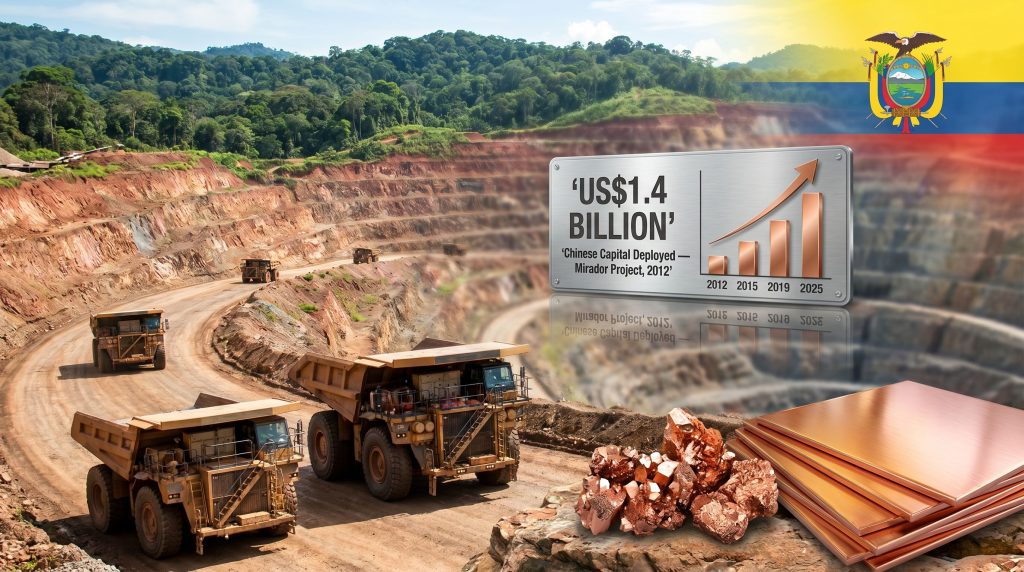
Total Chinese capital deployed in the Mirador project since construction commenced in 2012 is estimated at approximately US$1.4 billion, making it one of the largest single foreign mining investments in Ecuador's history.
TNMG's Local Ecuadorian Entity
In addition to its stake through the CRCC-Tongguan consortium, TNMG operates a dedicated local subsidiary: Tongling Nonferrous Metals Group Tongguan Construction and Installation Co., Ltd., incorporated on August 13, 2015, and registered in El Pangui, Zamora-Chinchipe Province at Av. de Ejercito. This entity handles nonresidential building construction, mining support services, and environmental compliance activities directly linked to the Mirador operation.
Ecuador's Power Crisis and What It Reveals About Operational Risk
The 2024 Hydropower Shortfall
In late 2024, Ecuador's national electricity grid experienced significant rationing pressures driven by critically low reservoir levels at its hydroelectric generation facilities. Ecuador's power system is heavily dependent on hydroelectric generation, which typically provides the majority of national electricity supply. When prolonged drought conditions reduced water availability, the National Electricity Dispatch Center implemented mandatory rationing protocols affecting industrial consumers including ECSA.
As a direct consequence, dual-series processing operations at Mirador were suspended. The interruption was not a failure of mine infrastructure or ore supply, but a macro-level energy system constraint imposed across Ecuador's entire industrial base. However, the episode underscores how mining geopolitics and infrastructure dependencies can materially affect even well-capitalised operations.
Operational Risk Flag: Energy-intensive copper processing operations require continuous, uninterrupted power at industrial scale. Mirador's dependence on Ecuador's national grid creates a structural vulnerability that is difficult for the operator to fully mitigate through on-site generation alone. The 2024 crisis is a material risk factor that must be incorporated into any long-term project economics assessment.
Restoration and Operational Continuity
In January 2025, ECSA confirmed the re-establishment of grid power from Ecuador's National Electricity Dispatch Center, with full dual-series production resuming shortly thereafter. The relatively rapid restoration of operations demonstrated meaningful operational resilience, though the episode highlights that grid dependency remains a recurring variable in Mirador's production profile.
Beyond Mirador: TNMG's Broader Andean Copper Portfolio
San Carlos-Panantza: Ecuador's Second Major Copper Frontier
TNMG holds interests in the San Carlos-Panantza copper project, located in Morona-Santiago Province in Ecuador's Amazonian southeast. The project represents a significant longer-dated development option within the broader CRCC-Tongguan portfolio, but its advancement timeline carries a distinct risk profile compared to Mirador.
San Carlos-Panantza sits adjacent to Shuar indigenous territory, a zone with historically elevated complexity in community relations. Any pathway to construction and commercial production will require sustained, good-faith consultation processes with affected indigenous communities, compliance with Ecuador's Free, Prior and Informed Consent (FPIC) obligations, and progressive permitting milestones. These are not insurmountable barriers, but they represent a genuinely longer development horizon than a commercially motivated investor would typically prefer.
Río Blanco, Peru: Cross-Border Andean Diversification
TNMG's Latin American copper exposure extends beyond Ecuador through its participation in the Río Blanco copper project in Peru. The ownership structure positions TNMG as a meaningful minority partner:
| Project | Country | TNMG Stake | Co-Investors | Status |
|---|---|---|---|---|
| Mirador | Ecuador | 70% (via CRCC-Tongguan) | CRCC (30%) | Operating |
| San Carlos-Panantza | Ecuador | Minority interest | CRCC consortium | Development stage |
| Río Blanco | Peru | 35% | Zijin Mining (51%), Xiamen C&D Inc. (14%) | Development stage |
At Río Blanco, Zijin Mining holds the majority 51% operating stake, with TNMG (35%) and Xiamen C&D Inc. (14%) as co-investors. Zijin Mining expansion into Latin American assets has consequently created a natural co-investment framework alongside TNMG, distributing both capital requirements and operational responsibilities across multiple Chinese institutional investors.
The next major ASX story will hit our subscribers first
Ecuador's Mining Sector: A Competitive Landscape in Formation
TNMG's presence in Ecuador does not exist in isolation. The country's mining sector is rapidly evolving from a single-project story into a multi-operator jurisdiction with approximately US$11 billion in planned mining investment across eight new mine projects in the pipeline.
The competitive landscape reveals a notable structural bifurcation between Chinese state-capital-backed projects and Western-listed operators:
- EcuaCorriente S.A. (ECSA): TNMG's own operating subsidiary for Mirador, directly tied to the CRCC-Tongguan consortium
- Exploraciones Novomining S.A. (ENSA): SolGold's Ecuadorian operating entity, advancing the world-class Cascabel copper-gold porphyry system
- Aurelian Ecuador S.A.: Lundin Gold's subsidiary, operating the producing Fruta del Norte gold-silver mine
- Curimining S.A.: The operating vehicle for the Curipamba-El Domo copper-gold project in Bolívar Province
- ExplorCobres S.A. (EXSA): A large-scale copper exploration company advancing Ecuadorian copper resources
- Carnegie Ridge Resources S.A.: Focused on copper and gold exploration in southern Ecuador
This bifurcation matters analytically. Chinese SOE-backed projects like Mirador operate with longer payback tolerance, state-supported financing structures, and a vertically integrated off-take rationale that connects mine output directly to Chinese smelting capacity. Western-listed miners operate under different capital discipline frameworks, with quarterly reporting obligations and commercial off-take arrangements that respond to spot and forward market pricing. Furthermore, understanding these distinctions is critical when evaluating copper investment strategies across both project types.
Risk and Opportunity Matrix for TNMG's Ecuador Operations
Key Risk Factors
| Risk Category | Specific Risk | Severity |
|---|---|---|
| Energy infrastructure | Grid instability and hydropower rationing | High |
| Social licence | Indigenous community relations at San Carlos-Panantza | High |
| Environmental | Tropical ecosystem sensitivity in Zamora-Chinchipe | High |
| Regulatory | Permitting delays and evolving mining law | Medium |
| Geopolitical | China-Ecuador bilateral trade and diplomatic dynamics | Medium |
| Concentration risk | Heavy Ecuador weighting in Latin American portfolio | Medium |
Structural Opportunity Drivers
Several macro and sector-level factors support the long-term strategic rationale for TNMG's Ecuadorian copper platform:
-
Energy transition demand: Copper is a foundational material for electric vehicle batteries, power grid infrastructure, solar generation, and wind turbines. Structural demand growth from decarbonisation programmes creates a durable price support thesis.
-
Underexplored endowment: Ecuador's copper resource base remains significantly underexplored relative to Chile and Peru, suggesting material upside potential for further resource delineation across TNMG's Ecuadorian concessions.
-
Established infrastructure: Mirador's existing processing plant, tailings facilities, concentrate pipeline, and port logistics infrastructure provide a built platform for incremental capacity expansion.
-
Portfolio synergies: Geographic proximity between Mirador and San Carlos-Panantza creates potential for shared workforce, logistics, and processing infrastructure that could improve development economics for the second project.
-
Jurisdiction signalling: Ecuador's continued openness to large-scale mining investment, despite periodic social opposition, demonstrates a government-level recognition of the sector's fiscal contribution potential.
Frequently Asked Questions: Tongling Nonferrous Metals Group Holding Co., Ltd. in Ecuador
What is Tongling Nonferrous Metals Group Holding Co., Ltd. and what does it do in Ecuador?
Tongling Nonferrous Metals Group Holding Co., Ltd. (TNMG) is a Chinese state-owned enterprise engaged in the full non-ferrous metals value chain, from mineral exploration through to copper smelting. In Ecuador, TNMG holds a 70% stake in the Mirador copper mine through the CRCC-Tongguan Investment consortium, with day-to-day operations managed by its Ecuadorian subsidiary ECSA. The company also holds interests in the San Carlos-Panantza development project.
Where is the Mirador mine located and what does it produce?
The Mirador mine is located in Zamora-Chinchipe Province in southern Ecuador, near the town of El Pangui. The mine produces copper concentrate as its primary product, with associated gold, silver, and molybdenum credits providing additional economic value.
When did Mirador begin commercial production?
Commercial production commenced at Mirador in 2019, with the first copper concentrate shipment exported directly to China in January 2020.
How much has been invested in the Mirador project?
Total Chinese capital investment in Mirador is estimated at approximately US$1.4 billion since construction began in 2012.
What caused the 2024 production disruption at Mirador?
Ecuador's national power rationing policy in late 2024, driven by severe hydroelectric generation shortfalls, forced a temporary suspension of dual-series processing at Mirador. Full production was restored in January 2025 following re-establishment of grid supply from Ecuador's National Electricity Dispatch Center.
Does TNMG have other mining investments in Latin America?
Yes. Beyond Ecuador, TNMG holds a 35% stake in the Río Blanco copper development project in Peru, alongside majority operator Zijin Mining (51%) and Xiamen C&D Inc. (14%).
This article is intended for informational and analytical purposes only. It does not constitute financial or investment advice. Forward-looking statements and project economics referenced above involve assumptions and uncertainties that may cause actual outcomes to differ materially from those described. Readers should conduct independent due diligence before making any investment or business decisions.
Want to Track the Next Major Copper Discovery Before the Market Moves?
Discovery Alert's proprietary Discovery IQ model instantly scans ASX announcements across more than 30 commodities — including copper — delivering real-time alerts on significant mineral discoveries so subscribers can identify actionable opportunities ahead of the broader market. Explore historic discoveries and their exceptional returns, then begin your 14-day free trial to position yourself ahead of the next major find.