June 21, 2026
The Hidden Cost of Ambition: Why Mega-Project Risk Is Mining's Defining Challenge
Large-scale resource projects have always carried a fundamental paradox at their core. The very size that makes them strategically valuable also makes them extraordinarily difficult to execute on time and on budget. Underground mining, in particular, introduces geotechnical realities that even the most sophisticated modelling struggles to fully anticipate. When construction inflation, design changes, and productivity shortfalls converge simultaneously, the result can be a budget revision that reshapes investor expectations overnight.
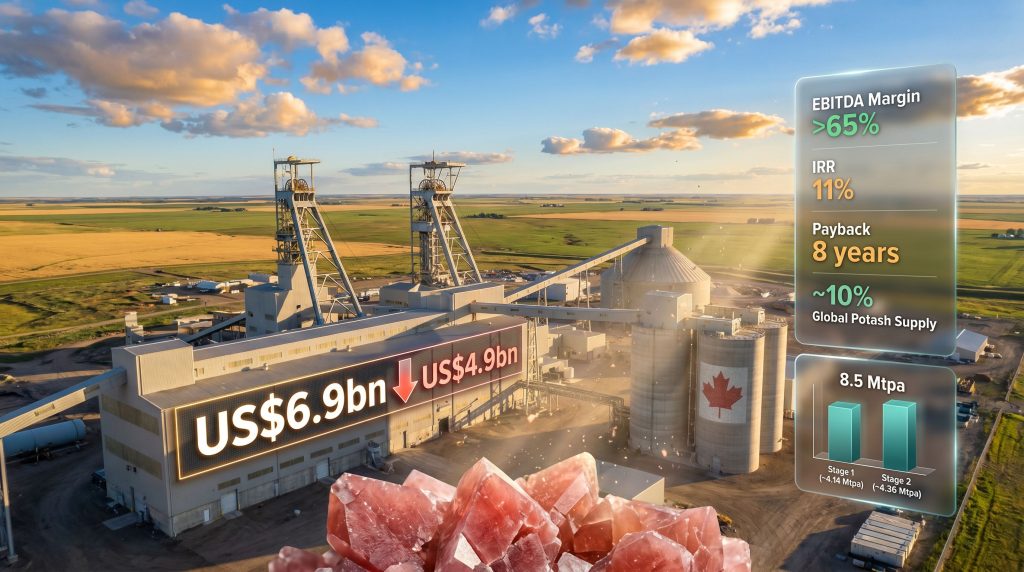
BHP's Jansen Stage 2 potash project in Saskatchewan, Canada, is now the most prominent example of this dynamic playing out in real time. A US$2 billion cost overrun, pushing the total capital estimate from US$4.9 billion to US$6.9 billion, alongside a US$2.3 billion impairment charge set to be recognised at 30 June 2026, has placed the BHP Jansen Stage 2 potash cost overruns at the centre of conversations about mega-project risk, commodity strategy, and the true cost of food security investment.
When big ASX news breaks, our subscribers know first
Breaking Down the Numbers: A US$2bn Budget Blowout Explained
The 41% increase in projected capital expenditure at Jansen Stage 2 is not a rounding error or a minor scope adjustment. It represents a fundamental reassessment of what it costs to build one of the world's largest underground potash operations from the ground up. With the project sitting at approximately 16% completion as of May 2026, the majority of construction expenditure still lies ahead, meaning cost discipline in the remaining phases will be critical.
| Metric | Original Estimate | Revised Estimate |
|---|---|---|
| Capital Expenditure | US$4.9bn | US$6.9bn |
| Cost Increase | N/A | US$2bn (+41%) |
| Impairment Charge | N/A | US$2.3bn |
| Projected EBITDA Margin | N/A | >65% |
| Internal Rate of Return | N/A | 11% |
| Payback Period | N/A | 8 years |
| First Production Target | FY2029 | Late FY2031 |
| Project Completion | N/A | ~16% (May 2026) |
Four primary cost drivers have been identified as contributing to the blowout:
- Construction cost inflation driven by sector-wide escalation in labour and materials pricing since 2022
- Engineering design modifications introduced mid-construction that added unforeseen expenditure
- Productivity shortfalls where on-site output came in below projected benchmarks, extending labour hours and overhead costs
- Higher material requirements where physical quantities of construction inputs exceeded original engineering estimates
Underground potash mining presents geotechnical challenges that are qualitatively different from surface operations. The geology of the Prairie Evaporite formation in Saskatchewan, while rich in high-grade sylvinite ore, also involves navigating complex salt and potash sequences at depth, where ground movement and brine management require constant engineering vigilance. These subsurface realities make cost control inherently more difficult than open-pit equivalents and amplify the financial impact of any productivity gap. Understanding mining project economics at this scale helps contextualise why such variables prove so difficult to model with precision.
A Pattern of Delays: The Timeline Behind the Revision
This cost revision did not emerge without precedent. Jansen Stage 2 has been accumulating schedule pressure for some time.
| Date | Event |
|---|---|
| 2023 | Jansen Stage 2 investment announced; original completion target FY2029 |
| August 2025 | Two-year schedule extension disclosed; completion revised to late FY2031 |
| May 2026 | Project reported at approximately 16% completion |
| June 2026 | US$2bn cost overrun confirmed; budget revised to US$6.9bn; US$2.3bn impairment flagged |
The original investment decision was directly shaped by the geopolitical disruption triggered by the 2022 sanctions on Russian and Belarusian potash exports. Those sanctions removed two of the world's largest potash-producing nations from accessible global supply chains almost overnight, creating an acute supply vulnerability that accelerated BHP's strategic rationale for expanding Canadian potash capacity. The project was announced in 2023 as a direct response to that structural supply shock.
However, the gap between strategic rationale and operational execution has proven significant. What looked like a well-timed investment thesis has encountered the hard reality of post-2022 construction cost inflation, which has affected major capital projects across the global mining sector without discrimination. According to reporting by the AFR, the cost blowouts at Jansen represent one of the most significant capital escalations in recent Australian mining history.
Does the Economics Still Hold? Making the Case for Jansen
Despite the scale of the BHP Jansen Stage 2 potash cost overruns, BHP has maintained its commitment to the project and offered a series of financial projections to support that decision.
The projected EBITDA margin exceeding 65% and an internal rate of return of 11% based on industry consensus price forecasts remain BHP's primary economic justifications for continuing construction, alongside an eight-year payback period that, while extended, sits within an acceptable range for a 60-year mine life asset.
The cost competitiveness argument is central to BHP's long-term thesis. Jansen is projected to become Canada's lowest unit cost potash operation, with estimated operating costs of US$114 to US$130 per tonne. Furthermore, this positions the combined Jansen operation at the attractive left-hand side of the global potash cost curve, meaning it would remain profitable across a wide range of potash price scenarios. Strong cost curve positioning is, consequently, one of the most important structural advantages any large-scale mining asset can hold.
Understanding the Global Potash Cost Curve
The concept of the cost curve is fundamental to evaluating any commodity asset's long-term resilience. Producers sitting at the lowest end of the cost curve maintain profitability even during periods of significant price weakness, while high-cost producers are forced to curtail or suspend operations. Being positioned as the lowest-cost Canadian producer matters for several reasons:
- It provides a structural margin buffer during potash price downturns
- It creates competitive pricing flexibility that higher-cost rivals cannot match
- It ensures long-term volume competitiveness in export markets, particularly in Asia and South America where price sensitivity is high
- It insulates BHP against the episodic but significant price volatility that has historically characterised the global potash market
Potash pricing has historically been subject to sharp cyclical swings. The post-2022 price spike, while providing the demand catalyst for Jansen's expansion, has since moderated. BHP's 11% IRR projection is based on industry consensus price forecasts rather than peak-cycle assumptions, which suggests a degree of conservatism in the financial modelling. However, investors should treat any forward-looking projection with appropriate caution given the project's track record of revision. The broader commodity price sensitivity of assets like Jansen underscores why margin resilience across price cycles is so critical to long-term project viability.
Combined Scale: 8.5 Mtpa and a 10% Global Market Share
One of the most compelling aspects of the Jansen investment, beyond unit cost positioning, is its sheer scale when both stages reach full operational capacity.
| Stage | Annual Capacity |
|---|---|
| Jansen Stage 1 | ~4.14 Mtpa |
| Jansen Stage 2 | ~4.36 Mtpa |
| Combined Total | ~8.5 Mtpa |
| Estimated Global Market Share | ~10% |
Reaching approximately 8.5 million tonnes per annum, including a two-year ramp-up period, would establish BHP as a structurally significant force in global potash supply. A ~10% market share of a commodity this strategically important to global food production is not a marginal position. It places BHP alongside established potash majors as a price-influencing supplier.
Crucially, Jansen Stage 1 remains on schedule, with BHP confirming it is tracking against critical path milestones and targeting first production in mid-2027. This phased approach to production is strategically significant. BHP will begin generating potash revenue from Stage 1 while Stage 2 construction is still underway, which partially de-risks the overall capital commitment by introducing cash flow before the full investment is deployed.
What the Impairment Really Signals to Investors
A US$2.3 billion impairment charge against the Jansen asset base is a material financial event that demands careful interpretation. Impairment charges in mining reflect a formal reassessment of carrying value against revised cost and revenue assumptions under applicable accounting standards. They are not automatically indicative of project abandonment or economic failure.
For long-duration infrastructure assets like Jansen, where the productive mine life spans nearly six decades, near-term cost escalation must be weighed against the multi-decade revenue potential the asset represents. The impairment acknowledges that original carrying values were set against assumptions that no longer hold, but it does not negate the forward cash flow thesis. Mining Weekly has noted that BHP shares experienced significant pressure following the announcement, reflecting the market's immediate reaction to the scale of the revision.
Importantly, BHP has confirmed that its Group capital expenditure guidance for FY2027 remains at approximately US$11 billion. This is a significant signal. It indicates that the Jansen cost overrun has been absorbed within BHP's existing financial framework rather than forcing a structural reallocation of capital across the broader portfolio. No other major projects appear to have been deprioritised to fund the Jansen revision.
The next major ASX story will hit our subscribers first
Potash as a Food Security Commodity: The Demand Architecture
Understanding why BHP continues to press ahead despite the BHP Jansen Stage 2 potash cost overruns requires understanding what potash actually is and why its demand profile differs fundamentally from most industrial commodities.
Potash, primarily in the form of potassium chloride (KCl), is a critical macronutrient applied to agricultural soils globally. Without adequate potassium, crop yields decline, soil structure degrades, and water use efficiency falls. There is no viable substitution pathway for potassium in crop nutrition at scale. This creates a structural demand floor that is largely insulated from economic cycles.
Key structural demand drivers include:
- Global population growth continuing to put pressure on agricultural productivity
- Arable land constraints requiring intensified fertiliser application to sustain output per hectare
- Soil depletion dynamics in high-intensity agricultural regions demanding continuous replenishment
- Supply concentration risk with global potash production remaining heavily concentrated in Canada, Russia, and Belarus
The supply concentration issue is particularly relevant to Jansen's strategic positioning. The 2022 sanctions on Russian and Belarusian potash effectively removed a substantial portion of globally accessible supply from the market. This supply shock elevated prices significantly through 2022 and 2023, and while prices have since moderated, the structural supply vulnerability it revealed has not been resolved. New Canadian production capacity is widely viewed within the industry as a necessary diversification of global fertiliser supply chains, regardless of near-term price movements.
BHP's Long-Term Portfolio Logic: A Multi-Generational Asset
BHP's strategic pivot toward future-facing commodities reflects a deliberate evolution away from its traditional weighting toward iron ore and coal, toward assets with long-duration demand profiles anchored to structural global trends rather than short economic cycles.
Brandon Craig, BHP's President Americas and CEO-elect, has described the combined Jansen operation as a Tier 1 asset, a classification within the mining industry reserved for operations that combine low unit costs, large-scale production capacity, and long mine life into a single, competitively resilient package. With a combined mine life of nearly 60 years, Jansen is evaluated on a generational investment horizon rather than the quarterly earnings lens applied to most capital expenditure decisions.
BHP has framed potash alongside copper as a central pillar of its future-facing commodity strategy, positioning food security as an equally significant structural investment theme to the global energy transition. This dual-thesis approach reflects a broadening of the strategic rationale for resource investment beyond the energy transition narrative that has dominated commodity market discourse since the mid-2010s. Completing rigorous definitive feasibility studies before committing to such large-scale construction programmes remains an industry best practice, though as Jansen demonstrates, even the most thorough planning cannot eliminate execution risk entirely.
The economic case for Jansen ultimately rests on three converging factors: a structurally inelastic demand base, a projected cost position at the low end of the global supply curve, and a mine life long enough to absorb near-term capital cost inflation across decades of productive output.
Key Takeaways for Investors and Industry Observers
- The US$2bn cost overrun reflects a convergence of construction inflation, design changes, productivity shortfalls, and higher material quantities rather than any single point of failure
- BHP's projected EBITDA margin above 65% and 11% IRR provide a financial framework for continued investment, though all forward-looking projections carry inherent uncertainty
- The US$114 to US$130 per tonne operating cost target positions Jansen as Canada's lowest-cost potash producer, offering meaningful protection against price downturns
- With Jansen Stage 1 on track for mid-2027 first production, revenue generation begins before Stage 2 construction is complete
- The US$2.3bn impairment is an accounting reassessment, not a signal of project abandonment
- BHP's FY2027 Group capex guidance of approximately US$11bn remains unchanged, absorbing the Jansen revision without portfolio-wide disruption
- At approximately 8.5 Mtpa combined output representing roughly 10% of global potash production, the fully operational Jansen asset would establish BHP as a structurally significant player in global food security supply chains
This article contains forward-looking financial projections and production estimates sourced from BHP's public disclosures. These projections are subject to material risks and uncertainties and should not be construed as investment advice. Past project performance and current estimates do not guarantee future outcomes.
Want to Stay Ahead of the Next Major ASX Mineral Discovery?
Discovery Alert's proprietary Discovery IQ model delivers real-time alerts on significant ASX mineral discoveries, instantly cutting through complex data to surface actionable opportunities — explore historic discoveries and their returns to understand the scale of what early positioning can mean, then begin your 14-day free trial at Discovery Alert to ensure you never miss a market-moving announcement.